

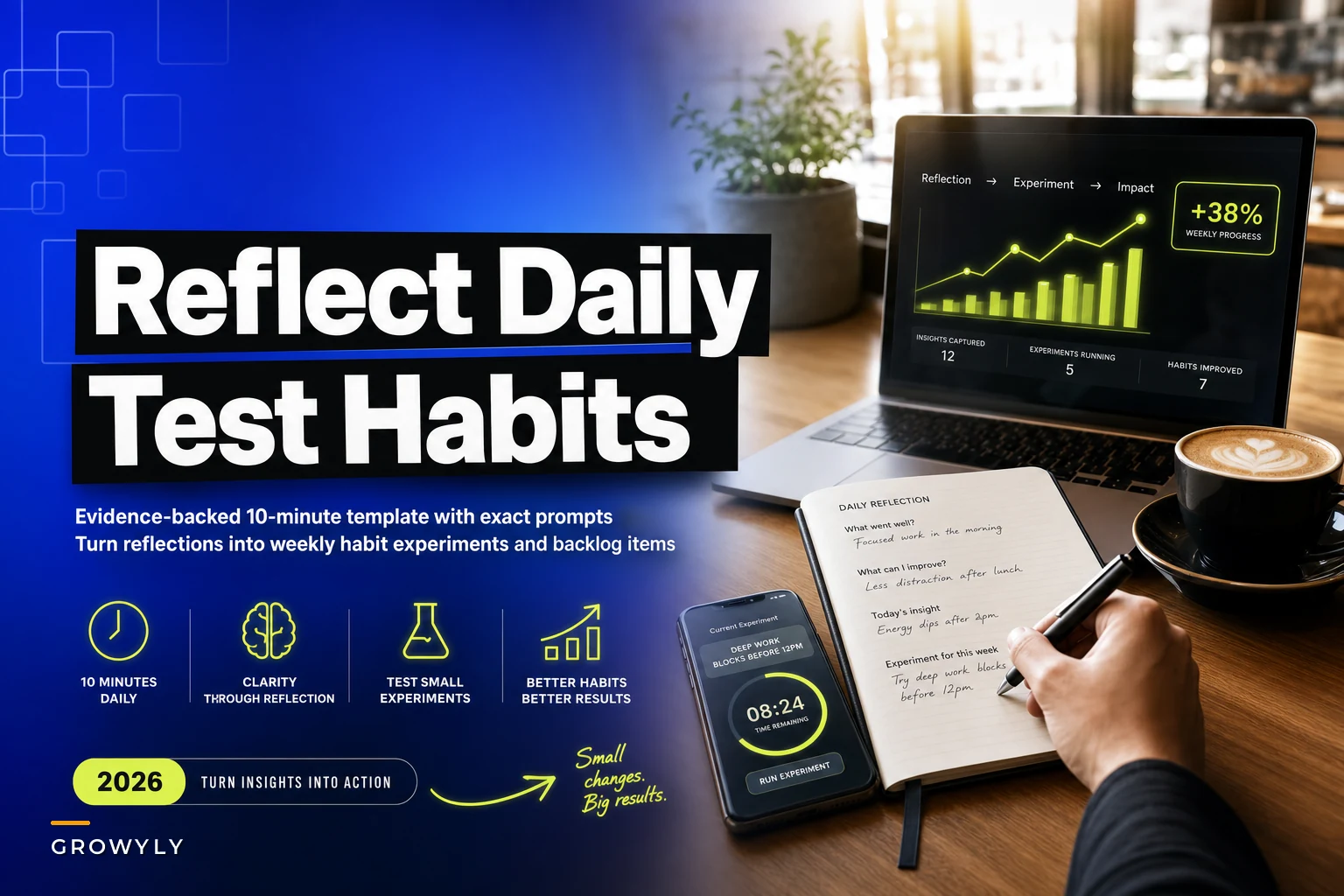

Most reflection practices fail because they produce feelings, not actions. You sit there journaling about your day, maybe write down some gratitude, notice a pattern or two, then nothing changes. The insights evaporate. The patterns repeat. Your 10-minute reflection practice becomes another abandoned habit itself.
The problem isn't reflection—it's the missing bridge between noticing something and actually doing something about it. The same issue keeps surfacing with people trying to improve their routines: they generate insights they never act on. They notice they're tired every Tuesday afternoon but never experiment with their Monday night routine. They realize they skip workouts when meetings run late but never test a backup plan.
What works is treating reflections like an operational intake system. Not a diary, but a processing queue that converts observations into experiments and backlog items. Think of it like a restaurant kitchen—orders come in, get triaged, and either go straight to the line or get staged for prep. Your reflections should work the same way.
The Processing Template That Actually Produces Change
Here's the exact structure that consistently converts reflection into action. It takes 10 minutes when you follow it precisely:
Minutes 1-3: Pattern Capture
Start with three prompts that force specificity:
-
"Today broke down when..." (identify the exact moment things went sideways)
-
"I noticed myself..." (catch recurring behaviors without judgment)
-
"Tomorrow needs..." (immediate tactical adjustments)
Don't write paragraphs. Write fragments. "Broke down when kids interrupted morning routine at 7:23." Not "Had some challenges with my morning routine when the family schedule conflicted with my goals."
Minutes 4-6: Root Pattern Analysis
Take your three captures and ask one question: "What system failed here?"
Not "what did I do wrong" or "how do I feel about this." Systems thinking only. Your morning routine broke because you have no protocol for interruptions. Your afternoon energy crashed because lunch timing floated. Your evening workout died because you treat it as optional after 6pm.
Write the system failure in operational terms. "No interruption protocol for morning routine" not "need more discipline."
Minutes 7-9: Experiment Design or Backlog Entry
This is where most people stop—and also where the actual work begins. Every system failure becomes either:
-
A this-week experiment (if it's urgent and simple)
-
A backlog item (if it needs more thought or resources)
Use this decision matrix:
| Goes to This Week | Goes to Backlog |
|---|---|
| Can test in 2-3 days | Needs research first |
| Single variable change | Multiple dependencies |
| Under 5 minutes to implement | Requires buying something |
| Failed system is actively hurting you | Optimization, not crisis |
Minute 10: Schedule the Test
If it's a this-week experiment, put it in tomorrow's calendar right now. Not "try to remember" or "when I get time." An actual calendar entry. "Tuesday 7:15am: Test 2-minute interruption protocol."
If it's backlog, add it to your Sunday review list with one clarifying question you need to answer before designing the experiment.
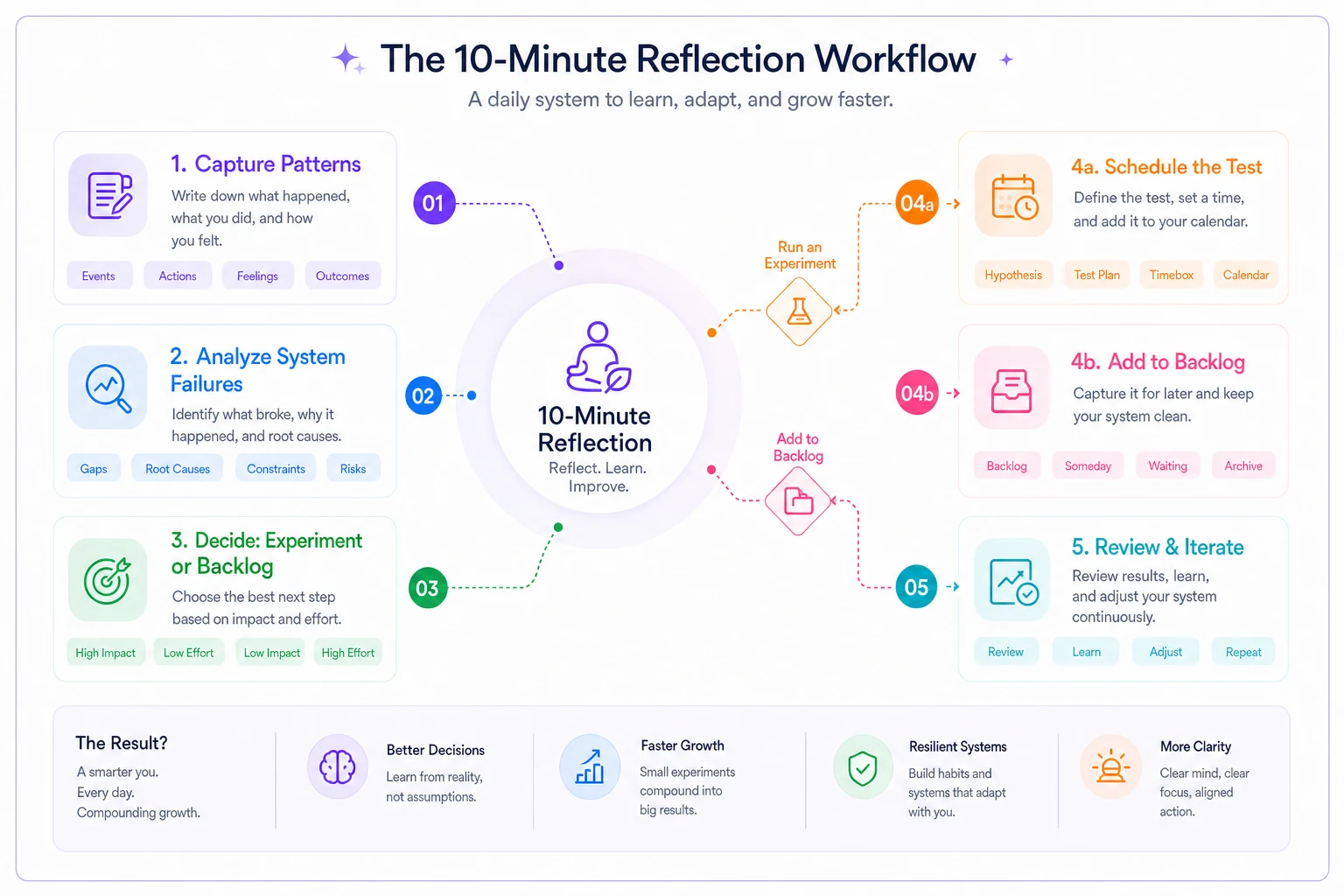
A quick visual of this flow helps you run the process faster.
Real Examples of the Conversion Process
Example 1: Energy Management Pattern
Achieve more by focusing on what matters.
Growyly helps you build lasting habits and track your personal growth effortlessly.
- Goal setting with progress tracking
- Daily habit reminders
- Motivational insights and analytics
No credit card required
Capture: "Broke down when 2pm hit and couldn't focus on proposal. Noticed myself reaching for fourth coffee. Tomorrow needs earlier lunch."
System Failure: "No energy management protocol for afternoon work"
Experiment Design: Test eating lunch at 11:45am instead of 1pm for three days. Track 2pm energy on scale of 1-5.
Calendar Entry: "Monday-Wednesday 11:45am: Early lunch test (track 2pm energy)"
Example 2: Exercise Consistency
Capture: "Noticed myself skipping gym third Monday in a row. Pattern is real."
System Failure: "Monday workout has no protection against work spillover"
Experiment Design: Backlog item—need to analyze Monday meeting patterns first
Backlog Entry: "Q: What makes Mondays uniquely vulnerable? Check calendar patterns for last 6 Mondays"
Example 3: Digital Distraction
Capture: "Today broke down when opened Instagram 'for a second' at 9:43am. Lost 47 minutes."
System Failure: "No friction between intention and social media"
Experiment Design: Test app limits 9am-12pm for five weekdays
Calendar Entry: "Monday 8:55am: Enable app limits until noon"
Frequency Options Based on Your Change Velocity
Daily Practice (High Change Velocity)
-
You're establishing 3+ new habits
-
Major life transition happening
-
History of abandoned habits
-
Need tight feedback loops
Run the 10-minute template every evening, same time. Non-negotiable for the first 30 days of any major habit change.
Three-Day Rhythm (Steady State)
-
Maintaining existing habits with minor tweaks
-
Life is relatively stable
-
You naturally notice patterns
-
Past success with habit formation
Run reflection Monday, Thursday, Sunday. Monday catches weekend drift, Thursday prevents end-of-week collapse, Sunday sets up the week.
Weekly Pulse (Maintenance Mode)
-
Habits are locked in
-
Minimal life turbulence
-
Strong self-awareness
-
Really just optimizing edges
Sunday only, but expand to 20 minutes and review the full week's patterns at once.
Match frequency to how fast your life is changing, not to some ideal standard. A new parent needs daily. Someone five years into the same stable routine probably needs weekly at most.
Converting Backlogs Into Experiments Without Overwhelm
The backlog is where most reflection systems die. You accumulate forty-odd "someday" experiments and never run any of them. Here's the processing system that actually moves items forward:
Every Sunday, spend 15 minutes on backlog review:
-
Sort by experiment size (not importance)
-
Pull exactly ONE tiny and ONE small Never more. The constraint forces a real choice.
-
Answer the clarifying question Remember that question you wrote when adding to backlog? Answer it now with what you've learned since then.
-
Design the simplest possible test Not the best test. Not the comprehensive test. The simplest test that gives you one clear signal.
-
Schedule it for Tuesday Not Monday (too much pressure) and not "this week" (too vague). Tuesday, specific time.
-
Tiny
Can test in one day
-
Small
Need a week
-
Medium
Need two weeks
-
Large
Need a month
Here's what this looks like with a real backlog item:
Original Backlog Entry: "Morning meditation keeps failing - Q: Is timing or location the issue?"
Sunday Processing:
-
Size
Small (week-long test needed)
-
Clarifying Answer
Probably timing—location hasn't changed but schedule has
-
Simplest Test
Try meditation immediately after coffee instead of before
-
Tuesday Entry
"7:15am: Coffee then immediate 5-min meditation test"
Pick the tiny item you can schedule for Tuesday so you start the week with momentum.
Tuesday Entry: "7:15am: Coffee then immediate 5-min meditation test"
The Exact Prompts That Generate Actionable Insights
Morning Prompts (if reflecting on yesterday):
-
"Yesterday's pivot point was..." (forces you to find the crucial moment)
-
"The gap between plan and reality was..." (identifies system breakdowns)
-
"If I could change one decision from yesterday..." (highlights improvable choices)
Evening Prompts (reflecting on today):
-
"Today worked until..." (finds the breakdown moment)
-
"I surprised myself when..." (catches positive deviations to reinforce)
-
"Tomorrow's obvious trap is..." (preempts predictable failures)
Weekly Prompts (Sunday reflection):
-
"This week's repeating scene was..." (patterns you're stuck in)
-
"My energy peaked when..." (conditions to replicate)
-
"Next week's bottleneck will be..." (proactive problem solving)
Notice what these don't ask: How do you feel? What are you grateful for? What are your goals? Those questions have their place, but not in an operational reflection practice. This is about catching patterns and converting them to tests.
Avoiding the Three Reflection Traps
Trap 1: Insight Hoarding
You generate brilliant insights but never test them. You know exactly why your habits fail but keep reflecting instead of experimenting. The fix: cap insights at three per session. If you notice more patterns, tough—pick three. This forces action over analysis.
Trap 2: Experiment Stacking
You design seven experiments from one reflection session. By Thursday, you're running zero of them. One experiment at a time, max two if one is truly tiny. Your reflection practice should produce a steady stream of small tests, not a flood of parallel changes you can't track.
Trap 3: Vague Experiments
"Try to wake up earlier" is not an experiment. "Set alarm for 6:47am instead of 7:15am for five weekdays" is an experiment. Every test needs:
-
Specific action
-
Exact timing
-
Clear duration
-
Single measure of success
If you can't calendar it precisely, it's not ready to test.
Building a Lightweight Tracking System
You don't need complex software for this. A simple note app works fine, but structure matters:
Daily Reflection Log [Date] ------ Captures: [your 3 captures] System Failure: [root cause] Experiment: [specific test] Scheduled: [when/where] [Previous Experiment Result] Test: [what you tried] Result: [what happened] Next: [keep, kill, or modify]
Keep entries short. This isn't journaling—it's operational documentation. You're tracking what broke, what you're testing, and what happened. That's it.
Experiment Backlog [Item]: [One sentence description] Question: [What you need to know first] Size: [Tiny/Small/Medium/Large] Added: [Date]
Some people graduate to spreadsheets or habit-tracking apps once their practice stabilizes. Fine. But start with text. The structure matters more than the tool.
When This Practice Actually Breaks Down
During Crisis Periods: When your house is flooding, you're not reflecting on habit patterns. Skip it. Come back when life stabilizes.
Vacation Mode: Either pause completely or switch to one weekly reflection on Sundays.
Illness or Recovery: Your body needs resources for healing, not optimization. Pause without guilt.
Success Plateau: When everything is working smoothly for six or more weeks, reducing frequency is fine. That's not failure—it's graduation.
The practice is meant to serve your growth, not become another obligation. Use it when you need change, pause it when you need stability.
Making It Stick: The First Two Weeks
Days 1-3: Do it badly. Set a timer for exactly 10 minutes and stop when it goes off, mid-sentence if necessary. You're building the habit of showing up, not perfecting the practice.
Days 4-7: Add one experiment. Just one. Tiny as possible. Successfully scheduling and running one experiment matters more than generating ten insights.
Days 8-11: Find your rhythm. Are you a morning processor or evening reflector? Standing at kitchen counter or sitting at desk? Lock in your location and timing.
Days 12-14: Run your first backlog review. Even if you only have three items. Practice the full system: sort, select, schedule.
After two weeks, you'll have run a few experiments and started building your backlog. More importantly, you'll have proven to yourself that reflection produces changes, not just thoughts.
The Compound Effect
Here's what happens after about twelve weeks of consistent reflection-to-experiment practice:
Your problems get more interesting.
Instead of "I can't wake up on time," you're solving "my morning creative window conflicts with family breakfast timing."
Instead of "I never exercise," you're testing whether afternoon walks outperform morning runs for sustained energy.
Instead of "I'm always tired," you're experimenting with supplementation timing to optimize evening recovery without disrupting sleep.
The 10-minute reflection practice doesn't just solve your current problems—it upgrades the quality of problems you get to solve. You stop fighting the same battles and start optimizing systems that already work. Each week's experiments build on the last week's learnings. Your backlog evolves from fixing broken things to improving things that are mostly fine.
That's the real value of converting reflection into experiments. You don't just change your habits, you change the level at which you operate.
Starting Tonight
Stop reading about reflection and start your first 10-minute session tonight at 8pm. Or tomorrow morning at 6:45am. Pick an exact time right now.
Set a phone alarm labeled "10-min reflection practice" for that time.
When it goes off, open a note app and write:
-
Today broke down when...
-
I noticed myself...
-
Tomorrow needs...
Find the system failure. Design one tiny experiment. Put it in tomorrow's calendar.
The frameworks and prompts in this post will still be here when you need them. But the only thing that matters today is running your first 10-minute session and scheduling your first experiment.
Reflection without experimentation is just thinking about change. Your first experiment is waiting to be designed.
Ready to unlock your full potential?
Join thousands of users transforming their lives using Growyly to stay motivated, organized, and growth-focused every day.