


Your morning routine dies in the kitchen drawer.
Not metaphorically—literally. That meditation app you bought three months ago stays unused because your phone charges in the bedroom, but you need coffee first. By the time you remember meditation exists, you're already checking emails at the kitchen counter.
This happens with every habit you're trying to build. The environment quietly sabotages your intentions through friction points that compound into total failure.
Most habit advice focuses on motivation, tracking, or accountability. But watching so many people fail at the same three habits over and over, the pattern becomes obvious: their physical spaces actively work against them.
Most people's environments are accidentally optimized for their worst habits.
The good news? You can audit and fix these friction points in about 15 minutes per room. The changes are small, almost stupid-simple, but they genuinely shift daily behavior patterns.
Why environment beats willpower every single time
A software developer I worked with wanted to read more books. She had a Kindle, physical books, even audiobook subscriptions. Six months later? Still scrolling Instagram before bed.
The problem wasn't motivation. Her books lived in the home office. Her phone charged on the nightstand. Every night, the choice became: get up, walk to another room, find a book, come back to bed—or just grab the phone that's literally inches away.
Guess which one wins at 10 PM after a long day.
Physical environment creates what behavioral scientists call "choice architecture." Every object placement, every step required, every visual cue either pushes you toward or away from a behavior. Most people's environments are accidentally optimized for their worst habits.
The good news? You can audit and fix these friction points in about 15 minutes per room. The changes are small, almost stupid-simple, but they genuinely shift daily behavior patterns.
The three-habit focus method
Trying to optimize your entire life at once guarantees failure. The human brain can only handle so much conscious behavior change before defaulting back to autopilot.
Achieve more by focusing on what matters.
Growyly helps you build lasting habits and track your personal growth effortlessly.
- Goal setting with progress tracking
- Daily habit reminders
- Motivational insights and analytics
No credit card required
-
One physical habit (exercise, stretching, walking)
-
One mental habit (reading, meditation, journaling)
-
One productivity habit (deep work, planning, skill practice)
Everything else stays on the back burner. Your environment audit focuses entirely on removing obstacles for these three specific behaviors.
A marketing consultant I know picked:
-
Morning yoga (physical)
-
Evening reading (mental)
-
Morning writing before emails (productivity)
Her entire apartment reorganization took under an hour across three days. Within two weeks, all three habits were happening without much effort. Not because she suddenly had more willpower, but because the environment was pulling her toward these behaviors instead of away from them.
Room-by-room audit process
Bedroom: The launch pad problem
Your bedroom determines your first and last actions of the day. Most bedrooms are optimized for phone scrolling and hitting snooze.
Before audit:
-
Phone charges on nightstand
-
No workout clothes visible
-
Books buried in closet
-
Alarm clock across room (classic mistake)
After fixes:
-
Phone charges in bathroom or kitchen
-
Workout clothes laid out on dresser
-
Current book on nightstand with bookmark visible
-
Gentle wake-up light instead of jarring alarm
Priority fix: Remove the phone. This single change affects both morning and evening routines more than any other adjustment.
Fidelity test: Can you name what you did in the first 10 minutes after waking up yesterday? If the answer is "checked phone," the bedroom needs work.
Kitchen: The transition zone trap
Kitchens aren't just for food—they're behavioral transition zones. Most people make or break their morning habits based on kitchen setup.
Before audit:
-
Coffee maker buried behind appliances
-
Vitamins in cabinet
-
Workout supplements... somewhere
-
Journal in home office
-
Healthy snacks behind junk food
After fixes:
-
Coffee maker front and center, water already filled night before
-
Vitamins in clear container next to coffee maker
-
Pre-workout visible on counter
-
Journal and pen on kitchen table
-
Fruit bowl blocks path to pantry
Priority fix: Create a "morning station"—everything for your first habit physically touching each other in one spot.
Fidelity test: Time yourself tomorrow morning from entering kitchen to starting first habit. Under 60 seconds = optimized. Over 3 minutes = environment fighting you.
Living room: The default behavior battleground
Whatever's easiest in your living room becomes your default evening activity. Most living rooms are accidentally optimized for Netflix marathons.
Before audit:
-
TV remote on coffee table
-
Gaming console ready to go
-
Books on bookshelf across room
-
Yoga mat in closet
-
Dumbbells... do I even own dumbbells?
After fixes:
-
Remote in drawer, TV unplugged
-
Console controllers in bedroom closet
-
Current book on couch arm
-
Yoga mat already unrolled by TV
-
Resistance bands draped over couch back
Priority fix: Make your desired behavior the literal easiest option. If you have to move the book to sit down, but need three steps to turn on the TV, reading wins.
Fidelity test: Walk into your living room with your eyes closed. Open them. What's the first thing you could do without moving? That's your default behavior.
Home office: The focus fortress failure
Most home offices are distraction museums. Every surface covered with yesterday's projects, tomorrow's worries, and seventeen browser tabs worth of physical clutter.
Before audit:
-
Desk covered in miscellaneous papers
-
Phone within reach
-
Multiple monitors showing everything
-
Snacks in desk drawer
-
No timer visible
-
Guitar or gaming setup in peripheral vision
After fixes:
-
Desk cleared except current project
-
Phone in kitchen during deep work
-
Single monitor, single task
-
Water bottle only
-
Physical timer on desk (not phone app)
-
Distractions behind you or covered
Priority fix: Create activation energy for distractions. Every extra step between you and distraction increases focus time meaningfully—office productivity studies consistently back this up.
Fidelity test: Sit at your desk. Count how many non-work items you can see without turning your head. Each visible distraction chips away at your focus window.
Start with the priority fix in each room—it's often the highest-impact, lowest-effort change.
Here's a quick visual workflow of the room-by-room audit.
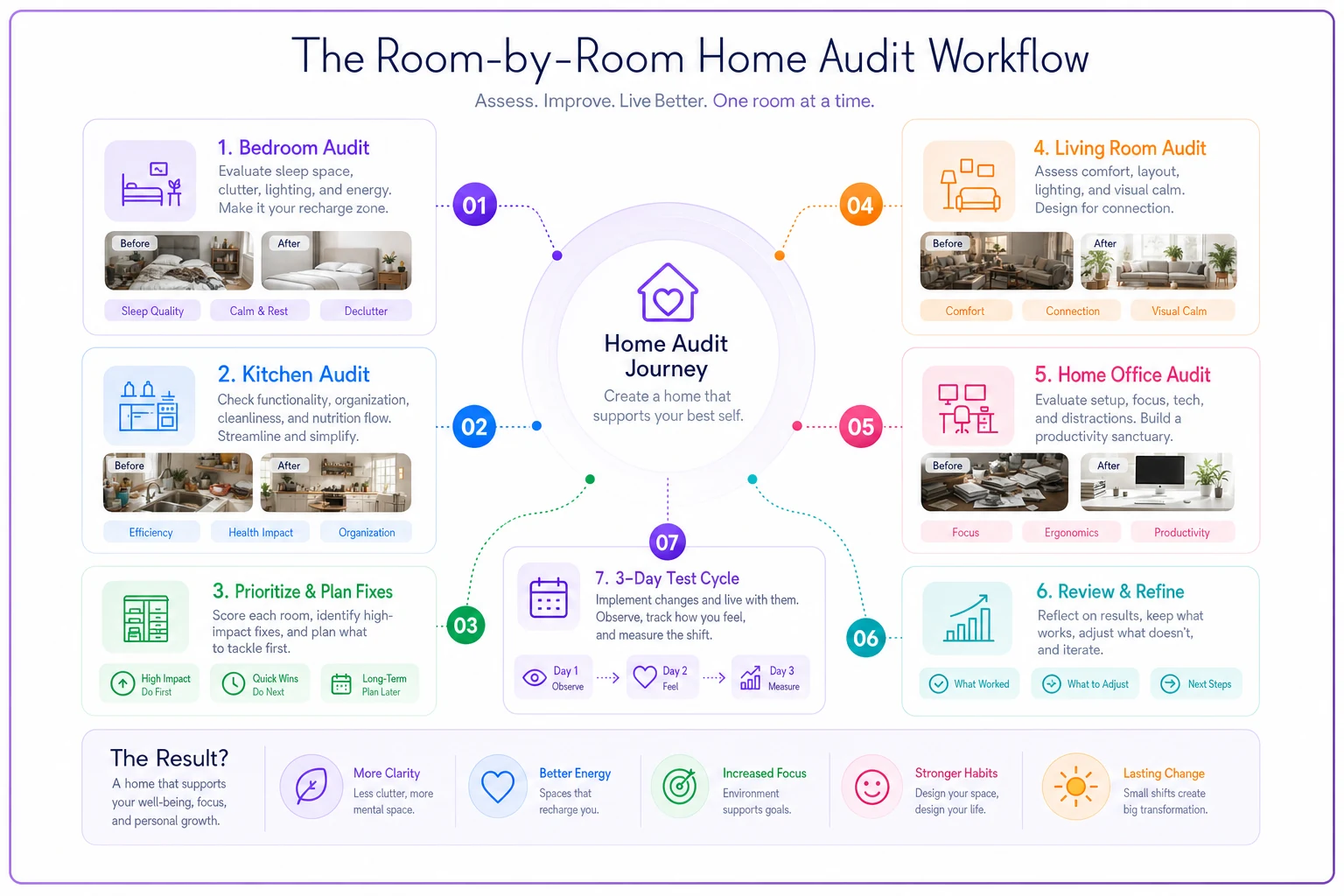
Use the workflow to move quickly through each room: identify the single highest-friction item, apply the priority fix, and run the three-day fidelity test.
The tiny test protocol
Grand transformations fail. Tiny tests succeed.
For each room, implement exactly one change. Test for three days. Only add another change after the first one sticks.
Example progression:
| Days | Change |
|---|---|
| Day 1–3 | Phone charges in kitchen |
| Day 4–6 | Book replaces phone on nightstand |
| Day 7–9 | Workout clothes visible on dresser |
| Day 10+ | Full bedroom optimization |
This feels slow but works faster than trying everything at once. Each successful test builds confidence and momentum for the next change.
Common failure patterns to avoid
The "nuclear option" mistake
Don't hide everything in boxes hoping motivation will magically appear. That's not optimization, it's self-punishment. Make bad habits slightly harder, good habits slightly easier.
The "perfect setup" trap
A personal trainer spent three hours creating the "ultimate home gym corner" with labeled zones and color-coded equipment. Used it twice. Meanwhile, her friend hung a pull-up bar in a doorway and does 50 pull-ups daily just walking around her apartment.
The "app instead of environment" delusion
Habit tracking apps don't fix environmental friction. You can track your meditation streak all you want—if the cushion is in storage, you're not meditating.
What nobody tells you about habit environments
The biggest insight from studying workspace optimization across different industries: environments don't just enable behaviors, they trigger them.
When salon owners reorganize their supplies, stylists automatically become more efficient. When restaurants redesign kitchens, order accuracy improves without additional training. When offices rearrange furniture, collaboration patterns shift immediately.
The same principle applies to personal habits. Your environment isn't neutral—it's either actively helping or actively sabotaging every behavior you're trying to build.
A small business owner restructured her entire house around three habits: morning exercise, afternoon focused work, and evening family time. She didn't need more discipline or better apps. She needed her running shoes by the bed, a timer on her office door, and her phone charging in the garage during dinner.
Six months later, all three habits feel automatic. Not because she became a different person, but because her environment stopped requiring constant willpower to navigate.
The operational reality of behavior change
Real behavior change isn't about motivation—it's about operations. Just like businesses optimize workflows for efficiency, you need to optimize your physical environment for desired behaviors.
Think about how restaurants arrange their kitchens. Every tool, ingredient, and surface is positioned to minimize movement and maximize flow. A cook doesn't need willpower to follow the right sequence—the environment guides them through it naturally.
Your home can work the same way. When your environment is properly configured, good habits stop feeling like work. They become the natural, obvious, easiest choice.
This is why even the best scheduling and task management tools only go so far without environmental design behind them. You can have the perfect morning routine planned, with reminders and accountability systems lined up. But if your gym bag is in the basement and your TV remote is on the coffee table, the remote wins.
Making the audit stick
The difference between temporary changes and permanent habits is measurement. Not complex tracking—simple observation.
After your audit, note three things:
-
Time to start your first habit each morning
-
Number of times you had to overcome resistance
-
How many days the habit happened automatically
When these numbers improve, your environment is working. When they don't, something needs adjustment.
The audit isn't a one-time event. Every few months, habits drift, stuff accumulates, and friction points creep back in. A quarterly 15-minute sweep keeps your environment aligned with your intentions. It's not a big commitment, but it makes a real difference in whether the changes you made actually hold.
The bottom line on environmental optimization
Your environment is either your ally or your enemy. There's no neutral ground.
Every book on the shelf instead of the nightstand is a vote against reading. Every workout that requires hunting down equipment is a vote against exercise. Every snack sitting in plain sight is a vote against eating better.
The 15-minute audit flips these votes in your favor. Not through massive transformation or perfect systems, but through small, almost silly adjustments that compound into automatic behavior change.
Start with one room. Fix one friction point. Test for three days. The habits that have eluded you for years might suddenly feel effortless—not because you changed, but because your environment finally stopped fighting you.
The 15-minute audit flips these votes in your favor. Not through massive transformation or perfect systems, but through small, almost silly adjustments that compound into automatic behavior change.
Start with one room. Fix one friction point. Test for three days. The habits that have eluded you for years might suddenly feel effortless—not because you changed, but because your environment finally stopped fighting you.
Ready to unlock your full potential?
Join thousands of users transforming their lives using Growyly to stay motivated, organized, and growth-focused every day.