



About three years ago, I was sitting in a coffee shop with someone who'd just spent $4,800 on a personal development course. Six months later, when I asked how it was going, they couldn't remember half the modules. The binder was buried somewhere in their home office. The weekly check-ins had stopped after week three.
This wasn't unusual. It was the norm.
Personal growth has this weird disconnect where people invest massive amounts of time, money, and emotional energy into change, then watch it evaporate within weeks. Not because they lack discipline or motivation, but because they're trying to manage complex behavioral change with sticky notes and willpower.
The same coordination problems that cause businesses to fail at scaling show up in personal development. When a growing company tries to manage 50 employees with the same systems they used for 5, everything breaks. When someone tries to juggle career advancement, health improvements, relationship building, and skill development without any underlying infrastructure, the same breakdown happens.
After watching this pattern repeat and seeing how operational systems transform chaotic businesses into smooth operations, the solution became obvious. Personal growth needed the same modular, interconnected approach that makes complex business operations actually work.
What emerged was surprisingly straightforward: a 12-month personal growth system built on the same principles that help businesses scale from startup to stability. Not another goal-setting framework or habit tracker, but an actual operational system where quarterly themes, monthly checkpoints, and weekly execution all reinforce each other.
The Quarterly Architecture That Changes Everything
Traditional annual goals have this fundamental flaw—they assume you know in January what you'll need in October. That's like a restaurant planning their entire year's menu without knowing what ingredients will be available, what customers will want, or what their kitchen can actually handle.
Quarters solve this by creating natural pivot points. Each one becomes a contained experiment with clear boundaries. You're not locked into decisions made during your most optimistic January mood. You get four chances to adjust course based on what you've learned.
Most people miss this about quarters: they're not just smaller time chunks. They're different operational modes. Q1 when you're fresh and motivated operates differently than Q3 when you're in the middle of everything. Q4 when you're reflecting on the year needs different focus than Q2 when you're building momentum.
Think seasonal business cycles. Retail businesses don't operate the same in February as they do in November. Tax preparers have completely different workflows in April versus August. Your personal development should follow similar logic.
Each quarter needs its own identity:
-
Theme selection One primary area that gets most of your improvement energy. Not five goals fighting for attention—one clear focus with supporting elements. Q1 might be "Build Financial Foundation" while Q2 shifts to "Expand Professional Network."
-
Supporting pillars Two or three habits that reinforce your theme without overwhelming your capacity. If Q1 focuses on finances, supporting pillars might include weekly expense reviews, automated savings increases, and learning basic investing principles.
-
Exit criteria Specific, measurable outcomes that tell you whether the quarter succeeded. Not vague aspirations but clear markers. "Have three-month emergency fund established" or "Complete investment account setup with initial $2,000 invested."
The beauty of this structure is how it handles failure. Didn't nail your Q1 fitness goals? You're not a failure—you just learned something about your capacity or approach. Q2 gives you a fresh start with that knowledge built in.
Monthly Reflections as Operational Checkpoints
The typical person either never reflects on their progress or saves it all for New Year's Eve. Both approaches guarantee you'll miss critical adjustment opportunities.
Achieve more by focusing on what matters.
Growyly helps you build lasting habits and track your personal growth effortlessly.
- Goal setting with progress tracking
- Daily habit reminders
- Motivational insights and analytics
No credit card required
Monthly reflections work like quality control checks in manufacturing. You catch problems while they're small, identify what's working to amplify it, and spot patterns you'd never see in daily execution.
Block 90 minutes on the last Sunday of each month. Same time, same place, same process. This regularity matters more than you think. Your brain starts preparing for it, gathering observations throughout the month.
Here's a simple visualization of the monthly reflection workflow.
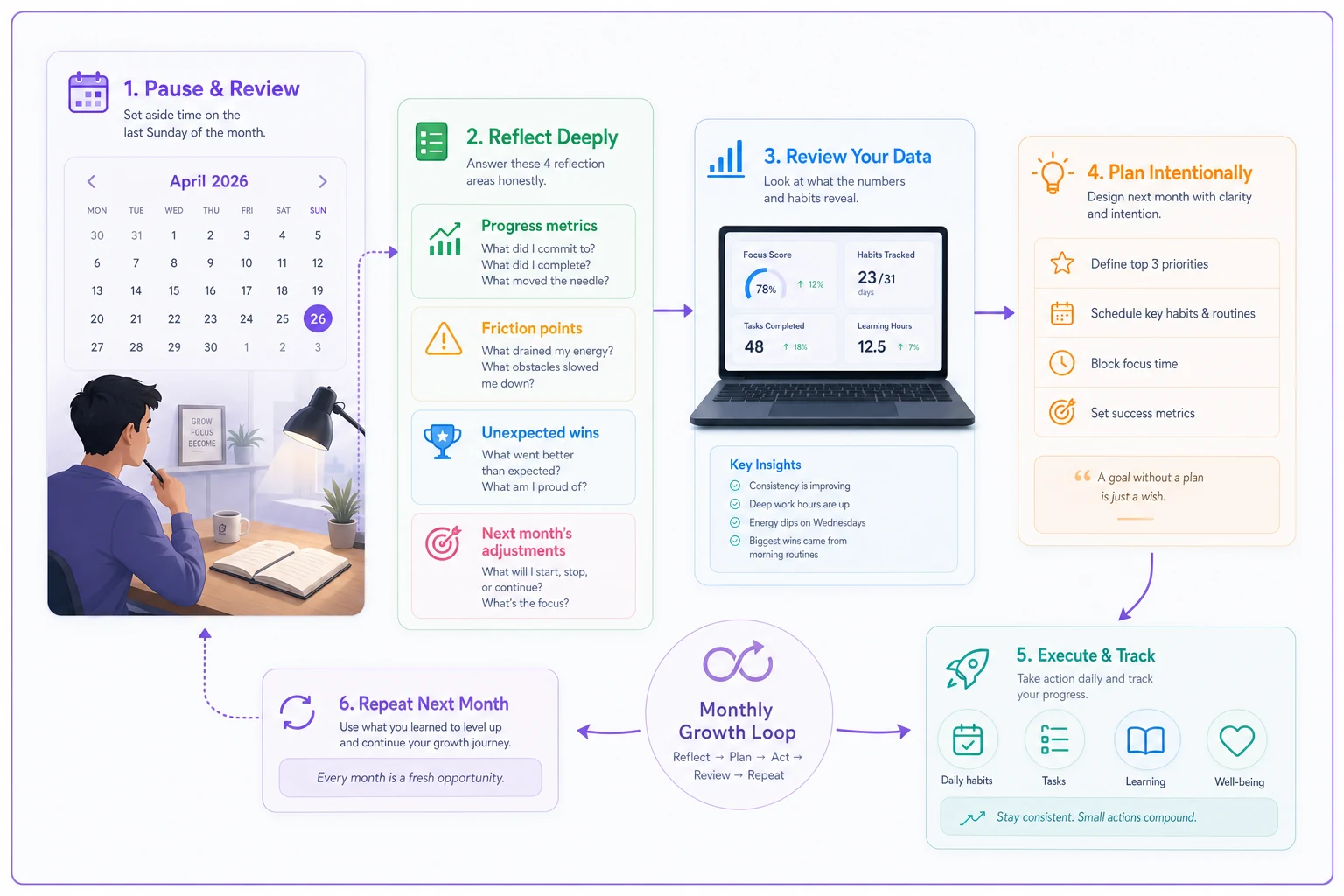
The review covers four areas:
-
Progress metrics Pull your actual numbers. How many workouts happened? How much did you save? How many books did you finish? Don't guess or estimate—look at real data. The gap between what you think happened and what actually happened often reveals everything.
-
Friction points Where did things consistently break down? Maybe evening workouts never happened because family dinner timing varied. Maybe the Saturday morning writing session got hijacked by errands every week. Document the specific obstacles, not general categories.
-
Unexpected wins What worked better than expected? Sometimes the throwaway habit becomes your strongest. The meditation app you downloaded skeptically might have perfect adherence while the expensive gym membership goes unused. These surprises often point toward your natural rhythms.
-
Next month's adjustments Based on the previous three areas, what changes will you test? Not dramatic overhauls—small iterations. Move workouts to lunch. Switch from books to audiobooks. Add a Sunday planning session. One to three specific changes maximum.
The monthly cadence hits a sweet spot. Weekly is too frequent—you don't have enough data. Quarterly is too long—you've already formed bad patterns. Monthly gives you enough experience to see patterns but enough time to course-correct.
Weekly Templates That Actually Match Reality
Most productivity systems pretend every week is identical. Wake up at 5am, meditate, exercise, deep work until noon, perfect evening routine, repeat. Then reality shows up with sick kids, project deadlines, travel, and unexpected opportunities.
The solution isn't abandoning structure—it's building modular templates that match different life contexts.
Start with three core templates:
-
Foundation weeks Your baseline when life follows predictable patterns. Maybe that's four gym sessions, two date nights, three focused work blocks, daily reading. This template should work about 60% of the time. Not every week, but most weeks.
-
Sprint weeks When external demands spike. Big presentation coming up, family visiting, moving apartments. Strip down to essentials. Maybe just 20-minute workouts, one date night, minimal reading. The goal isn't maintaining normal standards—it's keeping momentum alive. Expect these about 25% of the time.
-
Recovery weeks After intense pushes or during natural low-energy periods. Gentle movement instead of intense workouts. Extra sleep. Catching up on life maintenance. Reading for pleasure instead of growth. These show up about 15% of the time, often naturally following sprint weeks.
Every Sunday, choose your template based on the upcoming calendar to avoid over-optimistic planning.
Every Sunday, look at the upcoming week and choose your template. Client flying in Tuesday through Thursday? That's probably a sprint week. Calendar relatively clear? Foundation week. Just finished a major project? Recovery week might be perfect.
The template gives you structure, but you still customize. Foundation week has four workouts planned, but your kid has a recital Wednesday evening? Move that workout to lunch or skip it entirely. The template is a starting point, not a rigid contract.
This approach eliminates the two biggest weekly planning failures: over-optimistic scheduling that ignores reality, and throwing out all structure when things get hectic.
What Three Months Really Looks Like
Let me show you an actual quarter from someone who used this system to transition careers while maintaining their health habits. Not a perfect success story, but a real one with stumbles and adjustments.
Q2 Theme: Career Pivot Preparation
-
- Primary focus
Build portfolio and professional presence
-
- Supporting pillars
Maintain exercise routine, expand network
-
- Exit criteria
Three portfolio pieces live, 20 new professional connections, five informational interviews completed
April (Month 1):
Week 1 (Foundation): Standard schedule worked well. Six morning portfolio work sessions, three gym visits, two networking events attended. Felt sustainable.
Week 2 (Sprint): Unexpected project at current job ate the week. Only managed two portfolio sessions, one gym visit. No networking. Felt discouraged but recognized it as a sprint week, not a failure.
Week 3 (Foundation): Back to normal schedule but adjusted—moved portfolio work to lunch breaks since mornings proved vulnerable to work emergencies.
Week 4 (Foundation): Maintained lunch portfolio work. Added Sunday afternoon for bigger creative pushes. Rhythm starting to feel natural.
April reflection revealed: Morning work sessions too vulnerable to job demands. Networking events yielded few valuable connections. Gym consistency suffered when weeks got compressed.
May adjustments: Portfolio work shifted to lunch breaks and Sundays. Replaced networking events with targeted LinkedIn outreach and coffee meetings. Reduced gym target from 4x to 3x per week.
May (Month 2):
Week 1 (Foundation): New schedule clicked immediately. Lunch breaks perfect for portfolio work—natural time boundary prevented overthinking.
Week 2 (Foundation): Maintained rhythm. Two coffee meetings yielded better connections than all of April's networking events.
Week 3 (Sprint): Travel for family obligation. Managed portfolio work on flights, maintained LinkedIn outreach from hotel. No gym, but walked extensively.
Week 4 (Recovery): Intentionally lighter after travel. Gentle yoga instead of gym. Read fiction instead of business books. Still did Sunday portfolio session.
May reflection: Lunch break portfolio work was the key unlock. Coffee meetings far superior to networking events. Three gym sessions per week felt sustainable, four created stress.
June (Month 3):
Week 1-2 (Foundation): Rhythm now automatic. Portfolio pieces coming together faster. Coffee meetings leading to actual opportunities.
Week 3 (Sprint): Interview preparation consumed everything. Portfolio work paused, gym attendance dropped. Full focus on interview prep.
Week 4 (Foundation/Reflection): Interview complete, back to normal rhythm. Comprehensive quarterly review showed: Two portfolio pieces complete (missed target of three), 18 new valuable connections (close to 20 target), seven informational interviews (exceeded five target).
Quarter outcome: Didn't hit every metric but built sustainable systems. More importantly, landed two serious job interviews from the network built. The missed third portfolio piece mattered less than the quality of connections made.
| Q2 Theme Details |
|---|
| Primary focus: Build portfolio and professional presence |
| Supporting pillars: Maintain exercise routine, expand network |
| Exit criteria: Three portfolio pieces live, 20 new professional connections, five informational interviews completed |
Didn't hit every metric but built sustainable systems. More importantly, landed two serious job interviews from the network built. The missed third portfolio piece mattered less than the quality of connections made.
Building Your Measurement Dashboard
You can't improve what you don't measure, but most people either track nothing or try to track everything. Both approaches fail.
The key is selecting 3-5 signals per quarter that actually indicate progress. Not vanity metrics that make you feel good, but leading indicators that predict success.
For career transition quarter:
-
Portfolio pieces completed (not started)
-
Coffee meetings held (not emails sent)
-
Applications submitted with customized materials (not spray and pray)
-
Responses received to outreach (not messages sent)
-
Hours spent on skill development (not courses purchased)
For health improvement quarter:
-
Workouts completed (not gym visits)
-
Vegetables servings consumed (not calories counted)
-
Sleep hours averaged (not bedtime planned)
-
Energy levels rated 1-10 (not weight lost)
-
Recovery days taken (not consecutive workout streaks)
Track these weekly in whatever system you'll actually use. Fancy apps work for some people. Others need a simple spreadsheet or notebook. The tool doesn't matter—consistency does.
| Signals |
|---|
| Portfolio pieces completed (not started) |
| Coffee meetings held (not emails sent) |
| Applications submitted with customized materials (not spray and pray) |
| Responses received to outreach (not messages sent) |
| Hours spent on skill development (not courses purchased) |
| Workouts completed (not gym visits) |
| Vegetables servings consumed (not calories counted) |
| Sleep hours averaged (not bedtime planned) |
| Energy levels rated 1-10 (not weight lost) |
| Recovery days taken (not consecutive workout streaks) |
Review trends monthly, not daily. Daily fluctuations create anxiety. Weekly tracking provides data. Monthly analysis reveals patterns. You might discover workouts happen 90% of the time when scheduled before noon but only 30% when planned for evening. That's actionable intelligence.
The measurements also reveal when to pivot. If after six weeks your energy levels haven't improved despite consistent workouts, something needs adjustment. Maybe it's sleep, nutrition, or workout intensity. Without measurement, you're guessing.
The Compound Effect After Multiple Quarters
First quarter feels like wearing new shoes—functional but not quite natural. You're following the process but haven't internalized it. Monthly reflections feel forced. Weekly templates need constant tweaking. This is normal.
Second quarter brings the first real wins. You've got one quarterly cycle of learning. You know which weekly template variations actually work. Your monthly reflection takes 60 minutes instead of 90 because you know what to look for.
Third quarter shows system maturity. Different life areas start reinforcing each other. The exercise habits from Q1 give you energy for the career push in Q3. The financial foundation from Q2 reduces stress during Q4's relationship focus. Instead of competing priorities, you have complementary growth areas.
Fourth quarter accelerates everything. You're not building from scratch—you're optimizing. The infrastructure exists. The habits are established. Now you're fine-tuning and expanding. Where Q1 required constant willpower, Q4 runs largely on autopilot.
Someone I work with used this system starting with a simple fitness focus in Q1. By Q4, they were training for a half-marathon while launching a side business. Not because they became superhuman, but because the system created capacity. The fitness habits were automated by Q4, freeing mental energy for new challenges.
Year two gets interesting. You start with four quarters of experience. You know your patterns, your capacity, your failure points. The system becomes truly personalized—not what should work in theory, but what actually works for your specific life.
System Breakdowns and Recovery Protocols
Even solid systems fail. What matters is having recovery protocols ready.
The vacation demolition: You leave for a week, return to chaos, and never restart your routines. Prevention: Schedule a recovery week for your return. Don't try to jump back to foundation week immediately. Use the recovery template to rebuild momentum gradually.
The crisis abandonment: Life emergency hits—family illness, job loss, relationship breakdown—and the entire system gets shelved. Recovery: Don't try to restart everything. Pick one single habit from your foundation week. Just one. Rebuild from there over several weeks.
The success overload: Q1 goes so well you add five new goals to Q2. The system collapses under its own weight. Prevention: Strict theme discipline. One primary focus per quarter, no exceptions. Save those exciting new goals for next quarter.
The comparison paralysis: Someone else seems to be progressing faster, making your efforts feel pointless. Recovery: Return to your measurements. Compare your week 12 to your week 1, not your chapter 3 to someone else's chapter 20.
The perfect week myth: You design an ideal week that requires everything to go right. First disruption destroys motivation. Prevention: Your foundation week should work with normal life friction, not require perfect conditions.
When You're Not Ready for This System
This approach isn't universally applicable. Sometimes it's exactly wrong for where you are.
Skip this system if you're in acute crisis. Medical emergency, fresh grief, job loss with no savings—these situations need targeted response, not systematic improvement. Handle the crisis first, build systems later.
Also skip it if you thrive on pure intuition and spontaneity. Some people genuinely work better surfing moment-to-moment inspiration. The structure here would feel like a straightjacket rather than support. Those people usually already know who they are.
Don't use this if you have one urgent, specific goal with a tight deadline. Need to pass the bar exam in 10 weeks? Training for a specific competition? Focus everything on that single outcome. Systems thinking can come later.
The system also requires honest self-assessment. If you're not ready to acknowledge what's not working, the monthly reflections become pointless exercises in self-deception. Wait until you're ready for that level of honesty.
Your Next Quarter Starts Now
Forget waiting for January. Start with whatever quarter begins next. Currently May? Begin planning Q3. It's November? Set up Q1. The calendar is arbitrary—your growth isn't.
Pick one area for primary focus next quarter. Not three, not five. One. Everything else is supporting cast or completely paused.
Design your three weekly templates. Keep them simple initially. You'll refine through experience. Don't create the perfect templates—create usable ones.
Choose 3-5 measurements that actually matter. Leading indicators, not outcomes. Things you can track weekly without massive effort.
Block your monthly reflection time now. Last Sunday of each month, 90 minutes. Put it in your calendar. Protect it like you would a doctor's appointment.
That's it. Don't overcomplicate the start. Complexity can come later through iteration. The gap between a perfect system you never start and a simple system you use consistently is infinite.
The path from chaotic personal development to systematic growth isn't revolutionary. It's mostly about connecting pieces that already exist in your life but currently operate in isolation. Quarters instead of years. Months as checkpoints. Weeks as modular units. Measurements that matter.
Most importantly, it's about building infrastructure that makes improvement inevitable rather than accidental. Not through overwhelming willpower or perfect discipline, but through systems that adapt to your actual life while consistently moving you forward. The compound effect handles the rest.
The path from chaotic personal development to systematic growth isn't revolutionary. It's mostly about connecting pieces that already exist in your life but currently operate in isolation. Quarters instead of years. Months as checkpoints. Weeks as modular units. Measurements that matter.
Most importantly, it's about building infrastructure that makes improvement inevitable rather than accidental. Not through overwhelming willpower or perfect discipline, but through systems that adapt to your actual life while consistently moving you forward. The compound effect handles the rest.
Ready to unlock your full potential?
Join thousands of users transforming their lives using Growyly to stay motivated, organized, and growth-focused every day.