



Most people tracking habits collect metrics like hoarders collect newspapers. Steps, streaks, calories, mood ratings, sleep scores, meditation minutes—everything goes into the app. Then they wonder why nothing changes.
What actually works is simpler than most people expect: three carefully chosen leading indicators that predict whether a habit will survive past week four. Not twenty metrics. Not even five. Three.
The problem isn't lack of data. It's that most habit progress metrics measure the wrong thing at the wrong time. They tell you what already happened instead of what's about to break.
Why Traditional Habit Tracking Creates Metric Overload
Traditional habit tracking runs on a flawed assumption: more data means better insights. So people end up tracking completion rates, streak lengths, time spent, intensity levels, mood correlations, energy ratings, and whatever else the app suggests.
This creates three problems that kill momentum.
First, you spend more time logging than doing. I watched someone spend twelve minutes every morning filling out their habit tracker. That's over an hour a week just on data entry. Their actual morning routine? Twenty minutes.
Second, lagging indicators dominate the dashboard. Your 30-day streak tells you what you accomplished last month. Your average meditation duration shows historical performance. Neither metric warns you that next Tuesday's schedule conflict will derail everything.
Third, you lose signal in the noise. When you're tracking fifteen things, minor fluctuations feel like major failures. Miss one workout? Your weekly average drops. Skip meditation once? Your streak resets. The constant negative feedback crushes motivation even when the underlying habit is actually fine.
The same pattern shows up in business. A yoga studio tracked seventeen different student engagement metrics but couldn't predict who would renew their membership. A meal prep service monitored delivery times, customer ratings, portion accuracy, and ingredient freshness—yet kept missing the one signal that predicted churn: changes in order frequency.
The Impact-Fidelity-Observability Framework
After looking at hundreds of habit formation attempts across both personal and organizational contexts, a clear pattern emerged. The metrics that actually predict success share three characteristics:
Achieve more by focusing on what matters.
Growyly helps you build lasting habits and track your personal growth effortlessly.
- Goal setting with progress tracking
- Daily habit reminders
- Motivational insights and analytics
No credit card required
Impact: The metric directly influences whether the habit sticks. Not correlated with success—actually drives it.
Fidelity: The metric captures meaningful variation. Binary yes/no tracking misses crucial information. Rating everything 1-10 creates false precision.
Observability: You can measure it without special equipment or extensive logging. If tracking requires more effort than the habit itself, the system collapses.
Take a meditation habit as an example.
Most people track meditation minutes. Seems logical—more minutes means more progress, right? Except meditation minutes fail all three tests. Twenty minutes of distracted sitting has less impact than five minutes of focused practice. The metric lacks fidelity because it treats all minutes equally. And precise time tracking requires either constant clock-watching or post-session estimation, both of which disrupt the practice.
A better metric: "Did I notice when my mind wandered?" This directly impacts meditation quality—catching wandering attention is the practice. It has clean fidelity: you either noticed or you didn't. And it's instantly observable without any tools.
Pruning Your Metrics: A Practical Decision Tree
Here's how to select habit progress metrics that actually predict success:
Step 1: List everything you could measure
Write down every possible metric for your habit. Don't filter yet. If you're building a writing habit, your list might include: words written, time spent, days completed, quality rating, topic variety, publication status, reader engagement, editing time, idea generation, research depth.
Step 2: Apply the impact test
For each metric, ask: "If this number improved but nothing else changed, would my habit get stronger?"
Step 3: Check fidelity levels
Can this metric distinguish between meaningful differences?
Step 4: Test observability
Can you measure this without disrupting the habit?
Visualize the decision flow to make pruning repeatable.
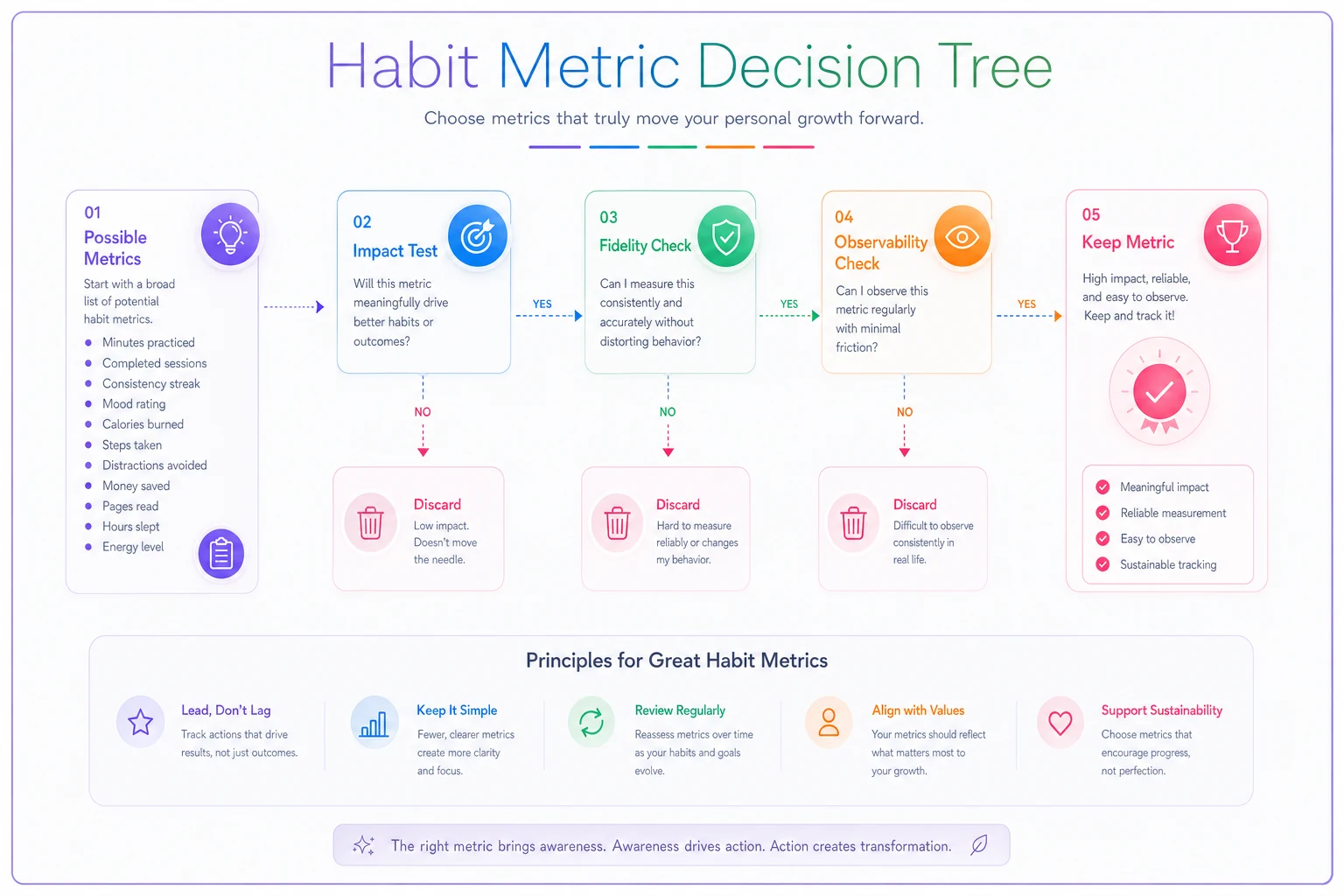
This simple flow helps you move from a long list to a tiny set of predictive signals without overthinking.
Finding Leading Indicators for Common Goals
Different goals require different leading indicators. Here's what actually predicts success across common habit categories:
Physical Health Habits
Common mistake: Tracking weight, calories, steps, workout duration
Better approach: Energy level after exercise (simple 1-3 scale), workout consistency at moderate intensity, hunger between meals
Someone trying to establish a gym habit tracked weight and workout duration for months with no progress. Switching to "Could I hold a conversation during cardio?" and "Did I feel energized two hours post-workout?" revealed the real problem: overtraining. Working too hard, getting exhausted, skipping days to recover. Backing off intensity improved consistency almost immediately.
Learning and Skill Development
Common mistake: Time studied, pages read, lessons completed
Better approach: Concepts explained to someone else, problems solved without reference, recall without notes
A developer learning a new programming language tracked hours spent on tutorials. Dozens of hours, minimal retention. Switching to "functions written without checking documentation" revealed the gap: passive consumption versus active practice. The metric shift drove the behavior change.
Creative Habits
Common mistake: Output quantity, time spent creating, project completion
Better approach: Ideas captured, iterations before satisfaction, sharing comfort level
Writers obsess over word count. Artists count finished pieces. Musicians log practice hours. None of these predict whether the creative habit survives stress, travel, or life getting complicated.
What does predict creative habit stability? "Did I capture an idea today?"—not execute, just capture. "How many iterations before I liked it?" tracks quality development. "Would I show this to someone?" measures confidence growth.
Relationship and Social Habits
Common mistake: Number of interactions, time spent together, activities completed
Better approach: Conversation depth marker, initiation ratio, energy after interaction
Tracking social habits feels weird because relationships aren't metrics. But if you're building habits around connection, certain signals predict success. "Did we talk about something beyond logistics?" distinguishes meaningful connection from task coordination. "Who initiated?" reveals relationship balance. "Do I feel energized or drained?" indicates whether the relationship is healthy.
Mental Health and Mindfulness
Common mistake: Mood ratings, meditation minutes, journal pages
Better approach: Noticed emotional patterns, response gap before reacting, physical tension awareness
Daily mood ratings create more problems than insights. Rating your mood forces you to judge your emotional state, which often makes it worse. Mood also fluctuates naturally—tracking every swing creates false patterns.
Better mental health metrics focus on awareness and response. "Did I notice anger or anxiety arising?"—not whether you felt it, but whether you noticed. "How long between trigger and response?" measures emotional regulation capacity. "Where did I hold tension?" tracks body-mind connection.
Real Example: Three Metrics That Predicted a Career Transformation
Here's how this framework played out for someone making a career transition while trying to maintain their health habits.
Context: Marketing manager transitioning to data science, needed to keep exercise and learning habits intact during an intensive bootcamp period.
Initial metrics (overwhelming and useless):
-
Hours studied daily
-
Coding problems completed
-
Gym visits per week
-
Weight and body composition
-
Energy levels (1-10)
-
Mood ratings
-
Sleep quality scores
-
Nutrition macros
After pruning to three leading indicators:
-
"Could I explain today's concept to my partner?" (Learning impact) - Not time spent or problems solved - Direct measure of understanding - Natural to assess during evening conversation
-
"Did I move intensely enough to think clearly after?" (Exercise impact) - Not duration or calories - Captures the actual goal: mental clarity - Observable within 30 minutes post-workout
-
"Did I protect one transition ritual?" (Habit stability) - Morning coffee before coding, or evening walk after study - Measures system resilience - Instantly observable
These three metrics predicted every major inflection point. When explanation quality dropped, it signaled concept confusion before test scores revealed it. When post-exercise clarity disappeared, it preceded energy crashes by days. When transition rituals broke, habit chains collapsed within a week.
The career transition succeeded. Health habits survived the intensity. The difference was tracking predictive signals instead of historical data.
The Template Exercise: Selecting Your Three Leading Indicators
Ready to identify your own leading indicators? Here's the exact exercise:
Part 1: Goal Clarification (5 minutes)
Write one sentence: "I want to establish [HABIT] so that [SPECIFIC OUTCOME]"
Example: "I want to establish daily writing so that I develop clear thinking and build an audience"
The outcome drives metric selection. "Build an audience" requires different metrics than "process emotions" or "document memories."
Part 2: Metric Brainstorm (10 minutes)
List 15-20 possible metrics. Include everything:
-
Quantity measures (words, minutes, reps)
-
Quality measures (satisfaction, difficulty, energy)
-
Consistency measures (streaks, frequency, timing)
-
Impact measures (outcomes, responses, changes)
Don't filter. Bad metrics teach you what to avoid.
Part 3: The Three Tests (15 minutes)
Create a table:
| Metric | Impact (Y/N) | Fidelity (H/M/L) | Observability (Easy/Hard) | Keep? |
|---|---|---|---|---|
| Words written | N | High | Easy | No |
| Published pieces | Y | Low | Easy | No |
| Reader comments | Y | Medium | Hard | No |
| "Would I share this?" | Y | High | Easy | Yes |
Run every metric through all three tests. Be ruthless. Most fail.
Part 4: Correlation Check (10 minutes)
If you have 4-5 survivors, check for overlap. Do they measure the same thing?
"Workout energy" and "post-exercise mood" correlate strongly—pick one. "Problems solved" and "concepts explained" measure different aspects—keep both if they fit within your three.
Part 5: The 7-Day Test (ongoing)
Track your three metrics for seven days. Ask yourself:
-
Can I capture this without thinking?
-
Does variation match my felt experience?
-
Do changes predict tomorrow's performance?
After seven days, you'll know if you've found true leading indicators.
Common Patterns to Avoid
The Vanity Metric Trap: Choosing metrics that make you feel good but don't predict success. Streak counters are the worst offenders. A 100-day streak feels amazing but tells you nothing about whether day 101 will happen.
The Precision Illusion: Using exact numbers when ranges work better. "Ran 3.2 miles in 28:34" versus "Could maintain conversation throughout run." The precise version requires GPS and timing. The simple one captures what actually matters: sustainable pace.
The Lag Indicator Disguise: Choosing metrics that seem predictive but actually report history. "Weekly average workout duration" sounds forward-looking but only tells you what already happened. "Energy before today's workout" actually predicts whether you'll complete it.
How AI-Powered Tracking Makes This Framework Practical
The biggest barrier to using leading indicators is capture friction. Even simple metrics become burdensome when you're tracking multiple habits across different contexts.
This is where AI-assisted tracking platforms help. Instead of manual entry, pattern recognition identifies your key indicators automatically. A voice note saying "felt clear after workout" becomes a data point. Natural language processing picks up habit-related signals from journals or messages without requiring explicit entry.
The automation handles correlation analysis too. When your three indicators move together, the system flags redundancy. When one indicator consistently predicts the others, it suggests simplification. When external factors—schedule changes, poor sleep—affect your indicators, it adjusts expectations automatically.
The real advantage is reducing capture overhead. You maintain habits. The system notices patterns, identifies leading indicators, and surfaces insights only when deviation from normal patterns predicts failure. No daily logging. No manual analysis. Just a signal when something actually warrants attention.
Leading Indicators Change as Habits Mature
Most habit tracking systems miss something important: the metrics that establish a habit aren't the ones that maintain it.
Weeks 1-4: Establishment Phase
Leading indicators focus on showing up. "Did I start?" matters more than "How well did I perform?" A writing habit might track "Opened document" rather than words produced. A gym habit might track "Arrived at gym" rather than workout quality.
Weeks 5-12: Consistency Phase
Indicators shift toward quality and integration. "Did I start?" becomes assumed. Now you track "Did I hit minimum effective dose?" or "Did I maintain form?" The writing habit evolves to track "Core idea clarity" rather than just showing up.
Weeks 13+: Optimization Phase
Indicators become more nuanced and personal. Generic metrics start to fail because your habit has developed its own characteristics. The writer might track "Surprised myself with an insight?" The gym-goer might track "Attempted something uncomfortable?"
Maintenance Mode: Failure Signals Only
Established habits don't need success metrics—they need failure warnings. Instead of tracking daily meditation quality, you only note disruption signals: "Skipped two days" or "Felt forced today." No warning signals means the habit remains stable.
This evolution explains why most tracking apps fail long-term users. They maintain the same metrics from day one to day 300, missing the natural progression of habit development entirely.
When to Stop Tracking Entirely
The ultimate goal of habit progress metrics is eliminating the need for metrics.
-
Identity shift completes
You don't "do meditation," you "are someone who meditates." The behavior becomes identity-consistent, not goal-driven.
-
Contextual triggers strengthen
Environmental cues trigger the habit automatically. Morning coffee triggers writing. Gym bag triggers workout. No conscious decision required.
-
Deviation feels wrong
Missing the habit creates discomfort stronger than any metric could provide. Your body expects the morning run. Your mind craves the evening reading.
When these three conditions exist, tracking becomes counterproductive. It adds cognitive overhead to an automatic process.
Premature tracking cessation kills habits, though. Stop measuring before the habit stabilizes, and it quietly disappears. The sweet spot is when you forget to track for a week but maintained the habit perfectly anyway.
The Mistakes That Break Good Metrics
Metric Gaming: When you optimize for the metric rather than the outcome. Tracking "Did I feel energized after workout?" leads to choosing easier workouts that feel good but don't build fitness. The metric becomes the goal.
Context Ignorance: Using the same metrics across different situations. Your home workout indicators don't work for hotel gyms. Your weekend writing metrics don't apply to weekday sessions. Context variation requires some flexibility.
Feedback Loop Corruption: When tracking changes behavior in unwanted ways. Tracking "creative output" makes you force production on uninspired days. Tracking "meditation quality" makes you judge your practice. The measurement distorts what it measures.
Threshold Creep: When "good enough" gradually becomes "not enough." Your "successful workout" definition expands from "showed up" to "personal record." Your "good writing session" evolves from "wrote anything" to "produced publication-ready content." Standards inflation kills consistency.
Building Your Personal Metric System
The path from metric chaos to clarity follows a predictable pattern.
Start with one habit, three metrics. Not five habits with fifteen metrics. One habit, three carefully chosen leading indicators. Master the selection process before scaling.
Start with one habit, three metrics.
Run monthly metric reviews. Which indicators actually predicted success or failure? Which provided noise? Which evolved naturally? Adjust based on evidence, not theory.
Document metric evolution. Keep a simple log: "Month 1: Tracked workout duration. Month 2: Switched to energy level. Month 3: Evolved to movement variety." This history reveals your personal patterns over time.
Share metrics with someone—not for accountability, but for calibration. An outside perspective catches when you're gaming metrics or losing signal in noise.
Accept that good metrics die. What predicted success in month one might create problems in month six. Killing outdated metrics takes some willingness to let go but prevents measurement burden from accumulating.
The goal isn't perfect metrics. It's minimum viable measurement that predicts maximum sustainable change.
Most people will keep tracking everything, hoping more data reveals hidden insights. They'll maintain elaborate spreadsheets, check apps constantly, and still wonder why habits don't stick.
Track three things that matter, notice problems before they fully surface, and build habits that survive real life. The difference is measuring what predicts tomorrow, not what happened yesterday.
Track three things that matter, notice problems before they fully surface, and build habits that survive real life. The difference is measuring what predicts tomorrow, not what happened yesterday.
Ready to unlock your full potential?
Join thousands of users transforming their lives using Growyly to stay motivated, organized, and growth-focused every day.