

Three nights ago, I decided to track my evening routine minute by minute. Started strong at 8 PM—cleaned the kitchen, prepped tomorrow's clothes. By 9:17 PM? Scrolling through YouTube shorts while telling myself I'd stop after "just one more."
The gap between wanting better sleep and actually disconnecting from screens isn't about willpower. It's about friction. Your brain takes the path of least resistance, and right now, reaching for your phone requires zero effort while starting a wind-down routine feels like climbing a mountain.
Most sleep advice ignores something crucial: you're competing against platforms designed by teams of neuroscientists to keep you engaged. When TikTok's algorithm knows exactly which video will keep you watching at 11:47 PM, you're not fighting fair. What works is building an evening routine that makes disconnecting easier than staying connected—not through restriction, but through strategic friction and environmental design.
The Two-Hour Wind-Down Window
Sleep quality isn't determined when your head hits the pillow. The cascade of hormonal changes that enable deep sleep starts roughly two hours before you actually fall asleep. Miss this window, and you're fighting biology all night.
During this pre-sleep phase, your body temperature needs to drop by 1-2 degrees, melatonin production ramps up, and your parasympathetic nervous system should gradually take over. Screens directly interfere with all three processes.
The blue light issue gets all the attention, but screen engagement creates a bigger problem—cognitive arousal. Each notification, each new piece of content, each decision about what to watch next keeps your prefrontal cortex firing when it should be powering down.
Think about your last poor night's sleep. Chances are, you used screens right up until the moment you tried to sleep. Your brain went from processing information at full speed to expecting immediate shutdown. That's like trying to park a car while driving 60 mph.
Hour-by-Hour Evening Framework
7:00 PM - The Transition Hour
Achieve more by focusing on what matters.
Growyly helps you build lasting habits and track your personal growth effortlessly.
- Goal setting with progress tracking
- Daily habit reminders
- Motivational insights and analytics
No credit card required
This hour sets the trajectory for your entire evening. Most people finish dinner and immediately default to the couch with their phone. Instead, use this time for light physical tasks that create momentum away from screens.
Kitchen cleanup works perfectly. Not just loading the dishwasher—fully resetting your space. Wipe counters, prep tomorrow's coffee, set out breakfast items. Physical movement plus task completion gives your brain the satisfaction it would otherwise seek from scrolling.
If you work from home, physically close your laptop and put it in a drawer or another room. This sounds trivial, but putting work away signals your brain that the productive portion of the day is complete.
8:00 PM - The Choice Point
By 8 PM, you face the evening's critical decision: passive consumption or active engagement. Most routines fail here because they rely on motivation when you're already depleted from the day.
Pre-decided activities with everything already set up work best. If you want to read, your book should already be on the coffee table with a bookmark at your spot. If you prefer podcasts while doing something with your hands, keep a puzzle or craft project permanently stationed in your relaxation space.
What doesn't work: deciding what to do in the moment. Decision fatigue makes your phone's infinite content stream irresistible. Remove the decision entirely.
One surprisingly effective swap is audio content while doing gentle stretches or foam rolling. You get the entertainment value without the visual stimulation, plus the physical component naturally makes you drowsy.
9:00 PM - The Preparation Ritual
This hour transforms tomorrow's morning stress into tonight's calming routine. Every task you complete now is one less decision tomorrow when your willpower is highest and most valuable.
Layout tomorrow's entire outfit, including accessories and shoes. Pack your work bag completely. Prep breakfast—even if that just means putting a bowl and spoon on the counter. Write tomorrow's three priorities on paper and leave it where you'll see it first thing.
These tasks occupy your hands and mind in a way that's incompatible with phone use, but doesn't require high mental energy.
During this hour, switch all overhead lights to lamps. If you must check your phone, do it standing up. Sitting or lying down with your phone after 9 PM almost guarantees extended use.
10:00 PM - The Actual Wind-Down
By 10 PM, all screens should be in another room, charging. Not on your nightstand, not face-down beside you—physically removed from your bedroom. This single change typically improves sleep onset by 15-20 minutes.
Replace the pre-sleep scroll with progressive muscle relaxation (tense and release each muscle group for 5 seconds), gratitude listing (write three specific moments from today), light fiction reading with a physical book, or gentle breathing exercises (4-7-8 pattern works well).
The shower question: hot water feels relaxing but temporarily raises core body temperature. Take hot showers 90 minutes before bed, or opt for lukewarm water 30 minutes before.
Visual guide to the hour-by-hour routine:
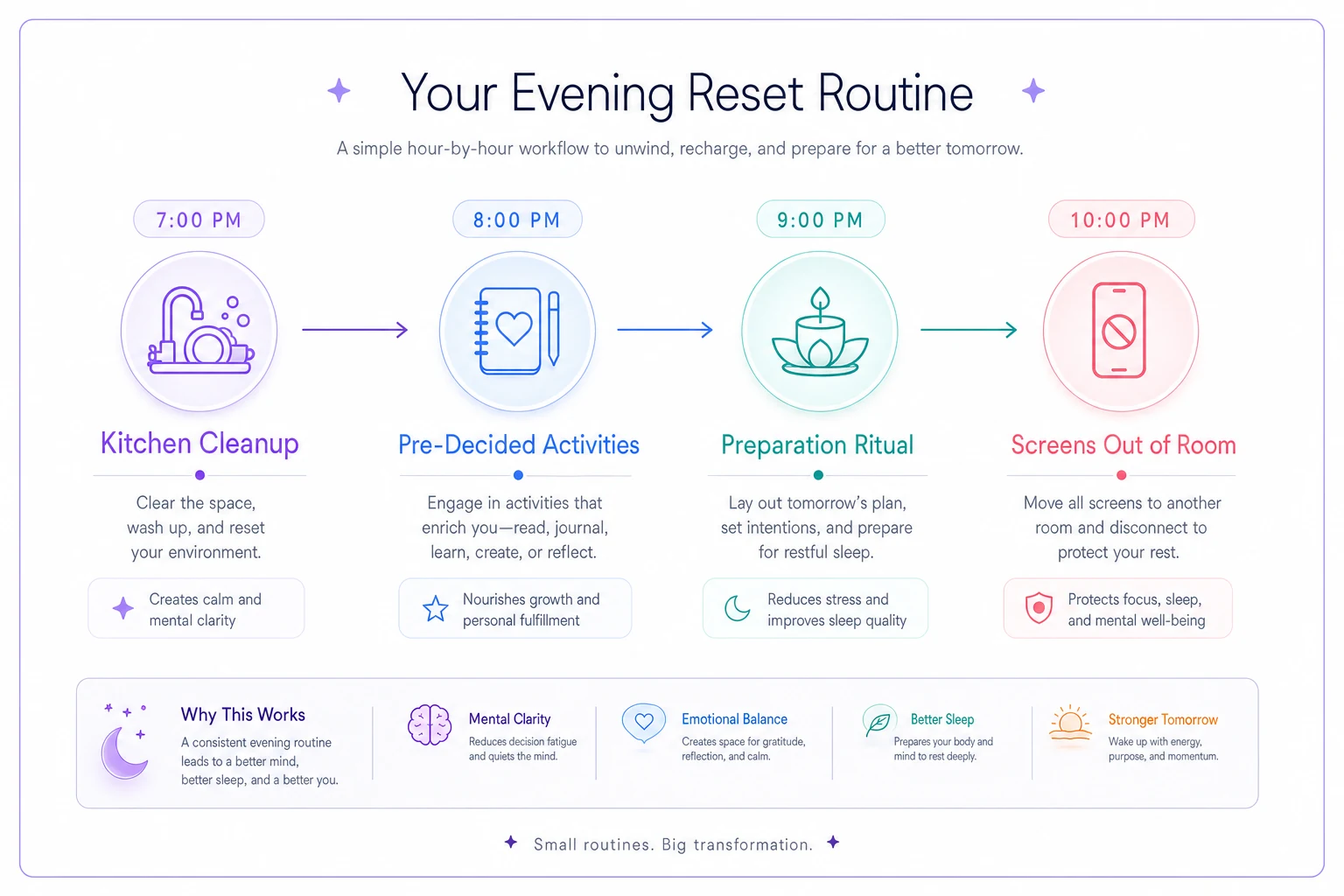
Use this flow to set alarms and reminders.
Environmental Design That Actually Sticks
Your environment determines your behavior more than your intentions. A charging station in your kitchen means your phone never makes it to the bedroom. A sunset lamp on a timer creates visual cues without conscious effort.
Lighting Adjustments:
-
Smart bulbs set to warm (2700K) after sunset
-
Charging station with built-in lamp in kitchen or hallway
-
Book light for bedroom reading
-
Nightlight for bathroom trips (avoiding overhead lights)
Device Placement:
-
Phone charges in kitchen after 9
30 PM
-
Laptop lives in closed bag or drawer after work
-
TV remote in inconvenient location (requires standing to retrieve)
-
Kindle or books visible on nightstand
Friction Builders:
-
App timers that require password override after 9 PM
-
Phone in grayscale mode after sunset
-
Logout of social media apps each evening
-
Router on timer (extreme but effective)
A charging station in your kitchen means your phone never makes it to the bedroom.
The key is making your desired behavior easier while adding small obstacles to problem behaviors. It doesn't have to be complex—sometimes moving your phone charger to another room changes everything.
The Low-Friction Swap List
Replacing habits works better than eliminating them. Your brain wants stimulation in the evening—give it alternatives that don't destroy sleep.
| Instead of This | Try This | Why It Works |
|---|---|---|
| Instagram scrolling | Photo album organizing | Visual satisfaction without endless content |
| YouTube videos | Podcast while stretching | Audio engagement with physical tiredness |
| Netflix binging | Audiobook with tea | Story immersion without blue light |
| News reading | Journaling | Mental processing without anxiety triggers |
| Gaming | Puzzle books/Sudoku | Problem-solving satisfaction with natural endpoint |
| Work emails | Tomorrow's task list | Productivity feeling without stress activation |
| Shopping apps | Meditation app | Designed for wind-down, not engagement |
The trick is matching the psychological reward you're seeking. If you scroll Instagram for visual stimulation, organizing photos scratches the same itch. If you watch YouTube for entertainment while your brain zones out, podcasts during light activity provide similar engagement without the visual component.
Measuring What Actually Matters
Track these three metrics for two weeks to see real patterns:
Screen-off time: The exact minute you last looked at a screen. Not when you "decided" to stop, but when you actually stopped.
Sleep onset latency: Time between lights-off and falling asleep. Most people overestimate this by 20-30 minutes. Use a sleep tracking app initially to calibrate your perception.
Morning energy (1-10 scale): Rate this at the same time each morning, ideally after you've been awake 30 minutes. Look for patterns between screen-off time and next-day energy.
Don't track everything. These three numbers tell you whether changes are working without turning sleep into another optimization project. Most people see noticeable patterns within 5-7 days of consistent tracking.
The data usually shows clear patterns pretty quickly. When my screen-off time pushes past 10:30 PM, my morning energy rating drops below 6. Simple correlation, but powerful for behavior change.
Common Failure Points and Fixes
The "Important Email" Trap
You check one important thing at 9:45 PM and suddenly it's 11:15 PM. Fix: Set a phone reminder at 8:30 PM to handle anything urgent. After that, it can wait until morning.
Partner on Different Schedule
When your partner stays up scrolling, your routine crumbles. Fix: Separate wind-down spaces. You read in the bedroom while they watch TV in the living room. Meet in bed when both are ready for sleep.
Revenge Bedtime Procrastination
After a day of obligations, your evening feels like the only "you" time. Scrolling becomes rebellion against tomorrow's responsibilities. Fix: Schedule personal time earlier—even 20 minutes at lunch changes the evening dynamic.
Weekend Destruction
Friday night destroys a week of progress. Fix: Allow one hour extra on weekends but keep the same routine structure. Consistency matters more than perfection.
These failures happen to everyone. The goal isn't avoiding them—it's getting back on track the next night instead of letting one bad evening derail the whole week.
The Biological Reality Check
Your circadian rhythm doesn't care about your Netflix queue. Every hour of screen time after 9 PM shifts your natural wake time later, creating a compound sleep debt that weekend catch-up can't fix.
Two hours of screen-free time before bed improves sleep efficiency by roughly 15%, increases REM sleep duration, and reduces next-day anxiety scores. That's equivalent to an extra 45 minutes of quality sleep without spending any additional time in bed.
Consistent evening routines reduce sleep onset time more effectively than any supplement, including melatonin. Your brain learns the pattern and begins the shutdown sequence automatically.
Building Your Personal Protocol
Start with one friction change and one environment tweak. Don't overhaul everything at once—that's how you end up reverting to old patterns within a week.
-
Week 1-2
Move phone charging outside bedroom, switch to lamps after 9 PM
-
Week 3-4
Add 15-minute prep routine at 9 PM
-
Week 5-6
Introduce one low-friction swap activity
-
Week 7-8
Full routine implementation
The goal isn't perfection. Following this routine five nights a week dramatically improves sleep quality compared to no routine at all. You're not fighting against technology, you're working with your biology.
Every small friction you add between yourself and screens makes it easier for your brain to follow its natural wind-down process.
The 30-Day Reality
After 30 days of consistent evening routine, most people experience sleep onset decreases by 10-25 minutes, morning grogginess reduces noticeably, 3 PM energy crashes become less severe, and weekend sleep debt accumulation drops by roughly 2-3 hours.
But here's the biggest change: evenings stop feeling like a battle between what you should do and what you want to do. The routine becomes the path of least resistance, and your phone becomes the thing that requires effort to reach.
Your evening routine doesn't need to be perfect. It needs to be consistent enough that your brain recognizes the pattern and begins preparing for sleep automatically. That's when better sleep stops being something you work for and becomes something that simply happens.
The choice you make at 9 PM tonight determines how you'll feel at 7 AM tomorrow. Make it once, design your environment to support it, and let biology handle the rest.
Ready to unlock your full potential?
Join thousands of users transforming their lives using Growyly to stay motivated, organized, and growth-focused every day.