


You missed three workouts. Then a week. Now it's been a month and that gym membership is just sitting in your wallet like a small monument to failure. Or maybe you were journaling every morning for 47 days straight, missed one hungover Sunday, and somehow that single miss turned into six weeks of blank pages.
The worst part isn't the lapse. It's the mental gymnastics that follow. That voice telling you you're weak, undisciplined, that you'll never change. Most people get stuck there—in what I'd call the shame spiral, where each day you don't restart makes the next day feel even heavier. After watching this pattern repeat with dozens of habit-tracking users and digging through restart data across thousands of records, one thing kept standing out: successful habit recovery has almost nothing to do with motivation and everything to do with having the right recovery framework.
Why Traditional Restart Methods Fail
The standard advice when you fall off a habit is almost offensively simple. "Just start again!" As if the problem is that you forgot habits exist.
What typically happens when people try to restart: They wake up feeling motivated (usually a Monday), declare they're back on track, jump straight to their previous habit intensity, fail within two or three days, and then conclude they're fundamentally broken.
This approach fails for three specific reasons.
First, there's usually a legitimate reason the habit broke. Maybe your morning meditation stopped when your kid started waking up earlier. Maybe your evening walks died when daylight savings hit. These aren't character flaws—they're real operational conflicts that need actual solutions.
Second, the neural pathways supporting the habit have genuinely weakened. Brain imaging research shows unused habit circuits start degrading after about ten days of inactivity. Jumping back to full intensity is like expecting to hit your deadlift max after a month off—it's just asking for another failure.
Third, shame creates a physiological stress response that makes execution harder. Cortisol spikes, executive function drops, and that simple habit starts feeling impossibly heavy. You're literally making it harder on yourself by beating yourself up about it.
The Hidden Cost of Habit Shame
A productivity coach I know tracked her clients' recovery patterns for two years. She found that people who approached lapses with self-compassion restarted habits roughly 73% faster than those who leaned into self-criticism.
Achieve more by focusing on what matters.
Growyly helps you build lasting habits and track your personal growth effortlessly.
- Goal setting with progress tracking
- Daily habit reminders
- Motivational insights and analytics
No credit card required
That's notable. But what really stood out was this: the self-compassion group maintained their restarted habits for an average of 14 weeks longer. The shame group typically lapsed again within three or four weeks.
The mechanism isn't complicated. Shame activates your brain's threat detection system. It starts treating the habit like something to avoid rather than something to pursue. Every time you think about restarting, you get a low-level spike of anxiety. Do that enough times and the association becomes: thinking about this habit feels bad.
Self-compassion keeps your brain in problem-solving mode instead. You're building, not defending.
Phase 1: The Root-Cause Audit
Before you even think about restarting, you need to understand why the habit broke. Not the surface reason ("I got busy"), but the actual failure point.
A simple five-question audit takes about ten minutes:
When exactly did the habit break? Not "sometime last month"—the specific day. Pull up your calendar if needed. This matters because it helps identify what triggered the break.
What changed in your environment or routine that week? Did you travel? Start a new project? Download a new app? Sometimes the connection is obvious, sometimes it's subtle—like starting to keep your phone charger in the bedroom.
What was the physical context of the break? Where were you supposed to do the habit? Had anything in that space changed? One person discovered her yoga practice collapsed when she started using her mat area to stack packages during holiday shopping.
What emotional state preceded the lapse? Not during the lapse—before it. Were you stressed about something specific? Feeling stretched thin? Emotions are rarely the root cause, but they usually point to the real pressure.
What did you gain from NOT doing the habit? This one stings, but it matters. Every lapse provides something—extra sleep, less anxiety, more time for something else. Until you acknowledge what you got from stopping, you can't design a restart that holds.
One woman I worked with couldn't figure out why her writing habit kept dying after two or three weeks. The audit surfaced something she hadn't connected: every lapse lined up with her husband being back from work travel. Turns out her early morning writing time was also her only real alone time. When he was home, she unconsciously chose connection over writing. The fix wasn't more discipline—it was a direct conversation about needing solo mornings even when he was around.
Phase 2: The Soft Reset Protocol
Once you understand why the habit broke, you can design a restart that actually holds. The soft reset runs on two principles: micro-commitments and seven-day experiments.
Micro-Commitments: Starting Stupidly Small
Your ego wants to restart where you left off. If you were meditating for 20 minutes, it wants 20 minutes on day one. That instinct is almost always wrong.
The micro-commitment for your restart should feel almost embarrassingly small. Were you running 5 miles? Your restart is putting on your running shoes and stepping outside. Were you journaling three pages? Your restart is one sentence.
It feels wrong. You want to prove you're back. But people who restart at roughly 10% of their previous intensity maintain the habit significantly longer than those who try to jump back to full speed.
The micro-commitment does three things:
It rebuilds the neural pathway without triggering resistance. Your brain doesn't mobilize defenses against one push-up.
It creates what researchers call completion momentum—that small win releases dopamine, which makes the next session a little easier.
It creates space to fix the operational problems that caused the original lapse. When the commitment is tiny, you have bandwidth to focus on the actual structural issues.
The Seven-Day Experiment Framework
Instead of declaring "I'm back on this forever," you run seven-day experiments. Each experiment has three parts:
The hypothesis: "I think doing X at Y time will work because Z"
The measurement: Not just did I do it, but how did it feel, what got in the way, what helped
The iteration: Based on what happened, what changes for the next seven days?
Here's a real example from someone restarting a meditation practice:
Week 1 Hypothesis: "I can meditate for 2 minutes right after morning coffee, sitting in my car before work" Result: Worked 5 out of 7 days. Failed on early meeting days. The car itself was actually perfect—quiet and private. Week 2 Hypothesis: "Same setup, but on early meeting days, I'll do it after lunch in the car instead"
After four weeks of experiments, she had a practice that worked regardless of schedule variations. Each week built on the last.
A quick visual of the Soft Reset flow can make the process easier to follow.
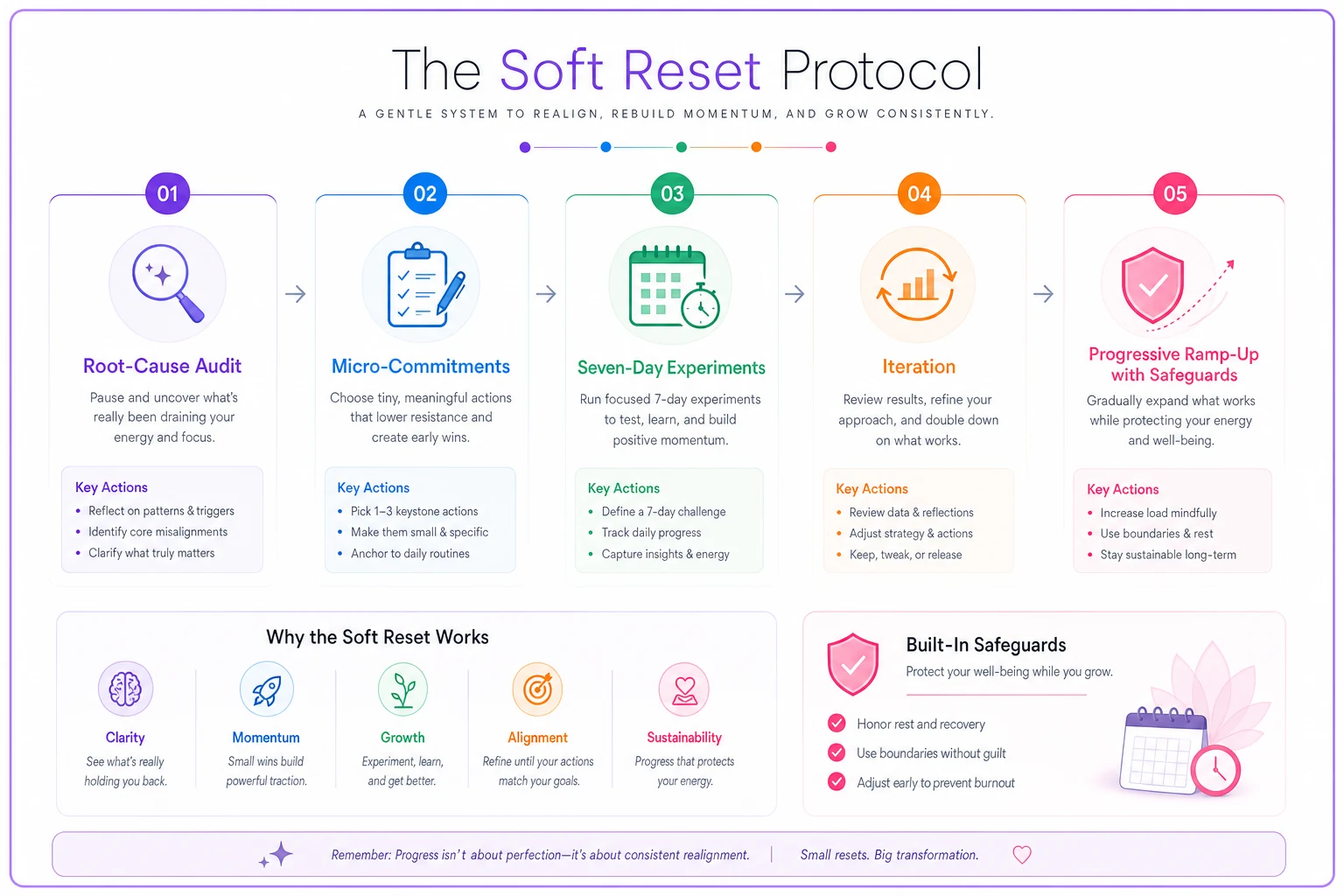
That flow captures the iterative nature of the soft reset: small step, test, learn, repeat.
Phase 3: Progressive Ramp-Up With Safeguards
Once your micro-commitment starts feeling automatic—usually after two or three successful seven-day experiments—you can start expanding. But this isn't about grinding harder. It's about strategic growth with built-in protection.
The 20% Rule
Don't increase habit intensity by more than 20% per week. Meditating for 5 minutes? Week two is 6 minutes, not 10. Writing 200 words? Next week is 240, not 500.
It feels slow, especially when you remember what you used to do. But the gradual ramp lets you catch and solve problems before they become breaking points.
A runner I know skipped this when restarting after an injury. Felt good, went from 1 mile to 5 miles in week two. Developed knee pain and had to stop entirely—ended up in a worse lapse than before. When he finally restarted with proper 20% increases, he was back to his previous distance in eight weeks with no pain. That was over six months ago and he's still running.
Installing Relapse Safeguards
The Minimum Viable Version Define the absolute smallest version of your habit that still counts. Can't do the full workout? What's the 5-minute version? Can't write 1,000 words? What's the 50-word version?
This isn't about lowering standards—it's about keeping the neural pathway alive during rough patches. A photographer I worked with uses a "minimum viable" rule: if he can't do a full shoot, he takes one intentional photo on his phone. He's used that safeguard maybe fifteen times over two years. It's prevented every potential lapse.
The Context Collapse Plan Identify your three most likely failure scenarios and pre-plan for them:
-
Travel
How do you do the habit in a hotel?
-
Illness
What's the sick-day version?
-
Schedule chaos
Where's the backup time slot?
The Accountability Gradient Instead of announcing your restart to everyone and feeling crushed if you slip, build accountability gradually:
-
Days 1–7
Private tracking only
-
Days 8–21
Share with one supportive person
-
Days 22–42
Small group if you want
-
Day 43+
Wider accountability if that feels useful
The gradual increase prevents the kind of pressure that tanks early restarts before they have a chance to stick.
The Recovery Monitoring System
Restarting a habit requires tracking different things than building one from scratch. You're not just checking completion—you're monitoring system health.
The Three-Metric Dashboard
| Metric | Description |
|---|---|
| Completion Rate | Standard "did I do it" tracking. Aim for 80%, not 100%. Chasing perfection is one of the fastest ways to trigger a shame spiral. |
| Resistance Level | Rate each session from 1–10 on how much you had to push to start. Rising resistance scores tend to predict lapses about five to seven days out. |
| Context Stability | Log any environmental or schedule changes. Habits break at context shifts, so tracking these lets you adjust before things unravel. |
A simple spreadsheet works fine. Paper works too. The key is doing a quick weekly review to catch patterns early.
The Weekly Recovery Review
-
What made the habit easier this week?
-
What made it harder?
-
What's changing next week that might affect it?
-
Do I need to activate any safeguards?
This isn't a judgment session. It's operational intelligence—data to make the system more resilient.
When Relapse Happens Anyway
Sometimes, even with a solid recovery process, you'll lapse again. Maybe more than once. That's not failure—it's data pointing to a deeper structural problem.
A few patterns worth recognizing:
The Competing Commitment: The habit conflicts with another value you actually care about. The person who can't maintain exercise because it cuts into family time needs a design change, not more willpower.
The Identity Mismatch: You're trying to maintain a habit that serves who you think you should be, not who you actually are. That's an alignment problem, not a discipline problem.
The Seasonal Pattern: Some habits naturally ebb and flow. The outdoor runner who lapses every winter might need to accept that rhythm rather than fight it.
If you're seeing repeated lapses despite good recovery protocol, it's worth questioning whether the habit itself needs redesigning—not just restarting.
Making Recovery Systematic
The businesses I've worked with that maintain the strongest operational habits share one trait: they treat lapses as system failures, not personal ones. When a process breaks, they fix the process.
Your personal habits deserve the same framing. A lapse isn't a character flaw—it's feedback showing you where the system needs work.
The three-phase recovery framework—audit, soft reset, progressive ramp-up—works because it addresses the actual reasons habits break rather than just throwing motivation at the problem. It treats restarting as a distinct skill from starting, one that needs different tools.
And it removes shame from the equation. Shame is just friction—it makes everything harder. When you approach recovery with curiosity instead of judgment, you're not just more likely to restart successfully. You're building something more resilient: a habit that can survive real life, not just ideal conditions.
That gym membership collecting dust, that journal sitting on the shelf—those aren't monuments to failure. They're chances to build something better.
The question isn't whether you'll lapse again. You will. The question is whether you'll have a recovery system ready when it happens.
Ready to unlock your full potential?
Join thousands of users transforming their lives using Growyly to stay motivated, organized, and growth-focused every day.