
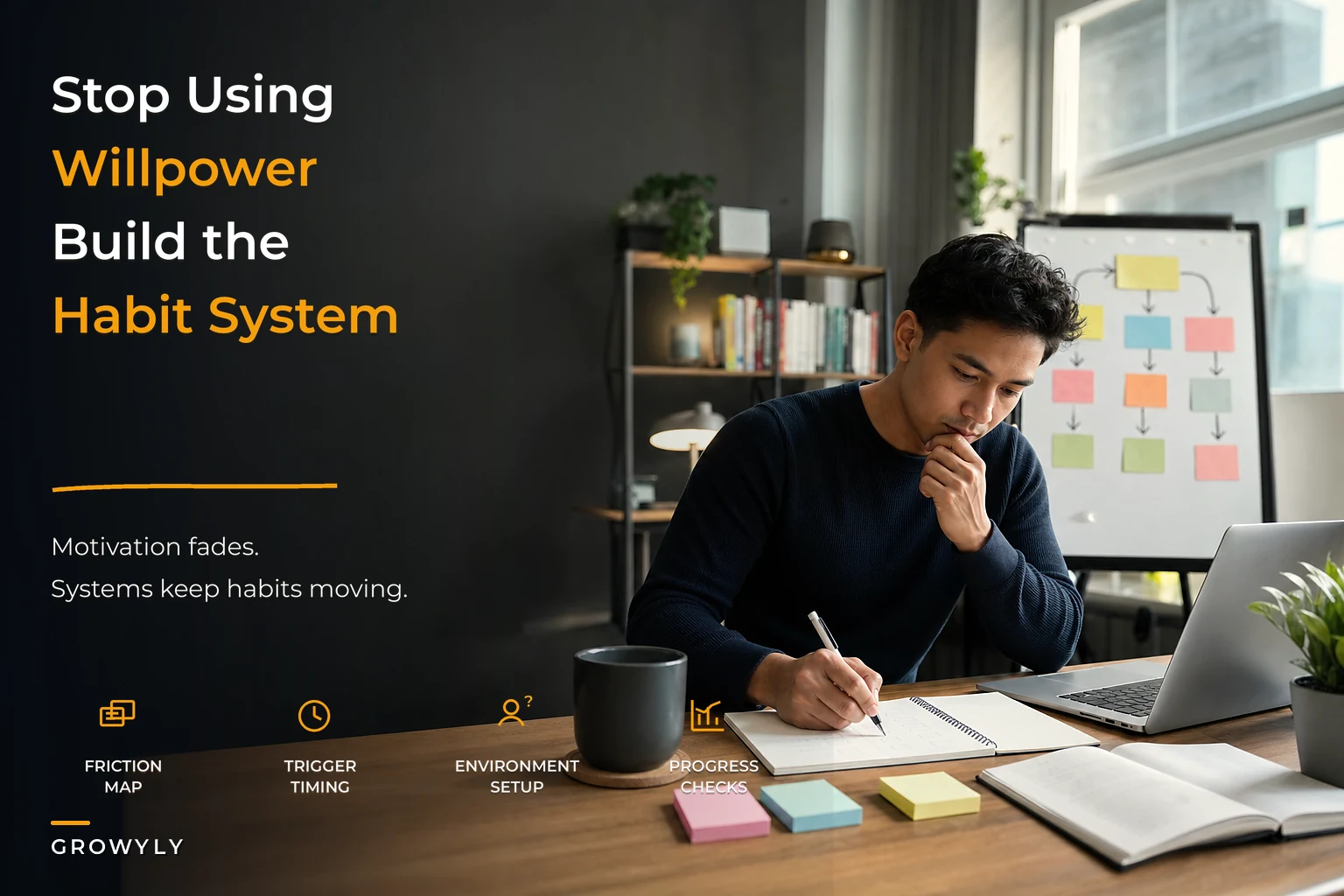

Most habit advice treats motivation wrong. They tell you to dig deeper, find your why, visualize success. Meanwhile, your actual habits die after three weeks because motivation runs out like gas in a tank.
My fitness app shows 47 abandoned workout streaks. Not because I lack discipline, but because I kept trying to push through friction instead of removing it. Every morning decision — finding workout clothes, choosing a routine, clearing space — burned through willpower I needed for actual exercise.
That's backwards. Motivation works better as infrastructure than fuel. You build systems that carry you forward when willpower dips, not systems that demand constant willpower to maintain.
Watching dozens of habit attempts fail (mine and others'), the pattern became obvious. Success rarely came from better goals or stronger commitment. It came from people who accidentally stumbled into systems that required less activation energy. The gym-goer who kept clothes in their car. The writer who left their notebook open on the kitchen table. The runner who slept in workout gear.
They weren't more motivated. Their habits just faced less resistance.
Why Traditional Habit Building Collapses at Scale
Standard habit advice assumes you're adding one behavior to an otherwise empty schedule. Reality hits different. You're trying to wedge new routines into days already packed with work deadlines, family obligations, and existing commitments.
Each new habit competes for the same limited resources — time, attention, decision-making capacity. Add three habits simultaneously and they cannibalize each other. The morning meditation disrupts your workout timing. The evening journaling pushes bedtime later. The meal prep Sunday conflicts with grocery shopping.
This resource competition intensifies as habits mature. A 5-minute meditation grows to 20 minutes. Daily walks become running programs. Simple journaling expands into morning pages. What started manageable becomes unsustainable without system redesign.
The cognitive load multiplies too. Every habit requires decisions. When to do it. How long. Which variation. Where. These micro-decisions accumulate until your morning routine needs a project manager. You spend more mental energy coordinating habits than executing them.
Most people interpret this chaos as personal failure. They assume successful habit-builders have superhuman discipline. But people with consistent long-term habits reveal something different — they've eliminated most of these decisions through environmental design and systematic triggers.
The Five-Component System That Actually Works
Sustainable habits need five interlocking components working together. Miss one and the system degrades. Get all five aligned and habits become nearly automatic.
Achieve more by focusing on what matters.
Growyly helps you build lasting habits and track your personal growth effortlessly.
- Goal setting with progress tracking
- Daily habit reminders
- Motivational insights and analytics
No credit card required
Friction reduction comes first. Every step between intention and action creates dropout risk. Opening an app, finding equipment, choosing what to do — each friction point kills attempts. Remove three friction points and you've doubled your success rate without touching motivation.
Start by removing the single biggest friction point you can identify.
Trigger engineering creates automatic activation. Instead of remembering to meditate, you meditate immediately after turning off your morning alarm. Instead of deciding when to exercise, you exercise the moment you close your laptop at 5:30pm. Triggers eliminate the "when" decision entirely.
Environment scaffolds make the right choice the easy choice. Your workout clothes laid out become a visual cue. Your phone in another room removes distraction temptation. Your journal open on your nightstand invites evening writing. The environment does the heavy lifting.
Habit bundling leverages existing routines. New habits attach to established ones like remora fish. Stretching while coffee brews. Listening to educational podcasts during commutes. Planning tomorrow during tonight's dishwashing. The existing habit carries the new one.
Calendar commitments transform intentions into infrastructure. A recurring calendar block for deep work. A standing Tuesday gym appointment. A protected Sunday meal prep window. The calendar defends the time automatically.
These aren't separate tactics. They form an integrated system where each component reinforces the others.
Building Your Implementation Roadmap
Start with friction mapping. Pick one target habit and document every micro-step from intention to completion. Want to meditate? List it out: remember to meditate → find quiet space → open app → choose meditation → find comfortable position → actually start.
Each step represents potential failure. Your job is systematic elimination.
Next, identify natural triggers already in your routine. Morning habits trigger off waking, showering, coffee. Evening habits trigger off work ending, dinner, or pre-bed routines. Midday habits trigger off lunch, meetings ending, or energy dips.
Match your target habit to the most logical trigger. Then engineer the handoff to be frictionless. Your meditation app opens automatically when you turn off your morning alarm. Your running shoes wait by the door you exit for lunch. Your journal lives next to your bedtime glass of water.
Now scaffold the environment. Remove competing options from the trigger zone. Add visual cues that prompt action. Prepare everything in advance so execution requires minimal decisions.
Test for one week with just these three components. Document what breaks. Usually it's either trigger inconsistency (your morning routine varies) or environment interference (someone moves your stuff).
Once the basic loop works, add bundling and calendar protection. Bundle enjoyable content with the habit — favorite podcast during workouts, special coffee during morning writing. Block calendar time that treats the habit as unmissable as a client meeting.
The following visual shows the workflow from trigger to execution to maintenance.
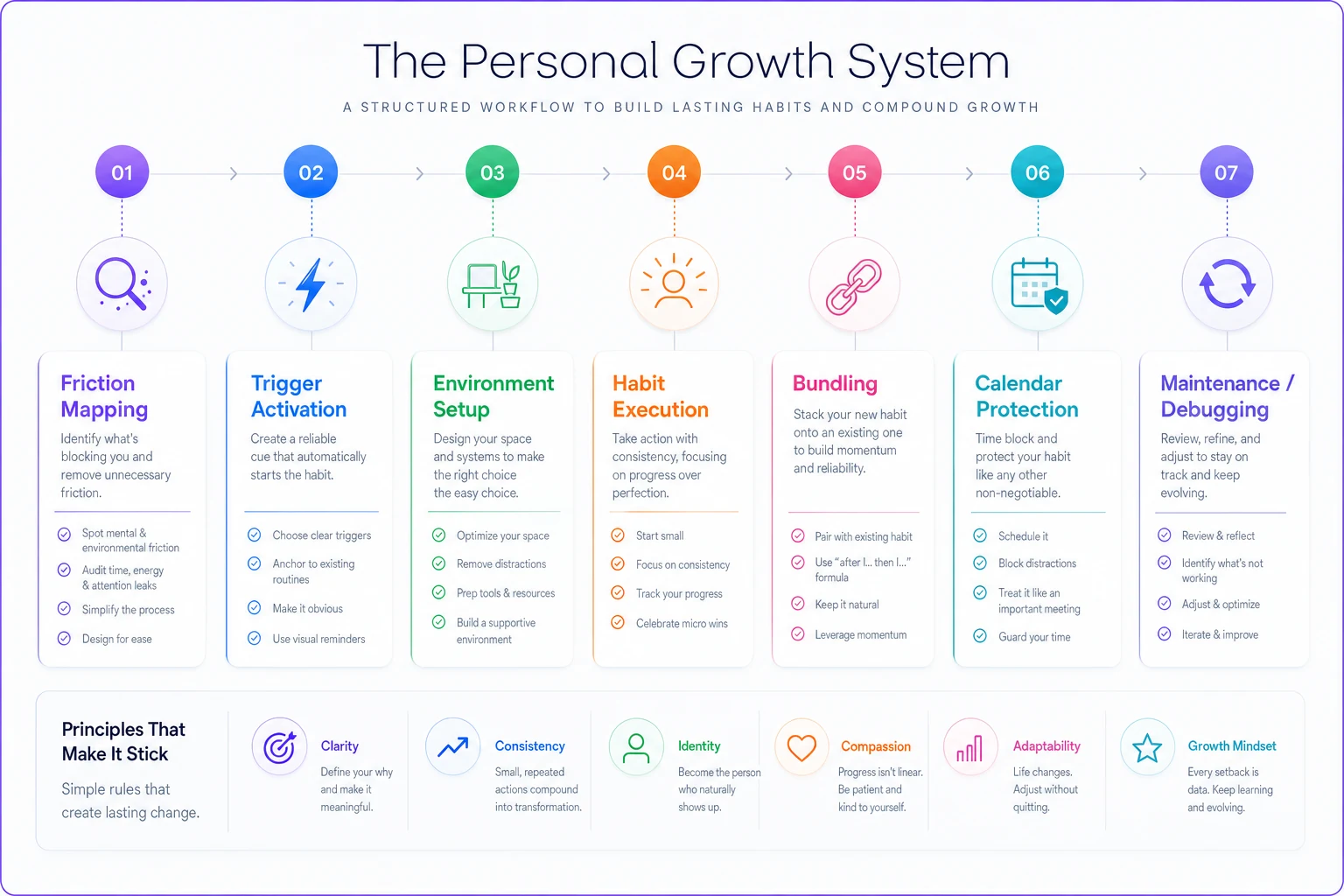
Keep iterating based on what the visual reveals.
The Checklist System for Daily Execution
Morning Setup (Night Before):
-
Tomorrow's workout clothes visible
-
Phone charger outside bedroom
-
Journal/book on nightstand
-
Water bottle filled and placed
-
First task already open on computer
Trigger Activation:
-
Alarm → immediate action (no snooze)
-
Laptop close → transition ritual
-
Lunch timer → movement trigger
-
Evening arrival → phone in drawer
-
Shower end → next habit starts
Environment Audit (Weekly):
-
Friction points identified and removed
-
Temptations relocated or eliminated
-
Cues visible and positioned correctly
-
Tools/materials prepared in advance
-
Backup plans for common disruptions
This checklist becomes your operational manual. Not a motivational reminder, but a system specification. Like a pilot's pre-flight check — same sequence, same verifications, regardless of how you feel.
Common Failure Modes and Recovery Patterns
The Perfectionist Spiral: Missing one day triggers shame, which creates avoidance, which builds more shame. The habit dies from emotional weight, not lack of discipline.
Recovery requires reframing misses as data, not failures. Log what broke — was it the trigger, the environment, unexpected schedule change? Fix the system weakness instead of punishing yourself.
Complexity Creep: Successful habits tend to expand. Five-minute meditation becomes 20-minute sessions with breathing exercises and journaling. Simple walks evolve into training programs with heart rate zones and recovery protocols.
Complexity creates fragility. More components means more failure points. Set hard boundaries on habit scope. When you want to expand, create a separate habit block rather than inflating the existing one.
The All-or-Nothing Trap: Treating partial completion as total failure. Can't do your full workout? Skip it entirely. Only have 10 minutes for usually 30-minute routine? Don't bother.
Build minimum viable versions of every habit. Can't run 3 miles? Walk around the block. Can't meditate 20 minutes? Do three breaths. Can't write 1000 words? Write one paragraph. Consistency beats intensity.
Social Friction: Other people disrupt your carefully designed systems. Partners rearrange your staged environment. Kids interrupt your triggers. Coworkers schedule over your protected time.
Solution involves habit portability — backup versions that work anywhere. Travel meditation that needs no app. Bodyweight exercises requiring no equipment. Micro-journaling in your phone notes. The habit survives even when the ideal system breaks.
Tracking Without Burning Out
Most tracking systems create more burden than benefit. Detailed metrics, mood ratings, duration logs — they transform habits into data entry jobs. The tracking becomes harder than the habit itself.
Instead, use binary tracking. Did it happen? Yes or no. No duration, quality, or intensity metrics. Just existence. This removes decision fatigue about "how much counts" while maintaining streak visibility.
Track the system, not just the outcome. Note when triggers fired successfully. When environment scaffolds worked. When bundling made things easier. You're debugging a process, not judging performance.
Keep tracking visible but not intrusive. A simple calendar mark. A physical token moved between jars. A single checkbox in a notebook. The act of tracking should take under 5 seconds.
Review patterns weekly, not daily. Daily review creates unhelpful pressure. Weekly review reveals actual trends. Look for system breaks, not motivation failures. Fix infrastructure, not mindset.
When Systems Approach Makes Sense (And When It Doesn't)
This systematic approach works best for routine-building and consistent behaviors. Daily habits, regular practices, ongoing disciplines. The infrastructure investment pays off through repeated use.
It fails for one-time projects or irregular goals. Don't build elaborate systems for occasional tasks. The setup cost exceeds the execution benefit. Save systems for behaviors you'll repeat at least three times weekly.
People who thrive with this approach usually struggle with consistency despite high motivation. They start strong but fade. They have good intentions but poor follow-through. They need external structure more than internal drive.
Skip this if you naturally maintain routines without effort. Some people don't need systems — habits just stick. They wake up and exercise automatically. They remember commitments without reminders. Systems would add unnecessary complexity.
Also skip if your life lacks routine stability. Shift work, travel jobs, or unpredictable schedules break systematic approaches. You need flexible protocols, not rigid infrastructure.
Where AI and Automation Support Habit Infrastructure
Digital tools can strengthen the system without becoming another burden. Automatic triggers eliminate the remembering-to-remember problem. Smart home routines adjust environment without manual intervention. Automated tracking removes the logging burden.
Calendar automation protects habit time better than willpower. Recurring blocks, automatic decline of conflicting meetings, buffer time enforcement. The calendar becomes your habit's bodyguard.
AI-powered operational software helps identify pattern breaks before habits fully collapse. Tracking consistency drops, trigger timing shifts, completion rates decline — the system notices trends you might miss and suggests specific adjustments.
Every tool should eliminate at least two manual steps. Otherwise you're adding complexity, not removing friction. Most habit apps fail this test — they create more work than doing the habit manually.
The 90-Day Implementation Timeline
This timeline assumes everything takes longer than expected.
| Period | Plan |
|---|---|
| Days 1-14: Foundation | Map friction points for one keystone habit. Design initial trigger and environment. Test daily, documenting every failure point. Don't judge success, just gather data. |
| Days 15-30: Refinement | Fix the biggest friction points discovered. Strengthen trigger consistency. Add one bundle element (enjoyment pairing). Continue daily testing with quick notes about what worked or broke. |
| Days 31-45: Expansion | Add a second habit using lessons from the first. Share at least one trigger or environment element between habits. This creates efficiency through overlap. |
| Days 46-60: Protection | Add calendar blocks for both habits. Set up social agreements about protected time. Create portable backup versions for disrupted days. |
| Days 61-75: Integration | Connect habits to existing life rhythms. Morning habits chain together. Evening habits create shutdown rituals. Weekend habits align with errands or social patterns. |
| Days 76-90: Optimization | Remove any remaining unnecessary steps. Simplify tracking to absolute minimum. Document the final system configuration for future reference or restart if needed. |
Most people try to compress this into two weeks and wonder why habits don't stick. Infrastructure requires time to solidify.
Making It Stick Long-Term
The system needs periodic maintenance or it degrades. Schedules change, environments shift, triggers lose power. What worked in January might fail by June.
Quarterly system audits prevent slow collapse. Review each component: Are triggers still firing? Has friction crept back in? Do bundles still provide enjoyment? Does the calendar still protect time?
Build habit flexibility for sustainability. Rigid systems break under life pressure. Have home and travel versions. Long and short options. High and low energy alternatives. The habit survives because it adapts.
Connect habits to identity shifts, not just behavior change. You're becoming someone who meditates, not just adding meditation to your schedule. This identity frame provides resilience when systems temporarily fail.
But don't rely on identity alone. Identity without infrastructure leads back to willpower dependency. You need both — the practical system that makes habits easy and the identity shift that makes them meaningful.
Willpower is a terrible foundation for behavior change. It depletes, fluctuates, and fails under stress — exactly when you need habits most.
The systems approach to motivation flips the script. Instead of pushing harder, you reduce resistance. Instead of remembering to act, you create automatic triggers. Instead of fighting temptation, you reshape your environment. Instead of finding time, you protect it in advance.
This isn't about becoming a productivity robot. It's about building infrastructure that supports who you want to become. The system carries you forward on days when motivation disappears. The habits happen because the system makes them inevitable, not because you're superhuman.
Most habit advice asks you to be extraordinary. This approach only asks you to be systematic. Design the system once, maintain it periodically, and let infrastructure do what willpower can't — create lasting change without constant effort.
The habits that survive aren't powered by motivation. They're supported by systems that make the right choice the easy choice, every single day.
Ready to unlock your full potential?
Join thousands of users transforming their lives using Growyly to stay motivated, organized, and growth-focused every day.