

Starting a new job feels like moving to a different country where your phone charger doesn't fit the outlets. Your morning routine that worked perfectly for three years? Useless when your commute changes from 15 minutes to 45. That gym session you never missed at lunch? Your new office is nowhere near a gym.
Most people abandon their habits completely during job transitions, telling themselves they'll rebuild once they "settle in." Four months later, they're on their third energy drink at 2pm, haven't exercised in weeks, and their sleep schedule looks like a toddler drew it with crayons.
The real problem isn't the new job. It's that nobody teaches you how to transition habits — new job environments need different anchors, and you're essentially trying to run software designed for completely different hardware.
Pre-Start Preparation: The Week Before You Begin
Most habit advice tells you to wait until you understand your new schedule. That's backwards. The week before you start largely determines whether your habits survive or die.
Map your non-negotiables first. Not your ideal habits — your absolute minimums. If you normally meditate for 20 minutes, your non-negotiable might be three deep breaths. If you run five miles, your minimum might be a ten-minute walk. These aren't goals. They're habit placeholders that keep the neural pathways alive while everything else shifts.
-
Location-independent
-
Equipment-free (or close to it)
-
Under five minutes
-
Not reliant on a specific schedule
A consultant I worked with who switched from remote to office-based kept his reading habit alive by swapping 45-minute morning sessions for reading two pages while his computer booted up. Not ideal, but the habit anchor survived the transition.
The week before you start, run your transition versions exclusively. Don't wait for day one. Start breaking your dependency on your current environment now. It feels uncomfortable — you're intentionally degrading your habits. But you're actually making them portable.
Run your transition versions the week before you start to begin weakening environmental dependencies.
Also, document your current habit triggers in great detail. "After morning coffee" isn't specific enough. Is it after you pour it? After the first sip? After you finish? When you're figuring out how to transition habits, new job schedules demand that kind of precision. You need to know exactly what triggers your current behaviors before you can find equivalent triggers somewhere new.
First Week: Finding Your New Anchors
Your first week isn't about maintaining habits. It's about collecting data on potential anchors.
Achieve more by focusing on what matters.
Growyly helps you build lasting habits and track your personal growth effortlessly.
- Goal setting with progress tracking
- Daily habit reminders
- Motivational insights and analytics
No credit card required
Notice the natural breaks in your new environment. When does everyone get coffee? When do meetings cluster? When does the office quiet down? These patterns become your new habit infrastructure.
Don't force habits into slots that don't fit. A developer who joined a startup tried to keep his morning workout despite his new team doing critical standups at 8am. He spent three weeks stressed and exhausted before realizing he could work out at 4pm when the office cleared out.
Track the micro-transitions throughout your day:
-
Walking to the bathroom
-
Waiting for elevators
-
The gap between meetings
-
Lunch prep
-
Computer startup
-
Commute segments
Each one is a potential habit anchor. You're not looking for perfect matches to your old routine — just reliable moments that happen regardless of how chaotic the day gets.
Test one anchor per day. Monday, try attaching a breathing exercise to your computer login. Tuesday, review goals while waiting for the elevator. Small tests, zero commitment. You're gathering data, not building permanent habits yet.
Week Two: Building Your Routine Stack
By week two, you've figured out which anchors actually work. Now build what I'd call a "routine stack" — habits that reinforce each other through proximity and sequence.
Your morning stack might look like:
-
Arrive at desk → Open water bottle (hydration anchor)
-
Computer boots → Review daily priorities (planning anchor)
-
First Slack check → Three deep breaths (mindfulness anchor)
-
Calendar review → Stand and stretch (movement anchor)
The goal is making each habit trigger the next one — not through willpower, but through environment design. Your water bottle sits on your planner. Your breathing app notification fires with Slack. Your calendar reminder has "STAND" in every meeting title.
Don't rebuild everything at once. Add one element to your stack every few days. A marketing manager transitioning to a new agency tried implementing her entire morning routine on day one of week two. By Wednesday she'd abandoned everything. When she rebuilt gradually — gratitude practice first, then priority review, then stretches — the whole stack stuck within two weeks.
The diagram below shows how a routine stack flows from one anchor to the next.
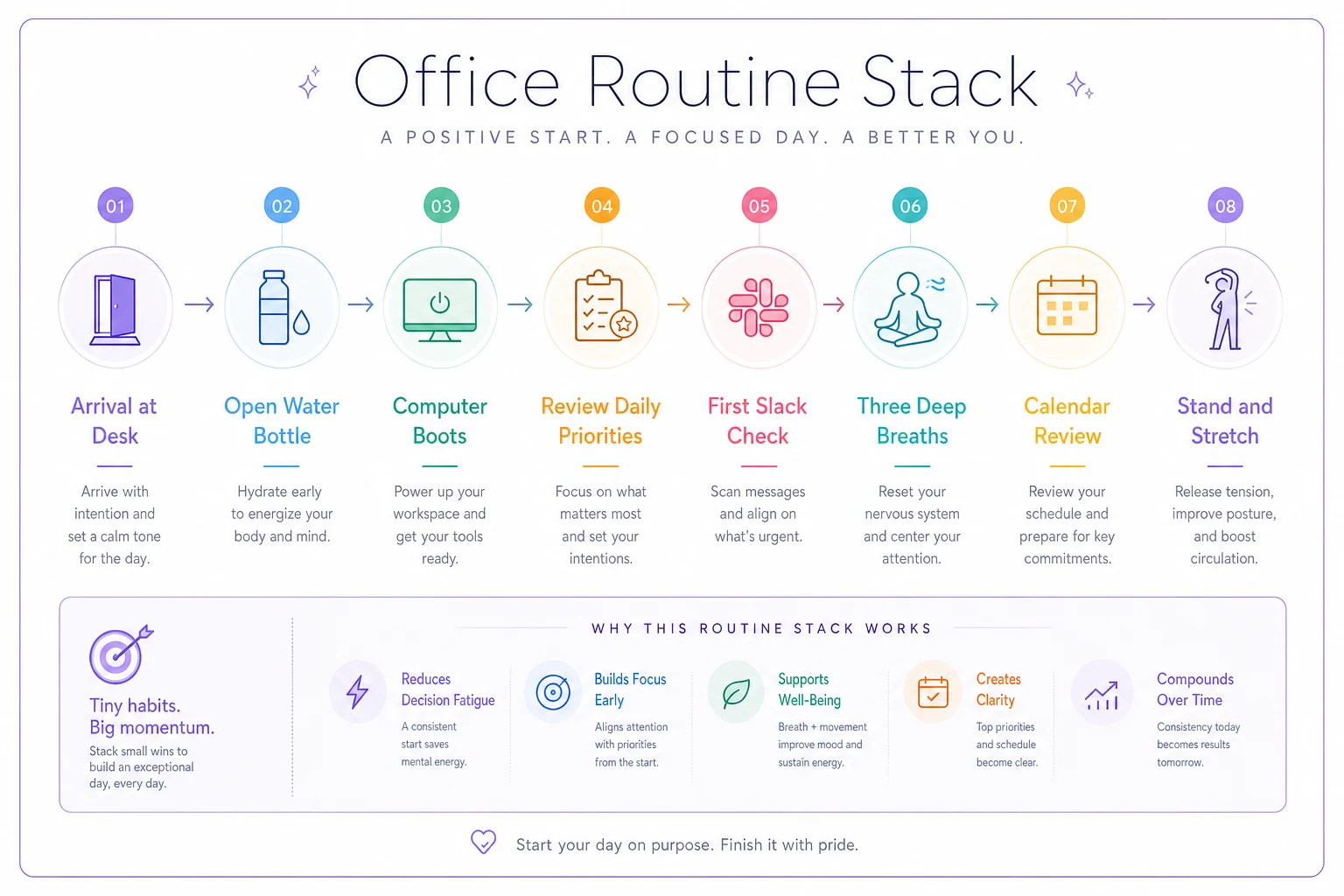
Use that flow to design simple links between habits so one naturally cues the next.
Week Three: Strengthening Through Repetition
Week three is when most people give up. The novelty's gone, but the habits aren't automatic yet.
This is when you need backup triggers for when your primary anchors fail. Your main trigger might be arriving at your desk, but your backup might be opening your laptop anywhere. Your primary workout anchor might be the lunch break, but your backup might be any calendar gap over 30 minutes.
Set up if-then rules for common disruptions:
-
If I have an early meeting, then I do my breathing during my commute
-
If I work late, then I do my simplified evening routine
-
If I can't leave for lunch, then I do desk exercises
-
If my morning is hijacked, then I use my first afternoon break for priorities
These aren't eliminations — they're redirections. You're training your brain that the habit always happens, just sometimes differently.
Measure consistency over quality right now. A sales rep who transitioned from inside to field sales tracked whether she did her habits at all, not how well. Her morning pages became morning sentences. Her yoga became stretching. Her meditation became one mindful breath. After three weeks of consistent micro-habits, she naturally started expanding them without forcing it.
Week Four: Optimization and Adjustment
By week four you have enough real data to make smart adjustments. Which habits are sticking without effort? Which ones still require willpower every single day? Which anchors are reliable versus constantly failing?
Cut the habits that aren't working. This feels like failure, but it's resource allocation. Every failing habit drains willpower you could use to strengthen the ones that are actually working. A product manager kept trying to maintain his lunch workout despite his new team doing working lunches daily. Once he dropped it and moved exercise to mornings, everything else improved almost immediately.
Double down on what's working. If your commute reading habit is thriving, expand it. If your desk stretches are consistent, add complexity. Success momentum matters more than perfect habit selection.
Look for combinations that create unexpected benefits:
-
Walking meetings that fold movement into work
-
Lunch prep that doubles as a mindfulness pause
-
Commute calls that maintain relationships
-
Standing desk time that includes balance work
Optimization is about reallocating energy and compounding wins, not forcing every old habit to survive.
The Reality of Shifting Schedules
New jobs rarely have consistent schedules right away. You might have training one week, travel the next, then an entirely different rhythm once real projects start.
Build "schedule-agnostic habits" — behaviors that work regardless of when they happen:
-
Water consumption tied to bathroom visits, not time
-
Breathing exercises tied to transitions, not scheduled breaks
-
Gratitude practice tied to first and last phone unlock
-
Movement tied to any meeting end, not specific times
Create minimum viable routines for three scenarios:
-
Ideal day
Full routine when everything goes right
-
Compressed day
40% of routine when you're rushed
-
Chaos day
10% routine when everything explodes
| Scenario | What it includes |
|---|---|
| Ideal day | Full routine when everything goes right |
| Compressed day | 40% of routine when you're rushed |
| Chaos day | 10% routine when everything explodes |
The compressed and chaos versions aren't failures — they're strategic adaptations. A CFO transitioning into a crisis management role had three versions of every habit. His meditation ranged from 20 minutes (ideal) to 5 minutes (compressed) to three breaths (chaos day). He never broke the chain because there was always a version that fit.
Creating Workplace-Specific Cues
Your new workplace has unique cues you can hijack for habits. Map the environmental triggers specific to your new context:
Digital cues:
-
Login screens
-
Loading bars
-
Notification sounds
-
Calendar alerts
-
App opens
Physical cues:
-
Elevator arrival
-
Coffee machine brewing
-
Printer warming up
-
Conference room entry
-
Parking arrival
Social cues:
-
Team arrivals
-
Lunch invitations
-
Meeting wrap-ups
-
Coffee runs
-
Happy hour announcements
Each cue can anchor a micro-habit. An accountant attached her posture check to Excel opening — that happened 40+ times a day. A designer linked his eye exercises to Photoshop's save dialog. Workplace-specific anchors mean your habits integrate with work rather than competing against it.
When Automation Actually Helps
Building these transition systems manually works, but tracking everything becomes genuinely overwhelming when you're also learning a new job, new people, and new processes at the same time.
This is where AI-powered operational software can reduce the mental load. Instead of manually tracking which anchors are working, automated habit tracking can run in the background and surface patterns you'd otherwise miss. Rather than relying on memory for your breathing exercise, automated notifications can appear exactly when your calendar shows a gap.
The point isn't to replace discipline with technology — it's to reduce friction during the period when you're most vulnerable to dropping everything. Once the habits stabilize, you can pull back the automation support.
Common Transition Mistakes
Trying to maintain exact previous routines Your old routine was optimized for a different environment. Forcing it into a new context creates friction that doesn't need to exist. Adapt the intent, not the exact behavior.
Waiting for the "right time" to restart habits There's never a perfect moment. Starting imperfectly on day one beats waiting for week six when you're finally "settled."
All-or-nothing thinking Missing your full workout doesn't mean skipping movement entirely. Two pushups maintain the neural pathway better than nothing.
Ignoring social dynamics If your team bonds over lunch, your solo meditation session might isolate you when you're still building relationships. Find ways to maintain habits without opting out of culture entirely.
Over-committing during the enthusiasm phase Week one motivation convinces you to add twelve new habits. By week three, you've abandoned everything. Build gradually.
Making It Stick Long-term
After thirty days, you're stable — not done. The habits that survived your transition need protection and gradual expansion.
Schedule a monthly habit audit. Which ones are automatic? Which require constant willpower? Which could expand, which should you drop? A consultant who changed firms every 12-18 months built this audit into his routine, treating habits like an operational system that needs regular maintenance.
Set progression rules for each habit:
-
Once I hit 14 consecutive days, I add one minute
-
Once I complete it without thinking, I increase complexity
-
Once it feels easy, I attach another micro-habit
Document your transition system. You'll change jobs again. Having a proven playbook turns future transitions from habit disasters into minor calibration exercises.
The harsh truth about habits during job transitions isn't that they're hard to maintain — it's that most people never build them to be portable in the first place. They create location-dependent, schedule-dependent, equipment-dependent routines that shatter the moment anything changes.
Build habits that travel. Create anchors that adapt. Design routines that compress without breaking. Your career will have multiple transitions. Your habits should survive all of them.
The goal during a transition isn't perfection. It's maintaining enough momentum that you can rebuild stronger once you stabilize. Every micro-habit you hold onto during chaos is a foundation for expansion during calm.
Most people see job transitions as habit disruptions. They're actually opportunities to build routines that are genuinely resilient — ones that get stronger under stress rather than falling apart. The habits that survive a job transition are the ones that will carry you through whatever comes next.
The harsh truth about habits during job transitions isn't that they're hard to maintain — it's that most people never build them to be portable in the first place. They create location-dependent, schedule-dependent, equipment-dependent routines that shatter the moment anything changes.
Build habits that travel. Create anchors that adapt. Design routines that compress without breaking. Your career will have multiple transitions. Your habits should survive all of them.
The goal during a transition isn't perfection. It's maintaining enough momentum that you can rebuild stronger once you stabilize. Every micro-habit you hold onto during chaos is a foundation for expansion during calm.
Most people see job transitions as habit disruptions. They're actually opportunities to build routines that are genuinely resilient — ones that get stronger under stress rather than falling apart. The habits that survive a job transition are the ones that will carry you through whatever comes next.
Ready to unlock your full potential?
Join thousands of users transforming their lives using Growyly to stay motivated, organized, and growth-focused every day.