

Most people treat all their habits the same way—pushing harder when they stall, adding complexity when things get boring, tracking more when progress slows. But habits have natural lifecycles, and fighting those stages is usually what causes burnout and eventual failure. Not lack of discipline.
This isn't about motivation or willpower. It's about recognizing that a morning meditation practice you started three weeks ago needs completely different support than a three-year-old exercise routine. Same principle applies to businesses moving through operational phases—the support structure that works at launch breaks down once you scale, and vice versa.
Think about your oldest successful habit. Maybe it's making coffee every morning or checking your calendar before bed. You don't track it, you don't reward yourself for it, you don't really think about it. It just happens. Now compare that to something you started last month. You're probably still fighting resistance, checking reminders, maybe counting streaks. These habits are in fundamentally different places, and treating them the same way quietly raises the chance of breakdown.
I've watched this play out repeatedly with people building personal systems. The person who burns out on six new habits in January isn't undisciplined—they're applying year-three management to week-two behaviors.
The Five Fidelity Milestones That Actually Matter
Stage 1: Build Phase (Weeks 1–8) This is where habits feel hardest. You're establishing new neural pathways while fighting existing patterns. Success here depends almost entirely on reducing friction. The habit needs constant environmental support—visible reminders, immediate rewards, simplified execution. You're not building the perfect version yet. You're building any version that sticks.
Complexity kills momentum in this phase. If your new journaling habit requires finding the right notebook, the right pen, and twenty minutes of quiet time, you've already made it too hard. A realistic build-phase version might be typing three sentences into your phone's notes app while coffee brews. Quality comes later. Right now, you just need the behavior to happen.
Stage 2: Stabilize Phase (Weeks 8–24) Once basic execution becomes reliable, habits enter stabilization. You're reinforcing pathways while gradually reducing external supports. Reminders become less critical. The immediate reward feels less necessary. You start missing occasionally without complete derailment.
Stabilization is honestly where most habits die—not from lack of motivation, but from premature complexity. Someone starts walking daily, feels good after two weeks, immediately upgrades to a structured training program, then quits within a month because the jump was too dramatic. The stabilize phase needs gradual, almost boring progression. Small increments every few weeks, not dramatic leaps.
Stage 3: Automate Phase (Months 6–18) Automation doesn't mean effortless. It means the effort becomes systematic rather than conscious. You stop deciding whether to do it and start optimizing how. This is where you can finally add complexity because the base behavior has real momentum behind it.
This phase is also where tracking tools and productivity systems actually help instead of creating overhead. Your established running habit can handle route planning apps, heart rate monitoring, structured training programs. Your solid reading habit can expand into note-taking systems, book clubs, genre exploration. The foundation is strong enough to support infrastructure.
Stage 4: Maintain Phase (Years 1–5) Maintenance looks like success from the outside but requires real calibration to prevent quiet decay. Long-term habits need periodic refreshing—new variations, seasonal adjustments, social elements. Without it, even strong habits gradually erode through boredom or shifting circumstances.
This phase runs on monitoring rather than tracking. You don't need daily streak counters, but you do need monthly check-ins. You don't need detailed metrics, but you do need to notice when execution quality drops. Think of it like maintaining equipment—regular inspection prevents catastrophic failure.
Stage 5: Retire or Transform Phase (Years 3+) Not every habit should last forever. Some serve their purpose and become obsolete. Others need complete transformation to match new life circumstances. Retirement isn't failure—it's strategic resource allocation. An elaborate morning routine that worked when you lived alone might need retiring when you have kids. An aggressive savings habit might transform into investment management once you hit your emergency fund target.
This phase recognizes that strategic retirement or transformation preserves capacity for new growth rather than signaling defeat.
Concrete Transition Signals Between Lifecycle Stages
Knowing when to shift your management approach prevents both premature advancement and stagnation.
Achieve more by focusing on what matters.
Growyly helps you build lasting habits and track your personal growth effortlessly.
- Goal setting with progress tracking
- Daily habit reminders
- Motivational insights and analytics
No credit card required
Build → Stabilize Signals:
-
You've completed the habit on roughly 80% of possible days for three consecutive weeks
-
Execution happens without checking your reminder system first
-
You feel mild discomfort when you skip rather than relief
-
The basic version takes noticeably less mental energy than it initially did
-
Environmental triggers naturally prompt action
If you're still negotiating with yourself about whether to do the habit, you're not ready for stabilization. The behavior needs to feel almost inevitable, even if it's still imperfect.
Stabilize → Automate Signals:
-
Six weeks without a full skip (modified versions count)
-
You start naturally planning around the habit
-
Missing once doesn't cascade into missing repeatedly
-
You begin wanting to optimize or expand on your own
-
The habit survives minor routine disruptions
This transition often happens unconsciously. You realize you've been automatically factoring gym time into your schedule or meal prepping without Sunday reminders. That's your signal to start adding systematic improvements.
Automate → Maintain Signals:
-
The habit survives major life disruptions with modifications
-
You find yourself helping others build similar habits
-
Execution quality matters more to you than simple completion
-
You've developed personal variations and preferences
-
The habit integrates naturally with other established behaviors
Maintain → Retire/Transform Signals:
-
The habit creates real scheduling conflicts with higher priorities
-
Original benefits plateau or disappear
-
Life circumstances make consistent execution genuinely difficult
-
Other habits provide better returns for the same investment
-
You're maintaining purely from obligation, not value
Use these signals to avoid both premature advancement and stagnant maintenance—shift operational support only when the evidence shows the habit is ready.
The Four-Part Transition Checklist
Part 1: Current State Audit Before transitioning, document what's actually working in your current phase. What triggers execution? What rewards maintain motivation? What environmental factors enable success? This baseline becomes your fallback if the transition struggles.
Write down three specific elements that make the habit work right now—not theoretical supports, but actual things you do or see daily. Running shoes by the door. Workout playlist ready to go. Calls scheduled during walk time. These concrete elements form your safety net during transition.
Part 2: Next Phase Requirements Each lifecycle stage demands different operational support. Building needs maximum external structure. Automation needs systematic optimization. Maintenance needs periodic variation. Before transitioning, make sure the next phase's infrastructure is actually ready.
List three new elements the next phase requires. Moving to automation? You might need a tracking system, a progression plan, and quality metrics. Moving to maintenance? Variation options, seasonal adjustments, and periodic social accountability. Don't transition until these things exist.
Part 3: Gradual Transition Protocol
-
Week 1
Maintain current phase supports while adding one next-phase element
-
Week 2
Reduce most dependent current-phase support, add second next-phase element
-
Week 3
Operate primarily in new phase while keeping an emergency fallback option
If execution falters during transition weeks, return to full previous-phase support immediately. Better to solidify longer than advance prematurely.
Part 4: Regression Prevention Every habit occasionally needs temporary regression to an earlier lifecycle phase. Illness, travel, major stress, life changes—they can knock even established habits backward. Create specific regression triggers that automatically downshift your habit to an earlier phase. Miss three consecutive days? Return to build phase supports. Quality drops below acceptable thresholds? Return to stabilize phase. These automatic triggers prevent complete collapse during difficult periods.
Here's a quick visual of the gradual transition protocol.
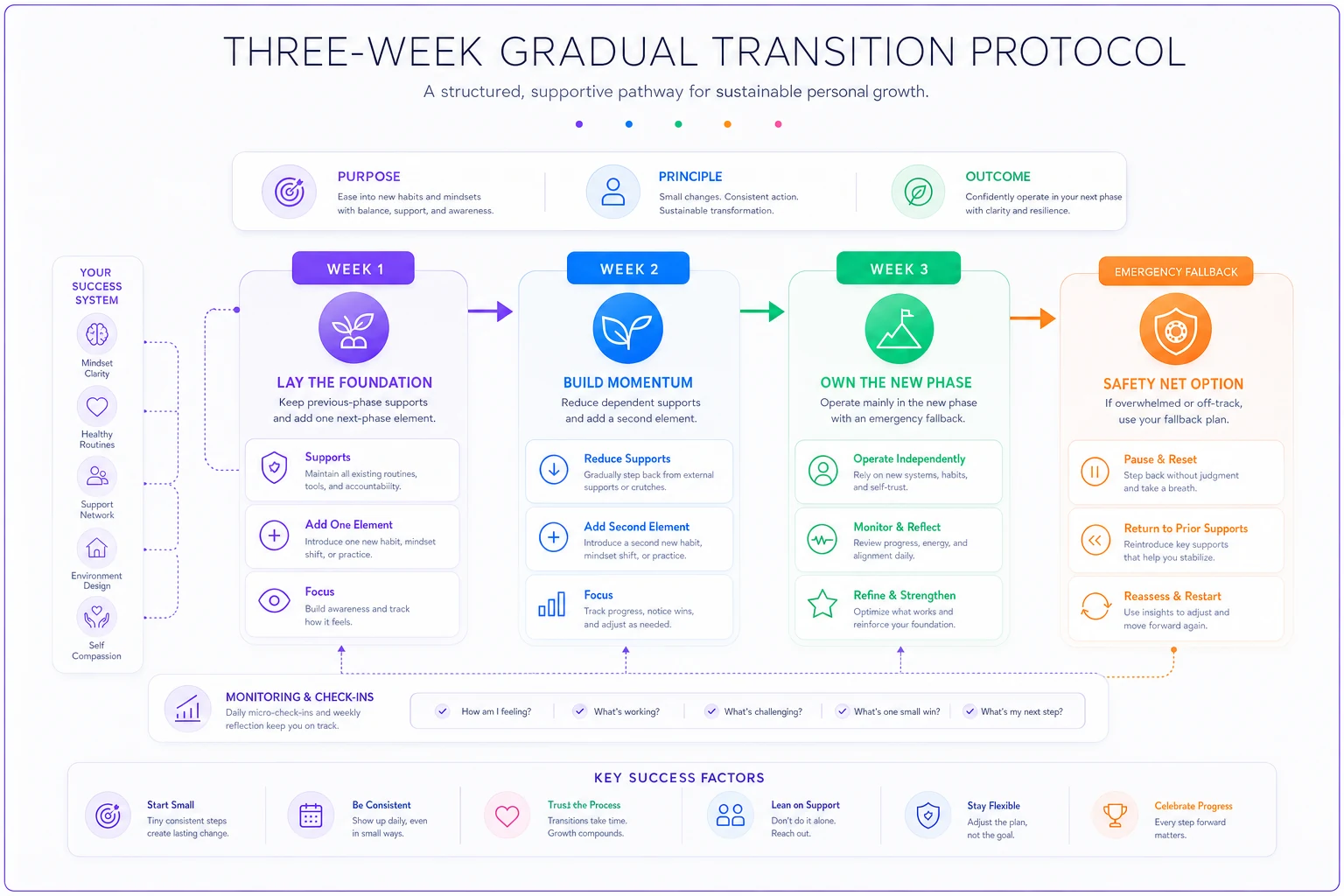
Use this checklist before shifting a habit's management style to reduce premature transitions and minimize regression risk.
Templates for Each Lifecycle Phase
Build Phase Template
-
Single, specific trigger moment identified
-
Execution simplified to under 2 minutes
-
Immediate reward (even tiny) after completion
-
Visual reminder in environment
-
Fallback micro-version for difficult days
---
Weekly Review Questions
-
Did I complete the habit more than I skipped?
-
What specific friction points appeared?
-
Which days naturally worked better?
-
What would make tomorrow's execution easier?
---
Success Metrics
-
Completion rate (target
70%+)
-
Consistency trend (improving weekly)
-
Friction reduction (getting easier)
---
Stabilize Phase Template
-
Consistent time/trigger maintained
-
Gradual complexity increases (small, not dramatic)
-
Reward system shifting from external to internal
-
Backup plans for common disruptions
---
Weekly Review Questions
-
Am I ready for slightly more challenge?
-
Which external supports can I reduce?
-
What variations might prevent boredom?
-
How does this integrate with other routines?
---
Success Metrics
-
Streak length (extending)
-
Quality consistency (stabilizing)
-
Mental resistance (decreasing)
---
Automate Phase Template
-
Clear progression pathway defined
-
Measurement system implemented
-
Integration with related habits mapped
-
Optimization opportunities identified
---
Monthly Review Questions
-
What inefficiencies can I eliminate?
-
How can this habit support others?
-
Where do I want this habit in six months?
-
What tools would enhance execution?
---
Success Metrics
-
Execution quality (improving)
-
Time efficiency (optimizing)
-
Knock-on benefits (expanding)
---
Maintain Phase Template
-
Variation options prepared
-
Seasonal adjustments planned
-
Social elements considered
-
Refresh triggers identified
---
Quarterly Review Questions
-
Does this still serve my current goals?
-
What would make this interesting again?
-
How has my life context changed?
-
Should this habit transform or retire?
---
Success Metrics
-
Sustained benefit delivery
-
Execution satisfaction
-
Resource efficiency
---
Common Lifecycle Management Mistakes
Mistake 1: Treating all habits identically Running every habit through the same management system creates real inefficiency. Your four-year meditation practice doesn't need a streak counter. Your two-week cold shower experiment doesn't need quarterly reviews. Match management intensity to lifecycle stage, not to whatever universal system you read about last week.
Mistake 2: Premature optimization Trying to perfect habits still in build phase kills them before they stabilize. Someone starts walking daily, feels good after two weeks, immediately upgrades to a complex training program with zones and periodization, then quits within a month because the jump was too much. Optimization belongs in the automate phase. Full stop.
Mistake 3: Zombie maintenance Keeping habits alive past their useful lifecycle wastes resources that could support new growth. That French practice maintained for three years despite never actually using French. The elaborate skincare routine that no longer addresses your skin concerns. Retirement isn't failure when the habit no longer serves its purpose.
Mistake 4: Ignoring regression signals Life happens. Stress, illness, travel, and major changes will knock habits backward. Fighting to maintain a complex automated habit during personal crisis just creates additional failure points. Temporarily downshifting to build phase supports preserves the habit core while reducing pressure during hard stretches.
When to Apply External Structure vs. Internal Motivation
The balance between external structure and internal drive shifts dramatically across lifecycle phases. Early stages need maximum external support—environmental design, reward systems, social accountability. Later stages run primarily on internal momentum with minimal external maintenance.
Build phase habits need everything external you can provide. Reminder notifications, visual cues, immediate rewards, social commitment—pile on the structure. You're fighting existing patterns, and willpower alone won't sustain it. This is where habit-tracking apps, accountability partners, and environmental design provide maximum value.
| Lifecycle Stage | External Support Level | Internal Drive Level | Primary Tools |
|---|---|---|---|
| Build | Very High | Low | Reminders, rewards, environment |
| Stabilize | Medium | Growing | Fewer cues, gradual complexity |
| Automate | Low | High | Tracking, optimization, apps |
| Maintain | Minimal | Very High | Periodic variation, social refresh |
| Retire/Transform | None | Redirected | Strategic assessment |
The table above isn't a rigid formula, but it gives you a reasonable starting point for calibrating your support structure at each stage.
Building Your Personal Lifecycle Portfolio
Most people need somewhere between three and seven active habits across different lifecycle stages. Too many in build phase creates overwhelming complexity. Too many in maintain phase leads to stagnation. A balanced portfolio enables continuous growth without burnout.
Start by auditing your current habits against the lifecycle framework. Where does each one actually sit? That exercise routine you claim is automated—does it truly survive travel and stress, or does it still need stabilization support? That new writing practice—have you actually built consistency, or are you optimizing something that doesn't really exist yet?
-
1–2 habits in build phase (maximum cognitive load)
-
2–3 habits in stabilize/automate phases (active development)
-
3–4 habits in maintain phase (background operation)
-
Periodic retirement to free resources for new growth
This distribution maintains forward momentum while preventing overextension. You're always building something new, developing something established, and maintaining core behaviors—but never everything simultaneously.
Sequence new builds to leverage existing infrastructure—establish one habit first, then layer complementary habits during its stabilize phase to reduce cognitive load.
The portfolio approach also enables strategic sequencing. Build complementary habits in waves rather than in isolation. Establish exercise first, then layer nutrition habits during exercise's stabilize phase. Build morning routine components sequentially rather than all at once. Each established habit provides infrastructure for the next.
Software Tools That Actually Support Lifecycle Management
Most habit-tracking apps ignore lifecycle reality entirely. They treat day-one habits identically to year-old routines—same reminders, same metrics, same interface. That's not lifecycle management, that's just a streak counter.
Operational software designed for behavior change can adapt its support to match your habit's current phase, automatically adjusting reminders, metrics, and complexity as behaviors mature. AI-powered platforms can recognize lifecycle transitions through execution patterns. When your meditation practice moves from sporadic to consistent, the system reduces reminder frequency while adding quality metrics. When your exercise routine shows signs of staleness, it suggests variations and social elements.
The real value at the portfolio level is coordination. Instead of managing a dozen separate habits independently, lifecycle-aware systems help you balance your overall development load. They'll flag when you're attempting too many build-phase habits at once or when multiple maintain-phase habits need refreshing—the kind of oversight that prevents the overwhelming complexity that kills most habit development attempts.
Modern platforms also enable smoother phase transitions. Rather than manually adjusting tracking metrics and reminder schedules yourself, the system gradually shifts support levels based on your actual execution patterns. Less guesswork, more maintained momentum through transitions.
Your Next 30 Days: Implementing Lifecycle Management
Start with your three most important habits and honestly assess their current lifecycle stage. Use the transition signals, not wishful thinking, to determine where each truly sits.
For habits in build phase, dramatically simplify execution while maximizing external support. Strip them down to their absolute minimum viable version. Add every external support available—reminders, rewards, environmental changes, social accountability. Your only goal is consistent execution, not perfect execution.
For habits in later phases, identify one specific optimization or variation to implement this month. Maybe your established reading habit needs genre variety. Perhaps your automated exercise routine needs social elements. Your maintained meditation practice might benefit from a new technique. Small refreshes prevent stagnation without disrupting the foundation.
Give yourself permission to retire or transform habits that no longer serve you. That elaborate productivity system from your startup days might not fit your current corporate role. The aggressive fitness routine from before you had kids might need real transformation for where life is now. Strategic retirement frees resources for new growth.
The habit maturity lifecycle provides something most self-improvement frameworks lack: a structure that adapts to reality rather than forcing reality to adapt to it. Your habits aren't failures when they need different support levels—they're following natural progressions that, once understood, become far easier to manage.
Stop fighting lifecycle patterns and start working with them. The path to sustainable behavior change isn't through more willpower or better tracking—it's through understanding which phase each habit occupies and providing exactly the support that phase requires.
Ready to unlock your full potential?
Join thousands of users transforming their lives using Growyly to stay motivated, organized, and growth-focused every day.