

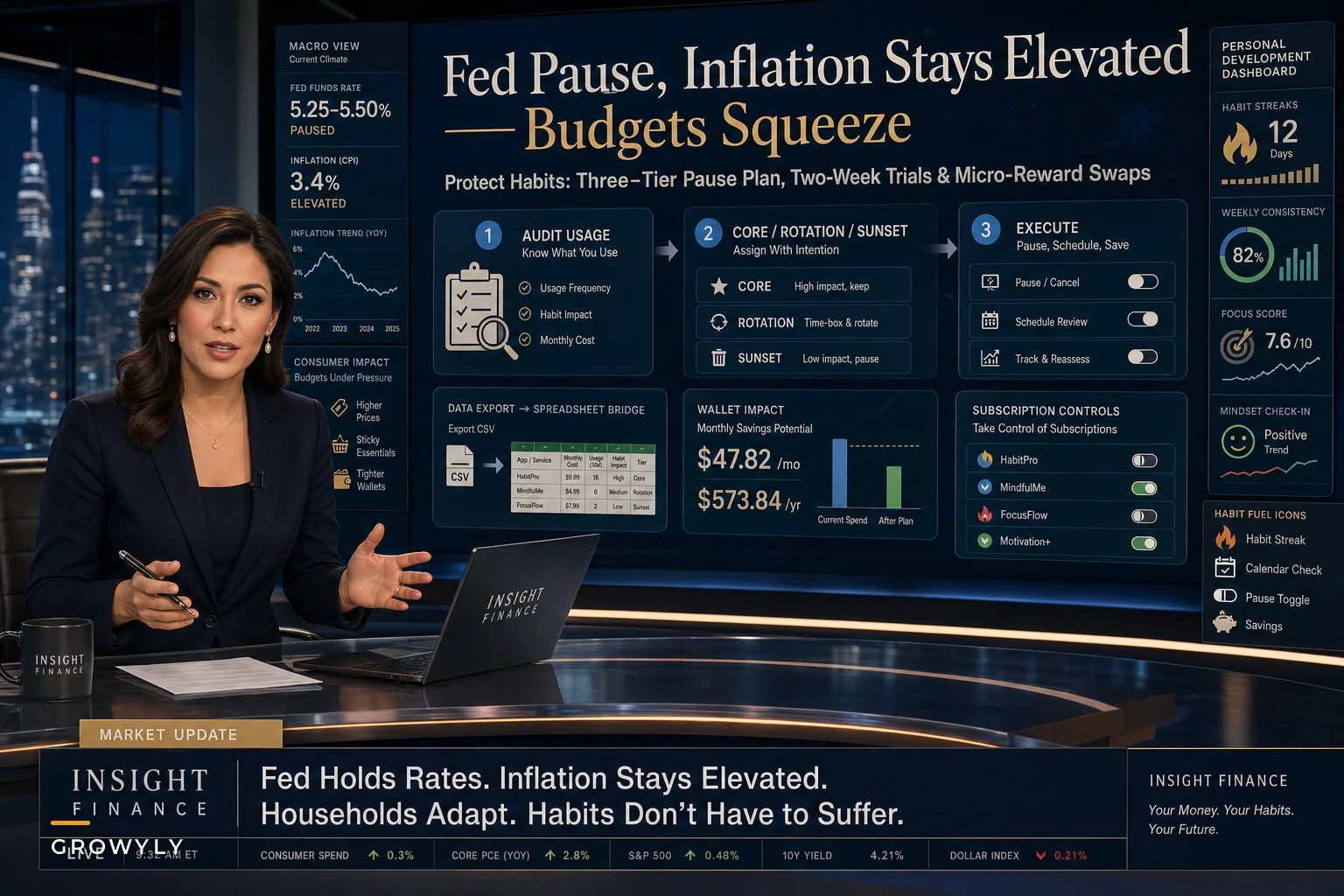

The Federal Reserve held rates steady at 3.50%-3.75% yesterday, but three regional Fed officials wanted to hike. That split vote—rare enough to make headlines—signals something deeper than monetary policy debates. Elevated inflation is sticking around, household budgets are still squeezed, and that $47 monthly stack of habit-tracking subscriptions suddenly looks a lot harder to justify.
You've built momentum with Headspace, Strava Premium, MyFitnessPal, maybe a journaling app and a language learning platform. Each one made sense when you signed up. But now you're staring at your credit card statement wondering if five different subscriptions are worth it when groceries cost 30% more than they did two years ago.
What usually happens next: people either panic-cancel everything and lose months of streaks and data, or do nothing and let the charges quietly pile up. Both fail. The first destroys real progress. The second adds financial stress that works against the habits you're trying to keep.
The subscription creep nobody really talks about
Personal growth apps have quietly become the new gym memberships—except worse in some ways. At least with a gym, you know exactly what you're paying. With habit apps, the damage spreads across a half-dozen $4.99 to $14.99 charges that each seem harmless but add up to $100+ monthly without much to show for it.
The business model is designed for this. Small recurring charges fly under the radar. Users forget they're subscribed. The perceived switching cost—losing data, breaking streaks, learning a new interface—keeps people locked in even when they've basically stopped using the app.
But something changes when budgets tighten. Those small charges start feeling heavier. CNBC's coverage noted that consumer confidence dropped immediately after the Fed's split decision, which suggests households are already bracing for more of the same.
What most people miss: you can maintain roughly 80% of your habit progress with a fraction of your current subscription spend. It's not about picking which apps to keep—it's about restructuring how you use what you already have.
Why the all-or-nothing approach breaks
Every January, the same pattern plays out. Someone discovers habit tracking, downloads five apps, builds an elaborate system, maintains it for six or eight weeks, then abandons everything when life gets complicated or money gets tight.
Achieve more by focusing on what matters.
Growyly helps you build lasting habits and track your personal growth effortlessly.
- Goal setting with progress tracking
- Daily habit reminders
- Motivational insights and analytics
No credit card required
The failure point isn't motivation. It's operational overhead. Five apps means five notification schedules, five data formats, five renewal dates. When financial pressure hits, that complexity becomes the excuse to quit entirely.
Think about your current setup. How many apps require daily input? How many auto-renew at different points in the month? Each touchpoint creates friction. Each renewal creates a decision. Each notification competes for attention you're already rationing.
Picking the "best" single app and ditching everything else is just another version of the same trap. The better move is building a tiered system that flexes with your financial reality while keeping your core habits intact.
Building your habit tracking subscription pause strategy
Start with an audit—not of features, but of actual usage. Check your last 30 days of activity across all your habit apps. Which ones did you open daily? Weekly? Which ones are basically expensive data graveyards?
Here's a framework worth trying:
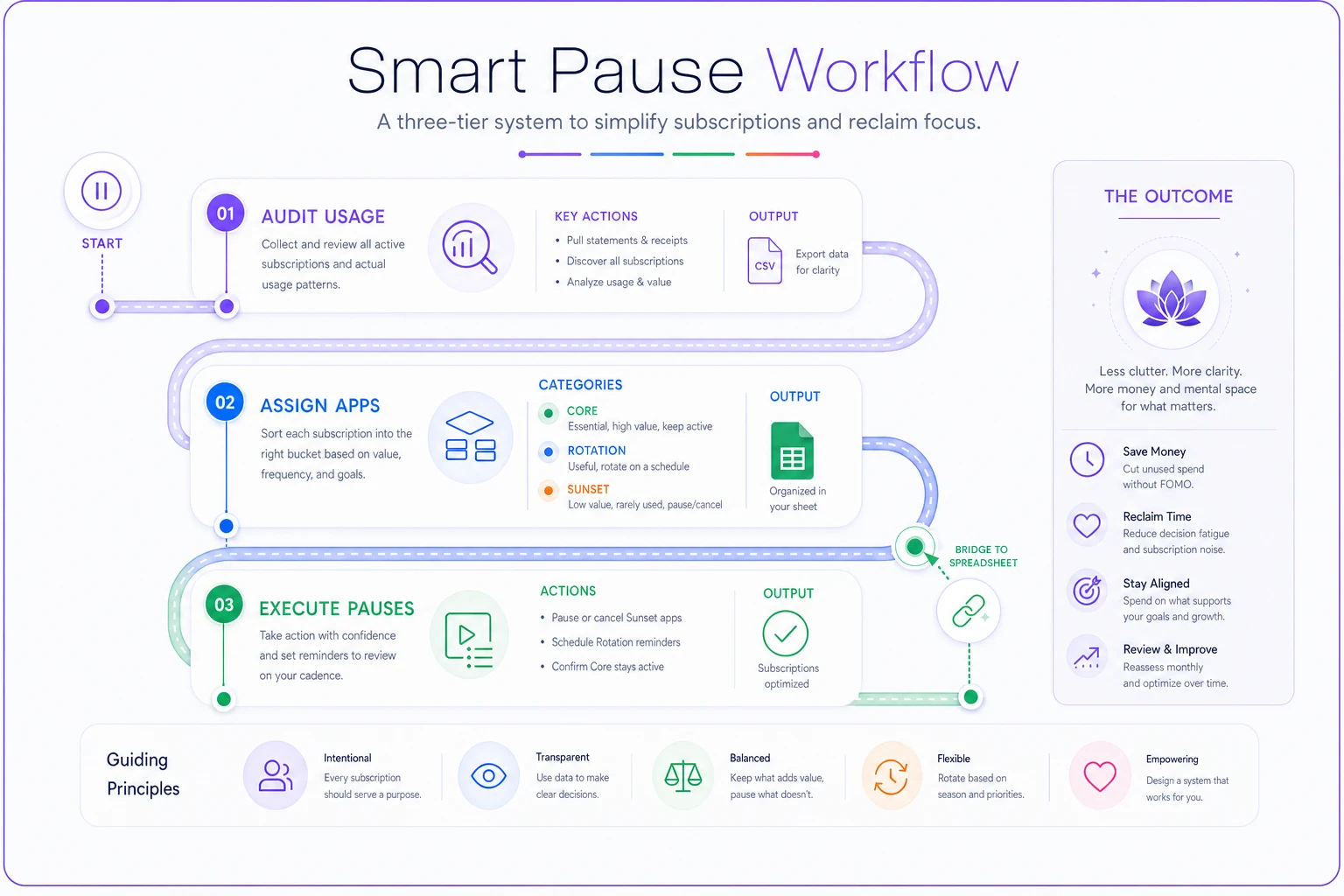
Tier 1: Core Engine (Keep Active) One primary app that handles 60-70% of your tracking. This stays on paid tier because it's your operational backbone—usually whichever app has the most historical data or the habits most tied to things you actually care about.
Tier 2: Rotation Pool (Downgrade or Pause) Secondary apps that add specific value but aren't daily drivers. Downgrade these to free tiers or use platform pause features. Many apps now offer 1-3 month pauses that preserve your data without charging you.
Tier 3: Sunset Queue (Cancel with Export) Apps you haven't touched in 30+ days. Export your data, cancel the subscription, delete the app. The psychological weight of maintaining zombie subscriptions is its own kind of drain.
| App Category | Keep Paid | Downgrade | Cancel |
|---|---|---|---|
| Primary Tracker | ✓ | ||
| Meditation | Free tier + YouTube | ||
| Fitness | Strava free | ✓ old apps | |
| Journaling | Apple Notes | ||
| Language | Rotate quarterly | ||
| Sleep | Phone's built-in | ✓ redundant |
The quarterly rotation strategy works especially well for learning apps. Instead of maintaining three language apps year-round, pick one per quarter. Same effort, 65-70% less annual spend.
If an app offers a pause feature, use it before canceling to preserve data.
Visualize the tiered pause process as a simple three-step workflow: audit, assign tiers, then execute pause/cancel actions.
The quarterly rotation strategy works especially well for learning apps. Instead of maintaining three language apps year-round, pick one per quarter. Same effort, 65-70% less annual spend.
The hidden cost of switching everything
Before you cancel everything in one sitting, understand what you're actually giving up. Not just features—operational momentum.
Your meditation app knows your preferred session length. Your fitness tracker has months of baseline data. Your food logger has your common meals saved. Rebuilding that infrastructure in new apps takes a couple of weeks minimum, and during that setup period your actual habit practice suffers.
That's why the pause-and-tier approach beats wholesale cancellation. You preserve the scaffolding while reducing cost. When your budget recovers, you can reactivate without losing ground.
Some platforms handle this better than others. Headspace lets you pause for up to 90 days. Strava keeps all your data on the free tier. MyFitnessPal maintains your food database even after downgrading. Five minutes of research on these options can save weeks of rebuilding later.
Creating low-cost bridges between platforms
Here's where the operational thinking actually pays off: you can create simple bridges between free tools that replicate most premium features.
Instead of paying for advanced analytics across multiple apps, funnel your basic tracking into one free spreadsheet. Google Sheets or Apple Numbers can handle habit tracking, mood logs, workout data, whatever you need. Less polished, but fully functional.
A basic weekly template might track:
-
Morning routine completion (Y/N)
-
Workout type and duration
-
Mood score (1-10)
-
Top three priorities completed
-
Evening wind-down time
This isn't meant to replace specialized apps forever. It's a bridge that keeps measurement consistent during financial pressure. The habits stay tracked, the streaks continue, and when budgets loosen you can either import the data back or stick with the simplified system if it's working.
The micro-subscription trap
One pattern wrecks more habit progress than almost anything else: the micro-subscription spiral.
It starts innocently. A timer app for pomodoros—$2.99/month. A water reminder—$1.99/month. A breathing exercise app—$3.99/month. A streak counter—$0.99/month. Suddenly you're paying $40 monthly for features your phone handles natively.
During uncertain times, these micro-subscriptions are especially dangerous. Too small to trigger immediate concern, but collectively draining resources better spent on one or two solid platforms.
My rule: if a subscription costs less than $5/month, question whether you actually need a dedicated app for that function. Most micro-subscription features can be replaced with:
-
Phone reminders and timers
-
Basic note apps
-
Free alternatives
-
Built-in health apps
-
Simple calendar blocks
The goal isn't to eliminate all tools. It's to eliminate redundancy that compounds into real costs.
When to actually cancel everything
Sometimes a full reset makes sense. If you're carrying more than five habit-related subscriptions, paying over $75 monthly, and your actual habit completion rate is below 40%, you might just need to burn it down and rebuild.
But don't just cancel and walk away. Do a controlled shutdown:
-
Export all your data (every legitimate app has to provide this)
-
Screenshot your streaks and achievements
-
Document what worked and what didn't
-
Pick one free app to maintain continuity
-
Set a calendar reminder to reassess in 60 days
The 60-day pause gives you distance to figure out what you actually miss versus what was subscription inertia. Most people realize they only needed one or two tools, not the five or six they were maintaining.
Protecting momentum during the pause
The biggest risk during a habit tracking subscription pause isn't losing features—it's losing rhythm. You've trained yourself to check these apps, log activities, maintain streaks. Removing those touchpoints suddenly can throw your whole routine off.
This connects directly to maintaining habit fidelity during any kind of disruption. Just like the 3-tier fidelity system for travel, you need graduated levels of practice during financial pressure. Full fidelity means all apps active. Medium fidelity means core app plus manual tracking. Low fidelity means paper tracking or mental acknowledgment—but still something daily.
Don't let financial pressure become an excuse to abandon the habits themselves. The tracking tools are just measurement infrastructure. The habits are what actually matter.
Building your 90-day transition plan
Economic uncertainty isn't resolving next month. The Fed's mixed signals suggest continued volatility through at least year-end, so you need a sustainable approach, not a panic move.
Days 1-7: Audit Phase
-
List all habit-related subscriptions
-
Check actual usage data
-
Calculate total monthly spend
-
Note renewal dates
Days 8-14: Tier Assignment
-
Assign each app to keep/pause/cancel
-
Research pause options
-
Export data from cancel tier
-
Test free alternatives
Days 15-30: Execution
-
Cancel tier 3 apps
-
Downgrade tier 2 apps
-
Optimize tier 1 app usage
-
Set up bridge tracking system
Days 31-60: Stabilization
-
Maintain habits with new setup
-
Track what's working and what's missing
-
Resist re-subscription temptation
-
Document pain points
Days 61-90: Optimization
-
Reassess based on actual usage
-
Consider rotating one tier 2 app back
-
Decide on permanent setup
-
Calculate actual savings
Most people end up saving $60-80 monthly while keeping around 85% of their habit tracking functionality. Over a year, that's $720-960 back in your pocket—real money when times are uncertain.
The automation angle worth considering
Premium habit app tiers are mostly selling you reminders, dashboards, and data aggregation. A lot of that can be replicated with basic automation tools most people already have access to.
Simple operational software—the kind small businesses use for scheduling and customer follow-ups—can handle daily check-in reminders, log responses to a central spreadsheet, and generate basic weekly summaries without a dedicated subscription for each function. You don't need anything complex. The same logic that reminds a service business to follow up with a client can remind you to log your evening routine.
Setup takes maybe an hour. Cost is usually less than one premium app subscription. And unlike consumer apps that pivot their pricing models or get acquired, business automation platforms tend to be more stable. Worth looking into if you're currently paying for analytics features across multiple apps.
Making peace with the pause
Not every economic decision has to be permanent, and not every optimization has to be perfect.
The habits you've built won't disappear because you downgraded to free tier. The progress won't evaporate because you switched from five apps to two. What matters is maintaining practice, even if measurement becomes less sophisticated for a while. A paper journal beats an abandoned premium app. A phone reminder beats ignored notifications from an app you resent paying for.
Financial pressure forces clarity. You find out which tools actually serve you and which ones you're serving through monthly payments. Which features drive results and which ones just feel like they should matter.
When conditions improve—and they will—you can add back the tools that proved their value through absence. But you might find that the stripped-down system you built under pressure actually works better than the complex stack you were maintaining before.
The Fed's pause signals more uncertainty ahead. Your habit practice doesn't need to be another casualty of tightening budgets. Strip down to essentials, maintain core practices, use free bridges where needed, and keep moving forward. The habits that survive economic pressure tend to be the ones worth keeping anyway.
Ready to unlock your full potential?
Join thousands of users transforming their lives using Growyly to stay motivated, organized, and growth-focused every day.