

Most habit tracking goes binary. You're either doing your morning meditation or you're not. Running three miles or skipping entirely. Tracking calories or abandoning the app for two weeks. That all-or-nothing thinking causes more damage than the travel itself.
Why Most Habit Systems Collapse the Moment You Leave Home
The real breakdown happens in the transition zones. That Thursday before vacation when you're mentally already somewhere else. The Monday after you return when your routine feels weirdly foreign. The third day of a business trip when the hotel gym doesn't have what you need and you just... stop.
What actually works is treating habit maintenance like business continuity planning. Three operational modes, clear switching criteria, and a documented re-entry process that doesn't depend on motivation to function.
Why Traditional Habit Advice Fails During Travel
The standard advice is "stay consistent" or "find creative ways to maintain your routine." It completely misses the operational reality.
Achieve more by focusing on what matters.
Growyly helps you build lasting habits and track your personal growth effortlessly.
- Goal setting with progress tracking
- Daily habit reminders
- Motivational insights and analytics
No credit card required
Your habits exist inside a specific environmental context. The 6 AM workout happens because gym clothes are next to your bed, pre-workout is on the kitchen counter, and your body expects movement at that exact time. Pull those anchors out and the whole system falls apart.
Travel doesn't just change your location—it dismantles every support structure you've built. Different time zones disrupt biological rhythms. Hotel rooms don't have your carefully arranged setup. Social obligations eat into protected time blocks. Even something as basic as water quality can throw off a hydration routine.
The mistake is trying to transplant your entire habit ecosystem into a travel context. It's like running enterprise software on a smartphone. Technically possible, practically useless.
The Three-Tier Fidelity System
Instead of binary thinking, habits need operational modes. Think of it like running a restaurant through different seasons. Peak summer operations look nothing like a slow Tuesday in February, but both follow documented protocols.
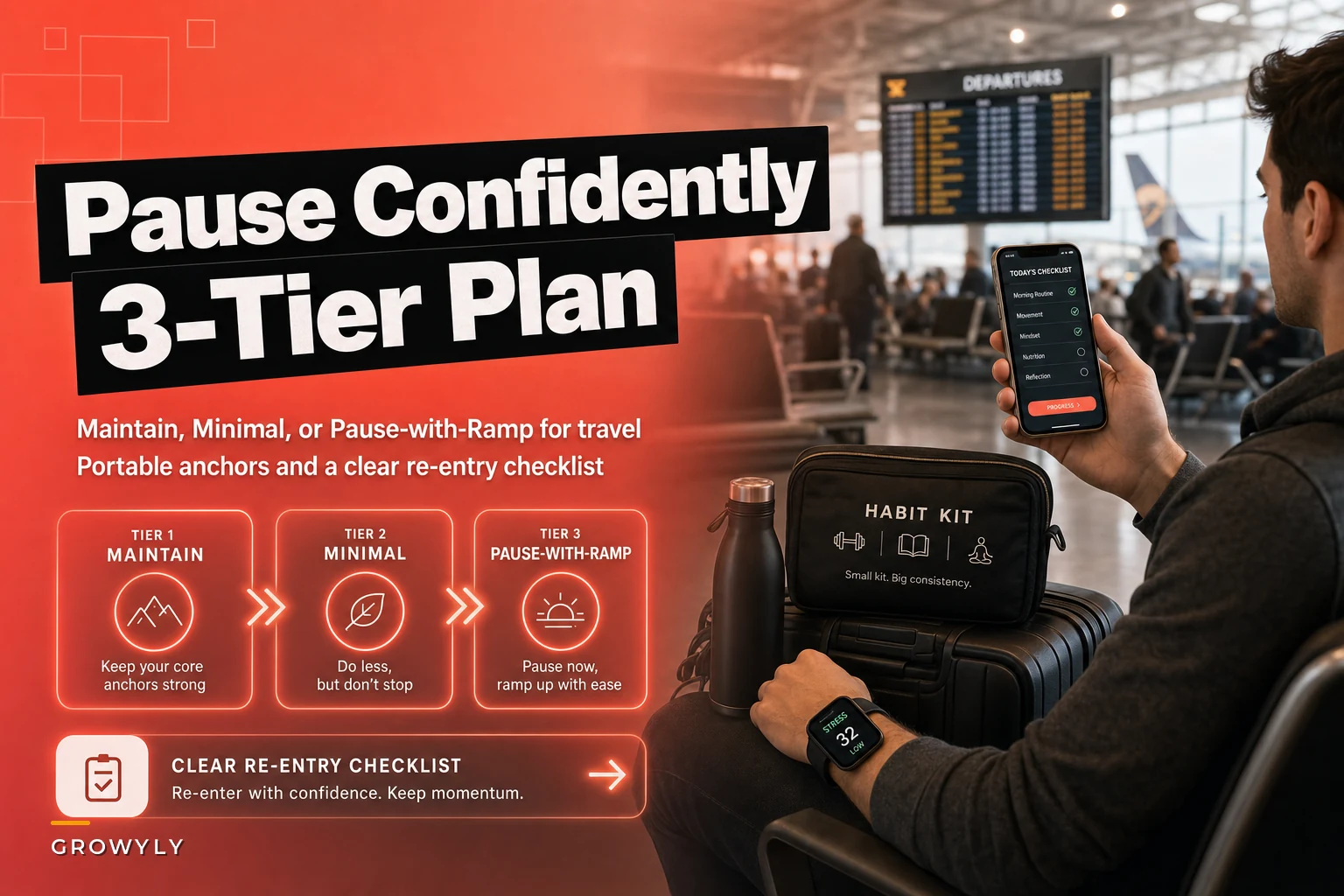
Maintain Mode keeps core operations running at roughly 70–80% normal capacity. You're still hitting primary metrics but with adjusted parameters. A runner maintaining their habit during travel might switch from outdoor 5K runs to hotel treadmill intervals. The goal stays constant—cardiovascular conditioning—but execution adapts to available resources.
Minimal Mode drops to essential operations only, somewhere around 20–30% of normal activity. This preserves the habit structure without demanding full execution. Your meditation becomes two minutes of breathing. Your journaling becomes three bullet points in your phone's notes app. The neural pathway stays active without requiring resources you don't have.
Pause-with-Ramp Mode acknowledges total cessation but includes pre-documented restart protocols. Sometimes a family emergency or an intensive work stretch makes even minimal execution genuinely impossible. Instead of letting the habit die through neglect, you actively pause it with a specific restart date and ramp-up schedule already written down.
Each mode needs explicit activation criteria. Maintain Mode might trigger for any trip under five days. Minimal Mode kicks in for trips over five days or high-stress stretches. Pause-with-Ramp is reserved for real emergencies or planned breaks longer than two weeks.
| Travel Type | Recommended Tier | Example Adjustment |
|---|---|---|
| Short trip, 1–4 days | Maintain Mode | Reduced duration, same habit type |
| Week-long vacation | Minimal Mode | Bare minimum daily action |
| High-stress work trip | Minimal or Pause-with-Ramp | Based on actual available time |
| Family emergency / 2+ weeks | Pause-with-Ramp | Pre-written restart schedule |
Here's a quick visual that lays out how to choose and switch modes based on travel conditions.
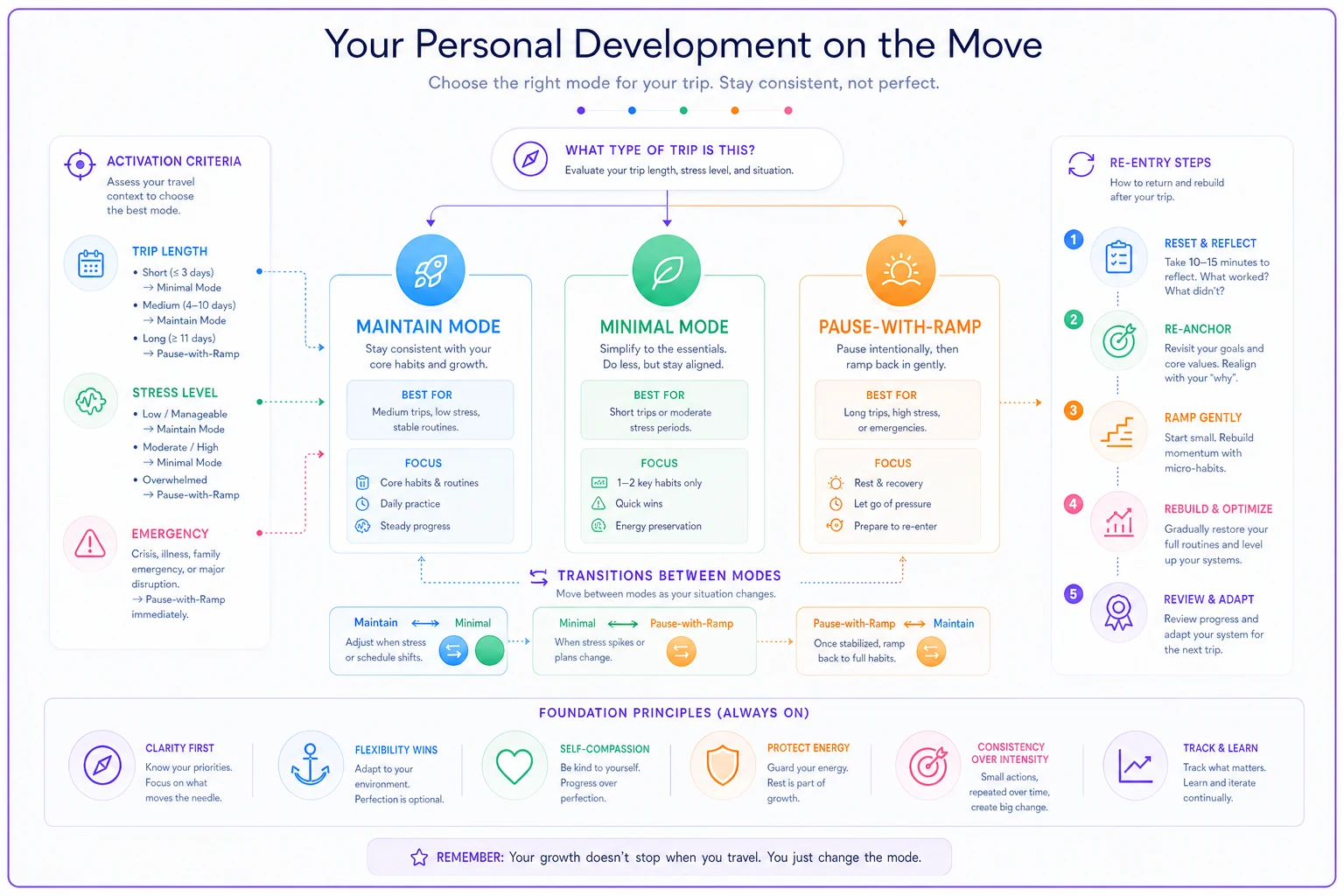
Use this workflow to decide mode quickly when travel disrupts routine.
Building Portable Anchors
Physical environment cues drive most habit execution—which is exactly why hotel rooms destroy routines. You need portable anchors. Environmental triggers you can recreate anywhere.
A portable anchor uses objects or sequences rather than locations. Instead of "meditate in my home office," the anchor becomes "meditate immediately after making morning coffee." Coffee exists everywhere. The sequence stays intact regardless of location.
Digital anchors work well too. A habit tracking notification at 7 PM fires identically in Tokyo or Toledo. A specific playlist can signal workout mode whether you're in a hotel gym or a park doing bodyweight exercises.
Some people build actual "travel kits" around physical anchors—a specific water bottle tied to hydration goals, a particular notebook for journaling, resistance bands for strength training anywhere. These objects become the operational infrastructure for habits on the road.
Establish portable anchors before you travel by practicing them during a normal week so they carry psychological weight.
The critical piece is establishing these anchors before you leave. You can't build new environmental cues while managing travel stress. They need to already carry psychological weight from regular use at home.
The Re-Entry Checklist
This is where most habit maintenance actually breaks down—not during the trip, but on the way back. You'd think the familiar environment would automatically restart everything. Instead, most people experience a strange disconnection, like returning to an old video game save and forgetting all the controls.
Re-entry needs active management, not passive hope. Professional kitchens run through startup checklists after any closure. Every system gets verified before service begins. Habits need the same rigor.
Start with an environmental reset. Your environment audit identified optimal conditions for each habit. After travel, those conditions need restoration. Gym bag back by the door. Meditation cushion in position. Journal and pen on the nightstand. Physical reset happens before you attempt any execution.
The re-entry protocols break down by tier:
-
From Maintain Mode Resume at 90% intensity immediately, full intensity within three days
-
From Minimal Mode Start at 50% intensity, increase roughly 10% per day until normal
-
From Pause-with-Ramp Begin at 25% intensity, follow the predetermined ramp schedule
Write these protocols before you travel, when your judgment isn't clouded by jet lag or re-entry fog.
Measurable Re-Onboarding Rituals
Vague intentions like "get back to working out" almost guarantee failure. Re-onboarding needs measurable checkpoints that confirm the system is actually being restored.
A measurable ritual has three components: specific action, completion criteria, and verification method. "Resume meditation" becomes "complete three 5-minute sessions using the Headspace basics course, verified by app history."
The timeframe matters. Most habits need 3–7 days of supported re-entry before autonomous operation resumes. During that window, you're not just doing the habit—you're rebuilding the operational infrastructure around it.
Think about how commercial gyms handle New Year's returners. They don't expect immediate peak performance. Reduced intensity, technique reminders, gradual load increases. Personal habits need the same logic.
Without clear metrics, "easing back in" quietly becomes a permanent reduction. Set specific targets: "By day 7, morning routine duration returns to within 5 minutes of pre-travel baseline." Numbers create accountability when willpower is still depleted.
Common Re-Entry Failures
The perfectionist trap catches high achievers constantly. After two weeks in minimal mode, they attempt immediate return to peak performance. Like sprinting after bed rest—the intention seems reasonable, the execution causes damage.
Then there's the compensation mindset. People try to "make up" for missed sessions by doubling intensity. Missing 10 meditation sessions doesn't mean you need a 100-minute session to catch up. Habits aren't debt that accumulates interest.
Delayed restart syndrome kicks in when people wait for perfect conditions. Monday start dates. Beginning of the month. After this one deadline. The restart friction compounds until the habit feels impossibly distant. The three-tier system prevents this by keeping minimal connection alive even during real disruption.
Social re-entry often gets ignored entirely. If your workout partner found a new gym buddy while you were gone, that social anchor disappeared. If your accountability group shifted meeting times, you lost that support structure. Re-onboarding includes rebuilding social infrastructure, not just restarting personal execution.
Practical Examples Across Different Habit Types
Each tier preserves the core habit architecture while adjusting operational load.
The habit never fully stops—it just runs in a different mode.
-
Writing Habits
-
Maintain
500 words daily becomes 200 words
-
Minimal
Three sentences in phone notes
-
Pause-with-Ramp
Return with 100 words day 1, add 50 daily until normal
-
Fitness Routines
-
Maintain
Full workout becomes hotel room bodyweight circuit
-
Minimal
10 pushups and 20 squats daily
-
Pause-with-Ramp
Week 1 walking, Week 2 light weights, Week 3 normal program
-
Dietary Tracking
-
Maintain
Full macro tracking becomes photo food log
-
Minimal
Track protein only
-
Pause-with-Ramp
Track one meal day 1–3, two meals day 4–6, full tracking day 7+
-
Reading Goals
-
Maintain
30 pages becomes 10 pages
-
Minimal
Read one article daily
-
Pause-with-Ramp
Start with 5 pages, add 5 pages every three days
Each tier preserves the core habit architecture while adjusting operational load. The habit never fully stops—it just runs in a different mode.
Technology and Tracking Considerations
Manual tracking gets overwhelming during travel fast. A carefully maintained spreadsheet adds friction when you're managing flight connections and hotel check-ins simultaneously.
AI-assisted tracking can genuinely reduce that burden. Modern habit tracking apps maintain minimal data collection through quick voice notes or photo uploads, then organize that information properly once you're back in maintain mode. The automation handles structure while you focus on execution.
Some platforms now offer "vacation mode" settings that automatically adjust goals and maintain streak calculations without breaking psychological momentum. The software recognizes context shifts and adapts expectations accordingly.
The danger is over-relying on technology. If your entire habit system lives inside one app and that app crashes mid-trip, you've lost all operational infrastructure. Keep analog backups—a simple notebook or phone notes that capture essential data regardless of what the technology does.
Long-Term Progress Preservation
The three-tier system isn't about being perfect during travel. It's about preventing complete operational collapse that takes months to rebuild.
Think of it like managing a sourdough starter. Full feeding schedule when you're baking regularly. Reduced feeding when life gets busy. Refrigerator storage for extended breaks. But you never let it die completely, because starting from scratch takes weeks.
Each successful travel cycle strengthens the system. You learn which portable anchors actually hold, which re-entry rituals generate real momentum, which tier makes sense for different kinds of trips. The protocol gets better through iteration.
Document what works. After each travel experience, note which habits survived, which struggled, and why. Build a personal playbook based on your actual patterns, not generic advice. The goal isn't a perfect system on day one—it's a system that improves every time you use it.
The Compound Effect of Controlled Downshifts
Organizations that practice controlled downshifts handle disruption better than those trying to maintain constant peak operation. Habits work the same way.
Every time you successfully downshift to minimal mode and return to full operation, you build real confidence in the system. Travel anxiety decreases because you know the habits will survive. The all-or-nothing pressure mostly disappears.
More importantly, you maintain forward momentum even during disruption. A year of consistent 70% execution beats six months at 100% followed by six months of nothing. That's not a complicated insight—it's just math that most habit advice ignores.
Making This Operational
Building your three-tier system takes real upfront documentation work, but minimal ongoing management after that. A couple hours of protocol writing can save dozens of hours of restart friction over time.
For each core habit, document:
-
Maintain mode specifics (what changes, what stays the same)
-
Minimal mode actions (absolute minimum to preserve the habit)
-
Pause-with-ramp schedule (if needed, how to restart)
-
Portable anchors (what travels with you)
-
Re-entry checklist (specific steps for when you return)
-
Success metrics (how you know you're actually back online)
Store this somewhere accessible during travel. Cloud storage, phone notes, a physical card in your wallet. When travel brain fog hits, you need clear instructions—not general principles.
The system works because it acknowledges operational reality. Travel will disrupt habits. Instead of pretending otherwise or accepting complete failure, you implement controlled degradation and systematic recovery. It bends without breaking. Your habits during travel don't need perfection—they need a protocol that preserves progress while acknowledging real constraints, and that's exactly what the three-tier system provides.
Ready to unlock your full potential?
Join thousands of users transforming their lives using Growyly to stay motivated, organized, and growth-focused every day.