

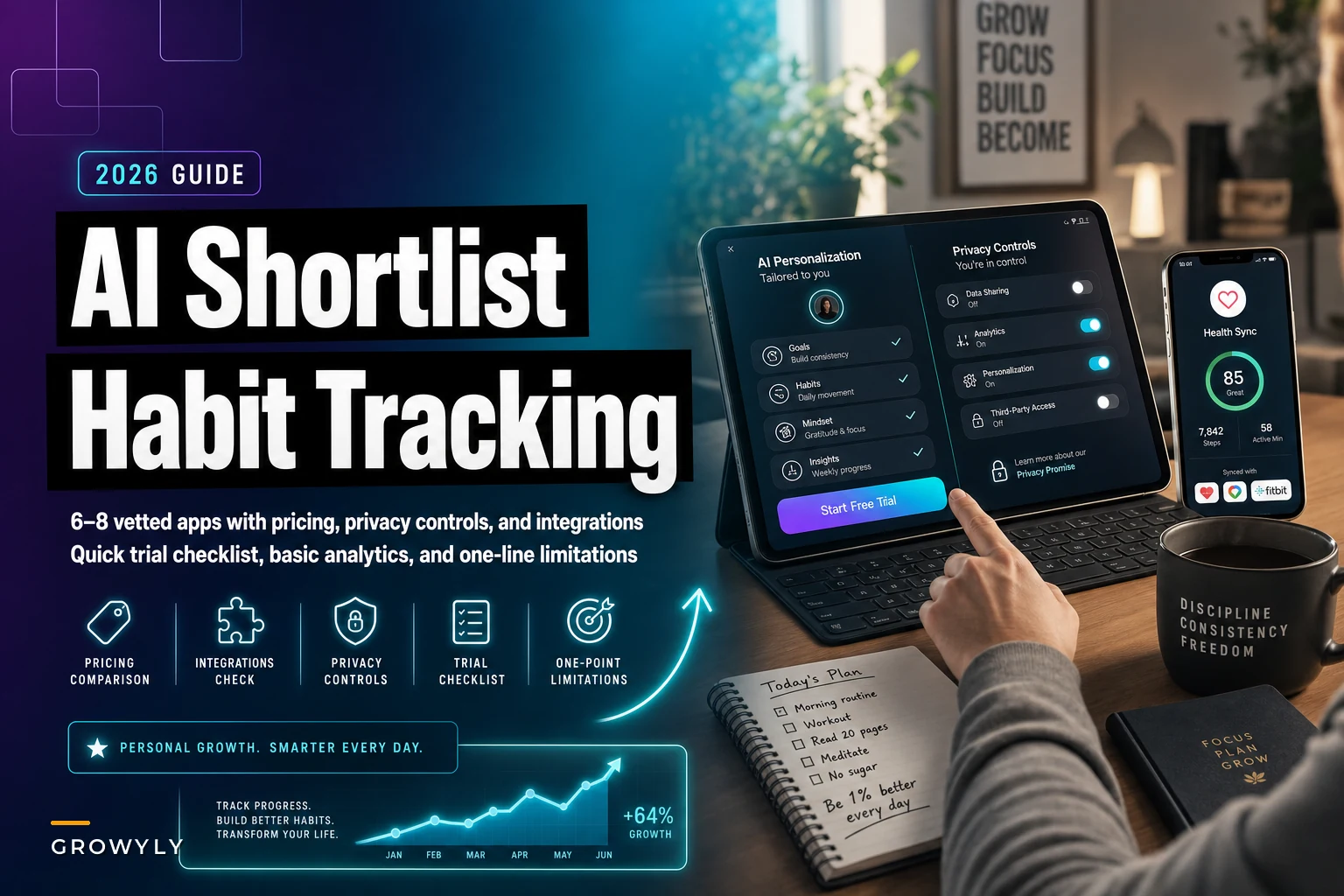

Most "best habit app" lists read like they were written by someone who installed each app for twelve minutes and screenshotted the pricing page. This one filters around four things that actually matter once you're past the novelty week: does the personalization do anything useful, can you control your data, is there a real way to try before you pay, and does it give you analytics you can act on rather than a wall of streak confetti.
The shortlist is tight — eight apps — because a 30-app roundup is useless. You don't need more options. You need the right six to eight and a fast way to test them.
One thing upfront: AI personalization in this category ranges from "genuinely adjusts your reminders and nudges based on behavior" to "we renamed our recommendation sidebar." I'll flag which is which where I can, and the test script at the end is designed to expose the difference in about a week.
How I Filtered This List
Every app here had to clear all four bars:
-
Advertises AI-driven personalization — adaptive reminders, pattern detection, coaching, or recommendations that actually change based on your data (not just a static template).
-
Has privacy controls — at minimum, data export and delete; bonus for local-only modes, end-to-end encryption, or clear opt-outs on model training.
-
Offers a free trial or freemium tier — you can get real use before paying.
-
Includes basic analytics — trends, completion rates, correlations, or progress charts you can read without a data science degree.
Quick honest caveat: pricing and features in this space shift constantly, and apps rebrand their "AI" features every few months. Treat the numbers below as a starting reference and confirm on the live pricing page before you commit.
The Shortlist at a Glance
The table below gives you a quick comparison across the eight apps — free access, rough pricing, standout integration, and the one thing worth knowing before you download.
Achieve more by focusing on what matters.
Growyly helps you build lasting habits and track your personal growth effortlessly.
- Goal setting with progress tracking
- Daily habit reminders
- Motivational insights and analytics
No credit card required
| App | Free tier / trial | Paid starts around | Standout integration | One known limitation |
|---|---|---|---|---|
| Fabulous | Freemium + trial on premium | ~$9–11/mo, ~$40–50/yr | Calendar, reminders | Coaching leans scripted, less truly adaptive |
| Reflectly | Freemium | ~$10/mo, ~$60/yr | Minimal; journaling-focused | Thin on cross-habit analytics |
| Habitify | Free tier (limited habits) | ~$5/mo, ~$30/yr, lifetime option | Apple Health, Google Calendar, Siri | AI nudges are basic vs. marketing |
| Way of Life | Free (3 habits) | ~$5/mo or one-time unlock | Export to CSV | Analytics strong, "AI" is light |
| Welltory | Freemium + trial | ~$9–12/mo | Apple Health, Google Fit, wearables | Heavy data use; privacy settings need attention |
| Routinery | Freemium + trial | ~$6–8/mo, ~$40/yr | Calendar, Health sync | Routine-based, weak on freeform habits |
| Finch | Freemium | ~$10/mo, ~$40/yr | Health data (limited) | Gamification can distract from real tracking |
| Rise (sleep/behavior) | 7-day trial | ~$60/yr | Apple Health, calendar | Narrow focus (energy/sleep), not general habits |
Now the detail that actually helps you choose.
1. Fabulous
What it does well: Fabulous is built around behavioral science journeys — morning routines, focus rituals, wind-down sequences. The personalization adjusts the pacing of your "journeys" based on what you complete and skip. It's one of the few that actually feels coached rather than just tracked.
Pricing: Freemium with a meaningful free layer; premium runs roughly $9–11/month or about $40–50/year. A free trial on premium is usually offered at signup — worth checking the current length because it rotates between 7 and 14 days.
Integrations: Calendar sync and solid reminder scheduling. Health API depth is lighter than the wearable-first apps.
Privacy: Standard export and account deletion. If you journal sensitive reflections inside the app, read their current data policy before you do.
One known limitation: The coaching, while polished, can feel scripted once you've gone through a few journeys. It adapts pacing more than content.
2. Reflectly
What it does well: AI-assisted journaling with mood tracking. It prompts you based on previous entries and surfaces emotional patterns over time. If your "habit" is really reflection and self-awareness, this is a strong fit.
Pricing: Freemium; premium around $10/month or roughly $60/year. The free tier lets you test the core journaling loop before committing.
Integrations: Intentionally minimal — this is a focused journaling tool, not a hub.
Privacy: Journaling content is sensitive by nature. Confirm their stance on data storage and whether entries are used to train models.
One known limitation: Cross-habit analytics aren't here. It's a mood and journal specialist, and that's about it.
3. Habitify
What it does well: Clean, fast, genuinely good analytics. Completion rates, streaks, time-of-day patterns, and progress charts that are actually readable. The AI nudging is modest, but the data layer is solid for people who want to analyze their own behavior rather than be coached through it.
Pricing: Free tier with a habit limit; premium is affordable at roughly $5/month or about $30/year. There's a lifetime option that's often worth it if you're actually going to stick with the app long-term.
Integrations: Apple Health, Google Calendar, and Siri shortcuts — useful for automating check-ins without a lot of manual effort.
Privacy: Straightforward export and delete.
One known limitation: The "AI" personalization is lighter than the marketing suggests. You're buying great tracking and analytics, not deep adaptive coaching.
4. Way of Life
What it does well: The gold standard for simple, flexible tracking with strong trend visualization. Color-coded chains, skip days, clean trend lines. Built for people who want to see patterns without being told what to do about them.
Pricing: Free for up to three habits; full unlock via subscription (~$5/month) or a one-time purchase on some platforms.
Integrations: CSV export is the real feature — pull your data out and analyze it however you want.
Privacy: Because it leans local and export-friendly, it's a reasonable pick for the privacy-conscious.
One known limitation: The AI personalization angle is thin. If adaptive nudges are your priority, look elsewhere.
5. Welltory
What it does well: Connects to your wearables and health data to correlate habits with measurable physiological signals — heart rate variability, sleep, energy. The AI genuinely crunches patterns across data streams, which is rarer in this category than the marketing would suggest.
Pricing: Freemium plus trial; premium runs roughly $9–12/month. The free tier gives you a taste but gates the deeper correlation analysis.
Integrations: Apple Health, Google Fit, and a wide range of wearables. Strongest health-data integration on this list.
Privacy: This app ingests a lot of sensitive health data. The privacy controls exist, but you need to actually configure them. Don't skip the settings review on day one.
One known limitation: Heavy data appetite. Great if you want deep insight, worth scrutinizing if you'd rather keep your data footprint small.
6. Routinery
What it does well: Routine-based structure with timed sequences and adaptive suggestions. If your habits live inside morning or evening routines rather than as standalone checkboxes, the personalization here fits the format well.
Pricing: Freemium with a trial on premium; paid is roughly $6–8/month or about $40/year.
Integrations: Calendar and Health sync for scheduling and activity data.
Privacy: Standard controls; review before syncing health data.
One known limitation: It's routine-shaped. Freeform, irregular habits don't map cleanly onto its sequence model.
7. Finch
What it does well: Self-care framed through a gamified companion. For people who bounce off clinical-feeling trackers, the emotional engagement keeps them opening the app. There's AI-flavored personalization in the reflections and suggestions.
Pricing: Freemium; premium around $10/month or roughly $40/year.
Integrations: Limited health data; this isn't a wearable hub.
Privacy: Standard export and delete; check policy on reflection content.
One known limitation: The gamification that drives engagement can also distort honest tracking — some users end up optimizing for the pet, not the habit.
8. Rise
What it does well: Narrow but deep. It models your energy and sleep patterns and uses that to time habits and recommendations. The personalization is genuinely data-driven for the specific problem of energy management.
Pricing: Typically a 7-day free trial, then around $60/year.
Integrations: Apple Health and calendar for timing recommendations around your real schedule.
Privacy: Standard controls; it's a health-data app, so review your settings.
One known limitation: Not a general habit tracker. If you want one tool for all habits, this is a specialist you'd run alongside something broader.
When AI Personalization Is Actually Worth Paying For
There's a pattern worth naming: people pay for "AI coaching" and then never change behavior because the nudges arrive at the same useless time every day. Adaptive personalization only matters if it changes what, when, or how you get prompted — based on your actual data, not a generic schedule.
Worth it when:
-
Your habits are tied to measurable signals (sleep, HRV, energy) and you'll actually act on correlations — Welltory and Rise fit here.
-
You need the app to reschedule or re-sequence based on what you skip — Fabulous and Routinery.
-
You genuinely review reflections and want prompts that build on past entries — Reflectly, Finch.
Not worth it when:
-
You just want to tick boxes and see a streak. Pay for Habitify or Way of Life and skip the AI premium entirely.
-
You're privacy-sensitive and the "AI" requires feeding in health and location data you'd rather not share.
-
You're habit-hopping and haven't settled on a few core habits yet. No personalization engine fixes an undefined target.
There's a pattern worth naming: people pay for "AI coaching" and then never change behavior because the nudges arrive at the same useless time every day. Adaptive personalization only matters if it changes what, when, or how you get prompted — based on your actual data, not a generic schedule.
Who Should Not Subscribe to Any of These Yet
If you haven't tracked anything manually for two weeks, don't buy a subscription. The most common waste is people paying for a premium tier to solve a motivation problem that a sticky note would've exposed in three days. Prove you'll open the app daily before you pay for adaptive coaching.
Also skip paid tiers if you're stacking subscriptions without reviewing them. Habit apps are classic silent-renewal traps — small monthly charges that outlive the habit itself. If that's a risk for you, run a quick audit of what you're already paying for; the mechanics in this breakdown of pricing and retention moves for habit-tracking subscriptions will save you more than any app's annual discount.
The Evaluation Checklist
Before you commit to any app on this list, run it against this:
-
[ ] Free tier or trial confirmed — and you know the exact trial length and renewal date.
-
[ ] Data export works — export your data on day one and confirm the file is usable (CSV, JSON, something portable).
-
[ ] Delete path is clear — you know how to fully delete your account and data, not just hide it.
-
[ ] Model-training opt-out — if the app uses your entries to train models, there's a way to decline.
-
[ ] Health/calendar integration tested — the sync actually works on your device, not just in the feature list.
-
[ ] Analytics are readable — you can answer "which habit am I failing most?" in under 30 seconds.
-
[ ] Personalization visibly changed something — reminders, sequence, or suggestions shifted based on your behavior during the trial.
-
[ ] Renewal reminder set — a calendar alert 2 days before the trial ends, outside the app.
If an app fails the export or delete test, walk away regardless of how good the AI sounds. Data you can't leave with is data held hostage.
The Free-Trial Test Script (Run This in 7 Days)
The problem with trials is that most people use day 1, forget days 2–6, and get charged. This script forces the app to show you what it's worth before the clock runs out.
-
Day 1 — Setup and export test. Add your 3–5 real habits. Immediately export your data and confirm the file opens. Set a calendar reminder for day 6 to decide.
-
Day 1 — Privacy sweep. Go into settings. Turn off anything you don't want (location, model training, unnecessary health scopes). Note how hard this was — friction here usually signals how they treat your data overall.
-
Day 2 — Integration test. Connect calendar and/or Health. Complete one habit and confirm it syncs correctly. Broken sync on day 2 rarely fixes itself.
-
Day 3 — Skip test. Deliberately skip a habit. See whether the app reacts — a reschedule, a different nudge, some acknowledgment. If nothing changes, the "personalization" is cosmetic.
-
Day 4 — Analytics read. Open the stats. Can you identify your weakest habit and your best time of day in under a minute? If the analytics confuse you now, they won't help in month three.
-
Day 5 — Nudge quality. Note every reminder you received. Were they useful or ignorable? Count how many you actually acted on.
-
Day 6 — Decision. Tally it
Did export work? Did privacy controls work? Did personalization do anything observable? Were analytics actionable? Three or more yeses, consider paying. Fewer, cancel before the charge hits.
Set a calendar reminder outside the app for two days before the trial ends so you don't get silently charged.
A week of structured testing beats three months of passive subscription every time.
Here's a rough picture of how that evaluation week should flow, if you're a visual thinker:
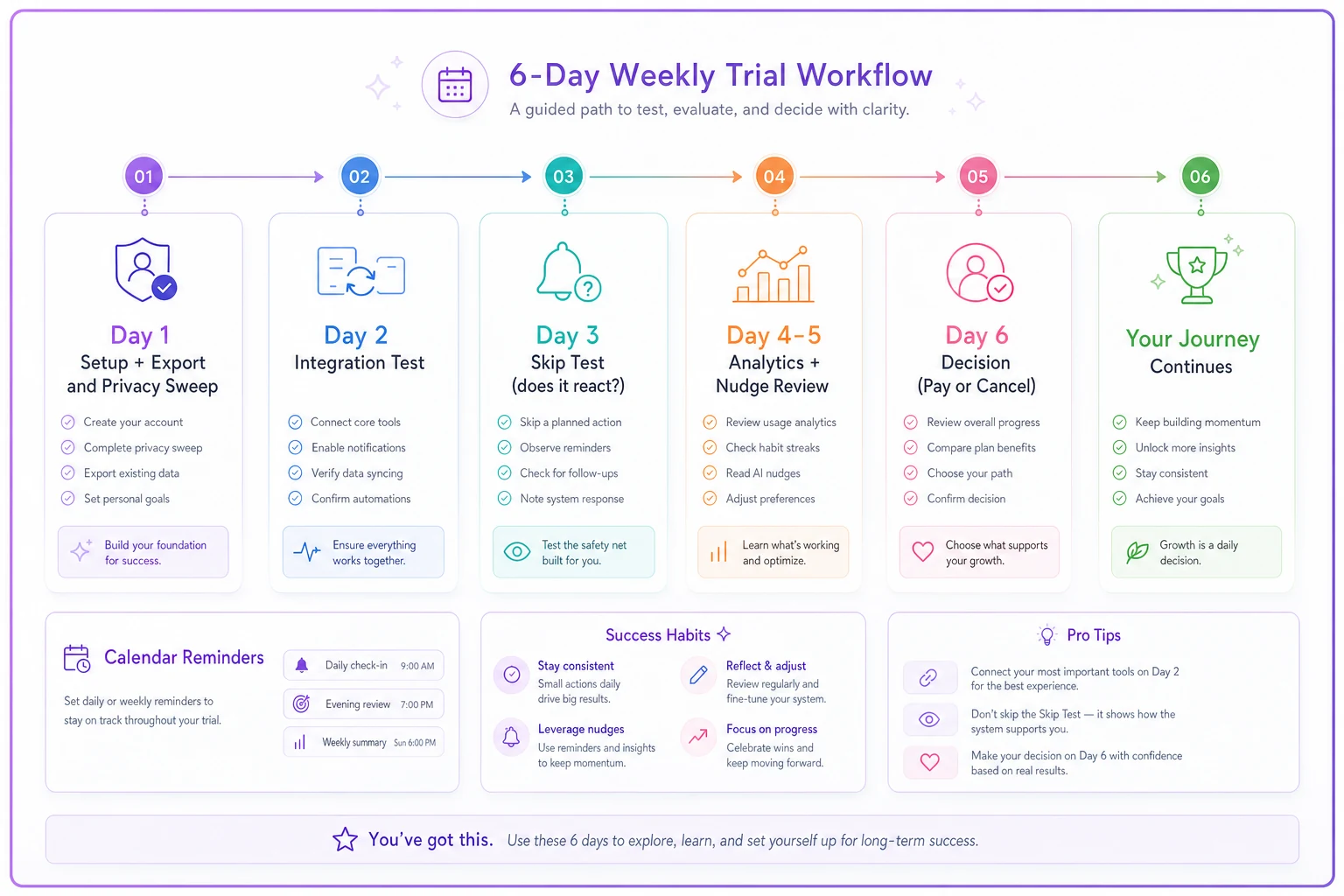
The skip test on day 3 is the one most people miss. It's also the most revealing.
The honest truth about this category: the best app is the one you'll open daily, and the AI premium is only worth it when it changes behavior you can actually measure. Half the apps here are worth paying for the tracking and analytics alone — the personalization is a bonus, not the reason.
Pick based on your real use case. Measurable health signals? Welltory or Rise. Clean tracking and solid charts? Habitify or Way of Life. Guided routines and coaching? Fabulous or Routinery. Reflection and mood? Reflectly or Finch. Then run the seven-day script, keep what earns its charge, and cancel the rest before the renewal catches you.
Ready to unlock your full potential?
Join thousands of users transforming their lives using Growyly to stay motivated, organized, and growth-focused every day.