

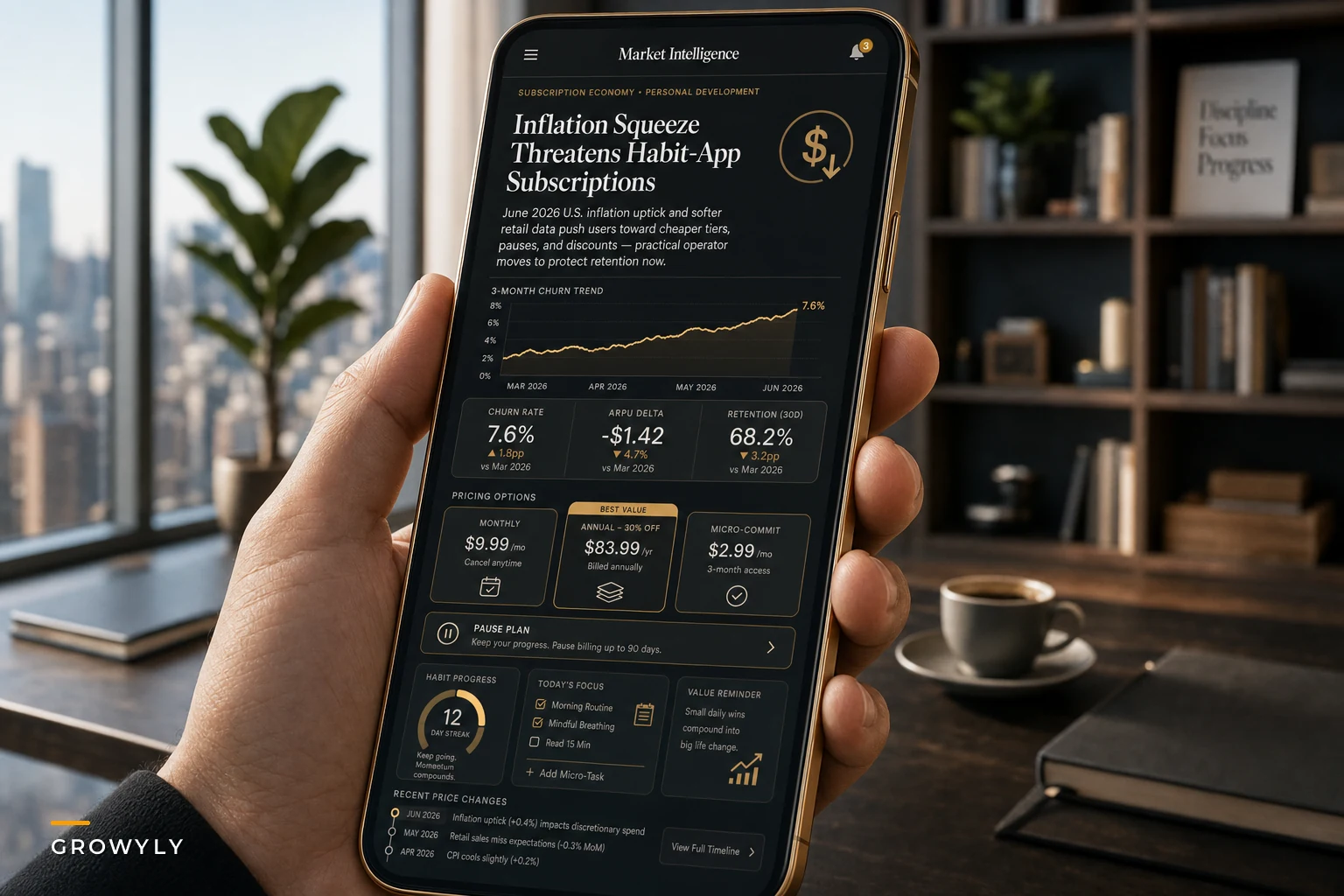

You opened your credit card statement and noticed everything costs a bit more than it should. The Reuters report from earlier this month confirmed what most people already felt—inflation jumped above 4% in May, the fastest acceleration in three years. And yet, according to Census Bureau retail data, spending is still up 0.9% last month. People are paying more and somehow still spending.
For your personal growth subscription stack, that matters. Every app you forgot about is quietly bleeding your budget. The meditation app you used twice in January? Still charging. The habit tracker you downloaded with the best intentions? Running in the background at $12.99/month.
What's actually interesting about this moment isn't that prices are going up. It's that inflation forces a real audit of what's genuinely working in your self-improvement toolkit—and that clarity is something most people never bother to find when money feels comfortable.
The Hidden Math Behind Subscription Creep
Most people underestimate their total subscription spend by somewhere between 40 and 60 percent. You think you're spending maybe $50 a month on apps, but when you actually sit down and look, it's closer to $85 or $110.
A typical personal growth subscription stack looks something like this:
-
Habit tracking app
$9.99/month
-
Meditation app
$12.99/month
-
Fitness tracking
$14.99/month
-
Sleep monitoring
$7.99/month
-
Journaling app
$4.99/month
-
Nutrition tracker
$9.99/month
-
Language learning
$11.99/month
-
Reading app subscription
$9.99/month
Total: $82.92/month (or about $995 per year)
With inflation factored in, that's pushing toward $1,035 annually. And realistically, most people are actively using maybe three of these.
The problem compounds because each app sells you on becoming a different version of yourself—someone who meditates daily, tracks every meal, journals before bed, and learns Spanish on morning runs. But you can't maintain eight new systems at once, especially when each one requires its own login, its own interface, and its own sustained attention.
Why Traditional Retention Tactics Are Failing Right Now
Habit-tracking companies are scrambling. Extended free trials, win-back discounts, guilt-trip emails about broken streaks—all of it. One journaling app I tested sent seventeen emails in two weeks after I stopped using it. Seventeen.
Achieve more by focusing on what matters.
Growyly helps you build lasting habits and track your personal growth effortlessly.
- Goal setting with progress tracking
- Daily habit reminders
- Motivational insights and analytics
No credit card required
These tactics miss the actual problem. When someone's reviewing their budget during an inflationary period, they're not looking for a 20% coupon. They're asking a completely different question: "Is this tool actually changing my behavior, or am I collecting digital gym memberships?"
The apps that survive the cut tend to share three things:
They integrate into existing routines rather than demanding entirely new ones. The ones that stick piggyback on things you already do—checking your phone in the morning, reviewing your calendar, texting someone.
They show concrete progress beyond streak counters. Not "you've meditated 47 days in a row!" but "you're averaging 6.5 hours of sleep versus 5.2 hours three months ago."
They reduce decision fatigue instead of adding to it. The keepers make choices for you rather than presenting endless customization options that require ongoing management.
The companies that survive this round of churn won't necessarily have the best features or the slickest interfaces. They'll be the ones that demonstrate clear, measurable value and fit into people's existing routines without demanding a complete behavioral overhaul.
A Framework for Auditing Your Growth Stack
Step 1: The Two-Week Usage Reality Check
Pull your last 14 days of actual app usage—your phone tracks this whether you realize it or not. Sort by time spent. Anything under 3 minutes of average daily use gets immediate scrutiny. That's not engagement, that's box-checking.
Step 2: The Behavior Change Test
For each subscription, identify one specific behavior that's measurably different because of that tool. Not "I feel more mindful." Real shifts like:
-
Wake time moved from a 7
45am average to 6:30am
-
Weekly exercise sessions went from 1-2 to 4-5
-
Screen time after 9pm dropped from 3 hours to under an hour
If you can't name a concrete change, you're paying for potential, not progress.
Step 3: The Stack Consolidation Opportunity
Map out what each app actually requires from you:
| App Type | Daily Time Investment | Unique Data Points | Could Replace With |
|---|---|---|---|
| Habit Tracker | 5-10 minutes | Custom habit list | Paper or Notes app |
| Meditation | 10-20 minutes | Guided sessions | YouTube/free apps |
| Sleep Monitor | 2 minutes | Sleep cycles | Phone's built-in health |
| Fitness | 5-15 minutes | Workout plans | Basic timer + notes |
| Journal | 10-15 minutes | Prompts, mood tracking | Physical notebook |
Most people discover they're paying for features they could replicate with things they already own. The value was never really in the app—it was in using it consistently. And consistency doesn't require a subscription.
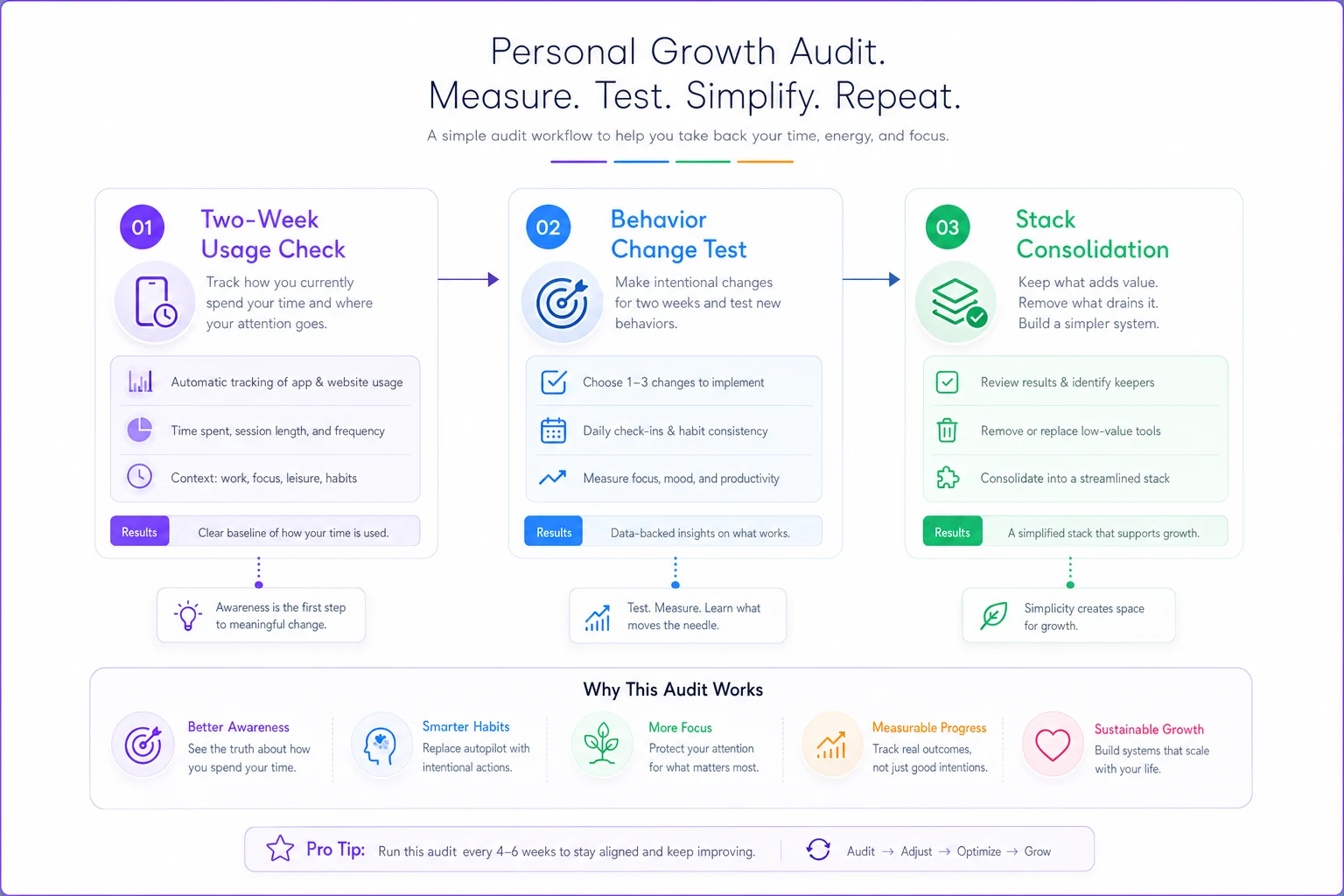
This diagram shows the audit workflow from usage check to consolidation.
The Momentum Preservation Problem
This is where subscription churn gets genuinely tricky for personal growth. When you cancel something you've used for months, you lose more than the app. You lose:
-
Historical data and progress tracking
-
The psychological commitment device ("I paid for this, so I should use it")
-
Established routines that were built around that tool
-
Social features or accountability partners within the platform
You can cancel three subscriptions to save $35/month and then watch your entire morning routine fall apart because it was built around those apps. Within six weeks, you're back to old patterns, having lost months of progress in the process.
The fix isn't keeping everything. It's transitioning intelligently.
Before canceling, export your data. Screenshot your streaks. Write your routines down somewhere outside the app. Build bridges before you burn them.
Smart Retention Moves That Actually Work
If you run a habit-tracking subscription or any personal growth product, here's what actually prevents churn when economic pressure hits—drawn from retention data across companies that survived previous downturns:
Offer pause options instead of cancellation. Let users freeze their subscription for 1-3 months without losing data. A significant portion—roughly 60% in some cases—come back when finances stabilize.
Create meaningful free tiers that preserve core value. Don't just strip features—limit frequency. Full access three days per week beats a crippled version every day.
Bundle complementary behaviors instead of fragmenting them. One subscription that handles habits, mood, and basic journaling beats three separate ones that never talk to each other.
Show ROI in real terms. "Your improved sleep consistency is worth approximately $180/month in productivity" lands differently than "Great job on your streak!"
Enable data portability by default. Users who can easily export their history are—counterintuitively—less likely to leave. The threat of lock-in creates preemptive churn. Remove that threat and you remove that trigger.
When Paying More Actually Makes Sense
Some people should spend more on their growth stack during inflation, not less. If a tool genuinely drives behavior change that affects earning potential or reduces other costs, it's an investment.
A project manager I know pays $49/month for a premium focus app that blocks distractions. Expensive? Sure. But it helped her bill an extra 8-10 hours monthly at $85/hour.
-
Cost
$49/month
-
Additional billable hours
8 × $85 = $680
-
Net gain
$631/month
That math works. But it only works when there's a real connection between the tool and measurable outcomes. "It helps me feel focused" doesn't hold up. "I complete three more client projects per month" does.
The Consolidation Through Operations
What most people miss during subscription audits is the chance to rebuild their growth systems more efficiently. Instead of eight specialized apps, you probably need two or three that handle multiple functions.
This mirrors what happens in small business operations—companies start by buying separate tools for scheduling, email, inventory, customer management, and billing, then economic pressure eventually forces consolidation into integrated platforms. The overhead of managing disconnected systems becomes its own operational failure point. Personal growth stacks work the same way.
A single app that handles habits, basic journaling, and mood tracking adequately beats three best-in-class apps that don't share data or reinforce each other.
Some people go further and build lightweight systems using tools they already have—spreadsheets, calendar apps, simple notes. More upfront setup, but no ongoing costs and no platform risk. You can't lose access to a notebook.
The Subscription Audit Checklist
Immediate cuts:
-
Anything unused for 14+ days
-
Duplicate functionality across apps
-
Aspirational purchases you're genuinely not ready for
-
Apps that add complexity without clear benefit
Keep and optimize:
-
Tools tied to measurable behavior change
-
Subscriptions that consolidate multiple functions
-
Apps that reduce friction for habits you already have
-
Platforms where you've built significant historical data
Negotiate or modify:
-
Switch from monthly to annual for discounts (only if you're certain you'll stick with it)
-
Downgrade to lower tiers that keep core functionality
-
Share family plans with accountability partners
-
Pause instead of cancel if there's a real chance you'll return
Negotiate or modify:
Making the Operational Shift
The smartest response to inflation-driven subscription churn isn't just cutting costs—it's rethinking how you approach personal growth systems altogether. Financial pressure creates clarity about what actually drives behavior change versus what just makes you feel like you're doing something productive.
The people who maintain momentum through budget crunches don't just have stronger willpower. They have better systems that don't depend on willpower. They've built routines that hold up regardless of which apps they're using at any given moment.
Look at your subscription stack as an operational system, not a collection of independent tools. Where are the redundancies? What are the failure points? Which pieces are load-bearing and which are just features that sounded good at the time?
The companies that survive this round of churn won't necessarily have the best features or the slickest interfaces. They'll be the ones that demonstrate clear, measurable value and fit into people's existing routines without demanding a complete behavioral overhaul.
For users, that means being more selective but also more committed. Go deep with two or three tools that genuinely serve your goals instead of spreading thin across eight. Export your data regularly. Document what works outside of any single platform. That habit alone will save you months of rebuilding the next time you need to switch.
The inflation spike won't last forever. But the lesson about subscription value should. Every tool in your stack should earn its place through demonstrated behavior change—not promised potential. When money gets tight, that distinction becomes obvious fast.
Your personal growth doesn't depend on having every possible app. It depends on consistently executing the basics with whatever makes that easiest. Sometimes that's a sophisticated platform. Sometimes it's a notebook and a timer. Economic pressure has a way of clarifying which is which, and that clarity is worth more than any streak counter.
Ready to unlock your full potential?
Join thousands of users transforming their lives using Growyly to stay motivated, organized, and growth-focused every day.