

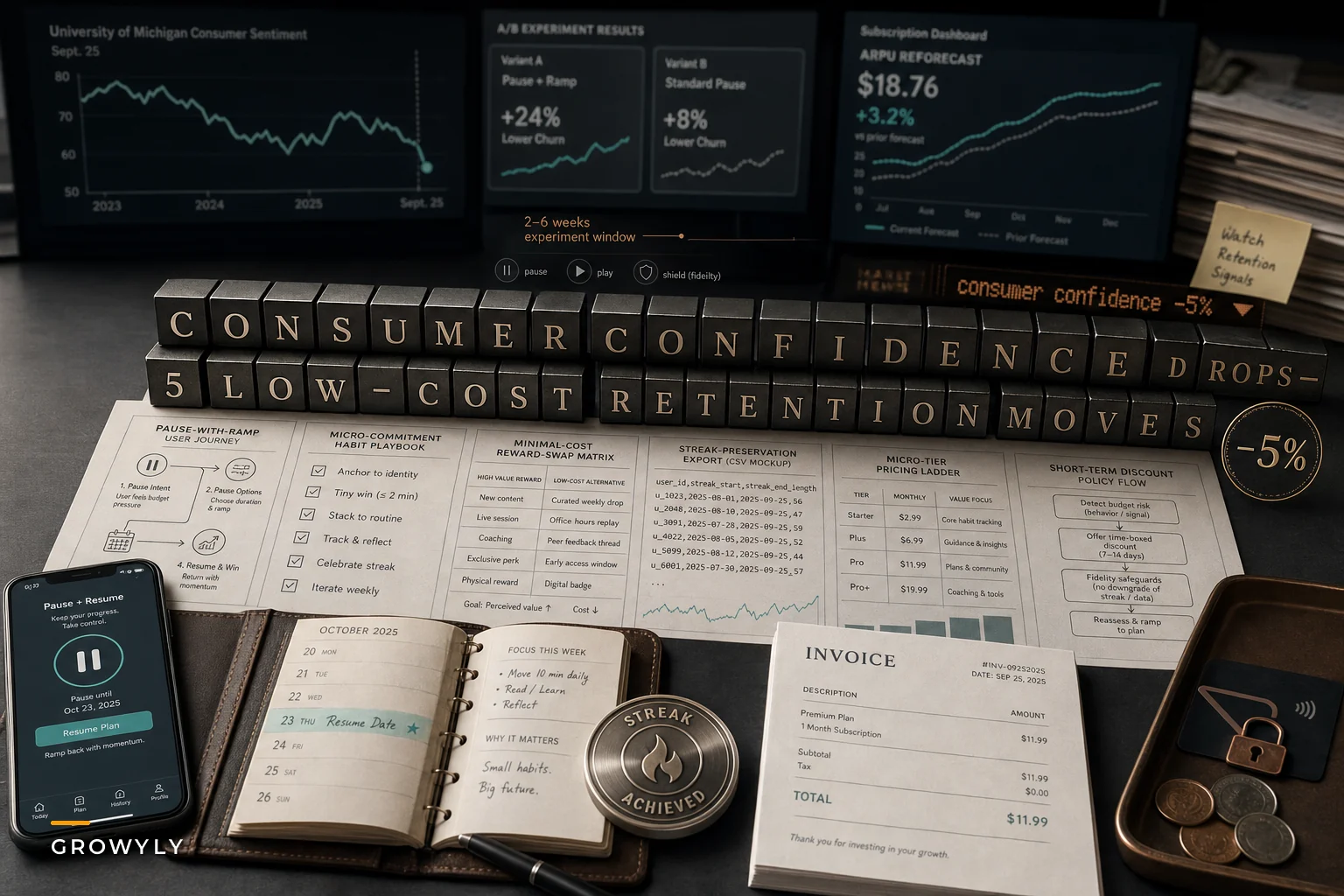

The University of Michigan's final sentiment reading for September 2026 slipped to a four‑month low, and a Reuters write‑up on the report framed it the way these stories usually get framed: households feel less sure about the near future, so they start trimming. The part that actually matters for anyone running — or paying for — a habit app isn't the headline number. It's the behavior that follows.
When people feel squeezed, they don't just cancel things that stopped working. They cancel things that are working but feel optional. A habit tracker you use every morning can still get cut during a 15‑minute "what am I actually paying for" audit on a Sunday night, right alongside a streaming service and a meal‑kit subscription. Your usage data says you love it. The budget spreadsheet doesn't care.
This post is split for two readers at once. If you're trying to keep momentum on your own growth without the monthly bill, the strategies below keep your progress intact even if you downgrade or pause. And if you own product or growth at a habit app, the same strategies point directly at where your retention risk is hiding — because users who can preserve their progress without you are also the ones most likely to come back.
The real exposure isn't price — it's how much progress lives inside the app
The uncomfortable thing most habit apps don't want to look at directly: the more progress a user has stored only inside your product, the more it reads as a sunk cost when money gets tight. And sunk costs don't create loyalty — they create resentment.
A typical pattern looks like this. Someone builds a 90‑day streak, logs 200+ entries, accumulates charts and badges and reflection notes. On paper that's lock‑in. But when consumer confidence drops and they're reviewing subscriptions, that stored progress cuts two ways depending on how the app is designed:
-
"If I cancel, I lose everything" → feels like a hostage situation → churn with bad feelings
-
"If I cancel, I keep my streak and notes, and the system still runs without the paid layer" → feels fair → more likely to pause, resume later, or re‑subscribe
The second group is worth more over a 24‑month window, even if they pay less in month three. The mistake teams make is optimizing for the first group because it looks like retention — until a confidence shock turns that "lock‑in" into a wave of angry cancellations and chargebacks.
For individuals, the lesson runs the other direction: don't let your progress live entirely inside one paid tool you might cut. Everything below is built around that idea.
Strategy 1: Build a "survives‑cancellation" core before you need it
The goal is straightforward — your habit should keep running even if the app disappears tomorrow. If pausing a $9/month subscription means your morning routine collapses, the subscription wasn't the habit. It was the scaffolding.
Achieve more by focusing on what matters.
Growyly helps you build lasting habits and track your personal growth effortlessly.
- Goal setting with progress tracking
- Daily habit reminders
- Motivational insights and analytics
No credit card required
For individuals, the move is to externalize the trigger and the record, not just the tracking:
-
Pick your three load‑bearing habits — the ones you'd actually miss.
-
Write the anchor somewhere you own
paper, a free notes app, anywhere that doesn't require a login.
-
Keep a dead‑simple backup log
a tally in a notebook, a recurring phone alarm, a single text‑to‑self thread.
-
Export your current streak data now, while you still have access — not mid‑cancellation flow when you're already annoyed.
A realistic example: someone paying roughly $7–$12 a month for a tracker moves their three core habits onto index cards and a free calendar. When they later downgrade to the free tier to save maybe $90–$130 a year, their streaks don't reset emotionally — the paper log carries the continuity. That's the person who re‑upgrades in four months when things ease up.
For product owners, this sounds like you're arming users to leave. You're not. You're separating churn you can't prevent from progress you can protect. Apps that offer clean exports, a usable free tier, and "your streak is safe" messaging consistently see more win‑backs. The ones that trap progress see one‑way exits.
Strategy 2: Shrink the habit before you shrink the budget
When money gets tight, the instinct is to quit habits that cost money — the gym, the course, the premium tool. The higher‑leverage move is shrinking the habit's footprint so it survives the leaner version of your life.
Drop to the smallest version that still counts. Not "run 5k" but "put on the shoes and walk out the door." Not "journal 20 minutes" but "write one line." The budget pressure becomes the forcing function that strips the habit down to its durable core.
| Full version (confident spending) | Durable core (tight budget) | What you preserve |
|---|---|---|
| Paid workout app + classes | 10‑min bodyweight circuit at home | The daily identity cue |
| Premium meditation subscription | 3 minutes, free timer | The nervous‑system reset |
| Paid language tutor weekly | 5 flashcards/day, free deck | The retrieval loop |
| Premium habit tracker w/ analytics | Free tier + paper streak | Continuity of record |
Run the durable core for a week to confirm it preserves your identity cue before you downgrade.
The thing most people miss: the shrunk version isn't a downgrade, it's insurance. A habit that only exists at full intensity is fragile. One that has a tested "lean mode" survives every budget cycle, not just this one. For the fuller pricing and retention logic behind this during tight months, the breakdown in our piece on inflation pricing and retention moves goes deeper on how downgrades can preserve value instead of destroying it.
Strategy 3: Replace monthly features with one‑time setup
A lot of what people pay monthly for is really a one‑time configuration problem wearing a subscription costume. Reminders, habit stacks, environment design — mostly setup, not ongoing service.
For individuals, audit what you're actually getting every month:
-
Reminders and nudges → rebuilt once with free phone alarms and calendar events.
-
Habit stacking logic → write the "after X, I do Y" chain once; it doesn't need a server to exist.
-
Environment cues → laying out gear, moving the junk food, charging the Kindle in the kitchen — zero recurring cost.
-
Streak tracking → a wall calendar and a marker.
What's genuinely worth paying for month after month is the stuff that updates and adapts — personalized adjustments, pattern detection across months of data, syncing across a household. If you're paying monthly and only using the one‑time‑setup features, you're renting something you already own.
For product owners, this is the churn signal worth watching. A user whose entire engagement is reminders and streaks is paying for things they can replicate for free the moment confidence drops. Your retention job is to make the adaptive layer — the part that actually requires ongoing computation and data — visible and valuable before the budget review hits, not after.
Strategy 4: Use the pause instead of the cancel (and build the ramp back)
Cancellation is usually binary and emotional. A pause is a decision you can reverse without starting over. Most people treat "I can't afford this right now" as "I'm done," which guarantees the habit dies and the resubscription never happens.
A better sequence when you hit a budget crunch:
-
Downgrade or pause the paid tier instead of deleting the account.
-
Keep the minimum viable habit running on the free tier or paper (see Strategy 1 and 2).
-
Set a specific resume date — not "someday," but an actual calendar entry tied to a pay cycle or a season change.
-
On resume, don't backfill guilt — pick up at the lean version and rebuild from there, not where you left off at full intensity.
The difference between a pause and a cancel is whether there's a ramp back. People who pause with a date return. People who cancel without one almost never do, because "deal with it later" never arrives on its own.
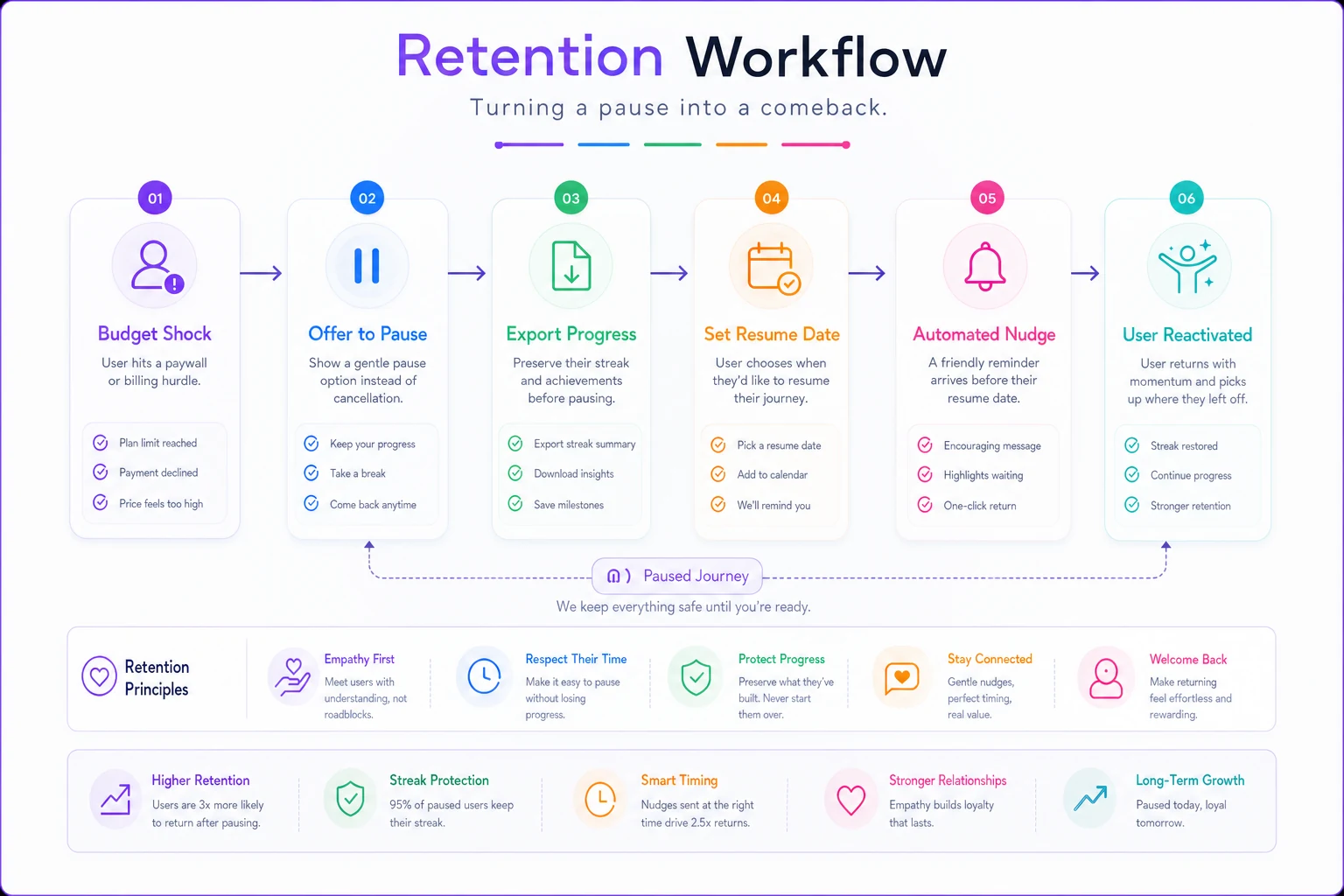
For product owners, this is probably the highest‑ROI retention experiment available right now. The arithmetic is blunt: a user who pauses three months and returns is worth significantly more than one who cancels cleanly, yet most apps make pausing hard to find and cancellation easy to complete. That's backwards in a confidence-shock environment. A visible pause flow, a preserved streak, and an automated "ready to pick back up?" nudge at the resume date recovers revenue that a one‑way cancel button just throws away.
Strategy 5: Concentrate spending on the one habit that compounds
When you can't fund everything, spreading a shrinking budget thin across five tools is how people end up with five mediocre habits and a worse mood about all of them. Pick the one habit where paid support genuinely changes the outcome — usually something with real accountability, expert feedback, or data you can't generate yourself — and protect that single line item. Everything else drops to free or paper.
A realistic version: someone running close to $40–$55 a month across a tracker, a fitness app, a meditation app, and a language tool consolidates down to roughly $12–$18 for the one subscription that actually moves the needle (the one with coaching or structured feedback), and runs the rest free. Spend drops meaningfully. The outcome barely moves — because most of that stack was convenience, not leverage.
When this actually makes sense
-
You have 3+ overlapping paid tools and real budget pressure.
-
At least one habit genuinely benefits from paid accountability or feedback.
-
You've already externalized your streaks so free versions don't reset your momentum.
When this is a bad idea
-
You'd cut the tool that's actually driving your biggest result just because it's the most expensive line.
-
You're consolidating before exporting your data — do the export first.
-
You're using "budget" as cover to quit a habit you were already looking for an excuse to drop. That's a motivation problem, not a money one.
Consolidating isn't always the right call, but when the budget pressure is real and the stack is genuinely overlapping, it's usually the move that protects both your finances and your actual progress.
A quick real scenario
Consider a user on a mid‑tier plan at around $10/month on a popular tracker. When sentiment dipped and their household started trimming subscriptions, the first instinct was to cancel outright. Instead they did three things: exported their 100‑plus‑day history, moved two core habits to a free calendar with alarms, and downgraded to the free tier with a resume date set for the new year.
They kept their streaks, cut roughly $120 off the budget for a few months, and re‑subscribed when things stabilized — more convinced the paid layer was worth it, because they'd felt the difference without it. From the app's side, that's not lost revenue. That's a paused user who came back warmer than before. The cancel button would have ended it permanently.
That's the whole point. The Michigan data — and you can see the ongoing sentiment survey details on the university's own site — is really just a signal that a lot of these pause‑or‑cancel decisions are happening at once this quarter.
What product and growth teams should actually do this quarter
If you own retention, don't wait for the churn report to confirm what the sentiment report already said. The move set is narrow and testable:
-
Ship a visible pause flow with a preserved streak and an auto‑scheduled resume nudge.
-
Make exports clean and obvious — counterintuitive, but it reduces hostile cancellations and builds the trust that drives win‑backs.
-
Introduce a genuine low‑cost tier that keeps habit‑continuity features and gates only the adaptive and analytics layer.
-
Message progress safety explicitly in the cancellation flow
"Your streaks and notes stay with you."
-
Reforecast with pause in the model, not just churn — a paused user is deferred revenue, not a dead one.
A simple flow to test these experiments:
The underlying problem a confidence drop exposes isn't that people stop valuing growth. It's that fragile pricing and trapped progress turn a temporary budget decision into a permanent loss.
Apps that treat a downgrade as a relationship to maintain — rather than a defeat to prevent — are the ones still standing when sentiment recovers. And it always does.
For individuals, same truth from the other side: protect your progress so no single line item can hold it hostage. Build the lean version before you need it, keep the record somewhere you own, and let the budget pressure sharpen your habits instead of ending them. The streak you can carry on an index card is the one that survives every September, no matter what the index says.
Ready to unlock your full potential?
Join thousands of users transforming their lives using Growyly to stay motivated, organized, and growth-focused every day.