



The FTC just dropped a policy statement that's about to change how every habit-tracking app operates. On July 1st, they opened public comments on AI accuracy requirements that essentially say: if your AI coach promises personalized insights, it better actually deliver them—or face enforcement action.
This isn't some distant regulatory threat. The comment period closes July 31st, and apps are already scrambling to audit their features. If you use Noom, Headspace, MyFitnessPal, or anything marketing "AI-powered recommendations," your experience is probably about to shift.
The compliance scramble hits different for habit apps
Most SaaS companies can tweak some marketing copy and move on. Habit-tracking apps can't do that. Their entire value proposition is built around personalization claims that the FTC now considers potential deception risks.
Take a meditation app that promises "AI-customized mindfulness journeys based on your unique stress patterns." Under the new guidance, they need documented proof that their algorithm is actually personalizing content in a meaningful way—not just shuffling generic meditation tracks based on a few basic tags. One app I consulted for discovered their "AI coach" was essentially a decision tree with about a dozen possible outputs. That's not personalization. That's a flowchart with marketing spin on top.
The operational burden lands hardest on smaller apps. Calm has the resources to implement model governance and run accuracy audits. The indie app with 50,000 users suddenly has to pull engineering time away from feature development and point it at compliance logging instead. Several apps I know are seriously considering removing AI features entirely rather than risk enforcement.
Your habit data becomes a liability overnight
What most users don't realize: every interaction you've logged is now part of an accuracy audit trail that apps are required to maintain.
Achieve more by focusing on what matters.
Growyly helps you build lasting habits and track your personal growth effortlessly.
- Goal setting with progress tracking
- Daily habit reminders
- Motivational insights and analytics
No credit card required
A running app can't just claim their AI "learns your optimal training zones" anymore. They need to show that their recommendations actually correlate with user performance improvements. If someone logs declining 5K times while following AI-suggested workouts, that's potential evidence of misleading claims sitting right in the app's own database.
The real mess shows up in sensitive coaching categories—weight loss apps making behavioral predictions, mental health trackers suggesting coping strategies, sleep apps claiming to identify disorders. Some of these features may disappear entirely because the liability exceeds the subscription revenue.
One company spent three weeks auditing their AI features only to find their "personalization engine" was mostly randomizing content within preset categories. They'd been marketing it as "adaptive coaching" for two years.
The exodus to manual tracking starts now
Smart users are already hedging. They're exporting their data, switching to apps without AI features, or going back to spreadsheets. Not because they hate AI, but because they can see what's coming: feature rollbacks, data audits, and the real possibility of losing years of logged progress if an app shuts down rather than comply.
-
Export all historical data now, not later
-
Document which insights came from AI versus your own manual entry
-
Screenshot any AI recommendations you're actively following
-
Build a backup tracking system outside the app ecosystem
A friend who runs a 200-person accountability group just moved everyone from an AI habit app to a shared Google Sheet. "We lost the fancy analytics," she said, "but we kept our data." That trade-off makes a lot more sense when apps might delete features—or entire histories—to reduce compliance exposure.
Product teams face an impossible timeline
July 31st sounds manageable until you actually map the work. Apps need to:
-
Audit every AI-powered feature for accuracy claims
-
Build measurement systems to validate those claims
-
Rewrite marketing copy and in-app descriptions
-
Add disclosure layers without wrecking the user experience
-
Create opt-out mechanisms that don't break core functionality
-
Document everything for potential FTC review
That's months of work compressed into weeks. The shortcuts are ugly: disable features, genericize recommendations, or add so many disclaimers that users lose trust in the product regardless.
One product manager put it bluntly: "We have an AI that suggests workout modifications based on recovery metrics. Proving it actually improves outcomes would basically require a clinical study. So we're probably just removing the feature."
The three-tier response strategy taking shape
Apps are splitting into three camps based on resources and risk tolerance:
| Path | Details |
|---|---|
| Full Compliance Path (big players only) | Comprehensive accuracy testing and model governance; Audit logs for every AI decision; Dedicated compliance and legal staff; Accepting 20–30% higher operational costs |
| Feature Reduction Path (most mid-size apps) | Remove specific AI claims from marketing; Rebrand "AI coaching" as "smart suggestions"; Disable features that can't be validated; Lean into rule-based recommendations instead |
| Exit AI Path (smaller apps and indie developers) | Strip out AI components entirely; Return to manual coaching or community features; Market as "human-centered" alternative; Potentially lose users who came for the AI |
The irony is that apps taking the exit path might actually come out better for it. Removing half-baked AI features and doubling down on solid habit-tracking fundamentals could genuinely differentiate them in an oversaturated market.
How to protect your progress right now
Week 1: Data Liberation Export everything. Not just your streak count—get the raw data. Most apps bury this in settings, but GDPR requirements mean they have to provide it. Download CSVs of every workout, meditation session, mood log, and goal completion. Store copies in at least three places: cloud, local, and an email attachment to yourself.
Week 2: Validation Audit Document which AI recommendations you've actually followed. Screenshot the suggestions that worked. Note which ones didn't. This becomes your personal effectiveness baseline—useful whether you stay with the app or migrate elsewhere. If the app changes their AI down the road, you'll have something to compare against.
Pro-tip: Name exported files by date and type (e.g., "runs_2026-07-01.csv") so migrating between tools later is straightforward.
Week 3: Parallel Tracking Start a simple backup system. A notebook, a spreadsheet, a basic app without any AI layer. Track your top three habits manually for a couple weeks. This isn't about abandoning your current app yet—it's about making sure you have continuity if features suddenly disappear.
Week 4: Decision Point Check whether your app has communicated anything about FTC compliance. Silence usually means one of two things: they're ignoring it, or they're planning significant changes. Either way, it's worth running your own two-week experiment with alternative tracking to find out what's actually driving your progress.
The hidden opportunity in this chaos
While everyone's worried about losing their AI coaches, something more interesting is happening underneath all of this: we're about to find out which features actually matter for behavior change.
-
Social features will resurge as apps shift from AI to community
-
Manual coaching subscriptions will price higher than AI versions
-
Open-source habit trackers will pick up unexpected momentum
-
"Dumb" apps that just track streaks will feel refreshingly honest
Apps will be forced to prove their AI provides real value beyond placebo effect. Users will learn whether they needed personalized algorithms or just consistent tracking. The habit-tracking industry might accidentally run the largest A/B test in behavioral psychology history.
Building your own compliance-proof system
Core Tracking Layer Use the simplest possible tool you fully control. A physical journal, a spreadsheet, even a plain text file. Capture the essential data: what habit, when completed, any relevant context. No AI needed, no compliance risk, totally portable.
Analysis Layer Once a month, go through your core tracking data manually. Which habits stick? What triggers lapses? When do you perform best? Honest self-review often beats algorithmic recommendations because you understand your own context better than any model does.
Enhancement Layer Layer apps on top for specific features—social accountability, reminders, visualizations—but don't let them hold your core data. Think of apps as optional add-ons to your base system, not the foundation itself.
Here's a quick visual of how these layers interact and where automation fits.
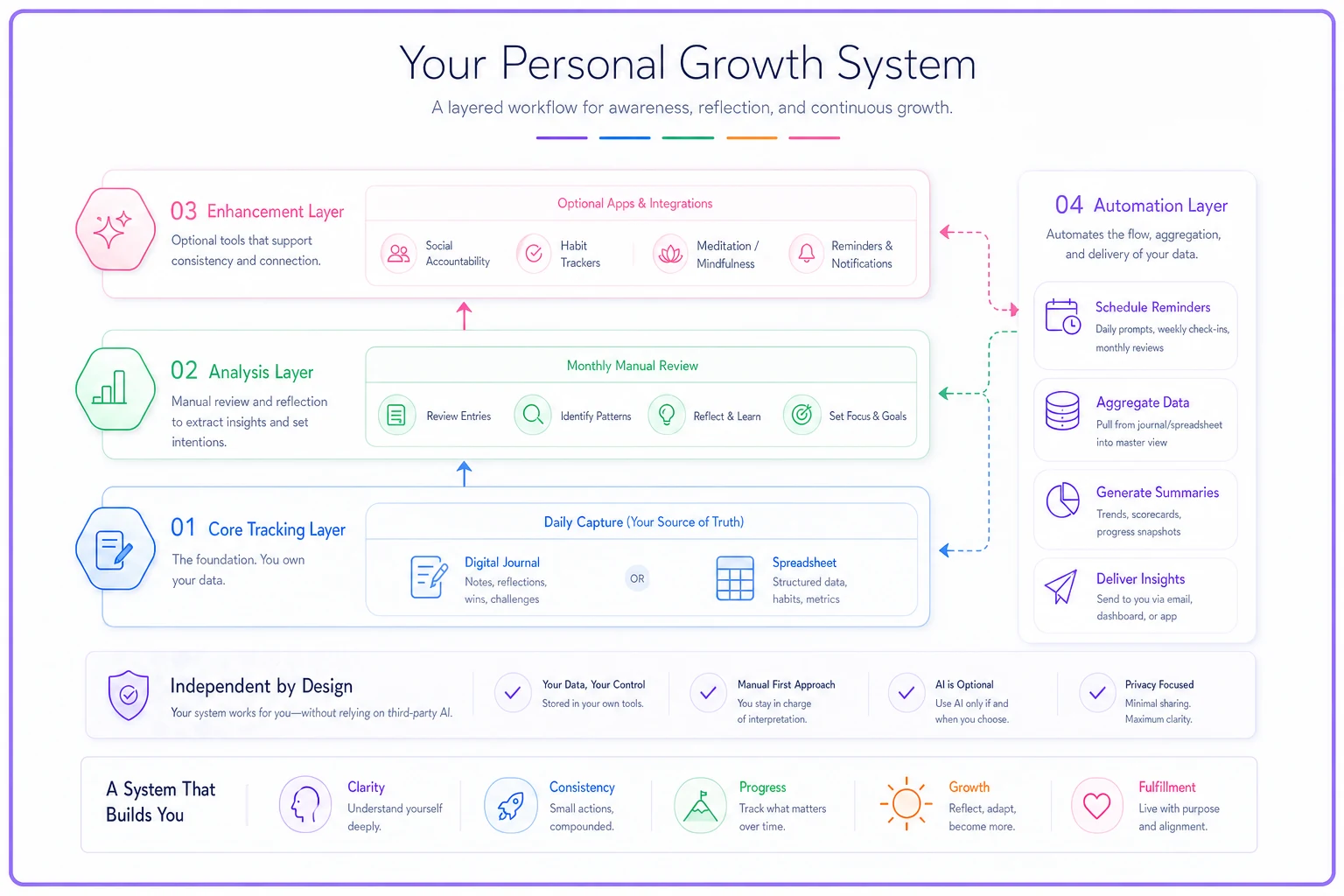
A simple visualization makes it clear which parts you control and which are optional add-ons.
Automation Layer This is where operational software becomes genuinely useful without any compliance risk. Not AI making behavioral predictions, but automation handling the tedious logistics: scheduling check-ins, aggregating data from multiple sources, sending simple reminders. AI automation works best managing workflows—not pretending to be your coach.
The Reuters report on this noted that companies may overcorrect, removing helpful features just to avoid any regulatory exposure at all. Building your own system means corporate legal decisions stop being your problem.
What actually happens next
By September, the habit-tracking landscape will look noticeably different. Some apps will respond to FTC guidance thoughtfully and emerge stronger. Others will strip features and bleed users. A few will probably fold rather than deal with potential enforcement at all.
The real question is what happens to your data. Apps under compliance pressure might archive or delete historical records that could theoretically be used as evidence against them. They might reset AI models and lose whatever genuine personalization you'd accumulated. They might change data formats, quietly making exports harder to migrate.
The window here is weeks, not months. Corporate legal departments have a long history of overreacting to regulatory signals, and that overreaction tends to come fast.
The bottom line nobody wants to admit
This FTC guidance is exposing something a lot of us already suspected: most "AI coaching" is randomized content dressed up in good marketing copy. The apps that survive will be the ones providing real value through thoughtful features, quality content, and genuine user support—not algorithmic smoke and mirrors.
For users, the right move is taking control of your habit tracking now, before apps make that decision for you. Export your data, figure out what's actually driving your progress, and build systems that don't depend on any single platform's promises.
The habits that stick aren't managed by the smartest AI. They're the ones you own completely, track consistently, and adjust based on real results. Whether that happens in a cutting-edge app or a plain spreadsheet matters a lot less than the industry spent years trying to convince you.
The habits that stick aren't managed by the smartest AI. They're the ones you own completely, track consistently, and adjust based on real results. Whether that happens in a cutting-edge app or a plain spreadsheet matters a lot less than the industry spent years trying to convince you.
Ready to unlock your full potential?
Join thousands of users transforming their lives using Growyly to stay motivated, organized, and growth-focused every day.