
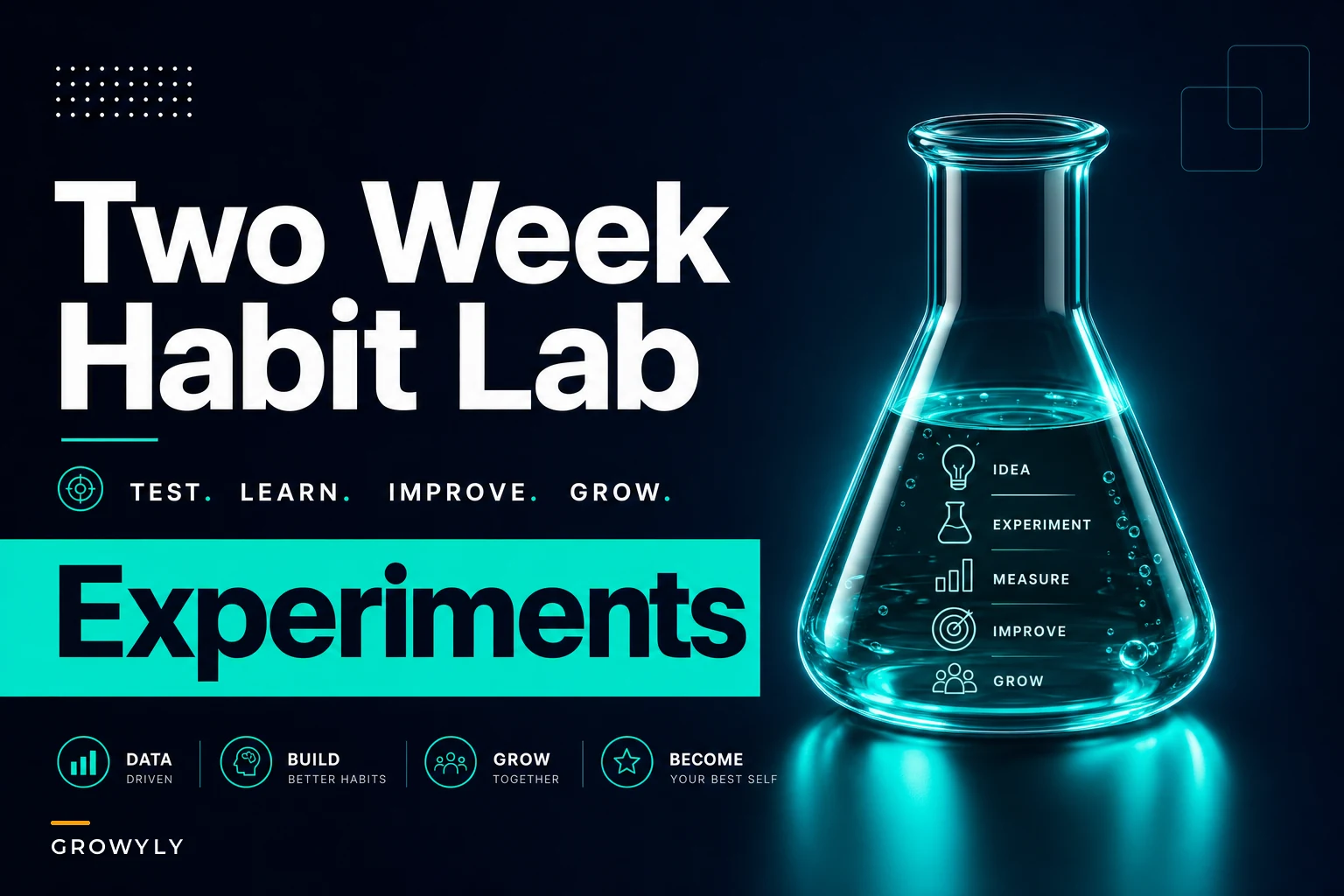

Most habit advice tells you to commit for 30, 60, or 90 days. But that's backwards. You're basically throwing spaghetti at the wall for months hoping something sticks. What actually works is running quick two-week experiments that give you clear data about what works for your specific life.
I stumbled into this after burning through about a dozen habit apps and feeling like I was getting nowhere. The problem wasn't motivation or willpower. It was that I kept committing to habits without testing whether they actually fit my schedule, energy levels, or priorities.
Now I run everything through a two-week testing protocol first. No big commitments. No guilt when something doesn't work. Just rapid experiments that tell me what's worth pursuing long-term.
Why Two Weeks Changes Everything
Fourteen days hits a weird sweet spot. It's long enough to get past the initial enthusiasm phase where everything feels easy, but short enough that you can actually commit without your brain throwing up resistance.
More importantly, two weeks gives you real data. You'll hit at least one weekend, one stressful workday, probably a social event or two. You see how the habit performs under actual life conditions, not just when everything's going smoothly.
The traditional approach — picking a habit and white-knuckling it for months — is like launching a product without any customer feedback. You're operating blind. A two-week experiment is more like a beta test. You're gathering signals before making the big investment.
When you frame it as an experiment instead of a commitment, your brain stops fighting you. There's no pressure to be perfect. You're just collecting data. That mental shift alone makes a massive difference in follow-through.
The Hypothesis Framework That Prevents Wasted Time
Before starting any two-week experiment, you need a clear hypothesis. Not "I want to exercise more" — something you can actually test and measure.
Achieve more by focusing on what matters.
Growyly helps you build lasting habits and track your personal growth effortlessly.
- Goal setting with progress tracking
- Daily habit reminders
- Motivational insights and analytics
No credit card required
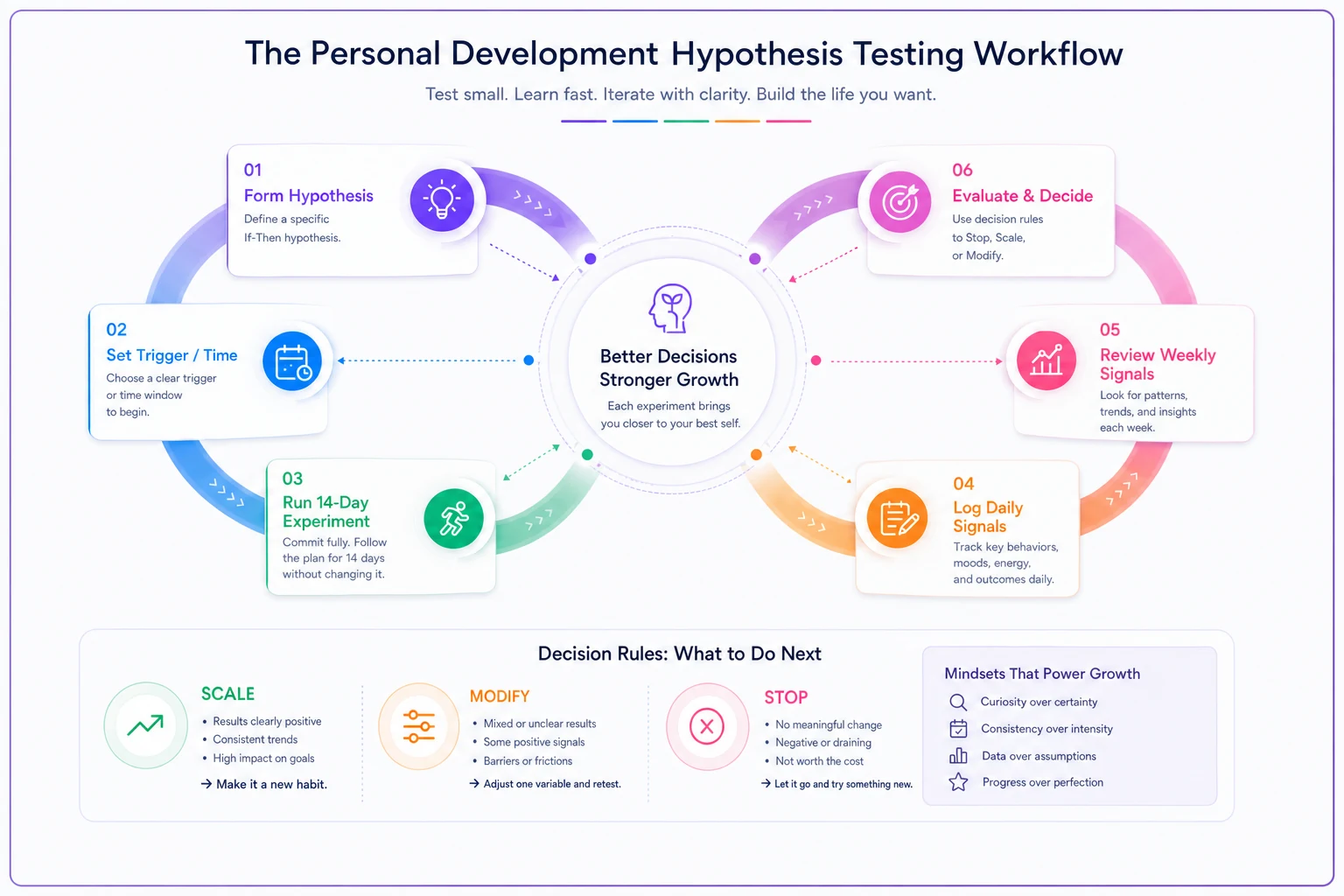
The format I use: "If I [specific behavior] at [specific time/trigger], then [measurable outcome] will happen within two weeks."
Here's a quick visual of the hypothesis testing workflow.
-
"If I write for 15 minutes immediately after morning coffee, then I'll produce at least 3,000 words by day 14"
-
"If I do 10 pushups every time I check social media, then I'll complete at least 120 pushups without it feeling forced"
-
"If I prep tomorrow's outfit before bed, then I'll save 5-10 minutes each morning and feel less rushed"
Notice how specific these are. You know exactly what to do, when to do it, and what success looks like. That clarity is what separates real experiments from wishful thinking.
The hypothesis also gives you permission to fail. If your prediction doesn't pan out, that's useful information. Maybe 15 minutes of writing is too much. Maybe the social media trigger fires too often. You learn and adjust instead of feeling like you failed at another habit.
Signal Templates for Tracking What Actually Matters
Most people track habits wrong. They obsess over streaks and completion rates when what really matters is understanding the conditions that make a habit work or fall apart.
Here's the tracking template I use for every experiment:
Daily Signals (30 seconds to log):
-
Completion
Yes/Partial/No
-
Friction level
1-5 (1 = effortless, 5 = massive resistance)
-
Energy after
Better/Same/Worse
-
Time taken
Actual minutes
-
Context note
One sentence about anything unusual
Log the single most relevant context note each day to make weekly pattern-spotting much faster.
Weekly Signals (5 minutes on Sunday):
-
Total completions
-
Average friction score
-
Most common failure point
-
Best performing day/time
-
Adjustment for next week
This gives you actual operational intelligence about the habit. You're not just tracking whether you did it — you're building a picture of why it works or doesn't.
For example, I tested a morning meditation habit and discovered my friction scores were 4-5 on weekdays but 1-2 on weekends. The issue wasn't the meditation itself. It was trying to squeeze it into a rushed morning routine. I moved it to lunch breaks and it clicked almost immediately.
Stop/Scale Decision Rules
After 14 days, you need a clear decision framework. Otherwise you'll end up in that grey zone of "maybe I should keep trying" — and nothing gets decided.
Stop Signals (abandon the habit):
-
Completed less than 50% of days
-
Average friction score above 3.5
-
Consistently negative energy impact
-
Requires unsustainable effort
-
Conflicts with higher priority habits
Scale Signals (expand the habit):
-
Completed 80%+ of days
-
Average friction score below 2.5
-
Noticeable positive outcomes
-
Takes less time than allocated
-
Natural momentum building
Modify Signals (run another experiment):
-
Completed 50-80% of days
-
Specific failure pattern identified
-
Works sometimes but not others
-
Good concept, wrong implementation
-
Needs different trigger or timing
These rules remove emotion from the decision. You're not giving up or being lazy. You're following the data.
I tested a 5am wake-up experiment that had great results when it worked — about 40% of the time — but averaged a friction score of 4.2. The data said modify, not scale. So I tested 5:30am instead. Same benefits, friction dropped to 2.3, completion jumped to 85%.
Five Ready-to-Run Experiment Templates
Here are tested experiments you can start right now. Each includes the hypothesis, protocol, and success metrics.
Experiment 1: The Energy Audit
Hypothesis: "If I rate my energy levels hourly for 14 days, I'll identify at least two optimal windows for difficult tasks"
Protocol: Set phone alarm every hour from 8am-8pm. Rate energy 1-10. Note what you just did.
Success Metrics: Clear pattern emerges, 85%+ data collection
Experiment 2: The Micro-Journal
Hypothesis: "If I write three sentences before bed about the day, I'll sleep better and have clearer priorities"
Protocol: Keep notebook by bed. Write: best moment, biggest challenge, tomorrow's priority
Success Metrics: Fall asleep faster 8+ nights, wake up with clear focus 10+ days
Experiment 3: The Task Batching Test
Hypothesis: "If I batch all emails into two 20-minute blocks, I'll save 45+ minutes daily"
Protocol: Check email only at 11am and 4pm. Time both sessions. Track total time vs. previous average.
Success Metrics: Time saved exceeds 30 minutes, no critical delays
Experiment 4: The Movement Snack
Hypothesis: "If I do 60 seconds of movement every 45 minutes, my afternoon energy won't crash"
Protocol: Timer for 45-minute intervals. Do pushups, stretches, or walk. Rate energy at 2pm and 5pm.
Success Metrics: Afternoon energy stays above 6/10, no 3pm slump
Experiment 5: The Commitment Inventory
Hypothesis: "If I list every commitment for two weeks, I'll find 3+ things to eliminate"
Protocol: Write down every yes, every obligation, every recurring task. Tag each as energizing/neutral/draining.
Success Metrics: Identify clear patterns, eliminate or delegate 3+ draining items
The Pre-Launch Checklist
Before starting any two-week experiment, run through this list:
Hypothesis Check:
-
[ ] Specific behavior defined
-
[ ] Clear trigger or time
-
[ ] Measurable outcome stated
-
[ ] Two-week timeline realistic
Environment Prep:
-
[ ] Required tools ready
-
[ ] Obstacles removed
-
[ ] Tracking system set up
-
[ ] Reminder system activated
Commitment Sizing:
-
[ ] Takes less than 15 minutes
-
[ ] Doesn't require perfect conditions
-
[ ] Can be done at 60% energy
-
[ ] Won't derail if missed once
Success Criteria:
-
[ ] Stop signals defined
-
[ ] Scale signals defined
-
[ ] Modification options identified
-
[ ] Review date scheduled
Backup Plan:
-
[ ] If-then scenarios mapped
-
[ ] Minimum viable version defined
-
[ ] Recovery protocol ready (see
| Checklist Area | Items |
|---|---|
| Hypothesis Check | [ ] Specific behavior defined; [ ] Clear trigger or time; [ ] Measurable outcome stated; [ ] Two-week timeline realistic |
| Environment Prep | [ ] Required tools ready; [ ] Obstacles removed; [ ] Tracking system set up; [ ] Reminder system activated |
| Commitment Sizing | [ ] Takes less than 15 minutes; [ ] Doesn't require perfect conditions; [ ] Can be done at 60% energy; [ ] Won't derail if missed once |
| Success Criteria | [ ] Stop signals defined; [ ] Scale signals defined; [ ] Modification options identified; [ ] Review date scheduled |
| Backup Plan | [ ] If-then scenarios mapped; [ ] Minimum viable version defined; [ ] Recovery protocol ready (see: restarting after a lapse) |
Missing any of these dramatically increases failure risk. The prep work takes maybe 10 minutes but saves weeks of wasted effort.
Common Failure Patterns and Fixes
The Overcommitter: Designs an experiment that requires 100% completion to feel successful. Fix: Build in 80% as your target. Perfect is the enemy of data.
The Vague Tracker: "I'll meditate more" or "I'll eat better." No clear metrics, no clear results. Fix: Define exactly what counts as completion.
The Context Ignorer: Runs experiments during vacation or unusually stressful stretches. Fix: Wait for a typical two-week period that represents normal life.
The Serial Starter: Runs 5 experiments simultaneously. All fail. Fix: One experiment at a time until you've got the process down.
The Perfectionist: Abandons the experiment after missing day 3. Fix: Missing days is data, not failure. Keep going.
How AI-Powered Tracking Amplifies Your Experiments
The manual tracking described above works, but it's honestly a pain to maintain consistently. This is where operational software becomes genuinely useful — not as a crutch, but as a force multiplier for your experiments.
Modern habit-tracking platforms with AI automation can surface patterns you'd likely miss on your own. Things like your completion rate dropping every time you have morning meetings, or your energy scores correlating with the previous night's sleep. Instead of digging through a spreadsheet on day 14, you're getting those signals by day 4 or 5 — early enough to actually adjust.
The automation also handles the tedious parts: check-in reminders, metric calculations, weekly review reports. You stay focused on actually doing the experiment while the software handles the overhead.
The key thing though — the software amplifies a good process, it doesn't create one. You still need the hypothesis, the clear protocol, the decision rules. AI-powered tools just make execution and analysis faster.
The Compound Effect of Rapid Testing
Running two-week experiments might seem slower than committing to a bunch of habits at once. It's not. After six months of experiments, you'll have tested 12 or 13 different approaches and know exactly what works for your specific situation.
Compare that to spending those same six months forcing one or two habits that don't really fit your life. The experimental approach gets you to the right habits faster, even though each individual test is shorter.
The real payoff comes when experiments start informing each other. You discover your peak energy window is 10am-noon, so you test placing your hardest habit there. You learn you need visual triggers, so you test adding sticky notes. Each experiment feeds the next one.
This is exactly how building a 12-month personal growth system becomes realistic. You're not guessing what habits to commit to for a year. You've already tested them. You know they work.
Start Your First Experiment Today
The biggest mistake people make is overthinking their first experiment. They want the perfect hypothesis, the perfect tracking system, the perfect window of time. But the whole point is to learn through action, not planning.
Pick something small. Something you've been curious about. Something that would take less than 10 minutes a day. Run it through the hypothesis framework, set up basic tracking, and start tomorrow.
Two weeks from now, you'll have real data about what works for you — not generic advice from productivity blogs or motivational videos. Actual evidence from your own life.
The two-week habit experiment isn't just another framework. It's a different philosophy. Instead of forcing yourself to commit based on hope, you're running controlled tests based on curiosity. Instead of guilt about "failed" habits, you're collecting data about what doesn't fit.
And that knowledge compounds. Each experiment teaches you something, whether it succeeds or fails. After enough of them, you stop guessing and start knowing how to design habits that actually stick.
Ready to unlock your full potential?
Join thousands of users transforming their lives using Growyly to stay motivated, organized, and growth-focused every day.