

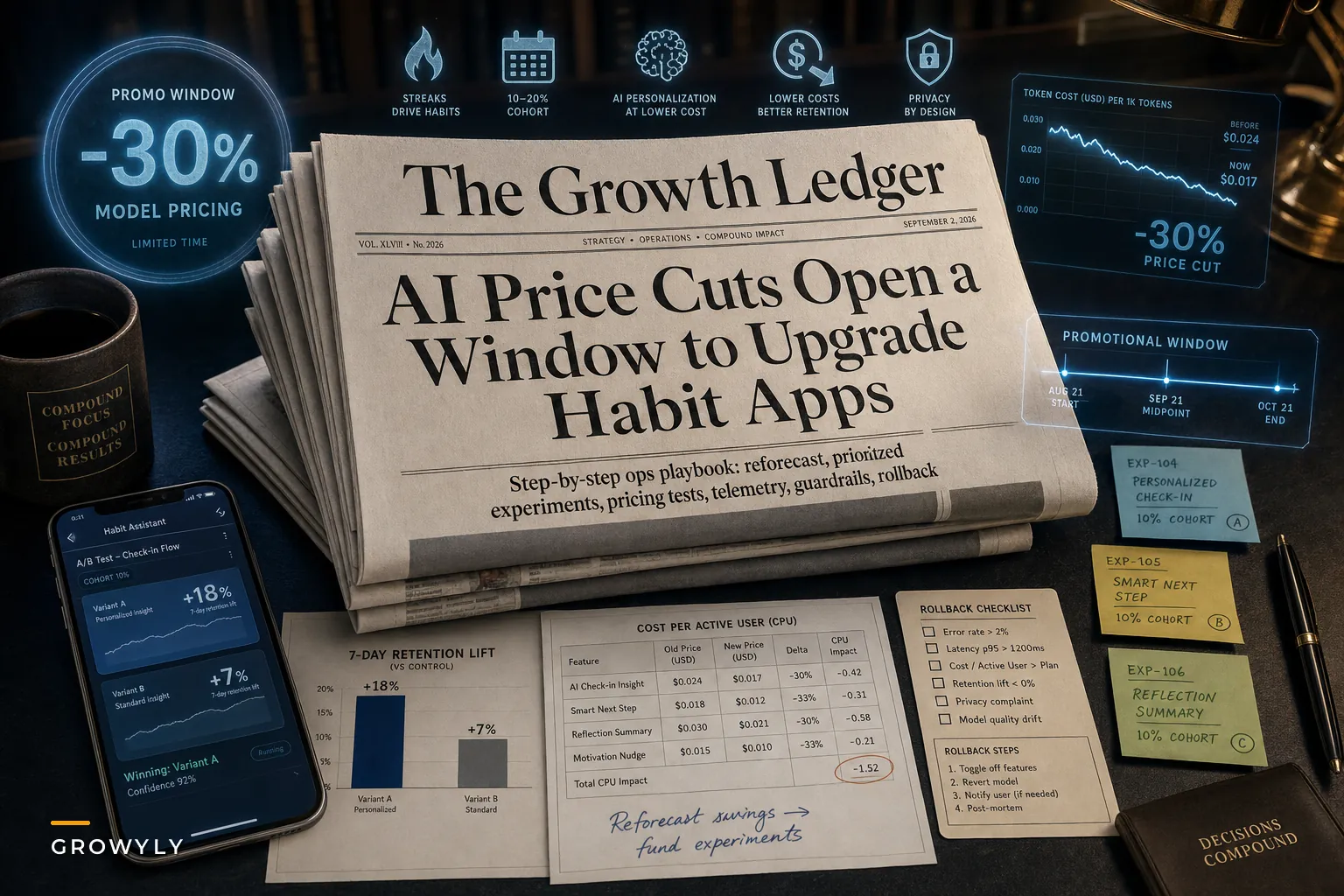

For most of the last two years, the expensive part of running an AI-heavy habit app wasn't the idea — it was the output tokens. Every richer reflection, every personalized nudge, every "here's what your week actually looked like" summary quietly ate into margin. So teams did the sensible thing: they capped it. Short responses. Cached prompts. Cheaper fallback models for anything that wasn't premium-tier.
That constraint just loosened. On August 21, 2026, OpenAI announced a promotional price reduction for its GPT‑5.6 Sol model — roughly 20% off input tokens and a steeper cut on output, as Reuters reported. The details on OpenAI's own page frame it as a frontier model getting cheaper to run at scale. The important word for anyone building product is promotional. It's a window, not a new floor. Which means the interesting question isn't "should we celebrate cheaper AI" — it's "what do we actually do with a temporary cost break before it closes."
This post is about that operational window, and the trap most teams fall into when a price cut lands.
The mistake almost everyone makes with a price cut
The reflex is to turn everything up. Longer AI reflections, more frequent coaching messages, richer weekly recaps for every user regardless of tier. Costs are down 20%, so ship 20% more, right?
AI API price cuts don't change your product decisions, they change your experiment budget. A cheaper output token doesn't make a feature good. It makes it cheaper to test whether a feature is good. Teams that treat the discount as permission to permanently inflate baseline usage end up with a cost structure they can't sustain and users who now expect a level of richness you priced for a promo.
Better framing: you've been handed a few months of cheaper experimentation. Use it to learn things you can keep whether or not the price holds.
What actually got cheaper, and where it matters for habit apps
Not all AI usage in a habit-tracking app is created equal. Some of it is high-frequency and low-value. Some of it is rare but genuinely changes retention. The price cut helps most where you were previously rationing the good stuff.
Achieve more by focusing on what matters.
Growyly helps you build lasting habits and track your personal growth effortlessly.
- Goal setting with progress tracking
- Daily habit reminders
- Motivational insights and analytics
No credit card required
| Feature type | Token profile | Was it rationed before? | Worth expanding during the window? |
|---|---|---|---|
| Daily streak nudges | Tiny, high volume | Rarely — already cheap | No, this wasn't your cost problem |
| Weekly reflection summaries | Large output, weekly | Often trimmed for length | Yes — test fuller versions |
| Real-time coaching on a lapse | Large, context-heavy, unpredictable | Usually gated to premium | Yes — test on a wider cohort |
| Pattern detection across weeks | Heavy input, moderate output | Often batched or skipped | Yes — richer input is now affordable |
| Onboarding personalization | Medium, one-time | Sometimes generic to save cost | Maybe — high leverage moment |
Your cheapest features — streak nudges — were never the problem, so throwing the discount at them does nothing. The features that got rationed — real coaching after a lapse, honest weekly reflection, cross-week pattern spotting — are the ones tied to whether someone keeps the app past week three. That's where the window actually pays off.
A workflow for using the window without getting burned
WORKFLOW: Making the Most of a Temporary Price Window [Reforecast at new + old rate] ↓ [Pick 2–3 rationed features tied to retention] ↓ [Roll to a cohort (10–20% of users)] ↓ [Instrument per-feature cost per active user] ↓ [Set alerts + write rollback plan before launch] ↓ [Measure lift over the promo window] ↓ [Decide what stays, what moves to premium, what gets cut]
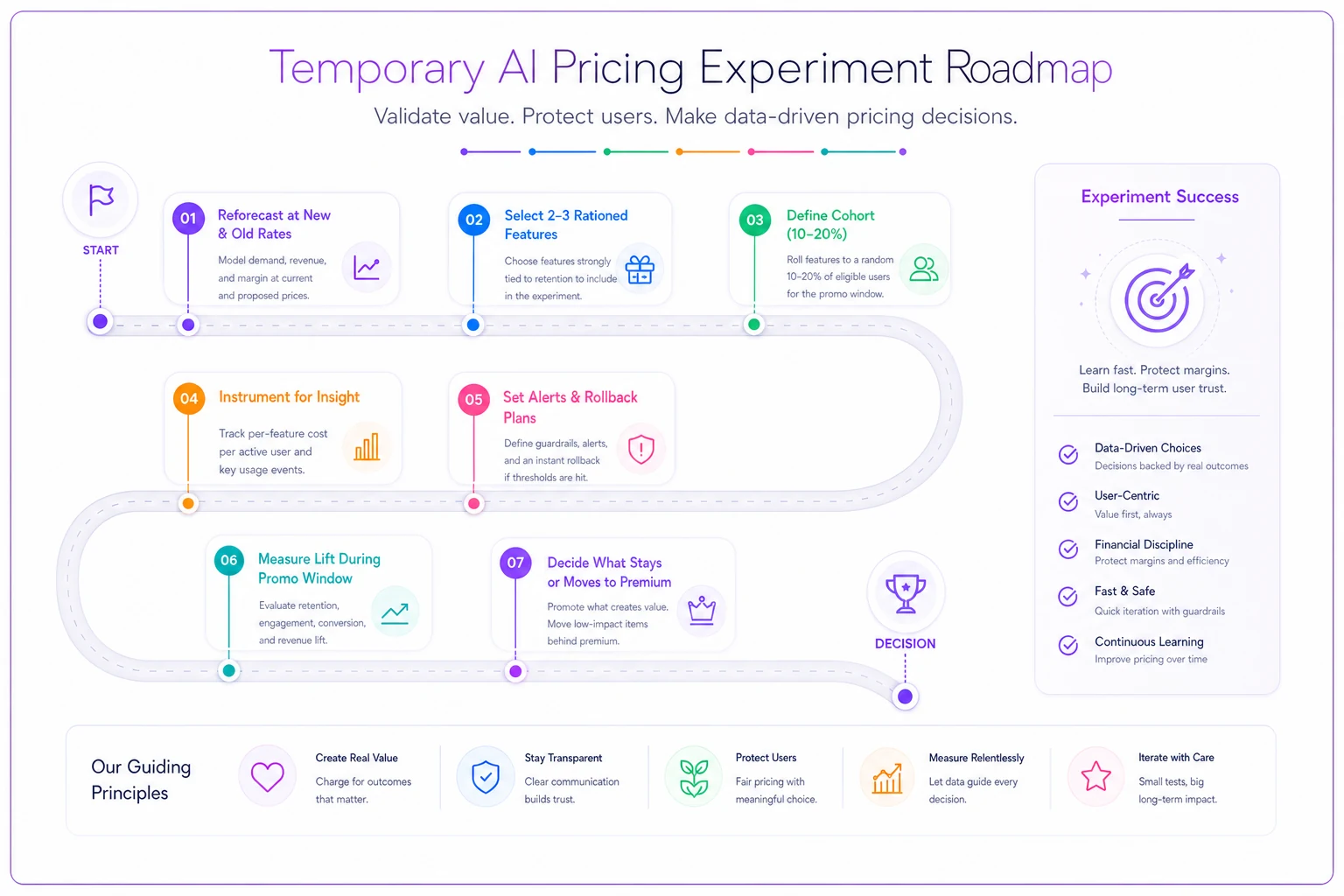
Here's the operational sequence visually.
-
Reforecast current AI spend at the new rate — then again at the old rate. You want both numbers. The old-rate forecast is your baseline for every experiment you're about to launch.
-
Pick 2–3 rationed features, not 10. Choose the ones you suspect drive retention but couldn't afford to run richly. Depth beats breadth here.
-
Ramp usage to a cohort, not the whole base. Roll richer reflections or wider coaching to 10–20% of users. You're measuring lift, not blanketing everyone.
-
Instrument cost per active user, per feature. Not blended cost. If you can't see what a single richer reflection costs per user, you can't decide what to keep later.
-
Set usage and billing alerts before you ramp, not after. Cheaper tokens plus a wider cohort plus an unexpected engagement spike is exactly how a "cheap" experiment triples your bill in a week.
-
Write the rollback plan on day one. Decide in advance
if pricing reverts in November, which features drop back, which move to premium tier, which you kill. Making that call under budget pressure leads to bad, reactive decisions.
Instrument per-feature cost before you scale a cohort so you can see the incremental spend in real time.
The teams that get value here treat this like a controlled experiment with a known expiry date. The ones that get hurt forgot the expiry date existed.
The deeper problem this exposes: your AI features have no cost identity
A price cut is a useful forcing function because it surfaces something most habit apps have avoided looking at — they don't actually know which AI features earn their cost.
In practice, this usually looks like: the app has a blended AI cost line, engagement is "fine," and nobody can tell you whether the weekly AI reflection is driving retention or just burning tokens. When AI was cheap-ish and trending cheaper, that fuzziness was tolerable. But a promotional cut is a trap for exactly these teams. They'll expand blindly, feel good for three months, then face a bill they can't attribute to any specific value.
The apps that come out of this window ahead aren't the ones that spent the most on richer AI. They're the ones that finally built a clean map of feature → cost → retention impact. Once you have that map, the promo ending doesn't scare you — you already know which features earn their keep and which two or three don't.
A concrete version of this: real-time coaching after a lapse feels expensive and premium, so it gets gated hard. But when you actually measure it, catching someone in the first 48 hours of a slip may be one of the highest-retention moments in the entire product. The window is your chance to prove that with data instead of assuming it.
A realistic scenario
Consider a mid-size habit app — around 40k monthly active users, freemium model, AI reflections currently capped at a couple of short sentences to control cost. Before the price cut, blended AI spend ran somewhere in the low five figures monthly, and richer weekly recaps were premium-only because the output tokens made them too expensive to give away.
During the window, they don't turn everything up. They pick one thing: full weekly reflections rolled to roughly 15% of free users, with tight per-user cost tracking. The richer reflection costs more per generation, but because it's cohort-limited and instrumented, the incremental spend stays manageable — not a doubling.
What they're actually buying isn't the feature. It's the answer to one question: does a genuinely good weekly reflection move week-4 retention enough to justify the cost at full price? If the cohort shows a clear lift — even a few points — they have a defensible case to either build it into premium or find another way to fund it when the promo ends. If it shows nothing, they killed a feature idea for the price of a three-week test instead of a permanent cost line.
Either outcome is a win, because the decision is now evidence-based rather than a guess made under budget pressure.
When expanding AI features makes sense — and when it doesn't
When this window is genuinely worth acting on:
-
You already have decent event instrumentation and can attribute cost per feature
-
You have at least one rationed feature you believe drives retention but couldn't afford to test properly
-
You can roll to a cohort and read results within the promo window
-
Finance and product are aligned on what happens if pricing reverts
When you should mostly sit still:
-
Your AI spend was never the constraint — you were shipping thin AI features for product reasons, not cost reasons
-
You can't measure per-feature cost yet (fix that first, then experiment)
-
You'd be tempted to make the richness permanent and base-wide with no rollback plan
-
You're pre-product-market-fit and richer AI would just be polishing something users haven't validated
Who should genuinely skip this: early-stage apps still figuring out whether people want the core loop at all. A cheaper output token doesn't fix a habit product nobody sticks with. It just lets you lose money on a nicer version of the wrong thing.
Where pricing strategy quietly enters the picture
A temporary drop in AI costs is also a temporary opening to rethink what you charge and what you give away — because you can test premium-feeling features at free-tier cost for a few months without immediately hurting margin.
That's a pricing and retention decision as much as a product one. If richer AI coaching turns out to drive retention, the real question becomes whether it belongs in premium, whether it justifies a price change, or whether it's the thing that converts free users. Those aren't decisions to make reflexively, which is why this connects directly to the fundamentals in this piece on pricing and retention moves for habit-tracking subscriptions. The mechanics of testing a price change, protecting existing subscribers, and not training users to expect promo-level richness forever don't change just because your token costs dipped for a quarter.
The discount gives you room to run those experiments cheaply. It doesn't tell you what to conclude.
What to actually walk away with
A promotional price cut is a countdown clock, not a windfall. The apps that benefit treat it as a cheap window to answer expensive questions — which AI features earn retention, what they'd cost at full price, and what stays versus what goes when the promo closes.
-
Reforecast at both new and old pricing
-
Pick 2–3 rationed features tied to retention, not your already-cheap ones
-
Ramp to a cohort with per-feature cost tracking
-
Set alerts and write the rollback before you launch
-
Decide what you keep based on measured lift, not vibes
Do that, and November isn't a threat. You'll walk out of the window knowing exactly which AI features deserve a permanent home in your product — and which ones were only ever affordable because the meter happened to be running slow.
Do that, and November isn't a threat. You'll walk out of the window knowing exactly which AI features deserve a permanent home in your product — and which ones were only ever affordable because the meter happened to be running slow.
Ready to unlock your full potential?
Join thousands of users transforming their lives using Growyly to stay motivated, organized, and growth-focused every day.