

A while back I watched someone completely abandon his morning writing habit during a business trip. Not because he didn't have time — he had two hours to kill at the airport. Not because he lacked motivation — he'd been on a solid streak for weeks.
He failed because his entire habit system was built around his home office desk, a specific coffee mug, and the view from his apartment window. Take those away and his brain had no idea it was supposed to write.
This is more common than most habit advice acknowledges. You build a routine that works great in your regular environment, then watch it fall apart the moment you're in a hotel room, on a train, or sitting in someone else's office. The fix isn't willpower or better planning. It's building portable habit anchors that don't depend on a fixed location.
The anchor problem nobody really addresses
Most habit advice assumes a fixed location. Sit at your meditation cushion. Use your workout corner. Go to your reading chair. Decent advice if you never leave your house.
Reality looks different. You're in a hotel bathroom trying to remember your morning routine. You're on a delayed train wondering if you can salvage your daily review. You're in a satellite office with none of your usual cues around you.
Your brain treats these situations as completely new contexts. Without familiar anchors, it doesn't register that it's time to run the habit. You might intellectually remember you're supposed to meditate, but the automatic trigger-routine-reward loop never fires.
The worst part is how this compounds. Miss a habit because you're traveling, and you're suddenly carrying the psychological weight of a broken streak. Now you're not just missing today — you're questioning whether the whole system works. Portable anchors solve a different piece of that puzzle than most habit advice gets into.
Building a library of one-minute anchors
People who maintain consistency across different environments don't rely on perfect setups. They build portable triggers that work regardless of location and take almost no setup.
Achieve more by focusing on what matters.
Growyly helps you build lasting habits and track your personal growth effortlessly.
- Goal setting with progress tracking
- Daily habit reminders
- Motivational insights and analytics
No credit card required
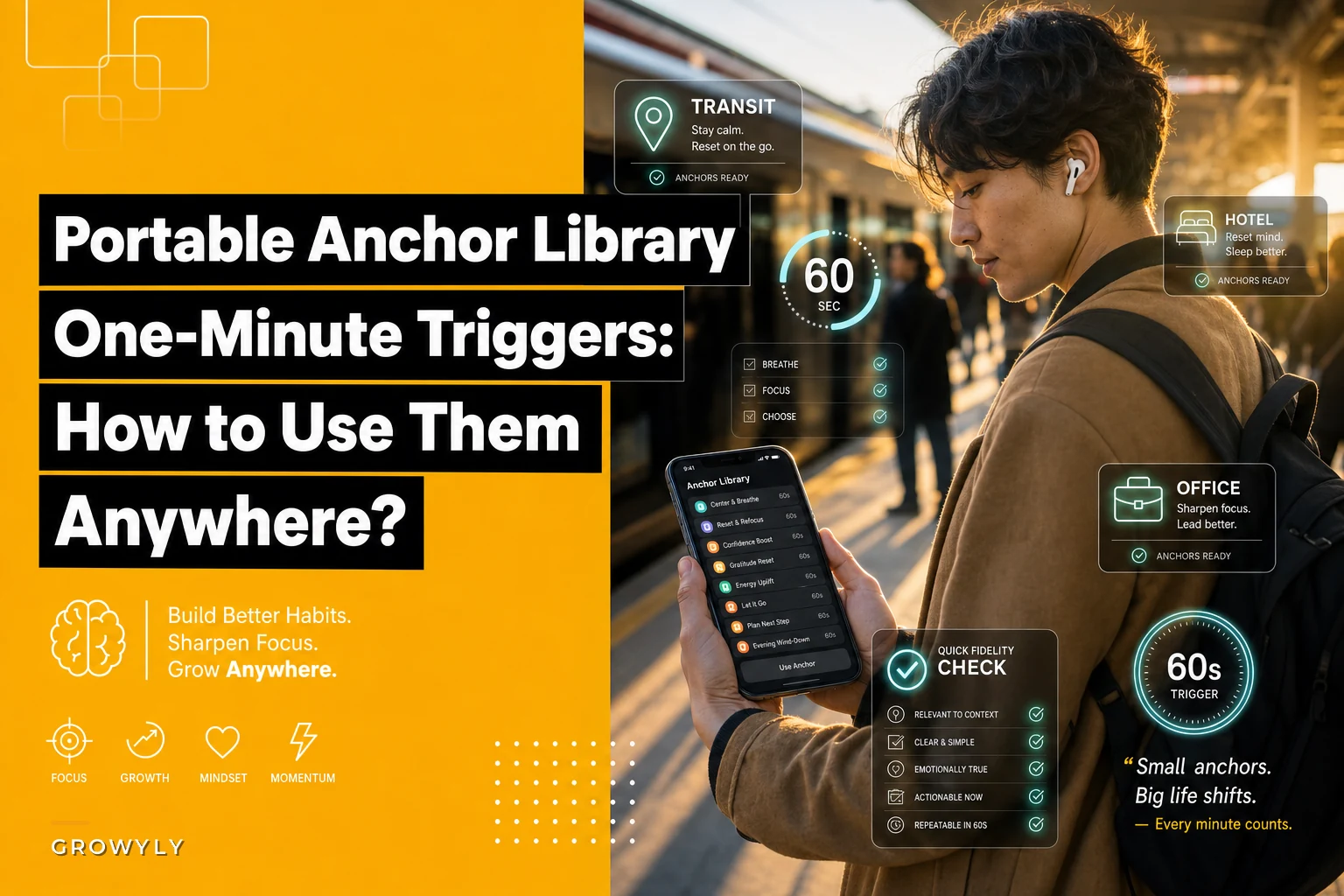
A portable habit anchor needs three things: it takes under 60 seconds to establish, it works across multiple environments without modification, and it creates a distinct sensory signal your brain recognizes as the starting gun.
Instead of needing your specific meditation cushion, you need a short breathing pattern that signals meditation time whether you're in a hotel bed or an airport gate. Instead of your home gym, you need a two-move warmup that tells your body it's time to move, even if you're doing bodyweight squats in a conference room.
Your brain doesn't need the fancy environment. It needs a consistent signal. Once that clicks, you can build anchors that travel with you everywhere.
Public transit anchors that actually work
Public transportation is genuinely difficult for habits. You're surrounded by people, dealing with noise, probably holding bags, not in control of anything. Yet commute time is one of the most consistent habit opportunities most people have, and almost nobody uses it well.
The playlist anchor: Create a specific 3-song sequence that only plays when you're doing your target habit. Not a whole playlist — exactly three songs, same order every time. Your brain learns this fast. Song one starts, you automatically pull out your journal app. Song three wraps up as you finish. Works on trains, buses, even walking.
The breathing ladder: Four counts in through your nose, hold for four, out for four. Repeat three times. The whole thing takes maybe 35 seconds. Works well for reading habits, language learning, or any cognitive work you want to establish on your commute. The controlled breathing shifts your mental state regardless of how packed the car is.
The notification flip: Turn your phone to airplane mode for exactly 10 minutes. Set a timer. This creates a clear boundary that says "habit time starts now." Particularly useful for anything requiring focus — writing, planning, reviewing.
One operations manager used the notification flip to write his daily priorities during his morning train ride. Started in the fall, and by winter he'd planned every workday during his commute, even when traveling to different cities. The airplane mode became the trigger — didn't matter if he was on the subway in New York or somewhere else entirely. The anchor moved with him.
Hotel room quick-starts
Hotel rooms throw people off. Everything's slightly wrong — the lighting, the smell, the layout. Your brain goes into novelty-seeking mode instead of habit-execution mode.
The bathroom reset: Before anything else, arrange three personal items on the bathroom counter in a specific pattern. Same layout every time. Takes maybe 20 seconds. The act of creating that setup in every new hotel room tells your brain you're in habit mode. Sounds almost too simple, but it works.
The kettle ritual: Most hotel rooms have a coffee maker or kettle. Fill it and start it heating while you do your first habit. The sound of heating water becomes your anchor. By the time it clicks off, you've meditated, journaled, or moved. You're using it as a timer and sensory cue, not really for the hot water itself.
The curtain cue: Open the curtains exactly halfway. Not fully open, not closed. This partial light becomes your signal for whatever habit you're building. Works morning or evening. Takes five seconds.
A sales director used the curtain cue for her evening review habit. Over a stretch of heavy travel — mostly budget chains, some nicer hotels — she only missed her review twice, both times when something was physically wrong with the curtains. Same anchor, consistent execution, totally different environments each time.
Office bathroom breakthroughs
This might sound odd, but office bathrooms are genuinely useful for habit anchors. They're private, accessible, and nobody questions why you're there.
The mirror check-in: Stand facing the mirror, hands on the counter, make eye contact with yourself for five full breaths. This becomes your trigger for a micro-meditation, affirmation practice, or mental reset. The physical posture combined with eye contact creates a surprisingly strong anchor.
The stall stretch: Stand with your back against the door, arms overhead, stretch up for three counts. This 15-second movement can signal a gratitude practice, visualization, or just a mental reset before a difficult meeting.
The soap pump pause: After washing your hands, leave them under the water for five extra seconds while you set an intention, review your next task, or run a quick breathing technique. Nobody questions someone thoroughly washing their hands.
Quick fidelity checks for any anchor
An anchor only works if it's actually triggering the habit. Here's a simple framework to test anything you create:
| Check Type | What to Measure | Red Flag |
|---|---|---|
| Setup Time | Time from decision to ready | Over 90 seconds |
| Recognition Rate | How often your brain "catches" the signal | Under 70% after a week |
| Context Independence | Number of different locations it works | Fails in more than 2 out of 5 places |
| Sensory Strength | How distinct the signal feels | Blends into background |
| Completion Rate | How often the anchor leads to the full habit | Under 50% conversion |
Run these checks after five days with any new anchor. If it fails more than two categories, modify or replace it. The table above isn't meant to be obsessive — it's just a gut-check so you catch dead anchors before they quietly kill the habit.
Adapting anchors for operational teams
When you're managing a team or running a small business, portable anchors matter even more. You're constantly switching contexts — client calls, team meetings, different workspaces. Your ability to stay focused across those transitions directly affects how you operate.
A procurement manager at a logistics company built what he called "transition anchors" between major context switches. Before client calls: three desk pushups. After team meetings: write three action items on a sticky note. Before deep work: noise-canceling headphones on with no music for 30 seconds. These micro-anchors helped him stay focused across a lot of context switches in a single day.
What made them work wasn't the specific actions — it was the consistency. His team started picking up on the signals too. When the headphones went on, they knew not to interrupt. The anchors started serving double duty: personal triggers and informal team communication.
This is where AI-powered operational software can actually help. Instead of manually tracking which anchors work in which contexts, automation can recognize patterns — noticing that a particular morning anchor has a high success rate but drops off in afternoons, or that your playlist anchor works well on trains but falls apart in noisy buses. It can suggest context-appropriate anchors based on your calendar and location. About to enter back-to-back meetings? It prompts a reset anchor between sessions. Traveling next week? It surfaces which anchors have worked best in hotel environments based on your history. It's not replacing your judgment — it's reducing the cognitive overhead of maintaining habits across constantly shifting contexts.
Environment mismatches and habit friction
Sometimes portable anchors fail not because they're poorly designed, but because they create too much friction in a specific environment. A breathing exercise that works great in your car might feel awkward on a packed elevator. A stretching routine perfect for your home office might seem off in a conservative corporate setting.
Build alternatives. For each core habit, develop anchors at three different friction levels:
Low friction: Works anywhere without anyone noticing. Usually mental or breath-based. Examples: counting backward from 10, clenching and releasing your fists three times, or humming a specific tune in your head.
Medium friction: Requires some space or privacy but still broadly applicable. Examples: standing and sitting three times, writing one sentence in your phone, or doing wall pushups.
High friction: Needs specific conditions but provides the strongest signal. Examples: a full stretching routine, loud affirmations, or equipment-based triggers.
Match the friction level to your environment. Packed subway? Low friction. Empty conference room? High friction. Hotel room alone? Somewhere in the middle, depending on what you're doing. Getting this right mostly comes down to trial and error — don't overthink it upfront.
The compound effect of portable habits
People who develop strong portable anchors don't just maintain their habits better while traveling — they actually improve their consistency at home too.
When you train your brain to recognize multiple triggers for the same habit, you're building redundancy into the system. Your home anchor fails? The portable anchor still works. Travel throws off your routine? Your anchors travel with you.
One account manager tracked her meditation habit over about a year and a half. First six months using only home-based anchors: consistency hovered around 72%. After adding portable anchors, it climbed to roughly 89%. By the end, with a full anchor library in place, she was hitting close to 94%. The portable anchors didn't just help during travel — they became backup systems for busy days and unexpected disruptions at home too.
This redundancy principle applies directly to business operations. Companies that rely on single-point systems fail when that point breaks. Organizations with multiple pathways and portable processes maintain consistency regardless of disruption. The same logic that makes portable habit anchors work makes operational systems more resilient to disruption.
When anchors stop working
Every portable anchor has a lifespan. Sometimes they wear out from overuse — your brain stops treating the signal as something special. Sometimes a life change breaks them. Sometimes they just quietly stop triggering the habit response.
Watch for these warning signs:
-
You do the anchor but "forget" to do the habit
-
The anchor starts feeling like a chore
-
You find yourself modifying it each time
-
The habit happens without the anchor more often than with it
When an anchor stops working, don't try to revive it. Build a new one. The goal is maintaining the habit, not preserving a specific trigger. Think of anchors as disposable tools, not permanent fixtures.
A product manager learned this when his "coffee shop writing" anchor stopped working after his favorite café closed. Instead of chasing a similar coffee shop, he built an entirely new anchor around library study rooms. Different environment, different trigger, same writing habit intact.
Building your personal anchor library
Start with your three most important habits. For each one, develop an anchor in each of these categories:
Movement-based: Physical actions that signal habit time. Push-ups, stretches, walking patterns, hand movements.
Sound-based: Audio cues that trigger habits. Playlists, alarms, notification sounds, or humming patterns.
Visual-based: Things you look at to start habits. Mirror work, specific images, lighting changes, or object arrangements.
Time-based: Duration-dependent anchors. Timers, countdowns, or specific time blocks.
Location-based: Place-dependent but still portable. Bathroom anchors, stairwell triggers, or parking lot cues.
Test each anchor in at least three different environments and document what changes.
Test each anchor in at least three different environments before adding it to your library. Document what works, what fails, and why. Five rock-solid anchors beat 20 unreliable ones every time.
The integration advantage
Instead of treating habits as isolated behaviors, start seeing them as integrated systems. Your portable anchors don't just trigger individual habits — they create operational flows.
AI-powered operational software makes this integration practical. It can track which anchors you've used on a given day, suggest alternatives based on your schedule, and surface patterns you wouldn't catch manually — like the fact that you consistently need stronger anchors after difficult meetings. It can prompt a reset proactively before you even think to use it.
The diagram below shows a simple flow: user performs anchor, system recognizes context, system suggests or enacts a supporting action.
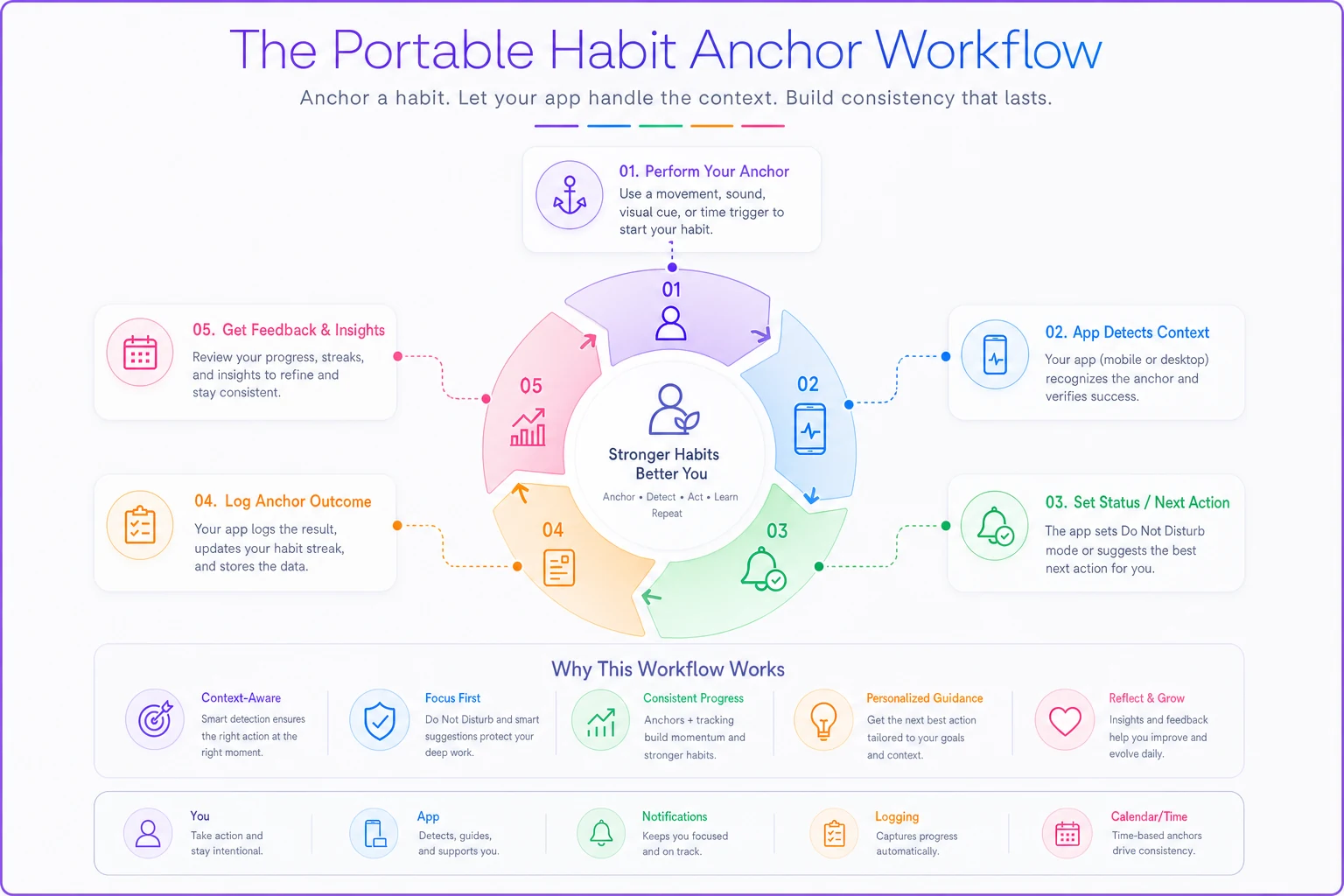
More practically: it can coordinate anchors with actual work. About to start deep work? The system suggests your "notification flip" anchor and sets your status to do not disturb across platforms. Finishing a stressful call? It blocks a few minutes on your calendar for a reset. It handles the logistics so you can focus on execution.
Making it stick
The biggest mistake people make with portable anchors is trying to implement too many at once. Your brain needs time to build each anchor-habit connection. Rush it and you end up with a bunch of weak triggers that work inconsistently.
Start with one habit and one portable anchor. Use it for two weeks in at least five different locations. Only after it feels automatic should you add a second anchor or start working on a different habit entirely.
Track your success rate. If an anchor works less than 70% of the time after two weeks, modify or replace it. Don't get attached to anchors that seem clever but don't actually trigger the habit.
The bottom line on portable triggers
Your habits shouldn't be prisoners of your environment. With the right portable anchors, you can maintain consistency whether you're in your perfect home setup or a hotel room that smells slightly off. The key is building a library of quick, reliable triggers that work across contexts — and knowing when to swap one out for something better.
Here's a simple sequence to get started:
-
Pick one habit you want to make portable
-
Choose one anchor type (movement, sound, visual, time, or location-based)
-
Test it in three different environments over the next week
-
After five days, run the fidelity check from the table above
-
If it passes at least three categories, lock it in — if not, swap it out and try again
Start small. Pick one habit, create one portable anchor, test it in three environments this week. Document what works, refine what doesn't, build from there. Within a few months, you'll have a system that travels with you everywhere.
The compound effect is real. People with strong portable anchor libraries don't just maintain habits better — they build them faster, restart more easily after lapses, and feel more in control regardless of what life throws at them. If you want to see how your sleep environment affects how well those anchors land in the first place, the hour-by-hour evening routine is worth working through alongside this.
Ready to unlock your full potential?
Join thousands of users transforming their lives using Growyly to stay motivated, organized, and growth-focused every day.