
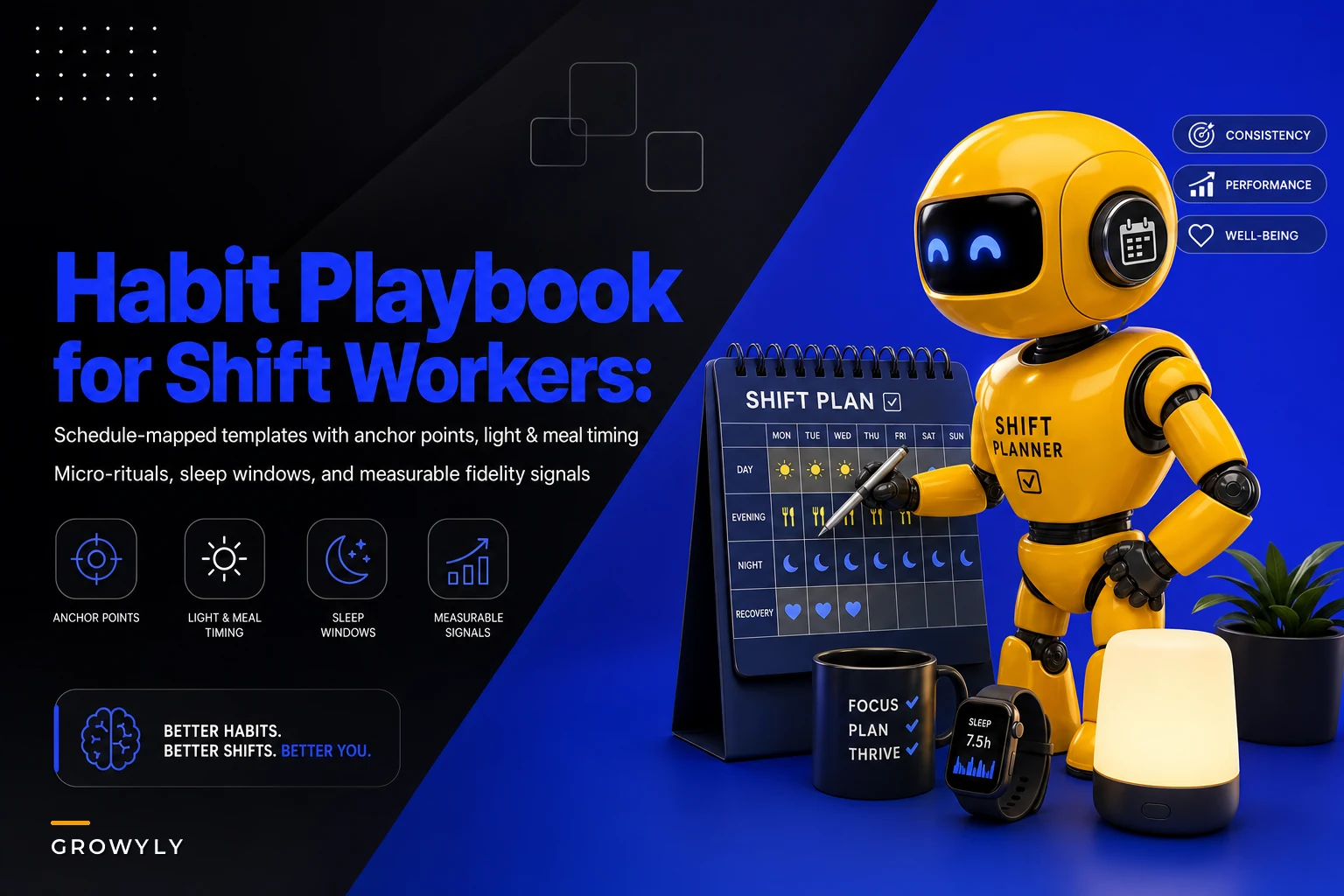

Working nights or rotating shifts destroys most habit advice. You know the type—wake at 5 AM, meditate, exercise, journal, then conquer your day. Great advice for someone whose "morning" happens at the same time every day. Completely useless when Monday's bedtime is Tuesday's wake-up call.
The typical habits for shift workers advice online tells you to "maintain consistency" or "stick to a routine." Which is almost funny when your schedule flips every few days. Or they tell you to power through with willpower and caffeine. Anyone who's worked nights knows that approach burns people out within a few months.
What shift workers actually need are flexible templates that adapt to schedule chaos while maintaining the core behaviors that keep you functional. Not rigid routines that fall apart the moment your shift pattern changes.
Why Standard Habit Systems Break on Shift Work
The fundamental problem isn't motivation or discipline. Conventional habit systems assume a stable 24-hour cycle. They're built on consistent anchor points—morning coffee, lunch breaks, evening wind-down. When you work nights, those anchors shift constantly or disappear entirely.
Take exercise habits. A day worker can hit the gym at 6 PM consistently. But if you're working 11 PM to 7 AM, that 6 PM slot might be your pre-shift prep time on work days and your sleep time on days off. The habit has no stable home.
Sleep routines get even messier. Standard advice says go to bed at the same time every night. On rotating shifts, that's just not possible. The biology doesn't care about your schedule—your body still releases melatonin based on light exposure, not whatever your employer decided this week.
The coordination problem compounds everything. Your family, friends, and the entire world operate on a day schedule. Maintaining relationships, appointments, and basic errands while working nights means constant schedule gymnastics. Every habit needs to flex around not just your work but everyone else's normal hours.
Most shift workers end up in reaction mode—sleeping when exhausted, eating whatever's available, exercising never. The habits that do stick tend to be the unhealthy ones that provide immediate relief from schedule stress.
The Three-Template System
Instead of forcing one routine to work across all shifts, you need three distinct templates that share core elements but adapt to timing realities.
Achieve more by focusing on what matters.
Growyly helps you build lasting habits and track your personal growth effortlessly.
- Goal setting with progress tracking
- Daily habit reminders
- Motivational insights and analytics
No credit card required
Template 1: Night Shift Active Days These are your working nights. Your "day" runs from roughly 6 PM to 10 AM the next calendar day. The template focuses on work performance and recovery.
-
Wake window
2-4 PM
-
Pre-shift routine
6-8 PM
-
Active shift
11 PM - 7 AM
-
Post-shift wind-down
7-9 AM
-
Sleep window
10 AM - 2 PM
Template 2: Transition Days The brutal shift between nights and days. Usually happens on your first day off when you're flipping back to a day schedule, or the day before returning to nights.
-
Short sleep after last night shift
9 AM - 1 PM
-
Active afternoon to build sleep pressure
1-8 PM
-
Early evening sleep
8 PM - 2 AM
-
Quiet morning activities
2-6 AM
-
Second sleep or rest
6-10 AM
Template 3: Day Mode Recovery Your days off when you're trying to sync with the normal world. This template prioritizes social connection and errands that require daylight hours.
-
Wake window
7-9 AM
-
Peak activity hours
10 AM - 6 PM
-
Evening routine
8-10 PM
-
Sleep window
10 PM - 7 AM
A simple visual workflow for choosing and switching templates.
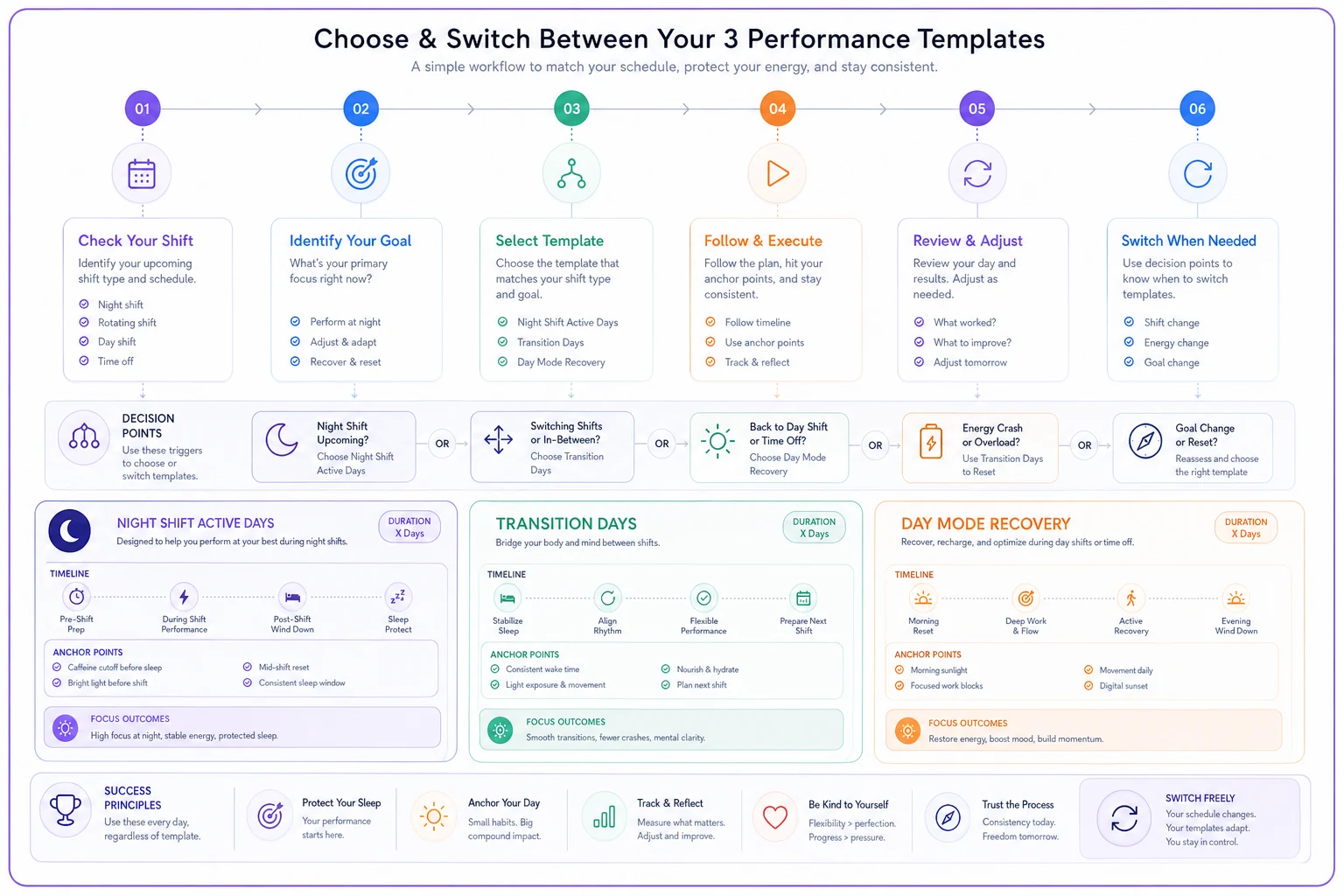
Each template has flexibility within structure. The windows aren't rigid—they're targets that can shift by an hour or two based on your specific situation.
Anchor Points That Travel Between Templates
Regular habits need anchor points that exist across all three templates. Unlike normal advice that says "always exercise at 7 AM," you need moveable anchors that maintain the habit regardless of when they happen.
-
First Conscious Hour Regardless of whether you wake at 2 PM or 7 AM, your first awake hour follows the same pattern. Hydration, light movement, checking your schedule. The behavior stays constant even as the clock time shifts.
-
Pre-Fuel Window The 2-hour window before your main activity period, whether that's a night shift or daytime errands. This includes your major meal prep, supplements, and energy management routine.
-
Mid-Point Reset The halfway mark through your active period. For night shifts, this might be 3 AM. For day mode, around 2 PM. This anchor triggers a quick assessment and energy adjustment.
-
Transition Ritual The 30-minute buffer between major activities—leaving for work, coming home, switching from work to personal time. These natural breaks become habit triggers.
-
Final Hour Your last awake hour before planned sleep. This keeps wind-down routines consistent regardless of whether you're heading to bed at 9 AM or 11 PM.
These anchors float with your schedule but maintain their relative position in your awake cycle. A meditation practice anchored to "first conscious hour" happens every day, just at different clock times.
Light and Meal Timing for Biology Management
Your body's circadian rhythm responds to light and food timing more than clock time. Managing these inputs helps reduce the biological chaos of shift work.
Light exposure strategy:
For night shifts, you're fighting natural light cues. Bright light exposure during your shift—especially 11 PM to 3 AM—helps maintain alertness. Blue light glasses aren't helpful during work; you actually want that alertness boost. Save the blue blocking for your post-shift wind-down when you need to trigger sleep despite morning sunlight.
The transition day light protocol is counterintuitive. After your last night shift, get sunlight exposure immediately even though you're about to sleep. That morning light starts resetting your rhythm for the day schedule you're moving toward. Your short sleep will be lower quality, but that's intentional—you want sleep pressure building for that evening.
On recovery days, maximize natural light between 10 AM and 2 PM. This reinforces normal circadian patterns and helps you stay in day mode even after returning to nights.
Meal timing adjustments:
Night shift eating works best on a modified intermittent pattern. Main meal pre-shift around 6-7 PM, lighter meal mid-shift around 2-3 AM, then fasting through your morning sleep period. This prevents the digestive disruption that comes from eating at biologically inappropriate times.
Transition days require careful timing. That afternoon wake period after your short sleep needs light foods—protein and vegetables, minimal carbs. Save the heavier meal for dinner around 5 PM, which helps trigger evening sleepiness.
Recovery days can follow more normal patterns, but keep dinner early (5-6 PM) to maintain good sleep pressure for your 10 PM bedtime. This matters more as you get older—shift workers over 35 often find late meals increasingly disruptive to sleep quality.
Micro-Rituals for Energy and Focus Management
Shift work demands frequent energy adjustments throughout irregular schedules. Instead of relying on caffeine crashes and sugar spikes, you need repeatable micro-rituals that provide quick resets without disrupting your biology further.
The 90-Second Reset
-
30 seconds of desk push-ups or wall push-ups
-
30 seconds of controlled breathing (4 counts in, 6 counts out)
-
30 seconds of cold water on wrists and face
Movement, oxygen, and temperature change trigger alertness without the 4-hour caffeine half-life that'll wreck your post-shift sleep.
The Handoff Ritual
-
Write three things you're leaving at work (literally write them on paper)
-
Change one piece of clothing (even just socks)
-
Do one physical movement that wouldn't happen at work (stretch, jumping jacks, whatever)
This sounds almost too simple, but physical actions create psychological transitions more reliably than mental intention alone.
The Permission Pause
-
Say out loud
"I have permission to sleep now"
-
List three things your sleep makes possible (income, safety for others if you work healthcare or security, being present on days off)
-
Set one boundary (phone on silent, door sign, etc.)
The permission pause is a 60-second ritual before sleep designed to counter social pressure and chronic guilt about inverted schedules.
Measurable Fidelity Signals
Tracking every metric is pointless when your schedule changes constantly. You need simple indicators that tell you whether your template system is working or breaking down.
Sleep Window Compliance Not sleep quality or duration—just whether you attempted sleep during your planned windows. Rate each sleep window:
| Rating | Definition |
|---|---|
| Green | Attempted sleep within 1 hour of planned time |
| Yellow | Attempted sleep 1-3 hours off plan |
| Red | Missed window entirely or shifted 3+ hours |
Three yellows or one red in a week means your template needs adjustment. Usually the fix is shifting all windows 30-60 minutes earlier or later, not throwing out the whole system.
The Alertness Checkpoint
-
Start of shift or main activity
-
Midpoint
-
Two hours before planned sleep
Rate your alertness 1-5 at each checkpoint. Don't overthink it—just gut reaction. Pattern recognition matters more than individual scores. If your midpoint rating drops below 3 for three consecutive shifts, your meal timing or light exposure needs adjustment.
Social Contact Success
Isolation hits shift workers hard. Track one metric: meaningful social contact per week. Not texts or social media—actual conversation with someone you care about. Voice calls count, video calls count more, in-person counts most. Less than three instances per week is a red flag. The template system should protect time for these connections, not eliminate them.
Schedule-Specific Habit Adaptations
Standard habits need modification to survive shift work. Here's how to adapt the most common personal development habits to your three-template system.
Exercise becomes "Movement Windows"
-
Night shift template
15-minute high-intensity at mid-shift (around 3 AM), longer workout on weekends
-
Transition template
Gentle yoga or walking only—your body can't handle intensity on four hours of sleep
-
Recovery template
Normal workout whenever it fits between 10 AM and 6 PM
Some weeks you'll get two good workouts. Other weeks maybe five. Progress happens in months, not weeks.
Meditation becomes "Stillness Practice"
-
Use transition rituals as mindfulness anchors (fully present during handoff ritual)
-
Practice breathing exercises during alertness checkpoints
-
Save formal meditation for recovery days when you have mental space
Reading becomes "Input Stacking"
-
Audiobooks or podcasts during commutes and mid-shift
-
Physical reading during pre-shift when alertness peaks
-
Save challenging material for recovery days
The goal shifts from "read 30 minutes daily" to "consume valuable input through whatever medium works today."
Building Your Personal Template Library
The three-template system is a starting framework. Your specific situation needs customization based on your shift pattern, family situation, and individual biology.
Start with one template—whichever covers your next three days. Run it as written for one week, tracking just the sleep windows. Then adjust windows by 30-minute increments until you find what works.
After nailing one template, add the second. The transition template usually needs the most experimentation because it's fighting biology the hardest. Some people do better with one long sleep, others need the split. Test both.
The recovery template comes last because it's closest to normal schedules. The main customization here is finding the balance between social time and actual recovery. Shift workers often overschedule their days off trying to maintain relationships, which leaves them exhausted heading into the next work cycle.
Your environment matters more for shift work than any other schedule type. Blackout curtains aren't optional—they're mandatory. White noise isn't just helpful—it's essential when you're sleeping while neighbors mow lawns. Your 15-minute environment audit should focus specifically on sleep environment and transition spaces.
Keep templates written down physically, not just in apps. When you're exhausted post-shift, you need to see exactly what comes next without having to think about it. A simple index card for each template, posted where you'll see it during transitions, prevents decision fatigue when you're already running on empty.
The Realistic Outcomes
Perfect compliance won't happen on shift work. That's not failure—that's reality. Success looks like hitting around 70% of your planned windows and maintaining core behaviors even when timing shifts.
The people who thrive on shift work aren't the ones with perfect discipline. They're the ones who build flexible systems that bend without breaking. Your templates will fail some weeks. Work emergencies, schedule changes, and life happens. The value is in having a framework to return to, not a rigid prescription to follow perfectly.
After a few months of running templates, most shift workers report better energy management even without perfect sleep. The predictability of knowing what template you're in reduces decision fatigue. Predetermined meal times prevent the panic eating that happens when you realize you haven't eaten in eight hours. The anchor points maintain some habits even when others fall apart.
Physical health metrics usually improve modestly—blood pressure settles a bit, weight stabilizes, energy becomes more predictable. But the mental health improvements tend to be more significant. Having a plan that acknowledges your schedule reality instead of fighting it reduces the constant background stress of feeling like you're failing at basic life maintenance.
Software Solutions for Template Management
Paper templates work initially, but managing three different schedule patterns plus tracking fidelity signals gets complicated quickly. This is where AI-powered operational software designed for personal habit tracking becomes genuinely useful.
Modern platforms can automatically switch between your templates based on your work schedule, adjusting reminder times and habit prompts accordingly. Instead of manually tracking sleep windows, the system logs when you actually sleep versus when you planned to and surfaces patterns in what's causing misalignment.
The alertness checkpoints and social contact tracking integrate into a single dashboard that shows whether your current template configuration is supporting your goals or needs adjustment. AI automation can identify when you're consistently missing specific habits and suggest alternative anchor points that might fit your actual behavior patterns better.
These platforms can also coordinate with family members' schedules, finding overlap windows where connection is possible—which is often harder to figure out than people expect. They can maintain your evening routine adjustments across different templates, adapting screen time limits and wind-down activities to match whether you're heading to bed at 9 AM or 10 PM.
The real value isn't tracking more data. It's having a system that adapts to your reality instead of expecting you to adapt to it. When you're exhausted after a night shift, you don't want to think about which template you're in or calculate when to eat. You want clear, simple prompts that match your current context.
Making Peace with the Unconventional
Working shifts means accepting that your habit practice will never look like the standard success stories. You won't have the perfect morning routine that productivity gurus promote. Your exercise schedule will be inconsistent by normal standards. Your meal timing will seem chaotic to anyone on a regular schedule.
But within that chaos, you can build real consistency—not the kind measured by clock time, but the kind measured by maintained behaviors across radically different schedules. The executive who never misses their 5 AM workout has nothing on the nurse who maintains a movement practice across rotating 12-hour shifts.
The habits for shift workers that actually stick are the ones that respect your biological reality while adapting to your schedule demands. They acknowledge that fighting your circadian rhythm is a losing battle, so they work with whatever rhythm you can maintain. They accept that perfection is off the table, so they aim for good enough consistently rather than perfect occasionally.
Your template system will evolve. What works during summer's long days might need adjustment for winter. What works at 25 might need changes at 40. That's not the system failing—that's intelligent adaptation to changing circumstances.
The shift workers who maintain long careers without burning out aren't tougher or more disciplined. They've figured out how to build sustainable systems that flex with their reality. Your template library is the foundation for that sustainability. It won't make shift work easy, but it'll make it manageable. And manageable, sustained over years, beats perfect attempts that last three weeks.
Ready to unlock your full potential?
Join thousands of users transforming their lives using Growyly to stay motivated, organized, and growth-focused every day.