



You know that feeling when you're crushing it with your morning routine for three weeks straight, then suddenly a work project heats up and everything falls apart? Or when you swear you'll finally tackle that side project, but somehow Netflix keeps winning every evening?
The problem isn't motivation. It's that nobody taught us to budget our attention the way we budget money.
After building operational systems for businesses juggling hundreds of daily decisions, I noticed something: the ones that survive treat attention as a finite resource. They don't pretend they can focus on everything equally. They make deliberate trade-offs.
The same principle applies to personal growth. You need an attention budget that accounts for three things most productivity systems ignore — cognitive load variations, seasonal energy patterns, and the reality that some goals actively compete for the same mental resources.
Why Traditional Goal-Setting Creates an Attention Deficit
Most of us approach goals like a buffet — pile the plate high with everything that looks good. Learn Spanish. Start running. Launch a side business. Read more books. Meditate daily.
Then we wonder why we're exhausted by February.
The issue runs deeper than just having too many goals. Different activities drain your cognitive tank at wildly different rates. A 30-minute run might leave you energized, while 30 minutes of learning Python leaves you mentally cooked. Yet most planning systems treat all time blocks equally.
Running a small consulting firm while trying to maintain personal habits made this obvious pretty fast. Monday mornings, I'd blast through client strategy work feeling productive, then try to squeeze in Spanish practice during lunch. By 2pm, my brain felt like mush and the afternoon client calls suffered.
The Spanish practice wasn't inherently bad timing — it was competing for the same focused attention my client work demanded. Once I moved language learning to evenings (when I couldn't do deep strategy work anyway), both improved.
The Hidden Cost of Seasonal Cognitive Shifts
Here's something that rarely gets discussed: your cognitive capacity isn't stable throughout the year.
Achieve more by focusing on what matters.
Growyly helps you build lasting habits and track your personal growth effortlessly.
- Goal setting with progress tracking
- Daily habit reminders
- Motivational insights and analytics
No credit card required
In January you might have the mental bandwidth to tackle complex habit changes. Come November, between holiday planning, end-of-year work deadlines, and shorter days, that same habit feels impossible. This isn't weakness — it's biology meets reality.
Small businesses deal with this constantly. A tax prep firm knows February through April means all hands on deck. They don't schedule major process overhauls during tax season. They protect their attention for what matters most during that crunch.
Yet personally, we pretend every month offers equal opportunity for growth. We set the same ambitious targets for December as we do for May, then feel guilty when December's reality hits.
Building Your Attention Budget Matrix
The solution isn't always to do less. It's to map your attention allocation strategically.
Start with a simple three-factor matrix:
Time Investment × Cognitive Load × Seasonal Timing = Attention Cost
-
Morning workout routine (5 hours/week)
-
Learning data analysis for work (3 hours/week)
-
Starting a newsletter (4 hours/week)
Traditional planning adds these up: 12 hours per week. Seems doable.
But factor in cognitive load:
-
Morning workout
Low cognitive drain, actually increases energy
-
Data analysis
High cognitive drain, requires deep focus
-
Newsletter
Medium cognitive drain, but creative energy — a different type
Now add seasonal context. If you're an accountant, learning data analysis during tax season is setting yourself up to fail. If you're in retail, launching a newsletter during the holiday rush means competing with your highest-stress period for the same mental real estate.
The matrix reveals the actual attention cost, not just the time cost.
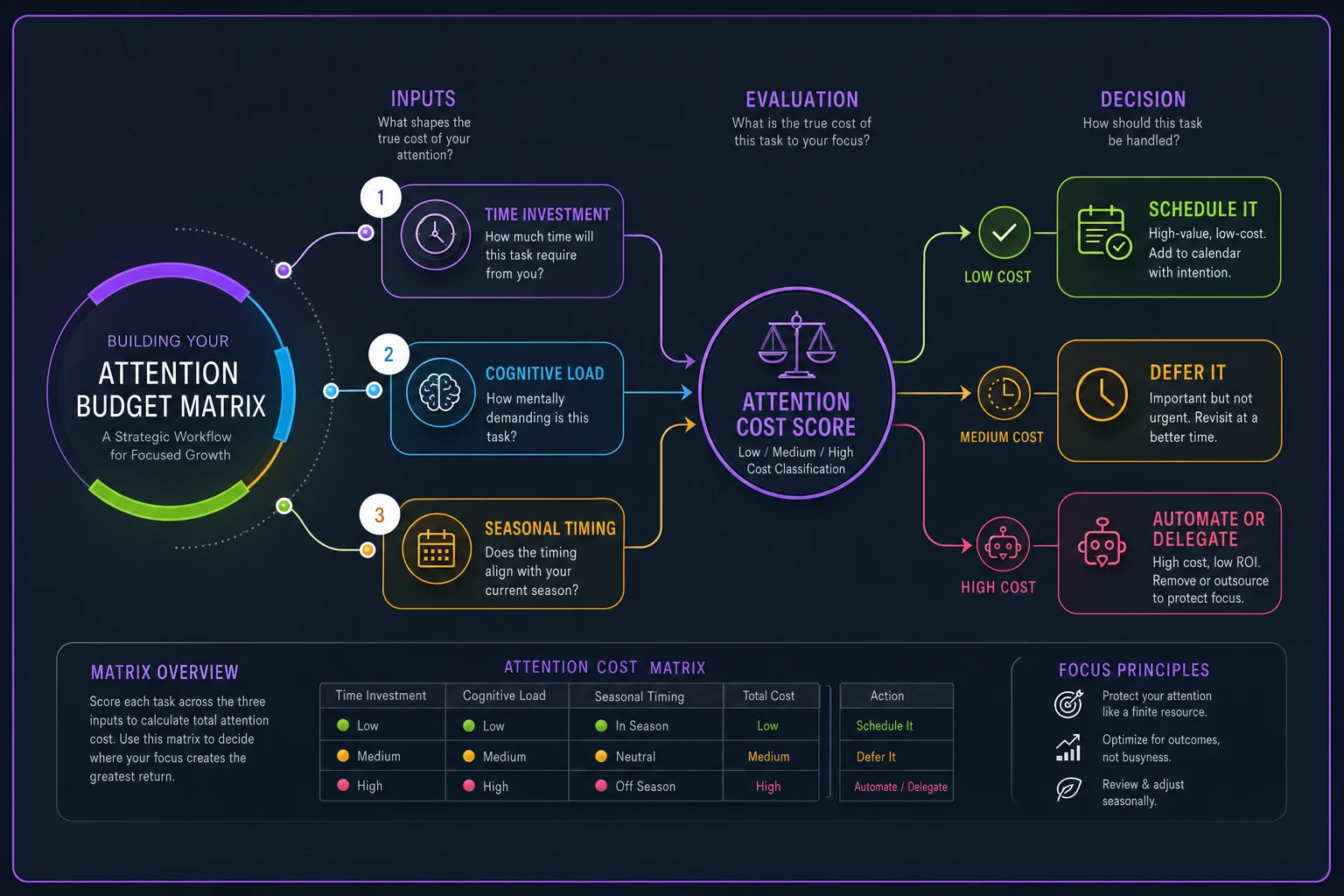
This visual shows how to flow from listing goals to evaluating load and seasonality, then making allocation decisions.
The Weekly Allocation Ritual That Actually Works
Every Sunday, spend 15 minutes running this allocation check:
-
Available Attention Inventory
-
Goal Cognitive Demands
-
The Allocation Decision
1. Available Attention Inventory Look at your upcoming week. What's already claiming your cognitive resources?
-
Major work deadlines?
-
Family obligations?
-
Health issues?
-
Seasonal stressors?
Rate your available attention on a 1-10 scale. Be honest about it.
2. Goal Cognitive Demands For each goal you're pursuing, assign a cognitive weight:
-
Physical/routine tasks
1-3 points
-
Learning/skill building
4-6 points
-
Creative/strategic work
7-9 points
-
Emotional/relationship work
5-8 points
3. The Allocation Decision If your available attention is 6/10 this week and your goals total 15 cognitive points, something has to give. That's not failure — that's strategic preservation.
The businesses that thrive understand this intuitively. During a product launch, customer service might run on minimum viable attention. During slow season, they invest heavily in team training. They don't try to maximize everything at once.
Conflict Resolution Rules When Goals Compete
Some goals don't just compete for time — they compete for the same type of mental energy. Learning guitar and learning to code both demand similar pattern-recognition bandwidth. Training for a marathon and starting a strength program both tax physical recovery.
When goals conflict, these resolution rules help:
Rule 1: Protect Your Keystone Identify your one non-negotiable habit — the one that enables everything else. Usually it's sleep, exercise, or a basic morning routine. This gets first priority, always.
Rule 2: Rotate Seasonal Focus Instead of maintaining six goals year-round at 30% effort, rotate through them at 80% effort. Three months of language learning, then three months of fitness focus, then three months of side project development. Your operational decision tree can help you sequence these effectively.
Rule 3: Stack Compatible Goals Some goals actually enhance each other. Meditation might improve your focus for learning. Walking might boost creativity for writing. Map these synergies and group them.
Rule 4: The Energy Audit Track not just whether you did something, but how it left you feeling. If guitar practice consistently leaves you energized while coding leaves you drained, that's data. Use it to schedule accordingly.
A Rebalancing Worksheet for Mid-Course Corrections
Life happens. Projects explode. Health issues arise. Relationships need attention. Your attention budget needs flexibility built in.
Every two weeks, run this rebalancing check:
| Goal | Original Allocation | Actual Last 2 Weeks | Energy Impact | Keep/Modify/Pause |
|---|---|---|---|---|
| Morning Run | 5 hrs/week | 3 hrs/week | +2 energy | Modify: 4 hrs |
| Spanish Study | 3 hrs/week | 3 hrs/week | -3 energy | Pause until May |
| Side Project | 4 hrs/week | 6 hrs/week | -1 energy | Keep: riding momentum |
| Reading | 2 hrs/week | 0.5 hrs/week | +1 energy | Modify: audiobooks during commute |
Notice we're tracking energy impact, not just time spent. This reveals which activities are sustainable versus which are slowly burning you out.
The Seasonal Planning Layer Most People Miss
Your attention capacity follows predictable seasonal patterns. Map them once, benefit forever.
High-Capacity Seasons:
-
Post-vacation (refreshed, motivated)
-
Spring (natural energy increase)
-
Start of school year (fresh start energy)
-
Your personal high-performance months
Low-Capacity Seasons:
-
End of year holidays
-
Tax season (if applicable)
-
Your industry's crunch time
-
Personal dates that carry emotional weight
Smart businesses adjust their operational intensity around these patterns. They don't launch major initiatives during their accountant's busy season or plan intensive training during the holiday retail rush.
Apply the same logic personally. Build your 12-month growth system around your natural capacity fluctuations, not despite them.
When Automation Becomes Your Attention Multiplier
This is where well-designed systems actually matter. Once you understand your attention patterns, you can build scaffolding that protects your cognitive resources for what matters most.
The most successful small businesses don't try to manually track every customer interaction, inventory change, and financial transaction. They use operational software to handle the routine stuff, freeing their attention for strategy and relationships.
The same principle applies to personal systems. AI-powered platforms can handle routine tracking, reminder scheduling, and progress monitoring that normally tax your executive function. When software handles the administrative overhead of habit tracking, your attention stays on actually doing the habits.
Every decision you don't have to make is attention you can invest elsewhere. Every routine you don't have to remember is cognitive capacity preserved for growth.
The Permission Structure Nobody Talks About
Saying "not right now" to a goal isn't giving up. It took me longer than it should have to really internalize that.
The businesses that scale are ruthless about this. They'll ignore profitable opportunities that would dilute their focus. They'll leave money on the table to protect their core operation. They understand that attention spread too thin accomplishes nothing well.
Yet personally, we feel guilty putting a goal on hold. We think we should be able to juggle everything if we just try harder.
An attention budget gives you permission to be strategic. To say "I'm protecting my capacity for these two things this quarter." To recognize that pausing something in November to preserve energy for family isn't weakness — it's just good sense.
Making the Matrix Work in Real Life
Take a realistic scenario. Sarah's a marketing manager trying to balance career growth with personal development. Her current goals:
-
Complete online MBA coursework (10 hrs/week, high cognitive load)
-
Train for a half-marathon (6 hrs/week, low cognitive, high physical)
-
Launch a freelance consulting side gig (8 hrs/week, high cognitive load)
-
Maintain her meditation practice (2.5 hrs/week, low load, high reward)
Total: 26.5 hours per week on top of a full-time job. Aggressive, but maybe possible?
Now factor in cognitive load. The MBA and consulting both demand analytical thinking — the same resource her day job depletes. Add seasonal context: it's September, her company's planning season. Work cognitive demands are peaking just as she's trying to add 18 hours of high-cognitive personal work.
The matrix reveals the problem clearly. She's triple-booking her analytical thinking capacity during her work's highest-demand season.
Strategic reallocation:
-
September-November
Maintain only meditation and moderate running (stress management). Pause MBA and consulting.
-
December-February
Add back MBA coursework when work calms down.
-
March-May
Launch consulting practice after the MBA routine is established.
Same goals, better sequencing, sustainable execution.
The Compound Effect of Protected Attention
When you stop overtaxing your cognitive resources, the goals you do pursue start working better. You have the mental energy to actually optimize them, not just survive them.
The business owner who tries to personally manage sales, operations, finance, and marketing does all four poorly. The one who delegates or automates three to focus on one creates real results in that area, which funds improvement in the others.
Your attention budget creates the same dynamic. When you're not constantly context-switching between six different growth goals, you can go deep on two. That depth creates momentum. Momentum creates results. Results fuel the next cycle.
Building Your Personal Attention Budget This Week
Start simple. Don't try to map your entire year right now.
-
List everything currently competing for your attention
-
Assign cognitive weights (light/medium/heavy)
-
Note which use similar mental resources
-
Check against this week's available capacity
-
Make one strategic cut or deferral
One week, one adjustment. But that adjustment preserves attention for what matters most right now.
The businesses that last understand this deeply. They don't chase every opportunity. They don't optimize every process simultaneously. They protect their attention and deploy it strategically.
Your personal growth deserves the same discipline — not because you're weak or lazy, but because attention is genuinely finite. The question isn't whether you can do everything. You can't. The question is what deserves your cognitive investment this season.
Budget accordingly.
Ready to unlock your full potential?
Join thousands of users transforming their lives using Growyly to stay motivated, organized, and growth-focused every day.