


Most goal decomposition frameworks fail because they treat goals like grocery lists instead of operational workflows. You end up with 47 sub-goals floating around with no clear sequencing, no dependencies, no measurable checkpoints. Just noise.
After building operational software for businesses that actually track goal completion rates, the pattern becomes obvious: successful goal execution looks more like software deployment than motivational posters. You need dependency mapping, effort calculations, and a way to know when something's actually working versus when you're just staying busy.
The Three-Variable Decision Tree That Actually Works
The reason traditional goal-setting breaks down isn't lack of motivation. It's lack of operational clarity. When someone says they want to "get healthier" or "build better habits," they're describing an outcome without defining the steps, dependencies, or feedback loops needed to get there.
A functional goal decomposition framework needs three core variables:
Impact: What measurably changes when this succeeds? Not the feel-good answer—the actual shift in behavior, output, or capacity.
Effort: The real time and energy cost, not the optimistic estimate. Most people budget for best-case scenarios and then abandon ship when reality hits.
Dependency: What needs to happen first? This is where the majority of goals die—trying to implement step seven before completing steps one through six.
Think of it like building software features. You wouldn't add payment processing before building user authentication. Yet people constantly try to implement advanced productivity systems before establishing a basic sleep schedule.
Breaking Down the "Get Fit" Example Everyone Gets Wrong
Take the classic "I want to get fit" goal that appears on roughly 40% of abandoned goal lists every January. Standard advice breaks this into sub-goals like:
Achieve more by focusing on what matters.
Growyly helps you build lasting habits and track your personal growth effortlessly.
- Goal setting with progress tracking
- Daily habit reminders
- Motivational insights and analytics
No credit card required
-
Join a gym
-
Eat healthier
-
Exercise 3x per week
-
Track calories
This looks organized but it's operationally useless. No sequencing, no dependency mapping, no effort calculation. It's a wish list dressed up as a plan.
Here's what an operational breakdown actually looks like:
Week 1-2: Baseline Measurement
-
Track current activity levels (your phone already does this)
-
Log eating times—not calories, just when
-
Note energy dips throughout the day
-
Impact
High (establishes a real starting point)
-
Effort
Low (5 minutes daily)
-
Dependency
None
Week 3-4: Single Habit Lock-In
-
Pick ONE activity that takes under 15 minutes
-
Do it at the same time daily
-
No optimization yet, just consistency
-
Impact
Medium (builds execution muscle)
-
Effort
Low-Medium
-
Dependency
Baseline data from weeks 1-2
Notice how different this is from "join gym, eat salad, become athlete." Each phase has clear dependencies, realistic effort estimates, and measurable outputs.
The Dependency Mapping Most People Skip
This is where traditional goal-setting completely falls apart: ignoring operational dependencies. It's like trying to run payroll software before setting up a business bank account.
Take someone wanting to launch a side project while working full-time. The typical approach:
-
Come up with idea
-
Build product
-
Find customers
-
Profit
The operational reality requires mapping actual dependencies:
Foundation Layer (Must Complete First)
-
Energy audit
When do you actually have mental capacity?
-
Time audit
Where are the real 2-hour blocks?
-
Tool setup
What systems already exist vs. what needs building?
Execution Layer (Depends on Foundation)
-
Prototype in the lowest-effort format possible
-
Test with 3 people maximum
-
Document what breaks
Scaling Layer (Depends on Execution)
-
Only now consider automation
-
Only now think about customer acquisition
-
Only now worry about revenue
Here's a quick visual of the dependency workflow.
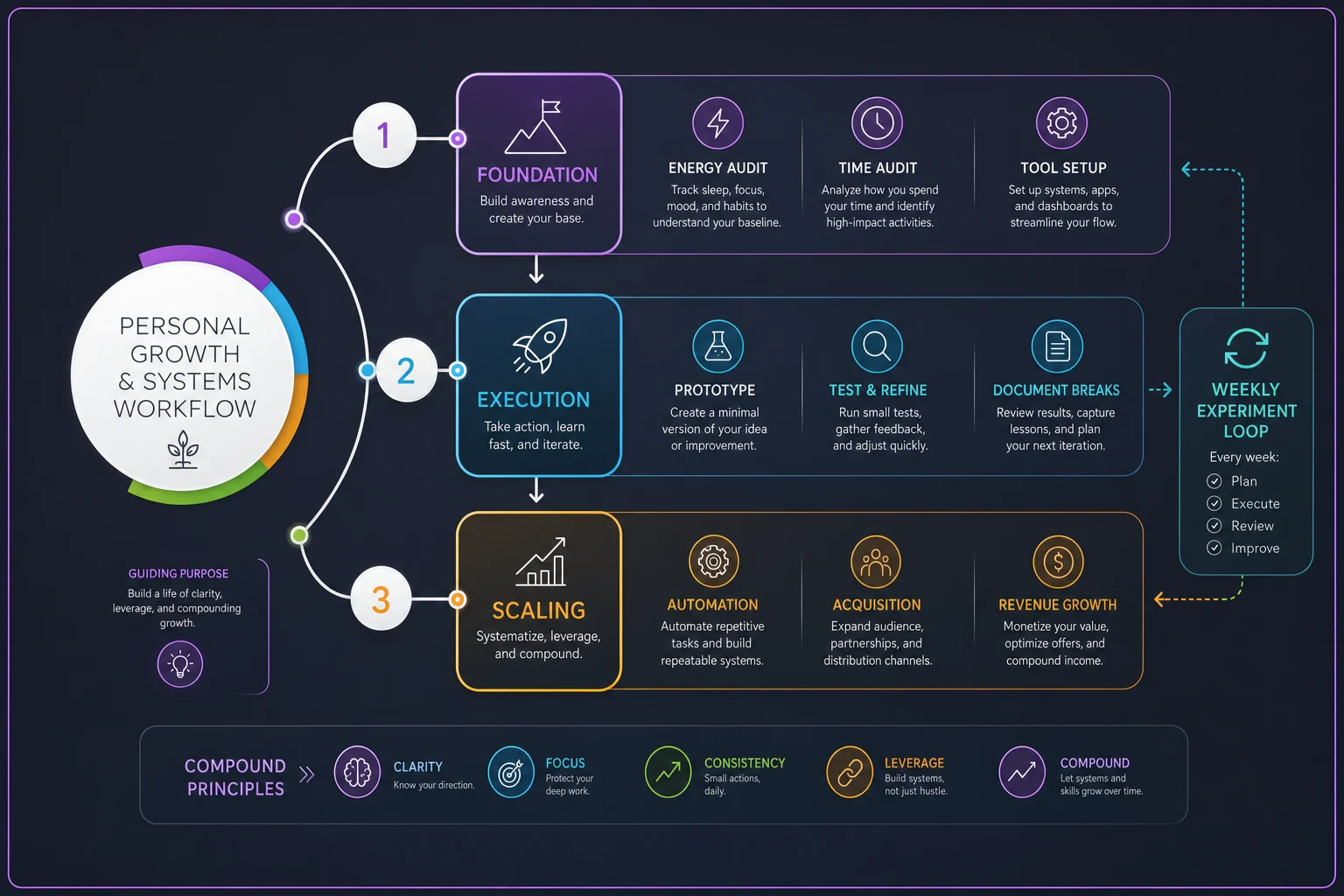
Most people jump straight to the scaling layer, wonder why nothing works, then blame themselves for lacking discipline. The issue isn't discipline—it's trying to install the roof before pouring the foundation.
Converting Vague Aims Into Weekly Experiments
The biggest operational failure in goal-setting is the gap between annual goals and daily actions. A good decomposition framework needs a translation layer—something that converts big ambitions into this-week experiments.
Traditional approach: "I want to read more books."
Operational approach: "Test whether 15 minutes before bed works better than morning reading."
One is a vague intention. The other is a testable hypothesis with clear success metrics.
Here's the experimental framework that actually generates data:
Week 1 Experiment Setup
-
Hypothesis
[Specific behavior] will produce [specific result]
-
Test duration
5-7 days maximum
-
Success metric
Binary yes/no—did it happen or not
-
Failure point
What typically breaks this?
Week 2 Iteration
-
If it worked
Add 20% complexity or duration
-
If it failed
Reduce by 50% and try again
-
If mixed
Identify the specific breaking point
This isn't motivational—it's operational. You're running actual experiments with actual data, not hoping things magically improve.
Impact vs Effort: The Calculation Nobody Does
Most goal decomposition frameworks ignore the basic math of effort allocation. They treat all goals as equally important and equally difficult, which makes no operational sense.
| Goal Component | Time Cost (Weekly) | Energy Cost (1-10) | Success Probability | Expected Value |
|---|---|---|---|---|
| Morning routine change | 5 hours | 7 | 40% | Low-Medium |
| Evening wind-down | 3.5 hours | 4 | 70% | High |
| Weekend meal prep | 3 hours | 6 | 50% | Medium |
| New exercise program | 6 hours | 9 | 25% | Low |
The math isn't complex—it's just rarely done. Energy cost combined with time cost against success probability gives you actual implementation difficulty. Yet people consistently pick the highest-effort, lowest-probability items first because they sound more impressive.
When you map this properly, the sequencing becomes obvious. Start with high-probability, low-energy items to build momentum. Use that momentum to tackle harder challenges. Basic operational sequencing—yet almost nobody does it.
The Template That Replaces 10 Planning Apps
Complexity kills execution. The most effective operators use simple templates that capture just enough structure without becoming their own maintenance burden.
Goal Decomposition Worksheet
Primary Outcome: [One sentence, measurable]
Phase 1 Dependencies:
-
[ ] Prerequisite A
-
[ ] Prerequisite B
-
[ ] Baseline metric established
Phase 1 Experiment:
-
Test
[Specific action for 5 days]
-
Measure
[Binary success metric]
-
Time block
[Exact time of day]
-
Failure trigger
[What usually breaks this]
Phase 2 Dependencies:
-
[ ] Phase 1 success confirmed
-
[ ] Next constraint identified
-
[ ] Resources allocated
Phase 2 Experiment:
-
Test
[Build on Phase 1 or pivot]
-
Measure
[Slightly more complex metric]
-
Time block
[Adjusted based on Phase 1]
This isn't fancy. It's not an app with 47 features. It's a basic operational structure that forces you to think about dependencies, sequencing, and measurable outcomes. The businesses that succeed use something this simple. The ones that fail are usually drowning in overcomplicated tracking systems.
Real Scenario: From "Better Focus" to Measurable Progress
A freelance designer wanted to "improve focus and productivity"—the kind of vague goal that usually goes nowhere.
Initial state: jumping between projects, constant context-switching, feeling busy but producing very little.
Week 1-2: Dependency Mapping
-
When does deep work actually happen? (Energy audit showed 9-11am as peak)
-
What breaks concentration? (Slack notifications firing every few minutes)
-
What's the minimum viable work block? (Testing showed 45 minutes, not the 2 hours they assumed)
Week 3-4: First Experiment
-
Test
45-minute blocks, 9-10am only
-
All notifications off, phone in another room
-
Success metric
Did 45 minutes happen, yes or no
-
Result
4 out of 5 days successful
Week 5-6: Effort Increase
-
Extended to 90-minute blocks
-
Added second block 2-3
30pm
-
Success metric
Completion of specific deliverables
-
Result
Morning blocks solid, afternoon hit around 60% success
Week 7-8: Dependency Addition
-
Realized afternoon blocks failed due to decision fatigue
-
Added a "next task defined before lunch" rule
-
Afternoon success jumped to 85%
After two months, the designer went from scattered 6-hour workdays to focused 4-hour blocks producing better output. Not through motivation or willpower—through sequencing and dependency management.
Why Most Goal Frameworks Fail at Scale
The fundamental problem with most goal decomposition frameworks is that they're designed for perfect conditions, not operational reality. They assume linear progress, unlimited willpower, and zero external disruptions.
A proper growth system accounts for setbacks, energy fluctuations, and shifting priorities. It bends without breaking.
Consider what happens at different scales:
Individual Level: One person can actively manage maybe 3-4 goals. Add more, and execution quality drops fast.
Habit Level: Each new habit has roughly a 30-day fragility window. Stack multiple habits inside that window and the failure rate climbs toward 90%.
System Level: Without clear dependencies, people end up optimizing random components that don't connect to actual outcomes.
The fix isn't working harder or caring more. It's building systems that match human capacity instead of fighting against it.
Building Your Own Goal Decomposition System
Step 1: Pick ONE primary outcome
Not three, not five. One. Everything else becomes a supporting component or gets cut. This matches how successful operations work—pick a north star metric and align everything to it.
Step 2: Map genuine dependencies
What actually needs to happen first? Not what would be nice, but what's operationally required. If you want better sleep, you need an evening routine. If you want an evening routine, you need to stop burning willpower earlier in the day.
Verify baseline metrics before committing to Phase 1—it's the fastest way to catch wrong assumptions.
Step 3: Calculate real effort
Take your time estimate and multiply by 2.5. Take your energy estimate and add 3 points. This isn't pessimism—it's what you find when you actually track estimated versus real effort over time.
Step 4: Design weekly experiments
Not monthly goals or daily habits—weekly experiments. Long enough to gather meaningful data, short enough to iterate quickly. Each experiment should test one specific hypothesis with a clear success metric.
Step 5: Track failures, not just successes
When something breaks, document why. After three failures at the same breaking point, that's your actual constraint—not the surface-level goal you started with.
The Hidden Bottleneck: Coordination Between Goals
Goals don't exist in isolation. They compete for the same resources—time, energy, attention. Without coordination, they end up cannibalizing each other.
A software team wouldn't run five deployment processes simultaneously without coordination. Yet people routinely try to implement five new habits at once, then wonder why everything falls apart around week three.
The operational fix is sequential, not parallel. Let one goal reach 80% consistency before adding the next. It feels slower. It isn't. Three sequential implementations at 70% success each yields around 34% total success rate. Three parallel implementations typically land under 10%.
Turning Framework Into Action
The gap between framework and execution is where most goal decomposition actually falls apart. You need translation mechanisms—specific structures that convert planning into doing.
This is where environment design becomes critical. Your operational environment should make the right actions easier and the wrong ones harder. Not through willpower, but through structure.
Some people find that AI-powered task management helps bridge this gap—handling dependency tracking and experiment scheduling so you can focus on execution. Not replacing judgment, just reducing the overhead of managing complex goal hierarchies.
Start simple. One goal, one experiment, one week. Build from there based on actual results.
The Difference Between Planning and Executing
Most goal decomposition frameworks are planning tools disguised as execution systems. They help you organize thoughts but don't drive behavior change.
Real execution requires:
-
Daily decision points reduced to binary choices
-
Progress visible without opening an app
-
Failure recovery built into the system
-
Experiments that generate actual data
Without these components, you're just rearranging aspirations on a spreadsheet. The people who consistently follow through treat goal execution like running operations—with proper systems, clear dependencies, and measurable checkpoints.
The framework itself isn't complex. Map your goals by impact, effort, and dependency. Sequence them. Test weekly. Most importantly, track what actually happens versus what you planned. That gap contains everything you need to figure out what's actually working.
Ready to unlock your full potential?
Join thousands of users transforming their lives using Growyly to stay motivated, organized, and growth-focused every day.