

The hardest part of coming back isn't the work. It's that the person who left and the person who returned are running on completely different operating systems. You used to be someone who ran three miles before your 8am standup. Now you're someone who's been awake since 4:40am for reasons that have nothing to do with fitness. Trying to bolt your old routines onto this new reality is where most people crash in the first two weeks.
Re-onboarding after parental leave fails for a predictable reason: people treat it as a resumption instead of a rebuild. They assume the routines will "come back" once things settle. They don't. The context that held those routines together—predictable mornings, uninterrupted evenings, a body that recovered on schedule—is gone. What follows is a 30-day plan built around that reality, phased so you're not asking a depleted nervous system to do a full reboot on day one.
Why the "just get back into it" approach breaks
Old routines were anchored to cues that no longer exist. Your morning run was probably triggered by waking naturally at 6:15 to a quiet house. That cue is gone. The habit didn't fail because you lost discipline—it lost its trigger. This is the same mechanic that makes habits collapse during any major life transition, and it's why treating this like a normal restart doesn't work.
There's also an identity mismatch nobody warns you about. For weeks or months, your entire identity was "primary caregiver." Now you're being asked to also be "focused professional" and "person who has hobbies" again, sometimes on the same Tuesday. Your brain doesn't switch cleanly between those. When people say they feel like they're "faking it" at work in week one, this is what they're describing—the identity hasn't caught up to the calendar.
And the energy math is different. Pre-leave, you probably had a fairly stable daily energy budget. Post-leave, your energy is fragmented and unpredictable—a great morning can be erased by one rough night. Any plan that assumes consistent daily capacity is going to set you up to feel like you're constantly failing.
The real cost of skipping a re-onboarding plan
The consequences don't show up as a dramatic collapse. They show up as a slow erosion.
Achieve more by focusing on what matters.
Growyly helps you build lasting habits and track your personal growth effortlessly.
- Goal setting with progress tracking
- Daily habit reminders
- Motivational insights and analytics
No credit card required
Week one, you skip your evening wind-down because the baby's schedule shifted. Week two, you're saying yes to every meeting because you feel behind and guilty. Week three, you and your partner have had the same low-grade argument about who's doing bedtime four times. By week four you've quietly abandoned every routine that made you feel like yourself, and you've concluded—wrongly—that "there's just no time right now."
The pattern I keep noticing: the people who struggle most aren't the ones with the least time. They're the ones who tried to do everything at full intensity immediately and burned out their willpower in the first ten days. The ones who recover well start almost embarrassingly small.
The 30-day plan, phased
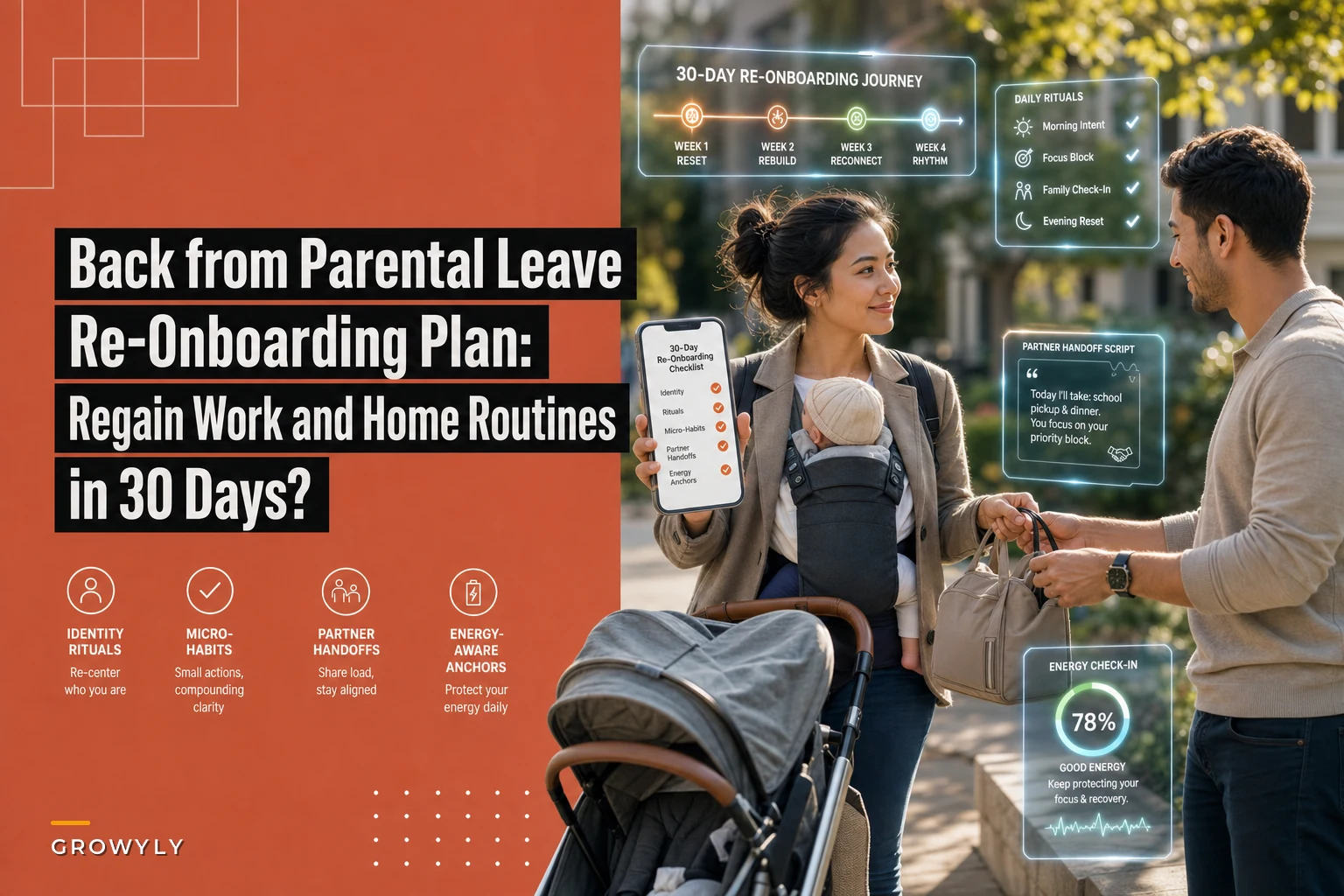
The whole thing is built in four phases. Each phase has one job. Don't skip ahead because you feel good on a Wednesday—the phases are sequenced to protect you from your own optimism.
| Phase | Days | Primary Job | What You're NOT Doing Yet |
|---|---|---|---|
| 1. Stabilize | 1–7 | Reclaim identity + one anchor | No performance goals, no "getting ahead" |
| 2. Rebuild anchors | 8–15 | Re-attach 2–3 routines to new cues | No intensity, no full workouts |
| 3. Coordinate | 16–23 | Partner handoffs + work boundaries | No solo heroics |
| 4. Load-test | 24–30 | Add intensity + stress-test the system | No permanent commitments yet |
Phase 1 (Days 1–7): Stabilize your identity, not your schedule
The goal of week one is not productivity. It's reminding yourself you're still you. This is where identity rituals do the heavy lifting.
An identity ritual is a tiny, deliberate action that says "this is who I am" independent of whether you performed at a high level. Not "I ran today" but "I put on running shoes and stood outside for two minutes." The point is the claim, not the output. A few that work well in this phase:
-
Morning identity line. Before you check your phone, say one sentence out loud: "I'm someone who does focused work and takes care of my kid." Sounds cheesy. Works anyway, because it pre-loads both identities before the day forces you to pick one.
-
One non-negotiable anchor. Pick a single micro-habit—coffee made a specific way, five minutes of stretching, writing one line in a notebook. This is your keel. Everything else can wobble.
-
The "still counts" rule. If the anchor happens for 30 seconds, it counts. You're rebuilding the neural claim, not hitting a metric.
The mistake here is adding a second anchor because the first felt easy on day three. Don't. Week one is deliberately under-loaded so you have margin for a bad night.
Phase 2 (Days 8–15): Rebuild anchors around your new cues
Now you attach routines to cues that actually exist in your current life. Your old triggers are gone, so you're building new ones from the fixed points in a baby-shaped day.
The fixed points are usually feeds, naps, and handoffs. Those are your new anchors because they happen no matter what. So instead of "run at 6:15," it becomes "after the first nap starts, I do my 10-minute mobility routine." The nap is the cue. The routine is small enough to survive a short nap.
This is the same energy-aware approach that keeps habits alive when your available capacity keeps shifting. Build your routines around your real energy curve—if your mornings are wrecked and your best window is 8–9pm after bedtime, stop fighting it and put your meaningful routine there. The three-tier fidelity plan for maintaining habits during disruptions is genuinely useful here: define a full version, a reduced version, and a bare-minimum version of each routine, so a rough night downgrades the habit instead of killing it.
Tie each routine to a visible physical cue (a sticker, magnet, or notebook) so the cue is hard to miss when the baby's schedule is chaotic.
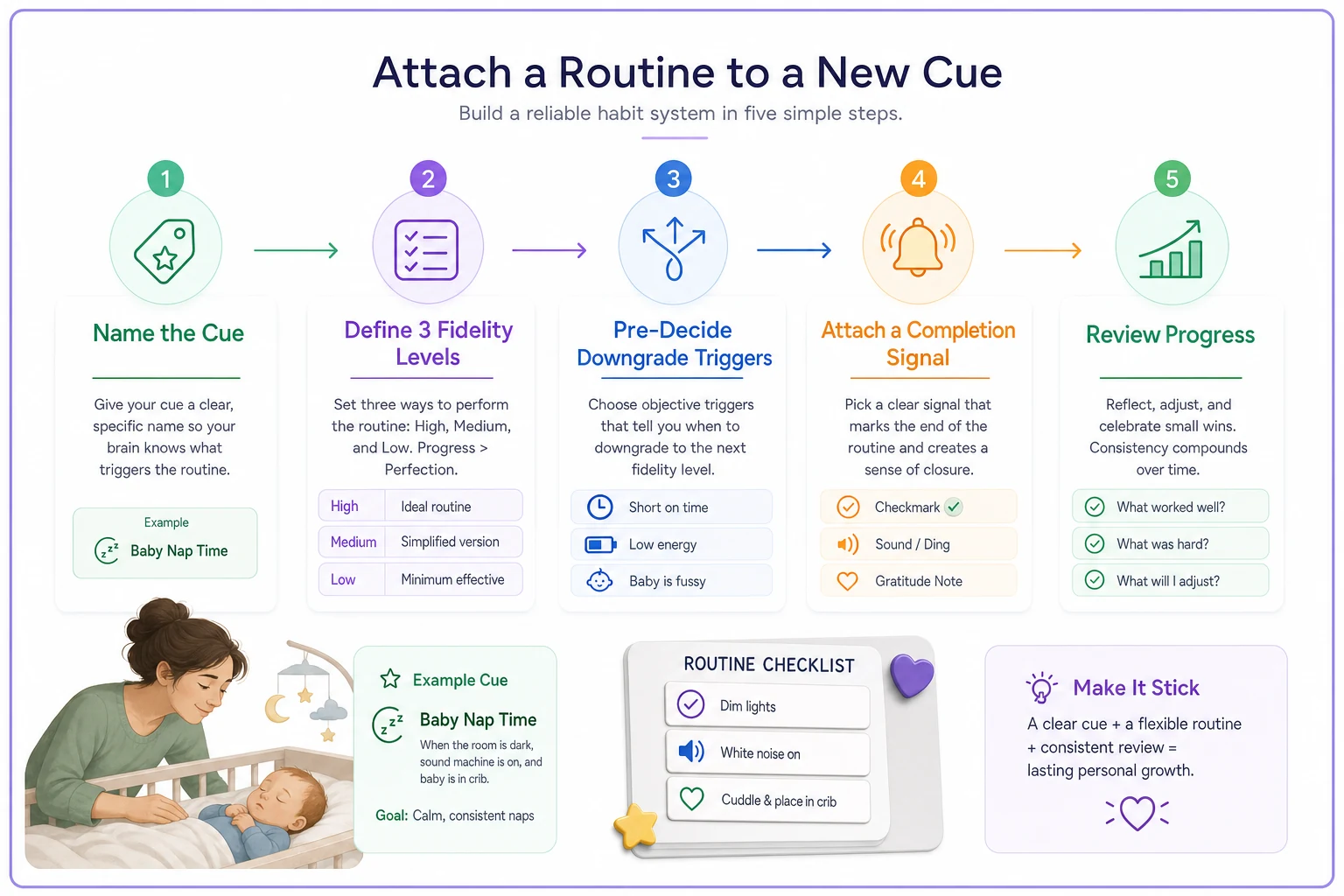
A workflow example for a single routine:
-
Name the cue ("first afternoon nap starts").
-
Define three fidelity levels (full
20-min workout / reduced: 8-min / minimum: 2-min stretch).
-
Pre-decide the downgrade trigger ("if I got under 5 hours sleep, I do the minimum version, no guilt").
-
Attach a completion signal (move a magnet, tick a box—something physical you'll see).
-
Review at day 15—which cues actually fired? Keep those, drop the ones that never triggered.
Here's a quick visual to make the workflow easier to imagine.
Phase 3 (Days 16–23): Coordinate before you optimize
This is the phase everyone underestimates, and it's the one that saves marriages. Most routine collapse post-leave isn't an individual failure—it's a coordination failure. Two exhausted people both assume the other is handling something, and the gaps become resentment.
Home handoff script (evening):
> "I've got bedtime start to finish tonight. You're off from 7 to 8—use it for your thing, not chores. Tomorrow we swap."
The word that matters is "use it for your thing." Handoff time that gets absorbed into laundry isn't recovery—it's just a different chore. Protect the recovered window like it's an appointment, because that's the window where your personal routines actually live.
Work handoff script (boundary):
> "I'm ramping back up and protecting focus blocks from 9 to 11. I'll be fully available after that—send anything urgent to my phone in that window."
You're not asking permission to have limits. You're telling people what to expect so they stop pinging you at 9:15. Teams adapt fast when the boundary is stated as information rather than an apology.
A short partner sync—ten minutes, once a week—prevents most of the drift. Trade the coming week's known disruptions, decide who owns which nights, and name one routine each of you is trying to protect so the other person can defend it. This is coordination, not a relationship summit. Keep it short.
Phase 4 (Days 24–30): Load-test and lock in
Only now do you add intensity. You've got a stable identity claim, cue-attached anchors, and coordinated handoffs. This last week you stress-test the system on purpose. Take one deliberately hard day—maybe a solo parenting day, or a heavy meeting day—and see which routines survive at minimum fidelity.
Whatever survives a bad day becomes permanent. Whatever collapses gets simplified further, not abandoned. If your workout only survives at the 2-minute level on hard days, then the 2-minute version is your real habit and the 20-minute version is a bonus. That's not lowering the bar—that's finding the bar that actually holds weight.
If you're also navigating a role change alongside the return, the sequencing logic here overlaps heavily with transitioning your core habits for a new job—both are about rebuilding routines when your context has completely shifted underneath you.
A real scenario
A mid-level marketing manager came back from a 14-week leave and tried to restart everything at once: 6am gym, morning journaling, evening reading, full meeting load. By day nine she'd dropped all of it and was working through both naps to "catch up," running on roughly five broken hours of sleep.
The reset was un-glamorous. Week one: one anchor only—coffee and a two-minute stretch, identity line before the phone. Week two: mobility attached to the afternoon nap, reading moved from morning (impossible) to the post-bedtime window. Week three: a written evening handoff with her partner and a stated 9–11 focus block at work. Week four: she load-tested on a solo day and kept the minimum versions.
Thirty days in, she wasn't doing more than before—she was doing about three routines consistently instead of six routines never. The focus block recovered maybe six to eight hours of real deep work a week that had been leaking into fragmented, guilty catch-up. And the weekly partner sync cut the recurring bedtime argument down to almost nothing, mostly because someone was finally named as responsible.
When this plan makes sense—and when it doesn't
This works well if you're returning to a role with some schedule control, you have a partner or support person to coordinate with, and your main problem is that routines evaporated rather than a deeper health issue.
This is a bad fit if you're dealing with postpartum depression or anxiety that's untreated. No handoff script fixes that, and a routine plan can actually add pressure. Get clinical support first; the routines can wait.
Skip the coordination phase entirely if you're solo parenting—but replace it by building your handoffs around other people: a family member, a paid sitter for two protected hours, a coworker who covers a recurring meeting. The principle holds; the counterparty changes.
The one thing to hold onto
The routines you had before leave aren't coming back the way they were, and chasing them is the actual trap. The version of you that returned needs routines built for this life—fragmented energy, shared responsibility, an identity that's genuinely larger than it was. Re-onboarding after parental leave works when you rebuild small, attach habits to the cues you actually have, and treat your partner and your energy as part of the design instead of things you push through.
Start with one anchor tomorrow morning. Not five. One. The rest of the system has thirty days to grow around it.
Ready to unlock your full potential?
Join thousands of users transforming their lives using Growyly to stay motivated, organized, and growth-focused every day.