


The freelance schedule doesn't break down the way office jobs do. There's no consistent 9-to-5 to build around. One week you're buried under three client deadlines, the next you've got open afternoons but zero mental energy because you just wrapped a brutal launch. Your creative practice — the personal work, the portfolio pieces, the stuff that actually moves your craft forward — keeps getting squeezed into whatever gap survives.
And that gap almost never shows up. So the practice dies quietly. Not from lack of discipline, but because you built it around conditions a freelance life will never reliably provide: a clear block of time, a settled mind, and momentum carrying over from yesterday.
This piece is about designing a creative practice for an irregular schedule that doesn't depend on any of those three things — specifically: ultra-short creative anchors, artifact-based progress signals instead of streaks, create-or-capture micro-sessions, and a weekly recomposition ritual that stitches the scattered pieces into something coherent.
Why the "block of time" model quietly fails freelancers
Standard advice says protect a two-hour block for deep creative work. For a lot of people that's genuinely solid. For freelancers with lumpy schedules it's a trap, because it sets a threshold you can only clear on your calm weeks.
When your rule is "creative work happens in a 90-minute block," your brain learns that anything less than 90 minutes doesn't count. So on a chaotic Tuesday with 20 free minutes, you don't open the project at all — there's "no point starting." Multiply that across a busy month and you've done zero creative work, not because you had no time, but because none of your time came in the right-sized container.
The second failure is momentum dependency. Block-based practices assume you pick up roughly where you left off. But if your last session was nine days ago, you spend the first 40 minutes just remembering what you were doing and why. The re-entry cost gets so high that starting feels exhausting before you've made a single mark.
Irregular schedules punish both of these. The fix isn't more discipline — it's redesigning the practice so short sessions count and re-entry is nearly free.
Ultra-short creative anchors: the 10-minute unit
An anchor here means a fixed, tiny creative action — small enough to survive your worst week. Not a session you hope to do. A unit you can almost always complete.
Achieve more by focusing on what matters.
Growyly helps you build lasting habits and track your personal growth effortlessly.
- Goal setting with progress tracking
- Daily habit reminders
- Motivational insights and analytics
No credit card required
Ten minutes is the sweet spot for most creatives. Long enough to make one real thing, short enough that you can't really talk yourself out of it. Five minutes feels too trivial; thirty reintroduces the "I need to clear my schedule first" problem. Ten sits right at the edge where you can say yes even on a bad day.
The key move is that the anchor produces something. Not "work on the novel for 10 minutes" but "write one scrap of dialogue." Not "practice guitar" but "record one 30-second phrase." The output orientation matters because it gives you an artifact — which becomes your actual progress signal, more on that in a moment.
-
Illustrator one thumbnail sketch, no cleanup
-
Writer one paragraph or one scene fragment
-
Musician capture one melodic idea as a voice memo
-
Photographer edit one frame to final
-
Designer one component or one layout variation
If ten minutes feels abstract, set a timer and commit to finishing the artifact before it dings.
These all end with a thing that exists. That's deliberate. The worst version of an anchor is "brainstorm ideas for 10 minutes," because you finish with nothing to point to and your brain doesn't register it as progress.
Create-or-capture micro-sessions
Some days you have 10 minutes and creative energy. Other days you have 10 minutes and you're completely fried from client revisions. Forcing "create" mode on an empty tank produces garbage and eventually makes you dread the anchor.
So split it into two modes and pick based on where you're at:
-
Create mode make a small artifact (a sketch, a paragraph, a phrase)
-
Capture mode collect raw material for later (references, screenshots, overheard lines, a rough voice note)
Capture isn't a consolation prize. A writer who spends a depleted afternoon collecting three overheard conversations has loaded ammunition for a create session next week. A designer collecting screenshots of layouts they admire is building a bank they'll actually pull from.
The rule that makes this work: you always do the anchor, but you get to choose the mode. This removes the single biggest excuse — "I'm not in the right headspace to create" — because on those days you're allowed to just capture. The anchor still happens. The chain doesn't break.
In practice, most people land around 60% create, 40% capture across a month. That ratio shifts with workload, and that's fine. Busy months lean capture. Slow months lean create. The point is the practice continues through both.
Kill the streak. Track artifacts instead.
Streaks are the wrong metric for irregular schedules. A streak punishes exactly the conditions freelancing creates — the unavoidable four-day client crunch — and one break tends to collapse the whole habit. The smallest signals that actually predict progress aren't consecutive days. They're accumulated artifacts.
An artifact-based signal counts things you made, not days you showed up. Ten sketches in a month is ten sketches whether they came from ten consecutive days or ten scattered ones.
Here's a simple artifact-tracking table you can keep in a notebook or a spreadsheet:
| Date | Mode | Artifact produced | Format | Reusable? | Notes |
|---|---|---|---|---|---|
| Mar 3 | Create | Dialogue scrap — argument scene | Text | Yes | Might open Ch. 4 |
| Mar 5 | Capture | 3 overheard phrases, café | Notes | Raw | Two feel usable |
| Mar 6 | Create | Character sketch, side profile | Sketch | Maybe | Nose needs work |
| Mar 9 | Capture | 6 reference photos, textures | Images | Yes | For background work |
| Mar 11 | Create | Melody idea, 40 sec | Audio | Yes | Verse candidate |
The "Reusable?" column is the quiet workhorse here. Over time it shows you which kinds of capturing actually feed your work and which were just busy-feeling noise. That distinction is worth knowing.
Counting artifacts also changes how a missed day feels. You didn't break anything. You have 11 artifacts this month instead of 12. The number holds its meaning through the gaps — which is exactly what a freelance schedule needs.
The weekly recomposition ritual
Scattered 10-minute artifacts don't automatically become a coherent project. You can end a month with 15 fragments that never connect to each other. Recomposition is the step where you sit down once a week — 20 to 30 minutes — and pull the pieces into some kind of shape.
Recomposition does three jobs:
-
Review the week's artifacts. Read the table. Actually look at what you made.
-
Connect and combine. That dialogue scrap plus that character sketch — do they belong in the same scene? Those reference photos — which project do they serve?
-
Set the next week's direction. Not a rigid plan. A loose theme: "next week's create sessions lean into the argument scene."
This is the difference between a pile of fragments and actual progress. The daily anchors generate raw material; the weekly ritual assembles it. Without recomposition, freelancers often feel like they're always doing bits and never finishing anything — and honestly, they're not wrong, because nobody's doing the assembly step.
A concrete recomposition routine looks something like this:
-
Open your artifact table and skim the week
-
Star the 2–3 artifacts worth developing
-
Physically or digitally group anything that connects
-
Write one sentence naming next week's focus
-
Note any capture gaps ("need more texture refs")
Keep it short. A recomposition session that balloons into a two-hour planning exercise just recreates the block problem you were trying to escape.
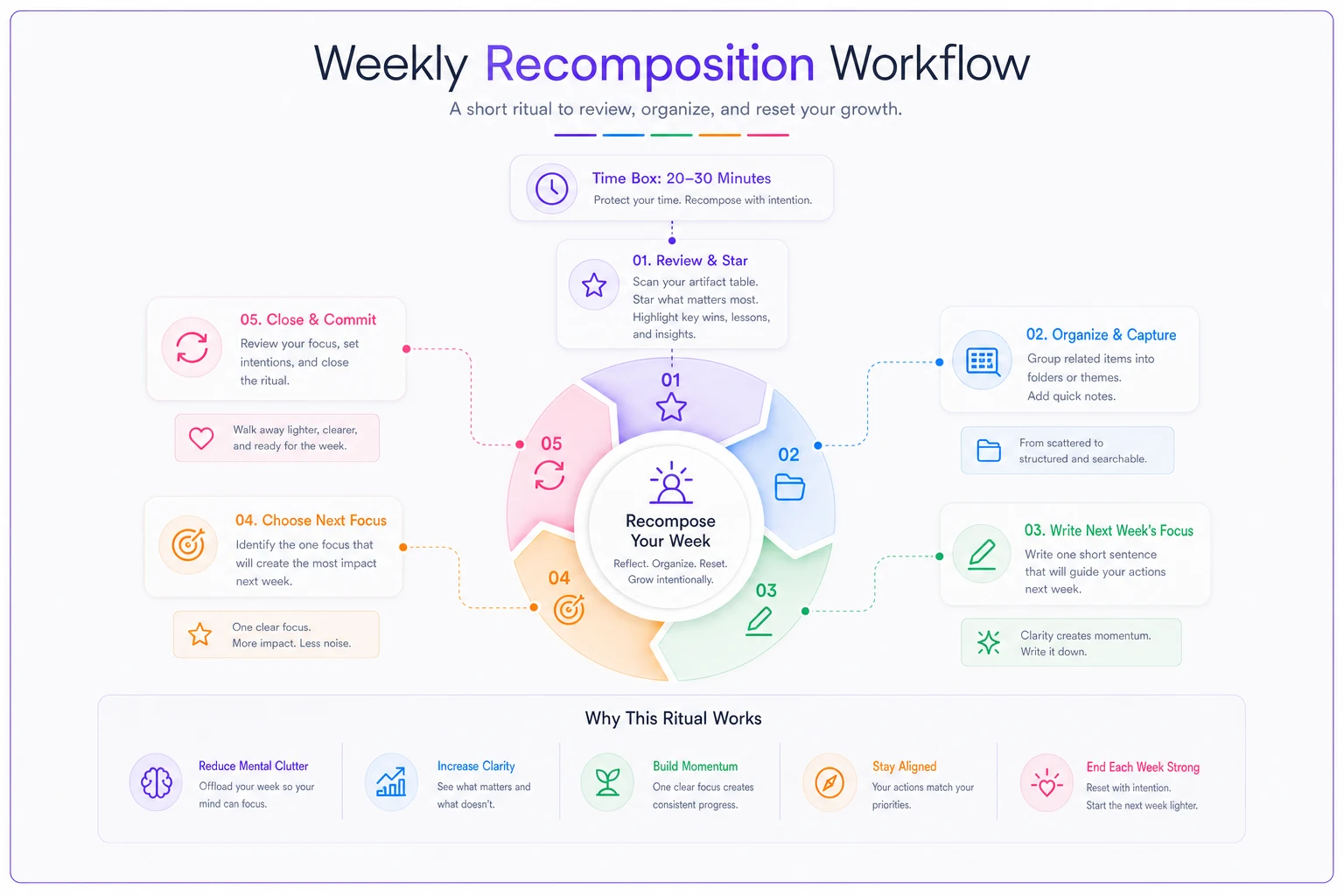
Here's a quick visual of the weekly recomposition workflow.
A real scenario: freelance illustrator, irregular client load
A freelance illustrator doing mostly editorial and packaging work had been trying to build a personal portfolio series for over a year and had almost nothing to show for it. Busy client months ate everything; slow months she was too drained to start. Her personal work existed mostly as good intentions.
She switched to a 10-minute daily anchor — one thumbnail or one small study — with create-or-capture flexibility and started logging artifacts instead of chasing a streak. Over roughly the first ten weeks: about 52 daily anchors attempted, around 44 completed. Of those, close to 30 were create sessions, the rest captures. She ended up with roughly 30 usable studies and a reference bank she actually pulled from.
The recomposition ritual is what turned that into a real project. Around week five, during a Sunday review, she noticed several of her captures and thumbnails kept clustering around the same visual theme — old transit signage. That became the spine of a personal series. By week ten she had six finished pieces, more than the entire previous year, built almost entirely out of 10-minute windows on days she previously would've written off.
The more interesting part wasn't the volume. It was that the heavy client weeks stopped being total losses. During her worst crunch she still logged captures most days — reference shots between meetings — so when it ended she had material waiting instead of a cold start.
When this makes sense — and when it doesn't
This system is built for a specific problem, so it's worth being honest about the edges.
When it works well:
-
Your schedule is genuinely unpredictable week to week
-
Your creative practice keeps losing to client work
-
You feel like you "never have time" but actually have scattered small windows
-
Your work can be broken into small artifacts (most creative work can)
When it's a bad fit:
-
Your creative process genuinely requires long uninterrupted immersion and resists chunking — some deep composition or complex technical work really does need that
-
You already have a stable schedule with protected blocks that are working — don't fix what isn't broken
-
You're in a mode where you need to finish and ship something large, not generate raw material. Recomposition helps, but the daily-anchor engine is built for generation, not final production sprints.
Who should probably skip it: anyone whose real problem is direction, not time. If you have plenty of hours but no idea what to make, ultra-short anchors will just produce a lot of aimless fragments faster. Sort out direction first. Running a short contained experiment before committing to a whole new system is smarter than overhauling everything at once — a two-week habit lab is a good frame for that kind of low-risk trial.
Getting started this week
Don't rebuild your whole system. Pick the one anchor that's smallest and hardest to skip, and run it for a week alongside artifact tracking. Concrete first steps:
-
Define one 10-minute anchor that ends in an artifact
-
Decide your two modes — what "create" and "capture" mean for your work specifically
-
Set up the artifact table (five columns, nothing fancy)
-
Do the anchor daily, choosing mode by energy
-
Sunday
run a 20-minute recomposition
-
At week's end, count artifacts — not days
The whole design rests on one reframe: an irregular schedule isn't a shortage of time, it's a shortage of usable-sized time. Once your practice is built to run on 10-minute units, produce artifacts instead of streaks, and reassemble weekly, the chaos of freelance life stops being the thing that kills your creative work — and starts being just the background you make things around.
The whole design rests on one reframe: an irregular schedule isn't a shortage of time, it's a shortage of usable-sized time. Once your practice is built to run on 10-minute units, produce artifacts instead of streaks, and reassemble weekly, the chaos of freelance life stops being the thing that kills your creative work — and starts being just the background you make things around.
Ready to unlock your full potential?
Join thousands of users transforming their lives using Growyly to stay motivated, organized, and growth-focused every day.