


You start tracking someone else's workout habits to keep them accountable. You share your meditation streak in a group chat for motivation. Your partner agrees to let you monitor their spending to help build better financial habits. These situations feel supportive, collaborative even. But somewhere between intention and execution, things get messy.
Habit experiments go sideways more often than people expect — not because of lack of commitment or bad tools, but because nobody thought through the ethics until someone felt violated, manipulated, or harmed.
Personal development culture treats habit change like it exists in a vacuum, separate from questions about consent, privacy, and psychological safety. But real habit experiments involve real people with real boundaries that shift and evolve. What starts as enthusiastic participation becomes uncomfortable surveillance. Data meant to track progress gets weaponized during arguments. Well-meaning accountability turns into shame-based pressure.
The Accountability Partner Who Became a Data Stalker
A few years back, I worked with a small fitness studio that had built an elaborate buddy system for member accountability. Partners could view each other's check-ins, workout stats, even nutrition logs through their app. The studio owner was proud of the "radical transparency" they'd created.
Then one member discovered her ex-boyfriend — still her accountability partner in the system — had been screenshotting her weight fluctuations and posting them in a group chat with mutual friends. Another member's spouse started using workout data as ammunition during divorce proceedings. "You had time for 90-minute gym sessions but not couples therapy."
The studio had no consent protocols. No data boundaries. No way for members to revoke access or limit what partners could see. They'd built surveillance infrastructure without ever considering how it might be misused.
This pattern shows up everywhere habit change meets social dynamics. A manager implements team productivity tracking without clear boundaries. Parents monitor teen screen time without discussing privacy limits. Friends create weight-loss competitions without considering eating disorder triggers. The infrastructure gets built fast; the ethics get figured out after someone gets hurt.
Why Traditional Consent Models Break Down in Habit Experiments
Medical research has IRB protocols. Clinical trials require informed consent. Habit experiments? We're making it up as we go, borrowing half-understood concepts from therapy and tech without adapting them to the specific dynamics of behavior change.
Achieve more by focusing on what matters.
Growyly helps you build lasting habits and track your personal growth effortlessly.
- Goal setting with progress tracking
- Daily habit reminders
- Motivational insights and analytics
No credit card required
What makes habit experiment consent genuinely different:
Power dynamics shift constantly. The person helping you quit smoking today might need your support with alcohol tomorrow. Unlike doctor-patient relationships with clear roles, habit partnerships involve fluid, reciprocal dynamics that traditional consent frameworks don't address well.
The stakes feel lower until they aren't. Sharing your morning routine data seems harmless until your employer finds it during a background check. Letting someone track your spending feels supportive until they judge every purchase. The transition from helpful accountability to invasive monitoring happens gradually, then all at once.
Enthusiasm clouds judgment early on. People agree to anything in that first burst of motivation — passwords, tracking apps, daily check-ins, whatever it takes to finally change. Three weeks later, when motivation dips and vulnerability peaks, those same agreements feel suffocating.
Mental health intersects unpredictably. Someone starts tracking mood alongside exercise, not realizing they're documenting a depressive episode. A food diary meant for nutrition becomes evidence of disordered eating. Sleep data reveals anxiety patterns nobody was prepared to address.
Building Your Operational Ethics Framework
After watching enough experiments implode, I've landed on a framework that actually works in practice. Not perfect informed consent — that's impossible when you don't know what you'll discover. But guardrails that prevent the worst outcomes while preserving the collaborative spirit that makes social habit change worth doing.
Here's a simple workflow you can follow to set boundaries, schedule revisions, and handle exits.
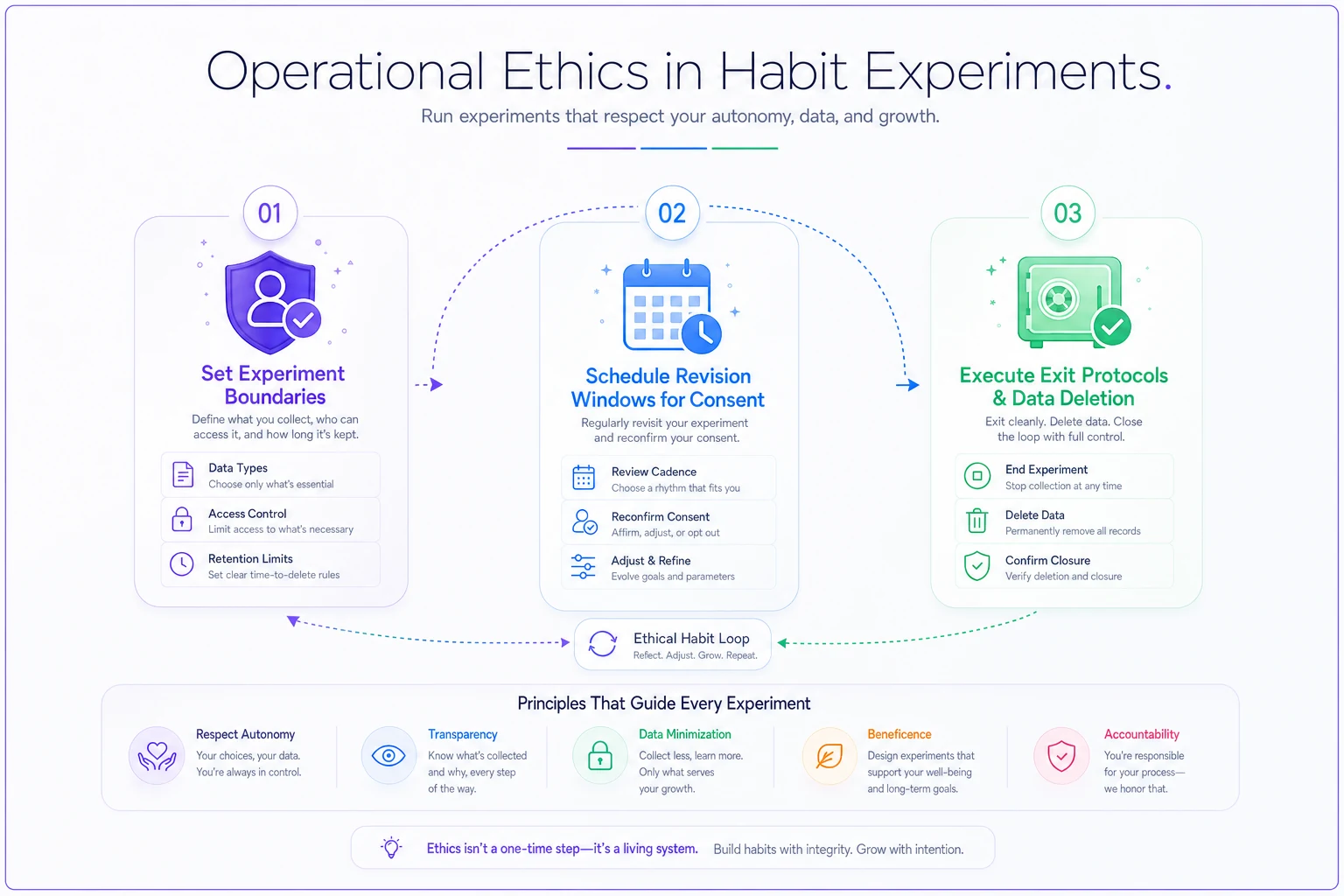
The goal is to make consent iterative and reversible, not a one-time checkbox.
The Three-Layer Consent Structure
Layer 1: Experiment Boundaries
Before any tracking begins, establish hard limits on what data gets collected, who can access it, how long it's retained, and under what conditions it gets deleted.
Write this down. Not a legal document — just clear agreements in plain language. "I'll share my gym check-ins but not weight data. You can see weekly summaries but not daily details. Everything gets deleted after 90 days."
Layer 2: Revision Windows
-
Week 1
Quick adjustment after seeing how it actually feels
-
Week 3
Deeper review once real patterns emerge
-
Monthly
Ongoing refinements as needs change
During each window, either party can modify agreements without judgment or explanation. The person who was comfortable sharing everything might need more privacy. Someone who started cautious might want deeper accountability. Consent evolves — plan for that.
Layer 3: Exit Protocols
Define how someone leaves the experiment: immediate data deletion options, no-questions-asked withdrawal, transition periods for coupled habits, post-experiment data handling.
Make leaving as frictionless as joining. The moment someone has to justify why they want out, you've built a trap, not a support system.
Data Minimization Rules That Actually Work
Most habit trackers collect everything because they can. Every rep, every meal, every mood rating. But more data creates more risk — privacy breaches, overwhelming complexity, analysis paralysis. I covered the dangers of over-tracking in my piece on personal data strategy, but the ethical dimension is worth its own treatment.
Collect only what drives specific actions. If you're not going to change behavior based on heart rate variability data, don't track it. Each data point should map to a concrete intervention.
Use categories instead of exactness. "Workout completed/skipped" instead of detailed performance metrics. "Mood: rough/okay/good" instead of 1-10 scales with journaling. Fuzzy data is often enough and always safer.
Prefer coarse categories and shorter retention windows: they reduce risk and make consent simpler.
Time-box everything. Data older than your experiment cycle — usually two to four weeks — should disappear automatically. You're running experiments, not building permanent records.
Separate identity from behavior. Store habits and patterns, not personal narratives. "User completed morning routine" not "Sarah struggled but pushed through despite anxiety." The moment you start documenting someone's inner life, you've crossed from tracking into surveillance.
Mental Health Escalation Triggers
This is where most habit experiments fail catastrophically — nobody plans for psychological crisis. You're tracking someone's meditation practice and suddenly they're expressing suicidal ideation in their notes. You're accountability partners for exercise and notice signs of compulsive overtraining. You're helping someone moderate drinking and realize they need professional intervention.
Red Flags That Stop Everything:
-
Any mention of self-harm
-
Eating disorder behaviors — severe restriction, purging, compensatory exercise
-
Substance use escalation
-
Manic or depressive episodes
-
Paranoid or delusional thinking
When these appear, the experiment stops. Not pauses — stops. Delete the data if requested. Provide resources. Step back.
Yellow Flags That Prompt Check-ins:
-
Consistent mood deterioration over a week or more
-
Social isolation patterns
-
Sleep disruption beyond three to five consecutive days
-
Compulsive behavior escalation
-
Noticeable increases in anxiety or panic
These don't end the experiment but trigger a consent review. "I'm noticing your sleep data shows consistent 3am wake-ups. Want to talk about whether tracking is helping or adding pressure?"
Resource List (Prepared in Advance):
-
Local crisis hotlines
-
Therapist referrals
-
Relevant support groups
-
Online resources
-
Emergency contacts
You're not a clinician. When mental health issues surface, your job is to recognize, pause, and refer — not diagnose or treat.
Sample Consent Templates and Agreement Wording
Theory is useful, but you need actual words when you're sitting across from someone ready to start. These templates have been refined through real use:
Basic Accountability Partnership Agreement
| Template | Best For | Key Feature |
|---|---|---|
| Basic Accountability Partnership | 1:1 peer accountability | Simple, plain-language terms |
| Group Challenge | Teams or communities | Aggregate vs. individual visibility controls |
| Family/Household | Domestic habit tracking | Age-differentiated consent |
| Professional Development | Workplace contexts | Explicit non-retaliation clause |
Use these as starting points and adapt language to your context.
Basic Accountability Partnership Agreement
"We're experimenting with [specific habit] for [timeframe]. I'll share [specific data points] through [method/platform]. You can see [frequency] updates but not [excluded information].
Either of us can modify this agreement at our weekly check-ins. If someone wants to stop, we delete all shared data within 24 hours, no questions asked.
If either of us notices signs of distress, compulsion, or harm, we pause immediately and reassess whether to continue."
Group Challenge Consent Structure
"This [duration] challenge tracks [specific metrics]. Participants can see [aggregate/individual] data but cannot screenshot, share, or discuss specific people's data outside the group.
Week 1: Everyone can adjust privacy settings. Week 2: Mid-point consent review. Final week: Decision about data retention.
Anyone can leave anytime by messaging [designated person]. Their data gets removed from group views within [timeframe]."
Family/Household Habit Tracking
"We're tracking [habit] as a household to [specific goal]. Kids under 16 need renewed consent monthly. Adults can opt-out anytime.
Visible to family: [specific data]. Private to individual: [specific data]. Never tracked: [specific boundaries].
If anyone feels pressured, judged, or unsafe, we stop immediately and delete all data if requested."
Professional Development Experiments
"This workplace habit experiment is 100% voluntary. Participation or non-participation won't affect reviews, promotions, or standing.
Data visible to you: Everything about yourself. Data visible to manager: Aggregate trends only. Data visible to team: Optional sharing only.
You can withdraw anytime by emailing [HR contact]. All your data gets purged within 48 hours."
When Harm Happens Despite Best Intentions
Even with solid frameworks, harm happens. Someone's eating disorder gets triggered despite careful boundaries. Private data gets exposed through a platform breach. An accountability partnership turns emotionally coercive. Shame and judgment derail people's recovery — something I explored in depth in my guide to shame-free recovery.
When things go wrong, the order matters:
-
Stop immediately. Don't try to salvage the experiment while someone's actively being harmed. Full stop comes first, assessment later.
-
Delete data if requested. No arguments, no "but we need it for..." If someone wants their data gone, it goes.
-
Document what happened. Not for liability — for learning. What early signals did you miss? Which guardrails failed?
-
Make amends where possible. Sometimes that means apology. Sometimes space. Sometimes resources for professional help. Ask what they need, then provide it without conditions.
-
Revise your framework. Each failure teaches something. Build those lessons into the next experiment.
The impulse to protect the experiment or explain your intentions comes naturally, but it's usually the wrong move. The person who got hurt doesn't need your reasoning — they need the harm to stop.
The Difference Between Support and Surveillance
The line between helpful accountability and invasive monitoring is thinner than most people realize. The same tracking system can feel supportive on Tuesday and suffocating by Friday. The difference isn't really in the data collected — it's in the power dynamics, consent structures, and exit options.
Support preserves autonomy. You choose what to share, when, and can stop anytime. The other person reflects data back to you without interpreting or judging it. "You worked out three times this week" — not "You should have worked out more."
Surveillance removes agency. Someone else decides what gets tracked, interprets your data, and makes it difficult to opt out. They use information against you, share it without permission, or create consequences for non-compliance.
Most habit experiments start as support but drift toward surveillance when stakes increase, power imbalances emerge as one person progresses faster, boundaries erode through gradual scope creep, or exit costs rise through social pressure and sunk cost thinking. None of these shifts feel dramatic when they're happening. That's the problem.
How AI Changes the Ethics Landscape
Modern habit tracking increasingly involves AI-powered systems that predict patterns, suggest interventions, and automate accountability. These platforms can identify depression before you realize you're depressed, predict relapse before you feel vulnerable, and develop a picture of your behavior patterns that's more detailed than your own self-awareness.
That creates genuinely new ethical territory.
Predictive insights without consent. An app notices correlation between your sleep data and anxiety spikes. Should it tell you? Your accountability partner? Your therapist? The line between helpful insight and invasion depends entirely on prior agreement — and most people never establish that prior agreement.
Automated interventions crossing boundaries. AI sends encouraging messages when you miss workouts. Helpful until you're missing them due to injury, depression, or a family emergency. The system reads patterns, not context.
Data permanence despite deletion requests. You delete your account, but the model trained on your behavior retains those patterns. Your habits become part of a prediction system you can't fully exit.
When using AI-enhanced tracking tools, the ethical baseline is higher, not lower. Understand what the system can detect and predict. Set clear limits on automated interventions. Know where your data goes and how it trains models. Maintain manual overrides for automated features. Keep human judgment primary, with AI recommendations secondary.
Building Ethical Habits at Scale
Everything gets more complex when you move beyond individual experiments to group or organizational contexts — a family tracking screen time, a team building productivity habits, an online community supporting recovery. Scale multiplies both positive outcomes and potential harms.
Create opt-in tiers. Not everyone needs the same level of transparency. Some want full accountability, others just want to participate. Build multiple engagement levels rather than forcing a single mode on everyone.
Designate ethics monitors. Someone whose actual job is watching for consent violations, boundary crossing, and signs of harm — with real authority to pause experiments and mandate reviews.
Build anonymous feedback channels. People won't report problems publicly if it makes them look weak or difficult. Create ways to raise concerns without social cost.
Document everything. Not for legal protection but for pattern recognition. Which experiments tend to cause problems? What early warning signs keep appearing?
Plan for inequality. Some people will progress faster, face fewer obstacles, or have more resources. Build in support for struggling members without shaming them or creating a two-tier system that advantages high performers.
Your Ethical Experiment Checklist
Before starting any habit experiment involving others:
-
[ ] Written consent agreement with clear boundaries
-
[ ] Defined data collection and retention limits
-
[ ] Scheduled revision windows (week 1, 3, monthly)
-
[ ] No-questions-asked exit protocol
-
[ ] Mental health escalation triggers identified
-
[ ] Resource list for crisis situations prepared
-
[ ] Clear distinction between support and surveillance
-
[ ] Plan for handling violations or harm
-
[ ] Anonymous feedback mechanism
-
[ ] Designated person monitoring for problems
During the experiment:
-
[ ] Regular consent check-ins happening
-
[ ] Data minimization rules being followed
-
[ ] Early warning signs being watched for
-
[ ] Power dynamics being monitored
-
[ ] Exit costs staying low
-
[ ] Privacy boundaries being respected
After completion or termination:
-
[ ] Data deletion as agreed
-
[ ] Lessons learned documented
-
[ ] Framework revised based on experience
-
[ ] Relationships preserved or properly closed
-
[ ] No lingering surveillance or judgment
Use this checklist as a living document and adapt it after each experiment.
Ethics for habit change isn't about perfect protocols or zero risk. It's about honestly acknowledging that behavior modification affects real people in complex ways. Every tracking app, accountability partnership, and group challenge creates potential for both transformation and harm — sometimes at the same time.
The most sustainable habit change happens within frameworks that protect autonomy while providing structure, maintain privacy while enabling accountability, and preserve dignity especially during failure.
Your next habit experiment will involve other people — partners, friends, family, colleagues. They'll share data, provide accountability, and trust you with vulnerable information about their struggles and progress. That trust comes with real responsibility.
Build your ethical framework before you need it. Create consent structures that evolve with experiments. Prepare for mental health crises before they emerge. Draw clear lines between support and surveillance.
The habits that actually stick are built on respect, consent, and genuine care for everyone involved. The tracking tools and accountability systems are just operational details. The ethics determine whether you're helping people change or just documenting their struggles.
Start with consent. Build in boundaries. Prepare for problems. Protect the humans behind the habits.
Ready to unlock your full potential?
Join thousands of users transforming their lives using Growyly to stay motivated, organized, and growth-focused every day.