



You check your habit tracker. 47 days of meditation streak, 82% completion rate on workouts, 6.7 average mood score, 14,283 steps yesterday, 7.2 hours of sleep with 23% REM phase, 112 heart rate variability score, 4 pomodoros completed, 3.5 liters of water consumed.
Now what?
Most personal tracking systems collapse under their own weight because they confuse measurement with progress. The problem isn't the apps or the wearables. It's that nobody teaches you how to build a personal data strategy for growth that actually connects signals to decisions.
Around week 6, most people abandon their tracking systems entirely. The pattern is pretty consistent—they track everything because they're afraid of missing the "key metric" that unlocks their growth. But without a framework for turning data into action, they end up with spreadsheets full of numbers and no clearer path forward than when they started.
Why Personal Data Becomes Overwhelming Instead of Actionable
The meditation app sends weekly reports. Your fitness tracker buzzes with achievements. The habit tracker shows colorful streaks. Each tool operates in isolation, generating its own metrics, demanding its own attention.
Then Sunday rolls around. You spend an hour reviewing dashboards, comparing this week to last week, noting that sleep quality dropped 8% while productivity increased 12%. You make vague commitments to "focus on sleep" or "maintain the momentum." By Tuesday, you're back to collecting data with no real connection between what you measure and what you actually do.
This fragmentation creates three specific breakdowns.
Signal confusion happens when different metrics suggest contradictory actions. Your step count says move more, but your recovery score says rest. Your productivity metrics improve when you skip morning routines, but your mood scores drop. Without a hierarchy of signals, every metric feels equally important and equally ignorable.
Retention anxiety emerges when you're afraid to delete any data because it might be useful "someday." You keep every workout log from three years ago, every mood entry, every meditation session. The data accumulates but never gets synthesized into insights because there's too much noise.
Review paralysis sets in when checking your metrics becomes a task itself rather than a trigger for decisions. You schedule "data review time" but end up scrolling through charts without taking any action—tracking your tracking instead of using data to guide behavior.
These patterns intensify as you add more tools. Each new app promises to be the missing piece but just adds another stream of metrics to manage.
The Framework That Makes Data Useful, Not Burdensome
A functional personal data strategy starts with purpose, not metrics. Before tracking anything, you need clarity on what decisions you're actually trying to make.
Achieve more by focusing on what matters.
Growyly helps you build lasting habits and track your personal growth effortlessly.
- Goal setting with progress tracking
- Daily habit reminders
- Motivational insights and analytics
No credit card required
A business doesn't track revenue to admire the number. They track it to decide whether to hire, invest, or pivot. Your personal data should work the same way—every metric should connect to a specific decision or action trigger.
Purpose-First Data Design
Start by listing the actual decisions you make about your habits and goals. Not the metrics you think you should track, but the real choices you face. Do I need more recovery or more intensity in workouts? Should I prioritize deep work or meetings this week? Is my morning routine helping or hurting my energy levels?
For each decision, identify the minimal signal that would give you enough confidence to act. Not perfect information—just enough clarity to choose a direction. Someone tracking fitness might only need weekly workout count and perceived energy levels, not detailed heart rate zones and lactate threshold measurements.
Map these signals to specific time windows. Daily signals guide immediate adjustments (energy level → afternoon schedule). Weekly signals inform routine tweaks (workout completion → next week's programming). Monthly signals suggest system changes (overall progress → goal adjustments).
This flips traditional tracking on its head. Instead of collecting everything and hoping patterns emerge, you identify the decisions you need to make first, then collect only the signals that inform those decisions.
Building Your Signal Hierarchy
Not all data deserves equal attention. Most tracking systems fail because they treat every metric as equally important, creating an overwhelming stream of numbers without any real priority.
Your signal hierarchy should reflect decision frequency and impact. Primary signals directly trigger actions—these get checked daily or weekly. Secondary signals provide context but don't drive immediate decisions. Archive signals exist for reference but don't need active monitoring.
Here's what this looks like in practice:
-
Morning energy rating (1-5)
Determines workout intensity
-
Deep work blocks completed
Adjusts tomorrow's schedule
-
Evening wind-down time
Sets next day's cutoff
Secondary Signals (Monthly Review)
-
Average weekly workout count
Informs program adjustments
-
Project completion rate
Guides capacity planning
-
Social connection frequency
Prompts relationship maintenance
Archive Signals (Quarterly/Annual)
-
Detailed workout logs
Reference for injury patterns
-
Mood correlation data
Long-term pattern recognition
-
Time audit results
Annual planning input
The hierarchy prevents data overload while ensuring important signals get attention. You're not ignoring data—you're being intentional about when and how you engage with it.
Setting Retention Windows That Reduce Anxiety
One reason personal tracking creates anxiety: we keep everything forever, building an ever-growing mountain of data that feels both precious and useless.
Professional data management uses retention policies—rules about how long to keep different types of information. Your personal tracking needs the same thing.
Raw daily data might only need 30-90 day retention. Once you've extracted weekly or monthly patterns, the granular details become clutter. That Tuesday workout from eight months ago? The specific sets and reps don't matter anymore—only the pattern of consistency or improvement over time.
Weekly summaries can persist longer, maybe 6-12 months. These capture trends without overwhelming detail. You can see that February was strong for workouts but weak for sleep without needing every daily data point to reconstruct that story.
Annual rollups become your permanent record. Total workouts, average metrics, major milestones—these create your long-term growth story without requiring infinite storage of daily minutiae.
This retention framework reduces both digital clutter and mental overhead. You stop feeling guilty about "losing" old data because you've deliberately decided what deserves preservation.
Creating Review Cadences That Produce Decisions
The most sophisticated tracking setup means nothing if review sessions don't generate concrete actions. Most people either skip reviews entirely or spend hours analyzing data without changing anything.
Effective review cadences match decision types to time horizons. Each tier serves a specific purpose.
Daily Microdecisions (2 minutes)
Check only primary signals. Make one adjustment for tomorrow. Did today's energy match expectations? Shift tomorrow's workout or work block accordingly. No deep analysis, just quick calibration.
Weekly Tactical Adjustments (15 minutes)
Review completion rates and energy patterns. Identify one specific obstacle from last week. Adjust one routine or target for next week. Skip the comprehensive analysis—focus on the single highest-impact change.
Monthly System Evaluation (30 minutes)
Examine secondary signals and trends. Question whether current targets still make sense. Adjust one major parameter—workout frequency, wake time, work block duration. This is where you modify the system, not just the execution.
Quarterly Strategic Alignment (60 minutes)
Review archive signals and long-term patterns. Reconnect metrics to larger goals. Decide what to start tracking, what to stop, what to keep. This prevents metric creep and maintains alignment between data and actual decisions.
Each review produces specific outputs, not vague intentions. The daily review changes tomorrow's schedule. The weekly review modifies next week's targets. The monthly review adjusts the system. The quarterly review refines the strategy.
Action Rules That Remove Decision Fatigue
The final component transforms signals into automatic responses. Instead of interpreting data fresh each time, you pre-decide what different signals mean for your behavior.
Think of these as if-then protocols. If weekly workout completion drops below 80%, reduce target by one session and focus on consistency. If morning energy averages below 3 for three consecutive days, enforce earlier bedtime and skip morning workouts.
These rules remove the cognitive load of constant decision-making. You've already decided what different signals mean, so you can act quickly instead of deliberating every time.
Some action rules trigger experiments rather than fixed responses. If productivity metrics stall for two weeks, test a new time-blocking method for the next sprint. If mood scores decline despite good habit adherence, investigate external factors through journaling.
The rules should be specific enough to drive action but flexible enough for context. Not "exercise more when stressed" but "when stress score exceeds 7 for two consecutive days, replace one intense workout with yoga or walking."
Privacy Guardrails for Personal Data
While building your tracking system, you're generating sensitive information about your behavior, health, and psychology. This data needs more than just password protection.
Consider data portability before committing to any platform. Can you export your information? In what format? How hard would migration be if the service disappears or changes terms?
Local-first options provide maximum control but require more setup. Cloud services offer convenience but come with privacy trade-offs. Many people find a hybrid approach works well—sensitive health data stays local while habit streaks sync to the cloud.
Export key datasets monthly in a portable format (CSV/JSON) so migrations are simple and you avoid vendor lock-in.
Be deliberate about what you share with apps. That fitness tracker doesn't need your real name or exact birthdate to function. The meditation app doesn't require location access. Question every permission request.
Regular data audits help maintain privacy boundaries. Every quarter, review what each service can access. Revoke permissions that aren't essential. Delete accounts for abandoned tools rather than leaving dormant data scattered across platforms.
A Practical Implementation Timeline
Rather than overhauling everything at once, phase your personal data strategy implementation over several weeks.
-
Week 1-2
Purpose Mapping
— List every decision you make about habits and goals. Identify the minimum viable signal for each decision. Stop adding new tracking until this foundation is clear. -
Week 3-4
Signal Hierarchy
— Categorize existing metrics into primary, secondary, and archive tiers. Set up simple review triggers for each tier. Delete or hide metrics that don't connect to decisions. -
Week 5-6
Retention Rules
— Implement your first retention window, probably for daily data. Export and archive data beyond your retention window. Notice how this reduces overwhelm. -
Week 7-8
Review Rhythm
— Establish your daily microdecision and weekly adjustment practices. Keep reviews time-boxed and output-focused. Document what changes after each review. -
Week 9-10
Action Protocols
— Create three to five if-then rules for your primary signals. Test these rules for two weeks before adding more. Adjust triggers based on actual response patterns. -
Week 11-12
Privacy Audit
— Review all services storing your personal data. Adjust permissions and sharing settings. Create backup and export routines for critical data.
Below is a visual timeline that maps the 12-week phased rollout.
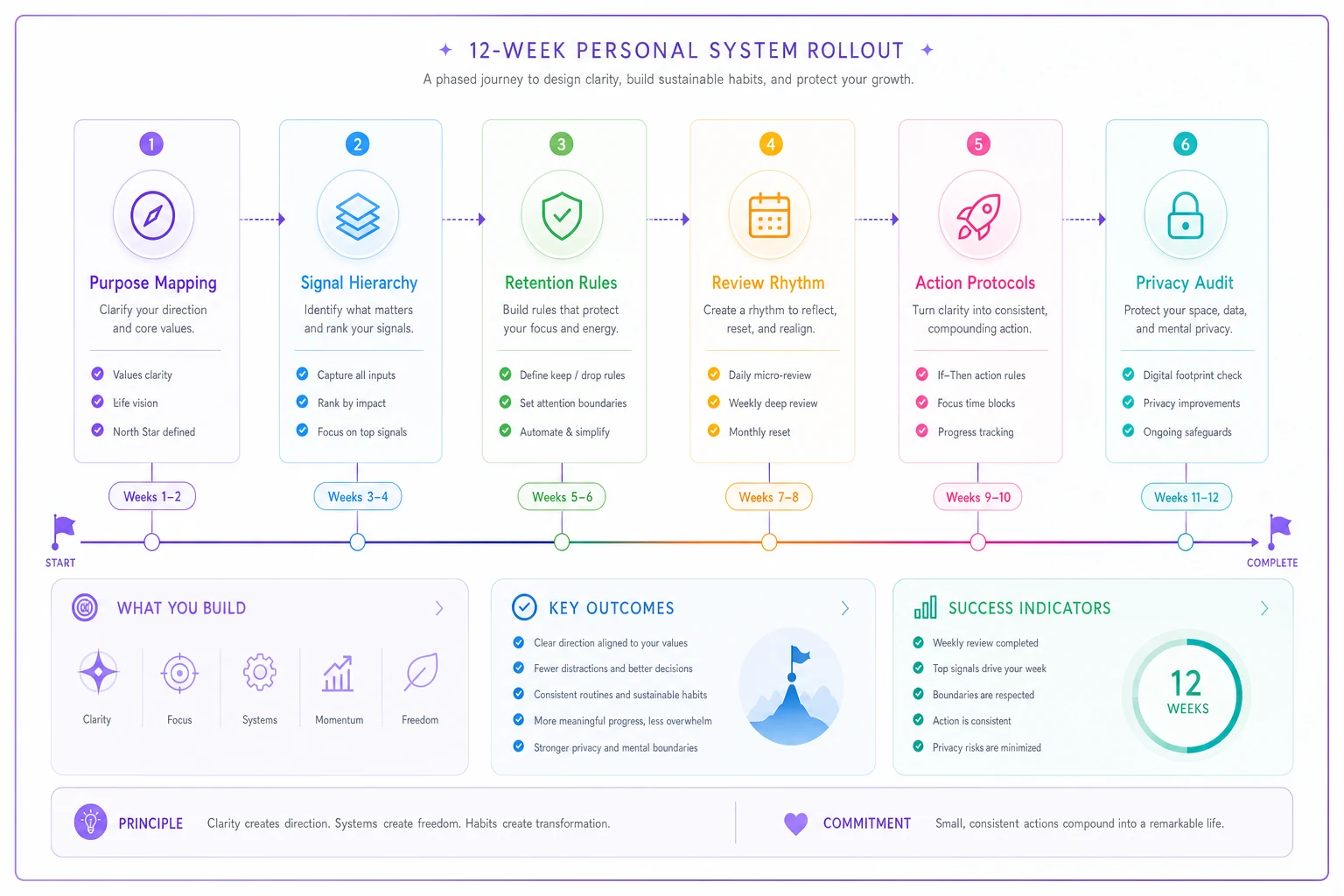
Use the timeline to pace your work: focus on one phase at a time and avoid adding new metrics mid-rollout.
Real Implementation Example
Marcus ran a small consulting practice and tracked everything—time per client, revenue per project, hours worked, energy levels, workout completion, sleep quality, reading time, family time, and a dozen other metrics across five different apps.
By March, he was spending about 45 minutes every Sunday creating reports nobody read, including himself. The data existed but drove zero decisions. Tracking had become a time-consuming ritual that produced guilt instead of growth.
Working through this framework, Marcus identified his actual decisions: how to balance client work with business development, whether to accept new projects, when to push hard versus recover, which habits actually supported sustainable energy.
He reduced his tracking to five primary signals: weekly billable hours, pipeline value, morning energy score, weekly workout count, and Sunday family time duration. Everything else became secondary or archived.
His daily two-minute review only checked energy score to adjust the next day's schedule. Weekly 15-minute sessions compared billable hours to targets and identified one schedule adjustment. Monthly reviews examined pipeline trends and energy patterns to guide capacity decisions.
The action rules simplified everything. If billable hours exceeded 35 in a week, the next week automatically included two recovery blocks. If pipeline dropped below $30k, time blocks shifted toward business development. If energy averaged below 3, evening routines tightened to support better sleep.
Six months later, Marcus spent roughly 80% less time on tracking while making clearer decisions. Revenue stabilized around $22k monthly, energy stayed consistent, and Sunday reports became 10-minute check-ins rather than 45-minute ordeals. Not a dramatic transformation—just a quieter, more functional system that he actually used.
Templates for Your Data Strategy
To implement your own personal data strategy for growth, use these templates as starting points.
Decision Mapping Template
| Decision | Frequency | Minimal Signal | Action Trigger |
|---|---|---|---|
| Workout intensity | Daily | Morning energy (1-5) | <3 = light day |
| Weekly schedule | Weekly | Last week completion % | <70% = reduce load |
| Goal adjustment | Monthly | 4-week trend | Flat = modify approach |
Signal Hierarchy Template
-
Primary (Daily/Weekly)
- [Signal]: [Specific decision it drives] - [Signal]: [Specific decision it drives]
-
Secondary (Monthly)
- [Signal]: [System adjustment it informs] - [Signal]: [System adjustment it informs]
-
Archive (Quarterly+)
- [Signal]: [Long-term pattern it reveals] - [Signal]: [Long-term pattern it reveals]
Review Cadence Template
-
Daily (2 min)
- Check: [Primary signal] - Decide: [Tomorrow's adjustment]
-
Weekly (15 min)
- Review: [Completion metric] - Identify: [One obstacle] - Adjust: [Next week's target]
-
Monthly (30 min)
- Analyze: [Trend data] - Question: [Current approach] - Modify: [One system parameter]
These are starting points, not rigid rules. Most people end up modifying the templates after a few weeks once they see how they actually use their data.
When This Approach Makes Sense (And When It Doesn't)
This framework works best when you're already tracking multiple habits or goals but struggling to connect data to decisions. If you've accumulated months of data without clear improvements, this structure can transform those numbers into actionable insights.
It particularly helps if you feel overwhelmed by tracking obligations or spend significant time reviewing data without changing behavior. The hierarchy and retention rules reduce both the volume and complexity of what you're managing.
Skip this if you're just starting with one or two simple habits. Basic tracking might be all you need. You don't require a comprehensive data strategy just to monitor whether you meditated today.
Also worth skipping if you genuinely thrive on detailed data exploration. Some people get real value from diving deep into their metrics as a form of self-reflection. If that's working for you, a minimalist framework might just feel restrictive.
The Operational Reality of Personal Data
Most personal data strategies fail because they're designed for perfect consistency in an imperfect life. This framework assumes you'll miss reviews, ignore signals, and occasionally abandon tracking entirely.
The environment audit approach applies here too—your tracking system should work with your natural patterns, not against them. If you never actually review data on Sundays, don't schedule Sunday reviews. If morning check-ins feel rushed, move them to lunch.
The retention windows and archive tiers mean gaps in tracking don't destroy long-term patterns. Miss a week of data? The monthly trends still work. Abandon tracking for a month? The quarterly patterns remain intact.
Action rules provide structure when motivation wavers. You don't need to feel inspired to follow an if-then protocol. The decision was already made when you had clarity, so you can execute even when you're running low.
This connects naturally to building a repeatable annual system—your data strategy should support long-term growth patterns, not just daily habits. The quarterly reviews ensure your tracking evolves as your goals shift.
Moving from Anxiety to Clarity
The shift from tracking everything to tracking what matters feels uncomfortable at first. You worry about missing important patterns or losing valuable data. That discomfort usually fades within a few weeks once the reduction in cognitive load becomes obvious.
Instead of drowning in dashboards, you check specific signals with clear purposes. Reviews produce decisions, not just observations. Data serves your growth rather than demanding constant attention.
Start with purpose, not platforms. Identify decisions before metrics. Create hierarchies before collecting more data. Set retention windows before storage fills up. Establish review cadences before analysis paralysis sets in. Build action rules before decision fatigue hits.
Your personal data should feel like a compass. When signals connect directly to decisions, tracking transforms from an anxiety-inducing obligation into something that actually clarifies your next move. The framework adapts as you evolve—what matters in January might not matter in June, and the quarterly strategic reviews exist precisely to catch that drift before it turns into a system that no longer reflects your actual goals.
Stop tracking everything. Start measuring what moves you forward. The right personal data strategy for growth isn't about perfect information—it's about actionable signals that produce real decisions. Everything else is just digital noise.
Ready to unlock your full potential?
Join thousands of users transforming their lives using Growyly to stay motivated, organized, and growth-focused every day.