


You added three new things in the same two weeks: a 10pm screen cutoff, magnesium before bed, and a morning walk. Your sleep got better. Great. Now which one did it?
Most people never answer that question. They keep all three, which sounds fine until you realize you're paying a time and willpower tax on two habits that might be doing nothing. And when life gets busy and something has to go, you cut the wrong one — because you never figured out which lever was actually connected to anything.
This is the attribution problem, and it's probably the most underrated skill in personal growth. Not building habits. Not tracking them. Figuring out which ones caused the result. Without that, you're just accumulating routines and hoping the pile is working.
The good news: you don't need a research lab. You need a decision tree, a few lightweight causal checks, and the discipline to stop changing six things at once.
Why attribution breaks for almost everyone
Your life is a terrible experiment. Everything moves at the same time. You start eating better and sleeping better and work calms down and it's finally spring. Your mood lifts. Which input gets the credit?
In practice, this usually plays out in three ways:
You attribute by recency. Whatever you added most recently gets credit for whatever improved. This is wrong surprisingly often — the habit you started three weeks ago finally compounded, but the new shiny thing steals the glory.
You attribute by effort. The hardest habit feels like it must have mattered most. Cold showers get worshipped not because they work but because they're miserable, and misery feels like it should buy results.
You attribute by story. You read something, it made sense, you started doing it, something improved — narrative closed. The problem is that a clean story isn't evidence. It's just a satisfying shape.
None of these are stupid. They're the brain doing cheap pattern-matching because real attribution takes work. The point of a system is to make that work manageable enough to actually do.
The one rule that makes everything else work
Before any method: change one meaningful thing at a time, and give it a clean window.
Achieve more by focusing on what matters.
Growyly helps you build lasting habits and track your personal growth effortlessly.
- Goal setting with progress tracking
- Daily habit reminders
- Motivational insights and analytics
No credit card required
That's it. That's most of the value right there. Almost every attribution failure traces back to stacking changes. If you add two habits on the same Monday, you've permanently entangled them unless you're willing to run a proper teardown later. You can't un-mix them after the fact.
This feels painful when you're motivated and want to overhaul everything at once. But stacking five habits and getting a vague "I feel better" is worth less than isolating one habit and knowing. Knowledge compounds. Vague feelings don't.
The attribution decision tree
When something improves (or tanks) and you want to know why, walk through this. It's designed to cut you off early so you don't waste effort on cases that can't be answered.
-
Did anything actually change, or is this just noise? If your "improvement" falls within your normal week-to-week swing, stop. There's nothing meaningful to attribute yet.
-
Did you change only one meaningful thing in the relevant window? If yes — you have a real candidate, keep going. If no — you have entangled variables. You can still learn, but you'll need a teardown (remove one at a time) to separate them.
-
Does the timing line up? Did the input come before the effect, with a plausible lag? If the effect started before you changed anything, your habit is innocent.
-
Is there a dose relationship? When you did more of it, did you get more effect? When you did less, did things dip? A dose–response pattern is one of the strongest signals you'll get outside a formal trial.
-
Can you run a cheap test? If the habit is reversible and low-stakes, stop doing it for a window and watch what happens. If the effect fades and returns when you resume, you've basically answered the question.
-
Is it worth the cost even if it works? A habit can be real and not worth keeping. Attribution tells you what works; your priorities tell you what stays.
Most people skip straight to step 5 on things that failed step 1 or step 2. Checking in order saves a lot of wasted effort.
The lightweight causal checks, in plain terms
These are the within-person versions of what researchers use. You don't need statistics — you just need to apply them honestly.
Temporal precedence
The cause has to come first. Obvious in theory, routinely violated in practice. If your energy picked up on Tuesday but your new supplement started Thursday, the supplement isn't doing it. Write down the date you started a change and the date you noticed the effect. A surprising number of false attributions die right here when you check the actual timeline instead of the one you remembered.
The subtle trap: lagged effects. A new sleep habit might take five to seven days to show up, so "I didn't feel different the first night" doesn't disqualify it. Know the expected lag for what you're testing and judge against that, not against "instantly."
Dose–response
If a habit is really working, scaling it up or down should move things in the same direction. Walked 30 minutes and felt sharp; walked 10 and felt mediocre; skipped it and felt foggy — that gradient is meaningful.
The mistake people make is running only one dose, always the same 20-minute meditation or the same one cup of coffee, so they never get the gradient that would confirm or kill it.
Control windows
A control window is a stretch where you intentionally pause the habit and observe. If the benefit disappears and comes back when you resume, you've got strong evidence. This is the closest thing to a real experiment you can run on yourself.
Use control windows for reversible, low-stakes habits. Don't use them for anything where the "off" period carries real risk, or where the whole value is consistency you don't want to break.
Micro A/Bs
Reserve Micro A/Bs for high-value habits where external trends could mask effects.
Instead of one long on-period and one long off-period, you alternate in short blocks — ABABAB. Mornings-with-walk on odd days, without on even days, two weeks, then compare. Alternating protects you from slow drifts — gradually calming work weeks, improving weather — because both conditions get spread across the whole period instead of one landing entirely during a good stretch.
Micro A/Bs are the most rigorous tool here and the most annoying to run. Save them for high-value habits you're genuinely unsure about. For a ready structure to drop these tests into, A Two‑Week Habit Lab: Fast, Low‑Risk Experiments That Actually Change Behavior gives you a useful container.
Signal vs. noise: keeping yourself honest
The most common way people waste attribution effort is reacting to normal variation. Sleep, mood, and output already swing day to day for no interesting reason. If you attribute every swing to a habit, you'll constantly adopt and drop things based on randomness.
A few rough heuristics:
-
One good day is not a signal. Neither is one bad one. You're looking for a shifted pattern, not a single data point.
-
If the change is smaller than your normal week-to-week range, treat it as noise until it persists. Know your baseline before you get excited.
-
Watch for direction holding across a week, not magnitude on any one day.
-
Be skeptical of the first three days of anything. Novelty and placebo are real and temporary. The honeymoon fades; judge after it does.
-
If you genuinely can't tell whether it's noise, it probably isn't big enough to matter yet. Big effects are usually obvious.
For the deeper version of separating real movement from random drift over longer horizons, Measure Habit Progress Without Noise Using Practical Long-Term Rules covers the longer-run rules worth layering on top of these quick checks.
Preregister your N‑of‑1: the template that stops self-deception
If you decide what counts as success after you see the results, you'll always find a way to call your favorite habit a winner. The brain is a lawyer, not a judge.
The fix is preregistration — writing down your prediction before you run the test. Sounds formal; takes ninety seconds. A workable template:
-
Habit being tested one thing
-
Predicted effect what specifically should improve
-
Metric the single signal you'll watch
-
Expected lag how long before you'd expect to see it
-
Test window dates, and whether it's on/off, dose-varied, or ABAB
-
What would prove me wrong the result that would make you drop this habit
-
Decision rule "If metric moves by X over the window, keep. If not, cut."
That last line is the whole game. Deciding the keep/cut rule in advance means the result makes the decision for you, not your attachment to the habit. The "what would prove me wrong" line is the one people skip — and it's the one that matters most. If you can't name a result that would kill the habit, you're not testing it, you're defending it.
Picking the right single metric is its own skill. Choosing one that's small enough to measure but meaningful enough to trust is covered in Habit Progress Metrics: Pick the Smallest Signals That Actually Predict Change.
Matching the method to the situation
Not every habit deserves a full A/B. Here's a rough guide to how much rigor is worth spending:
| Situation | Best check | Why |
|---|---|---|
| Reversible, low-stakes, quick effect | Control window (on/off) | Cheap, fast, decisive |
| Habit you can scale up or down | Dose–response | Gives a gradient, hard to fake |
| High-value, genuinely unsure, slow drift risk | Micro A/B (ABAB) | Protects against trends and external changes |
| Several habits added at once | Teardown (remove one at a time) | Only way to un-entangle |
| Effect is huge and obvious | Temporal precedence check only | Don't over-engineer a clear win |
| Within normal day-to-day swing | None yet — collect more data | Nothing to attribute to noise |
The principle worth internalizing: spend rigor in proportion to stakes and uncertainty. A free, pleasant, five-minute habit that seems to help? Keep it, don't test it, move on. A costly, unpleasant, time-heavy habit you're not sure about? That one earns a real control window or A/B before it keeps renting space in your week.
Worked example — sleep
Say you want to know if the 10pm screen cutoff is doing anything. You started it alongside magnesium and a morning walk. Entangled — step 2 of the tree sends you to a teardown.
You hold the walk and magnesium steady and run the screen cutoff as a micro A/B: cutoff on odd days, normal phone use on even days, two weeks. Metric: minutes to fall asleep, roughly estimated. Preregistered rule: if cutoff nights average noticeably faster — call it 15+ minutes — it stays.
Result comes back around 20 minutes, holding across most cutoff nights. Direction's consistent, magnitude's above your normal swing. Keep it. Then repeat the process on magnesium. Slow? Yes. But now you know, and you can drop whichever habit turns out to be dead weight instead of carrying all three forever.
Worked example — productivity
You started time-blocking and felt more productive for about a week, then it faded. Before crediting or blaming it, run the signal check: was week one just novelty? The honeymoon warning says yes, probably partly.
So you run a dose–response instead. Light blocking (just mornings), heavy blocking (full day), and none, rotated across days. Metric: number of meaningful tasks finished, your own judgment. What you find is that light blocking tracks almost as well as heavy blocking, and full-day blocking actually drops your output because it's exhausting to maintain.
That's an attribution win and a dosing win. The habit works — at a lower dose than you were running. Without the gradient, you'd have either kept the heavy version or dropped the whole thing after the honeymoon faded.
Worked example — fitness
You added morning walks and your afternoon energy improved. Clean candidate — only thing you changed, timing lines up. Tempting to just declare victory. But is it the walking, or the light exposure, or being outside, or the fact that you now eat breakfast afterward?
This is where attribution gets humbling: you often isolate a bundle, not a single mechanism. And that's fine. For practical purposes, if the bundle is cheap and pleasant, you don't need to dissect it further. Run a short control window — skip walks for four days — and if the afternoon slump comes back, the bundle is real. You don't have to know which part of the walk does it unless a part is expensive and you'd want to trim it.
Attribution to a bundle is still useful attribution. Don't let the inability to isolate the exact mechanism stop you from keeping something that clearly works as a unit.
When this level of effort is a bad idea
Worth saying plainly, because attribution can tip into obsession.
-
Don't test free, pleasant, low-cost habits. If it feels good and costs nothing, just keep it. The test costs more than the habit.
-
Don't run control windows on consistency-critical habits where breaking the streak does real damage. Some habits' entire value is that you never stop.
-
Don't try to attribute during chaotic life periods — moving, new baby, illness, job change. Too many variables moving at once. Wait for a stable stretch.
-
Don't over-measure. If tracking the test becomes a bigger habit than the thing you're testing, you've lost the plot.
The people who get the most out of this are the ones running a handful of genuinely costly or uncertain habits and wanting to prune. If you've got three routines and they all feel fine, you don't need a decision tree.
Putting it into a repeatable loop
Here's the whole thing as one workflow:
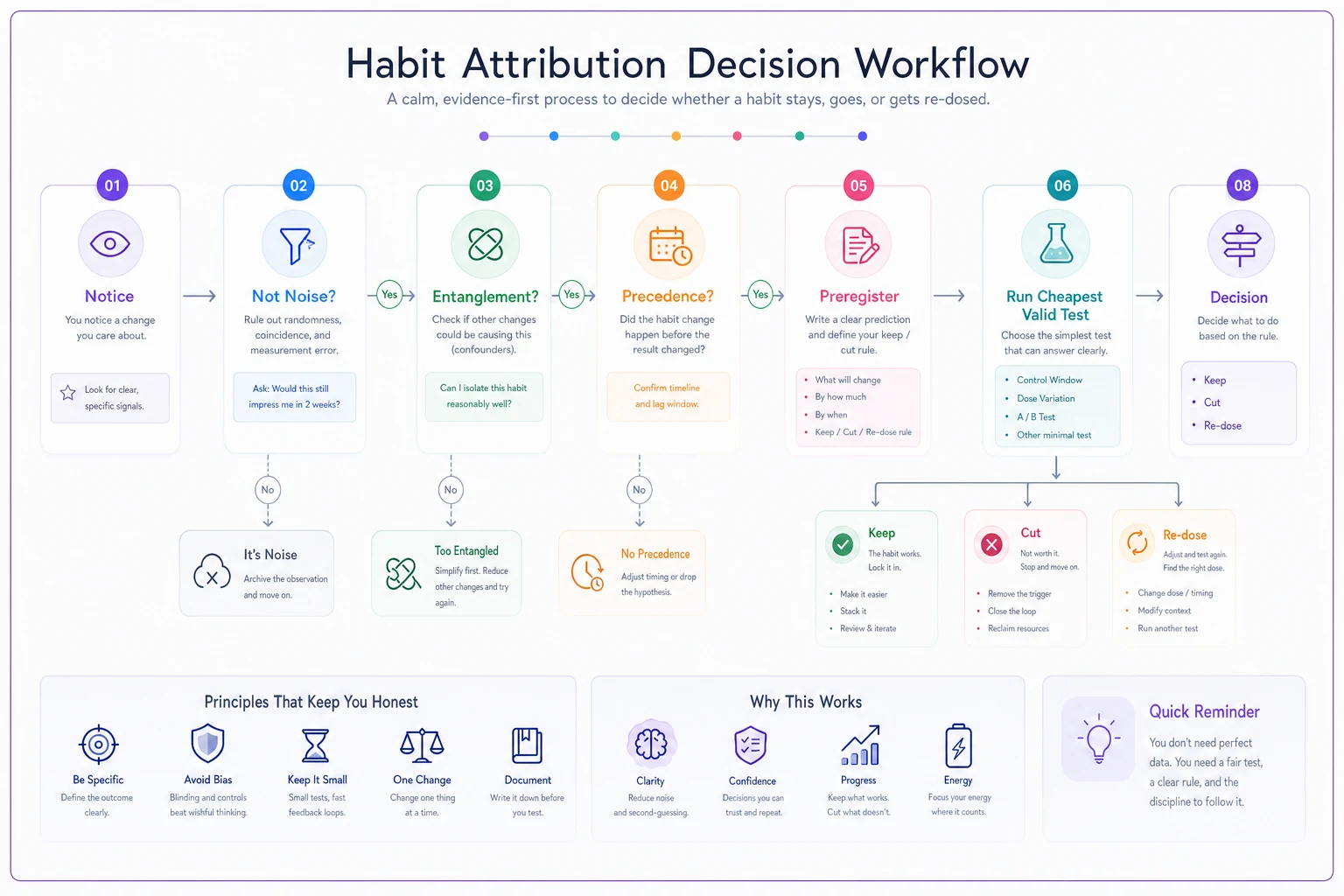
Notice a change in how you feel or perform → check it's not noise (bigger than your normal swing, holding across days) → check entanglement (did you change one thing or several) → check precedence (did the cause come first, accounting for lag) → preregister a prediction and a keep/cut rule → run the cheapest valid test (control window, dose variation, or A/B) → apply your preregistered rule without renegotiating → keep, cut, or re-dose → move to the next candidate.
Run it on one habit at a time and you'll slowly build something most people never have: an honest map of which routines actually earn their place. That map is worth more than any individual habit, because it's what lets you cut ruthlessly and keep the real levers when your capacity shrinks.
Most habit systems tell you how to build more. The harder, rarer skill is knowing what to keep — and that only comes from attribution you can trust. Change one thing, give it a clean window, decide the rule before you see the result, and let the evidence do the deciding.
You'll end up with fewer habits and far better ones.
Ready to unlock your full potential?
Join thousands of users transforming their lives using Growyly to stay motivated, organized, and growth-focused every day.