

Most habit systems are designed for your best days. That's the flaw hiding underneath almost every broken streak. You set up the workout, the writing block, the daily language practice — and it all works great until you catch a cold, your kid stops sleeping, or a work deadline swallows three weeks whole. Then the whole thing collapses, and you're back to zero.
The problem isn't discipline. The system just had no gears. A car with only one gear stalls the second it hits a hill. Habits built for peak capacity do exactly the same thing.
Resilience‑first habit design flips the assumption. Instead of asking "how do I keep this going when I'm at 100%," you ask "what does this habit look like at 60%, at 30%, at 10% — and how do I switch between those states without having to think?" You build the downshift in before you need it, so the decision is already made when your brain is too fried to make good ones.
This isn't about lowering standards. It's about keeping the machine at idle so it doesn't have to cold‑start every time you recover.
Why capacity drops break habits — and why willpower isn't the fix
Someone builds a solid routine over a few months. It's working. Then a stressor hits — illness, a family emergency, a brutal quarter at work. The habit doesn't gracefully shrink. It just stops. And because it stopped completely, restarting feels like starting from scratch, which kicks off the shame spiral that keeps people out for weeks instead of days.
The reason this happens is structural, not personal. Under stress, available executive function drops sharply. The exact resource you'd need to "push through" is the resource that got depleted. So the standard advice — try harder, remember your why, just show up — is asking for something you literally have less of right now.
There's a second, sneakier failure mode. Most people can't tell they've dropped in capacity until they're already three days into skipping. Capacity drops are invisible in the moment. You feel "a little off," you skip once "just for today," and by the time you notice the pattern, momentum is already gone. Without a signal that catches the drop early, you can't respond early.
Resilience‑first design solves both. It detects the drop through concrete signals, and it has a pre‑built lighter version ready to catch you before you fall all the way off.
The three pieces of a resilience‑first system
The whole approach comes down to three connected parts. Each one is useless without the others — this is the part people miss when they try to bolt "flexibility" onto an existing habit.
Achieve more by focusing on what matters.
Growyly helps you build lasting habits and track your personal growth effortlessly.
- Goal setting with progress tracking
- Daily habit reminders
- Motivational insights and analytics
No credit card required
-
Sensors — concrete, observable signals that tell you your capacity has dropped, ideally before you consciously notice.
-
A rule library — pre‑written downshift rules that map each capacity level to a specific, shrunken version of the habit.
-
Re‑entry protocols — a defined path back up to full fidelity that preserves the progress you protected on the way down.
Think of it as a thermostat, not a switch. A switch is on or off. A thermostat reads the room and adjusts continuously. Your habits need the thermostat model.
Sensors: how to actually detect a capacity drop
You can't respond to something you can't see. The mistake most people make is relying on how they feel, because feelings under stress are unreliable and lagging. By the time you "feel" too tired to exercise, you've usually been running low for days.
| Signal type | Example signal | How early it fires | Reliability |
|---|---|---|---|
| Sleep pattern | Two nights under ~6 hours in a row | Very early | High |
| Small friction | Snoozing the alarm 3+ times | Early | Medium |
| Skipped micro‑tasks | Not making the bed, dishes piling | Early | Medium‑high |
| Communication drift | Ignoring texts you'd normally answer | Mid | Medium |
| Physical symptoms | Sore throat, headache, low appetite | Mid | High for illness |
| Emotional flatness | Not wanting to talk to anyone | Mid‑late | Medium |
| The habit itself slips | You skipped the workout once | Late | High but too late |
Notice that the habit slipping is the last signal, not the first. If your only detector is "did I do the habit," you'll always be responding too late. You want upstream signals — sleep, alarm behavior, small household tasks — because those degrade before your structured habits do.
Pick a maximum of three sensors. More than that and you'll ignore all of them. A realistic setup: "If I sleep under 6 hours two nights running, OR I've snoozed past 30 minutes three days this week, OR I'm showing physical illness symptoms — I've dropped a gear." Simple enough to check in ten seconds.
One thing worth calling out: the best sensor is often something you already track passively. If your phone logs your sleep, that's a free signal. If you already glance at your kitchen every morning, "sink full of dishes" is a free signal. Don't build a monitoring habit just to monitor your habits — that's another thing to maintain, and it'll break under the same conditions.
Pick sensors you already track passively (phone sleep, alarm behavior, calendar) to avoid adding monitoring overhead.
Below is a simple workflow showing how sensors trigger a downshift and which rule tier follows.
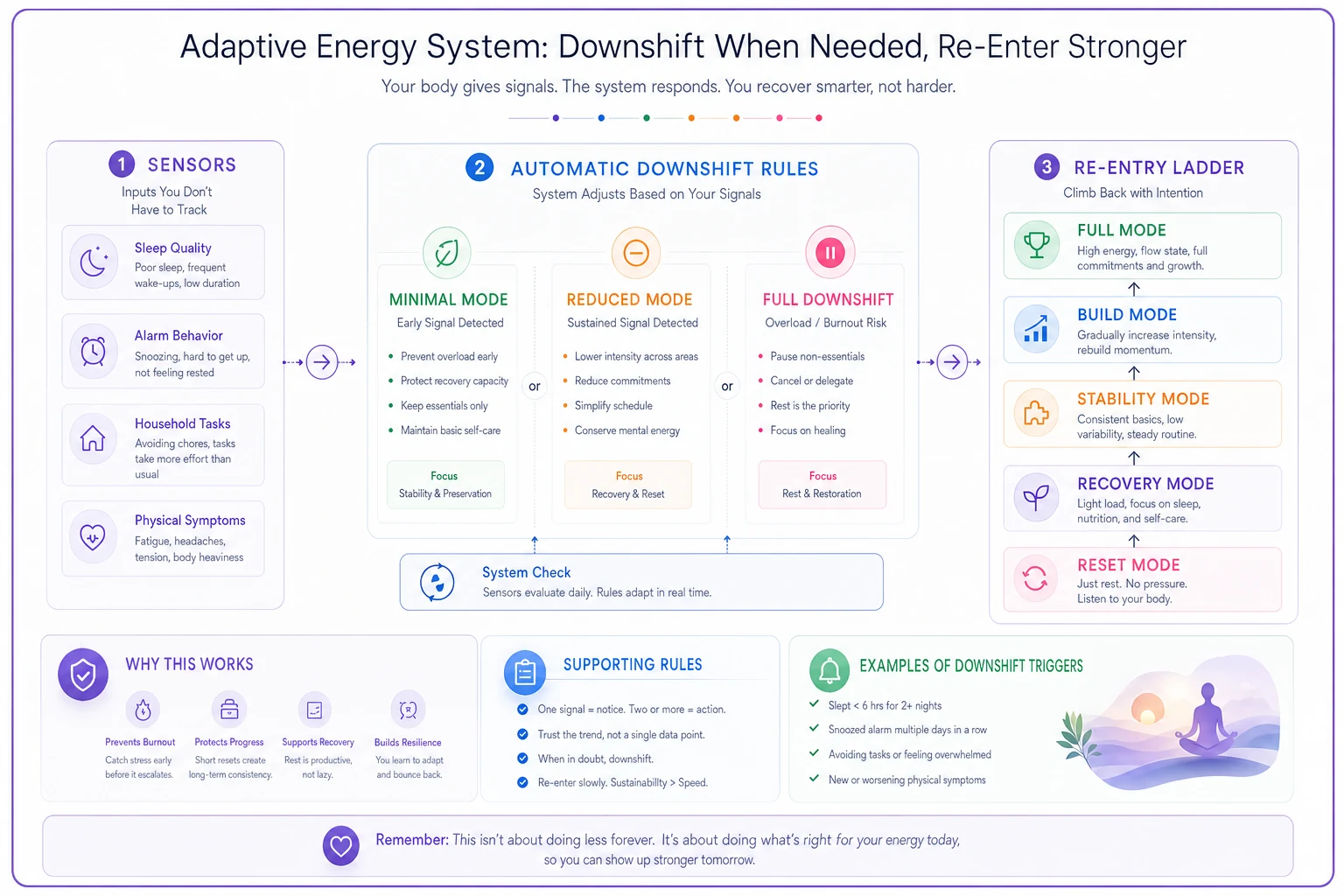
This graphic maps detection to action so the switch happens without conscious thought.
The rule library: pre‑built downshift templates
Once a sensor fires, you need a rule that already exists. Deciding in the moment what a lighter version looks like is exactly the decision your depleted brain will get wrong. So you write these when you're calm.
-
Full mode — your normal target. The version for good weeks.
-
Reduced mode — the version for when you're stretched but functional.
-
Minimal mode — the "keep the wiring intact" version. So small it almost feels pointless, which is the point.
The critical design rule: minimal mode must preserve the identity and the cue, not the volume. The purpose of minimal mode isn't fitness or output — it's keeping the neural path warm so re‑entry is a gradual step up, not a cold restart.
-
Exercise. Full
45‑minute strength session. Reduced: 15‑minute bodyweight circuit. Minimal: ten pushups and a two‑minute stretch, still in your workout clothes, still at the same time.
-
Writing. Full
1,000 words. Reduced: 250 words. Minimal: open the document and write one sentence. That's it.
-
Language learning. Full
30‑minute lesson. Reduced: 10‑minute review. Minimal: read one flashcard.
-
Meditation. Full
20 minutes. Reduced: 5 minutes. Minimal: three conscious breaths before you get out of bed.
The reason minimal mode works isn't the ten pushups. It's that you never had to renegotiate whether you're "a person who exercises." The identity survived intact, and the cue — clothes on, same time slot — stayed wired. That's what makes coming back cheap.
A mistake worth avoiding: making reduced mode too close to full mode. If your reduced version is "35 minutes instead of 45," it's not a real gear — it still requires nearly the same capacity, so you'll skip it just like you'd skip full. Each tier should require meaningfully less than the one above it. Rough rule of thumb: each downshift should cut the required effort by more than half.
This connects directly to the fidelity thinking behind planned pauses — the same logic that makes a tiered fidelity plan work for travel and vacations applies to unplanned capacity drops. The difference is that stress and illness don't give advance notice, so the tiers have to be pre‑built and the switch has to be automatic.
Re‑entry protocols: getting back up without losing progress
Downshifting is only half the system. The other half — the part people almost always skip — is a defined way back up. Without a re‑entry protocol, one of two bad things happens: you either get stuck in minimal mode long after you've recovered, or you leap straight back to full mode, get overwhelmed, and quit again.
A re‑entry protocol answers three questions in advance:
1. What signal tells me I've recovered? Use the same sensors in reverse. Sleep back above 6.5 hours for three nights. Physical symptoms gone for two days. Not "I feel ready," because you'll either wait too long or jump too soon.
2. What's my step‑up sequence? Don't go minimal → full. Go minimal → reduced → full, spending a set number of days at each. A workable default: three days at reduced before attempting full again. This gives your capacity a chance to confirm itself before you load it back up.
3. What do I do if I stall on the way up? If you try reduced mode and can't hold it, drop back to minimal without treating it as failure. Re‑entry isn't always linear. Some recoveries take one attempt, some take three. The protocol just needs to expect that.
Here's the numbered process in practice:
-
Recovery signal fires (sleep and symptoms normalized).
-
Move from minimal to reduced mode. Hold for three days.
-
If reduced holds cleanly, move to full mode.
-
If reduced feels shaky, stay another two days or drop back to minimal.
-
Once at full mode, confirm it holds for a week before considering yourself fully re‑entered.
The whole point of this ladder is that you never returned to zero, so there's no zero to climb out of. If you did drop all the way out despite the system, that's a different situation — recovering from a full lapse has its own playbook, and it's worth treating the shame‑free recovery process as a separate skill from the graceful downshifts described here.
A real scenario: the freelancer who stopped losing months
Consider a freelance designer running a one‑person studio, trying to maintain a daily writing habit alongside client work — publishing to build a personal brand. Her pattern was predictable and brutal: she'd write consistently for two or three months, then a big project would land, and the writing would vanish for its entire duration. Coming back took three to four weeks each time. Over a year she estimated she lost roughly three months to these collapse‑and‑restart cycles.
The fix wasn't more discipline. It was three gears and a sensor. Her signal: any week where billable hours crossed around 35, she automatically dropped to reduced mode. Full mode was 500 words a day. Reduced was one paragraph. Minimal — for genuinely brutal weeks — was a single sentence added to a running notes file.
The first heavy project after setting this up, she stayed in reduced and minimal mode for about six weeks. She wrote almost nothing of substance during that stretch — maybe a paragraph every couple of days. But she never stopped opening the file. When the project wrapped, re‑entry took roughly five days instead of a month, because the habit had never actually gone dark.
Over the following year she recovered most of that lost time — not because she wrote more on good weeks, but because she stopped hemorrhaging the recovery weeks. The gains came from the floor, not the ceiling.
When resilience‑first design makes sense — and when it doesn't
When it's clearly worth it:
-
Habits you've broken and restarted more than twice. Repeat collapse is the signal you need gears.
-
Habits tied to identity or long‑term skill — writing, exercise, a craft — where continuity matters more than daily volume.
-
Situations with predictable stress cycles
seasonal work, parenting young kids, chronic health conditions, rotating schedules.
When it's overkill:
-
Brand‑new habits you're still testing. Don't build a downshift ladder for something you haven't proven you want. Get it stable at one level first, then add gears.
-
Habits where minimal mode is genuinely meaningless. Some things don't have a useful floor — a medication schedule doesn't get a "reduced mode." For those, resilience means external backups, not smaller versions.
Who should skip this entirely for now:
If you're managing zero to two active habits and they're mostly holding, adding a sensor‑and‑rule system is premature complexity. The overhead can easily exceed the benefit. Build the habit first. Add resilience when you have evidence it keeps breaking.
Where tooling fits into this
Nothing above requires software. You can run the whole thing on paper and a phone alarm. But there's a real coordination problem once you have several habits, each with three modes and its own sensors — tracking which gear you're supposed to be in this week across everything gets messy fast.
This is where habit platforms with built‑in automation earn their place. Not by motivating you — by handling the switching logic. A system that reads your sleep data or logged skips and quietly surfaces "you've hit your downshift threshold — here's your reduced‑mode target for today" removes the one decision you're least equipped to make when you're depleted. The value isn't the tracking. It's that the rule fires automatically, so you don't have to notice, decide, and act at the exact moment you have the least capacity to do any of those things.
That's the whole philosophy: don't rely on a stressed brain to make good decisions. Make the decisions in advance, wire them to observable signals, and let the system carry the coordination load when you can't.
The habits that survive years aren't the ones with the highest peaks. They're the ones with a floor you never fall through. Build the gears before you need them — the sensors that catch a drop early, the pre‑written minimal versions that keep the wiring warm, and the step‑up ladder that brings you back to full without ever hitting zero. Do that, and stress and illness stop being the events that end your progress. They become just another gear you shift into and, eventually, out of.
Ready to unlock your full potential?
Join thousands of users transforming their lives using Growyly to stay motivated, organized, and growth-focused every day.