


Most habit-building advice treats rewards like an afterthought. Celebrate your wins, they say. Treat yourself. But when you look closely at why people fall off habits—not the ones who quit in week one, but the ones who made it to week six and then just... stopped—the reward structure is almost always part of the problem.
Random rewards create dependency. Predictable rewards create boredom. And most reward systems quietly collapse somewhere in that awkward window between six and ten weeks, after the novelty's gone but before the habit feels like second nature.
The problem isn't that rewards don't work. It's that we tend to dump everything into one basket—usually immediate gratification or some distant milestone—without thinking about how motivation actually shifts over time.
The Hedonic Treadmill Problem
You probably know this pattern. New habit starts with real energy. You reward yourself with a coffee after each gym session. Feels great for two weeks. Then the coffee becomes expected. By week four it barely registers. By week eight, skipping it actually feels like punishment.
Hedonic adaptation happens faster than most people expect. Studies suggest somewhere between two and eight weeks for most rewards, but simpler, repeated rewards often lose their pull within ten to fourteen days. The brain just rewrites its baseline, and what used to feel like a treat starts feeling like maintenance.
The dependency trap works differently but causes similar damage. You tie your habit to a specific reward—studying followed by Netflix—and eventually you can't study without the promise of Netflix waiting. The reward becomes the actual motivation. When life gets busy and you can't deliver the reward consistently, the habit goes with it.
What actually works is building something more like an economy: multiple tiers, some variability, and identity-based anchors that don't rely on external treats at all.
Three Tiers That Actually Sustain Motivation
Something that comes up consistently when you look at people who build genuinely durable habits: they tend to unconsciously run multi-tier reward systems. Not because someone handed them a framework, but because single-reward systems kept breaking on them and they adapted.
Achieve more by focusing on what matters.
Growyly helps you build lasting habits and track your personal growth effortlessly.
- Goal setting with progress tracking
- Daily habit reminders
- Motivational insights and analytics
No credit card required
Tier 1: Immediate Micro-Rewards (0-5 minutes)
These happen right after the habit action. Not big celebrations—small acknowledgments that register completion without creating the kind of dependency that tanks things later. Think operational checkpoints more than treats.
The key is variability within a consistent intensity range. Having five to seven different micro-rewards that rotate unpredictably keeps things from going stale. A habit tracker with different completion animations. A short stretch that changes daily. A rotating playlist of two-minute songs you only hear after the habit is done.
One runner I know created a set of different thirty-second "victory poses" loosely inspired by video game characters. Sounds a bit ridiculous, and he'd be the first to admit that. But the unpredictability kept it genuinely fresh for months—small enough to avoid dependency, varied enough to avoid adaptation.
Tier 2: Weekly Aggregated Rewards (accumulation-based)
This tier rewards consistency rather than individual actions. Not celebrating Tuesday's workout—acknowledging a full week of showing up.
The difference-maker here is letting rewards grow from the habit itself rather than attaching external prizes. If you're building a writing habit, your weekly reward might be organizing the week's output into something readable. For exercise, it might be trying a more challenging routine you've now earned the base fitness to attempt.
Weekly rewards should feel more like level-ups than prizes. A meditation practitioner unlocking a new guided style after a consistent week. A language learner accessing more advanced material. The reward pushes forward rather than just patting you on the back.
Tier 3: Identity Rewards (milestone transformations)
These aren't really rewards in the traditional sense. They're identity shifts that happen at major milestones. After thirty days of consistent morning workouts, you're not someone trying to exercise—you're a morning athlete. After sixty days of daily writing, you're a writer, not someone attempting to write.
Identity rewards show up in behavior changes and social recognition. You start buying different groceries. You restructure evenings. These shifts cost nothing but create the strongest long-term pull of the three tiers.
The Scaling Rules That Prevent Collapse
Reward tiers alone aren't enough. Without scaling rules, even well-designed multi-tier systems eventually fail. The structure matters as much as the rewards themselves.
Micro-Reward Rotation Schedule
Try not to use the same micro-reward more than twice in a week. With five to seven options, a dice roll or random picker works fine. The unpredictability matters more than what the reward actually is.
Over time, scale down intensity rather than frequency. After thirty days, micro-rewards might take thirty seconds instead of two minutes. After sixty, they might just be a specific breathing pattern or hand gesture. The habit carries more of its own weight and needs less external push.
Weekly Reward Progression
Start with purely experiential weekly rewards—trying something new within the habit domain. After four to six weeks, shift toward capability rewards: doing something you couldn't do before. After ten to twelve weeks, move toward contribution rewards—sharing progress, helping someone else.
This tracks how habits actually develop. Early weeks benefit from external validation. Middle weeks need competence confirmation. Later weeks need connection to something beyond the habit itself.
Identity Reward Thresholds
Set these at uneven intervals: 21 days, 50 days, 100 days, 200 days, a year. The gaps grow because identity shifts need time to actually stick. Each threshold should involve a concrete behavior change, not just a mental label you assign yourself.
At 21 days, you might start introducing yourself differently in relevant contexts. At 50 days, you join a community built around the habit. At 100 days, you invest in better equipment or resources. Each shift makes reversal a little harder, psychologically.
Here's a quick visual of the scaling workflow.
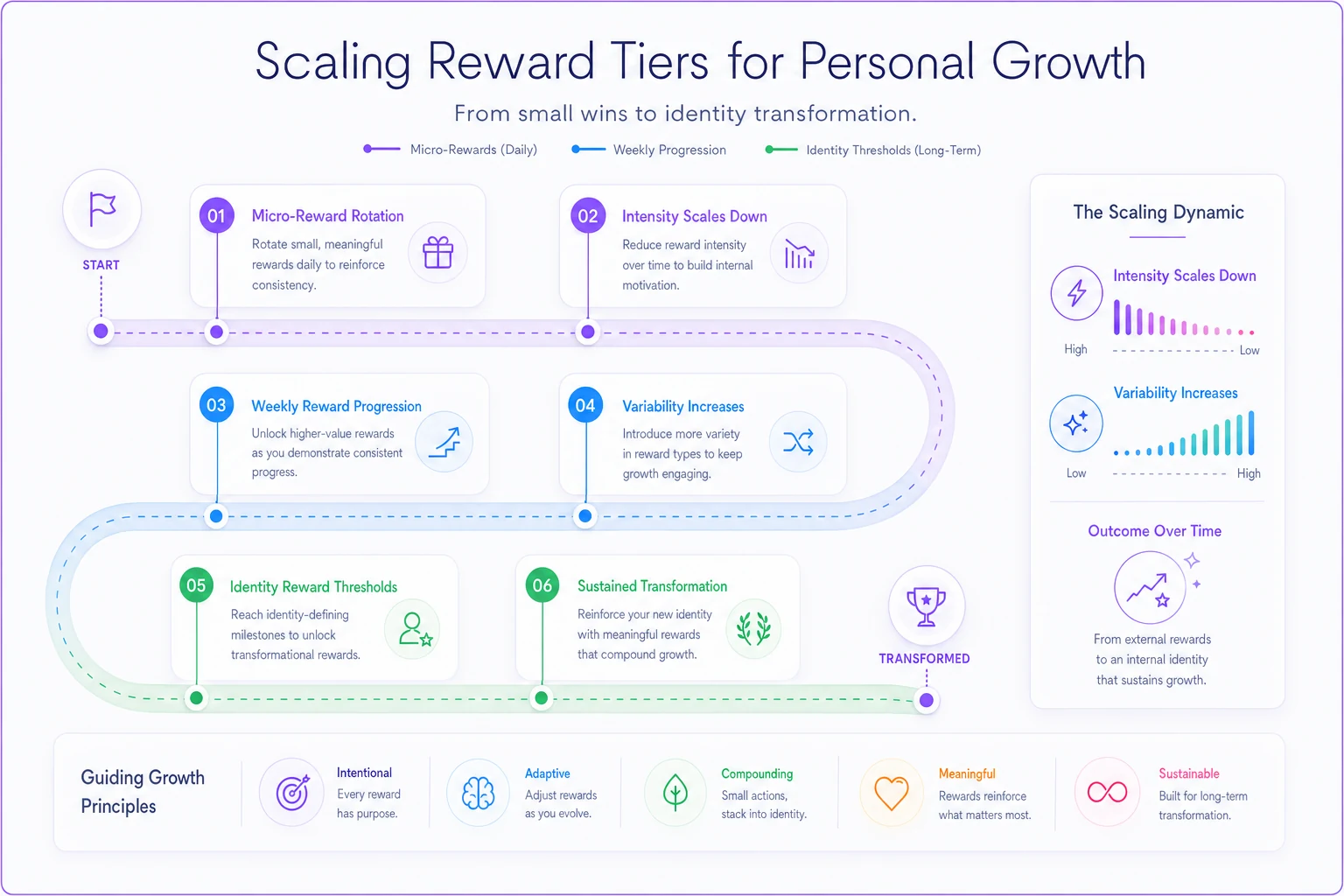
The structure matters as much as the rewards themselves—designing the rules is how you prevent the whole system from collapsing when novelty fades.
Variable Reward Schedules That Actually Work
Casinos figured out variable reward schedules a long time ago. Habit builders, meanwhile, keep using fixed schedules that almost guarantee hedonic adaptation. The key is controlled randomness within stable boundaries.
The 70/20/10 Rule
-
70% of habit completions get standard micro-rewards
-
20% get enhanced micro-rewards (double length or intensity)
-
10% get surprise bonuses—unexpected additional rewards
This ratio keeps consistency while preventing predictability. Your brain stays somewhat engaged because it can't fully anticipate what's coming, but the baseline stays reliable enough to build routine around.
| Ratio | Description |
|---|---|
| 70% | standard micro-rewards |
| 20% | enhanced micro-rewards (double length or intensity) |
| 10% | surprise bonuses—unexpected additional rewards |
For a reading habit: standard might be checking off the daily goal. Enhanced might be writing a short reflection paragraph. Surprise bonus might be discovering the book has a companion podcast episode.
Progressive Variability
Start with more predictable rewards in the first two weeks—closer to a 90/10/0 ratio. As the habit strengthens, increase variability. By month three you might run something like 60/25/15. The habit needs less external support and can tolerate more uncertainty.
This mirrors how building a sustainable motivation system works—you need stability first, then controlled variation to maintain engagement.
Real Examples from Different Habit Domains
Exercise Habit Reward Economy
Immediate Micro (randomized daily):
-
90-second victory dance to different songs
-
Protein shake with rotating flavors
-
Five minutes of guilt-free social media
-
Quick cold shower with timer
-
Stretching to a comedy clip
-
Recording a 10-second video journal
-
Sending a gym selfie to accountability partner
Weekly Aggregated (progressive):
-
Week 1-4
New workout playlist creation
-
Week 5-8
Trying one advanced exercise
-
Week 9-12
Teaching someone else a technique
-
Week 13+
Planning next month's progression
Identity Milestones:
-
Day 21
Buy proper workout clothes
-
Day 50
Join a fitness community/forum
-
Day 100
Sign up for an event (5K, competition, etc.)
-
Day 200
Become someone's workout accountability partner
Writing Habit Reward Economy
Immediate Micro:
-
Updating a visual word count tracker
-
Adding to a "sentences I'm proud of" document
-
Listening to one song from a "writing victory" playlist
-
Doing a brief standing celebration (however weird it looks)
-
Reading one page from a favorite author
-
Checking writing streak counter
-
Adding a sticker to physical calendar
Weekly Aggregated:
-
Week 1-4
Organize week's writing into single document
-
Week 5-8
Share one paragraph publicly (social media, blog)
-
Week 9-12
Submit something anywhere (contest, publication, etc.)
-
Week 13+
Mentor someone else's writing for 15 minutes
Identity Milestones:
-
Day 21
Create "writer" email signature
-
Day 50
Start a simple writing blog or newsletter
-
Day 100
Apply to a writing-related opportunity
-
Day 200
Call yourself a writer in professional contexts
Day 200: Call yourself a writer in professional contexts
Avoiding the Common Pitfalls
The Excitement Inflation Trap
A lot of people unconsciously escalate rewards when motivation dips. Coffee becomes fancy coffee, fancy coffee becomes coffee and a pastry, and suddenly there's a $12 daily ritual attached to a habit. This inflation always collapses eventually—either because of cost or because even the upgraded reward stops landing.
When motivation drops, reduce reward intensity and increase variety instead. If the post-workout protein shake isn't doing it anymore, don't upgrade to a more expensive one. Rotate between a few different affordable options rather than chasing one premium version.
The All-or-Nothing Reward Problem
"I only get the reward if I complete the full habit" sounds disciplined but creates a binary system that breeds perfectionism and anxiety. Scaled rewards based on effort are more forgiving and more effective:
-
25% completion
Acknowledge the attempt (mark it differently in your tracker)
-
50% completion
Micro-reward at 50% intensity
-
75% completion
Full micro-reward but skip the weekly count
-
100% completion
Full reward economy activation
This kills the "might as well skip it entirely" thinking that destroys habits during genuinely hard stretches.
The Social Reward Dependency
Sharing progress feels great until nobody responds to your Day 47 workout post. Social rewards are powerful but unreliable. They work well as surprise bonuses, but they're a shaky foundation.
Better approach: create social rewards you actually control. Instead of posting for likes, send updates to one specific person who agreed to be your witness. Schedule monthly check-ins rather than waiting on external validation that may or may not show up.
When motivation dips, swap intensity for variety—rotate inexpensive micro-rewards instead of upgrading to costlier options.
Better approach: create social rewards you actually control. Instead of posting for likes, send updates to one specific person who agreed to be your witness. Schedule monthly check-ins rather than waiting on external validation that may or may not show up.
Building Your Personal Reward Economy
Start with this framework, then adapt based on what you actually notice about your own patterns:
Week 1-2: Establish Baseline
-
Use the same micro-reward daily to build association
-
No weekly rewards yet (too early)
-
Track which times feel hardest
Week 3-4: Introduce Variety
-
Add 3-4 micro-reward options
-
First weekly reward (small, experiential)
-
Notice adaptation patterns
Week 5-8: Full System Activation
-
Complete micro-reward rotation in place
-
Progressive weekly rewards
-
Approaching first identity milestone
Week 9+: Optimization Phase
-
Reduce micro-reward intensity
-
Shift weekly rewards toward contribution
-
Identity reinforcement behaviors
A properly built reward economy eventually becomes self-sustaining. The micro-rewards turn ritualistic. The weekly rewards start feeling like natural progressions. The identity rewards become just who you are.
When Reward Economies Fail (And What to Do)
Even well-designed systems stop working sometimes. It usually happens somewhere between day 60 and day 80—novelty is gone, but identity hasn't fully formed yet. This is actually where multi-tier systems prove their value. You have multiple levers to adjust rather than one thing to fix or replace.
If micro-rewards stop landing, don't replace them right away. Reduce them to symbolic gestures—a specific breath, a hand movement—and lean harder on weekly aggregated rewards instead. If weekly rewards feel hollow, it's usually a sign you're ready for the next identity milestone earlier than originally planned.
Single-reward systems just stop working with no backup. A layered economy gives you room to adapt without losing all your momentum at once.
The Automation Opportunity
Tracking and automation tools become genuinely useful here—not for motivation, which you can't automate, but for managing the complexity of a proper reward economy. Manually tracking several different micro-rewards, progressive weekly rewards, and milestone thresholds while also just doing your habit becomes its own cognitive burden quickly.
Smart habit tracking systems can handle rotation logic, remind you when a weekly reward is due, and flag when you're approaching an identity milestone. They turn reward economy management from an ongoing mental task into something that mostly runs in the background.
The same way a yearly growth system needs structure to work long-term, reward economies need some systematic management to stay effective. The principles stay human, but the execution benefits from operational support.
Making It Sustainable Long-Term
Around the six-month mark, something shifts. Habits with functioning reward economies reach a point where the reward system itself becomes part of why the habit is appealing. The morning runner looks forward to whichever micro-reward is coming today. The writer genuinely anticipates the small ritual waiting at the end of the session.
The reward economy stops being about motivation and becomes part of the experience.
That's actually the goal—rewards that enhance rather than drive the habit. You're not exercising for the protein shake or writing for the sticker. But the small rituals create texture and consistency that make habits more resilient when life gets disruptive, and life always eventually gets disruptive.
Start with enough structure to build momentum, but enough flexibility to evolve. What your reward economy looks like at day 200 should be pretty different from day 20—not because you planned every detail in advance, but because the habit and you both changed.
Most advice treats rewards like candy—something to make the medicine go down. But when you build a real reward economy, the rewards become part of the habit's identity. They shift from external motivators to internal rituals, from treats to something closer to traditions.
The difference between habits that last and habits that don't usually isn't willpower. It's whether the system stays interesting without becoming dependent, supportive without becoming critical, rewarding without becoming predictable. Get the economy right, and the habit starts taking care of itself.
The difference between habits that last and habits that don't usually isn't willpower. It's whether the system stays interesting without becoming dependent, supportive without becoming critical, rewarding without becoming predictable. Get the economy right, and the habit starts taking care of itself.
Ready to unlock your full potential?
Join thousands of users transforming their lives using Growyly to stay motivated, organized, and growth-focused every day.