



Most people think their willpower runs out because of big, dramatic choices. It doesn't. It leaks out through the small stuff — what to eat, what to wear, which workout, whether to accept that 4pm meeting, what to make for dinner when you're already fried. By the time you hit an actual important decision, you're running on fumes and defaulting to whatever's easiest.
A weekly decision ritual fixes this by making those micro-decisions once, in advance, instead of forty times spread across the week. Thirty minutes on a Sunday — or whenever your week resets — sets up a "decision-shield": a set of pre-loaded defaults, templates, and conflict rules that answer the small questions before they even interrupt you.
This isn't about rigid discipline or turning your life into a spreadsheet you'll resent by Thursday. It's about pre-deciding the low-value stuff so your attention is free for the things that actually matter.
The checklist comes first, because that's the whole point
Here's the actual ritual before any of the reasoning. Most articles bury the practical part under three sections of context. Not doing that.
-
Meals (8 min) Lock 5 dinners, 3 lunches, and a repeatable breakfast. Not recipes — categories. "Tuesday = stir-fry, Wednesday = pasta." Add anything you're missing to a grocery list as you go.
-
Clothes (4 min) Pick a default outfit template for each day-type you have (deep-work day, meeting day, gym day, errands day). You're deciding the category, not the exact shirt.
-
Workouts (4 min) Assign a movement type to each slot you already have open. "Mon/Thu = strength, Wed = walk, Sat = long run." Don't plan the sets. Plan the type.
-
Meeting defaults (6 min) Set your standing rules — default meeting length (25 not 30), no-meeting blocks, which requests auto-decline, which auto-accept.
-
Calendar macros (5 min) Drop your repeatable blocks onto the week as templates. Deep work, admin, meals, wind-down. Copy from last week if it worked.
-
Conflict rules review (3 min) Skim the week for collisions and apply your pre-written tie-breaker rules (below). Resolve now, not at 8am Tuesday.
Six categories, one pass, thirty minutes. Everything after this section is about why each piece works and how to make it stick.
A simple visual of the workflow helps remember the steps.
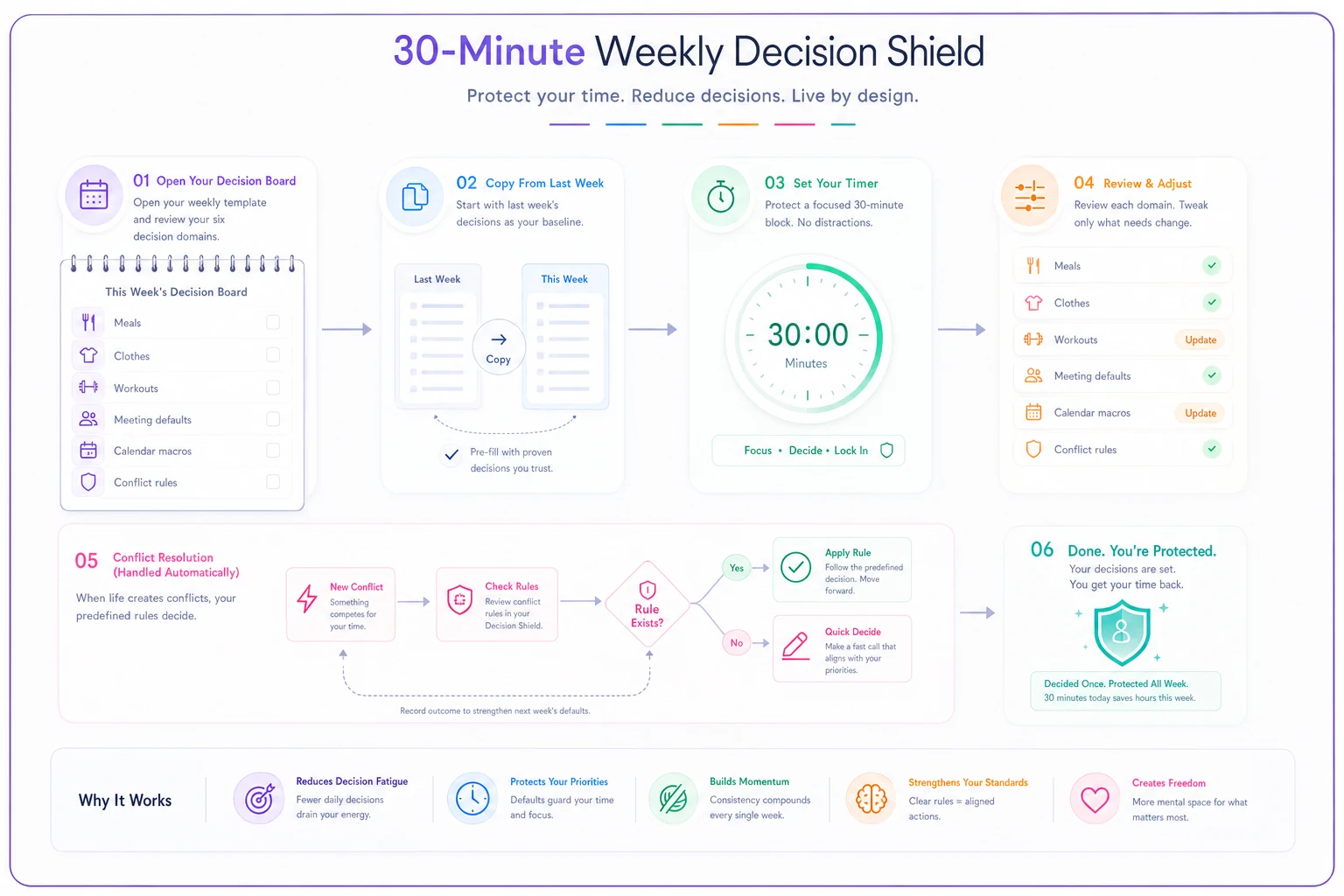
A quick visual keeps the ritual actionable and hard to forget.
Why micro-decisions cost more than they look like they should
The cost isn't the decision itself. Deciding what to wear takes maybe four seconds. The cost is the interruption and the re-entry.
Achieve more by focusing on what matters.
Growyly helps you build lasting habits and track your personal growth effortlessly.
- Goal setting with progress tracking
- Daily habit reminders
- Motivational insights and analytics
No credit card required
You wake up with a rough plan. Then you hit a small unplanned decision — no clean shirt, so now you're figuring out what else works. Then breakfast isn't obvious, so you stand in the kitchen for a minute. Then a meeting invite pings and you're weighing whether to accept. None of these are hard. But each one pulls you out of momentum and forces a tiny cold start.
A typical knowledge worker's morning contains somewhere around 20–35 of these micro-decisions before they've done anything meaningful. Each one is cheap in isolation and expensive in aggregate — not because of the time, but because decision fatigue is cumulative. You're spending premium cognitive fuel on questions that don't deserve it.
The insight most people miss: you don't need better willpower, you need fewer decisions. This connects directly to the idea that motivation works better as a system than as a resource you keep trying to refill. If you've read the case for treating motivation as a systems problem rather than a willpower problem, the decision-shield is basically that principle applied to your calendar.
The templates, in detail
Templates are the core of this. A template means you've decided the shape of a choice in advance, so the day-of version is just a small fill-in rather than a fresh decision from scratch.
Meal templates
| Day | Category (pre-decided) | Day-of decision |
|---|---|---|
| Mon | Grain bowl | Which protein's in the fridge |
| Tue | Stir-fry | Which veg needs using |
| Wed | Pasta | Red or white sauce |
| Thu | Leftovers / clear-out | None |
| Fri | Takeout or "easy" | Which place |
The category is locked. The specific is trivial and flexible. This survives a chaotic week because it bends without breaking. You're never staring into the fridge at 6:45pm with zero framework and a full day's worth of depletion behind you.
Clothing templates
You don't need a Steve-Jobs black-turtleneck uniform. You need day-type defaults. Most people have three or four kinds of days, and each one has an obvious "correct" outfit category. Deciding those once means your morning collapses from "what do I wear" to "grab the meeting-day set." Small thing, but it's one of the first micro-decisions of the day. Starting without that stall matters more than it seems.
Workout templates
Assign type, not detail. "Strength day" is a decision that survives contact with a bad night's sleep. "5x5 squats at 185, then Romanian deadlifts" is a decision that collapses the moment your body or schedule doesn't cooperate — and then you skip entirely. The pre-decided type keeps the habit alive even on days you'd otherwise bail.
Calendar macros: your week as a copyable template
Calendar macros are repeatable blocks you drop onto the week instead of rebuilding the whole thing from scratch. Most people rebuild their calendar every single week like it's a brand-new puzzle. It isn't. Roughly 70–80% of your week is structurally the same as last week.
-
Deep-work block — same time daily, protected, phone elsewhere.
-
Admin block — one or two windows for email, small tasks, and the drip of little to-dos.
-
Meal + prep windows — anchored so they don't get consumed by meetings.
-
Buffer blocks — 15-minute gaps between commitments so a late meeting doesn't cascade into the next thing.
-
Wind-down block — a hard stop that protects your evening.
The workflow: open last week's calendar, copy the blocks that worked, paste onto the new week, then layer the actual appointments on top of that skeleton. You're not building — you're adjusting. That shift alone cuts the planning session down significantly and kills the Sunday-night "how does this week even fit together" spiral.
Conflict-resolution rules: decide the tie-breakers before you're in one
This is the part almost nobody sets up, and it's probably the highest-leverage piece of the whole thing.
-
Deep-work block beats meetings unless the request is flagged genuinely urgent by a specific short list of people.
-
Default meeting length is 25 minutes. Anyone asking for 60 has to justify it.
-
Two same-day requests for the same slot → the one that can be async goes async.
-
Anything after your wind-down block auto-declines with a canned "let's find a morning slot" reply.
-
Workout beats "I'll do it later" — the block is non-negotiable unless something on your urgent list overrides it.
In the moment, you don't decide — you apply. That's a completely different cognitive act. Applying a rule is fast and guilt-free. Improvising a decision under pressure is slow, draining, and usually wrong.
A real scenario: the freelance designer with a shredded morning
This is a pattern that shows up pretty consistently. A freelance designer was losing her mornings to exactly this friction. Client requests hit her inbox overnight, she'd wake up and start reacting, and by 11am she'd handled a dozen small things but hadn't touched actual design work. She estimated maybe 2 focused hours a day, most of them in the afternoon when her energy was already lower.
She set up a version of this ritual on Sunday evenings. Meal categories, a default deep-work block from 9–11:30 that beat all non-urgent meetings, a 25-minute meeting default, and an auto-decline rule for anything after 6pm. Conflict rule: overnight client requests get triaged in one 30-minute admin window at 11:30, not as they arrive.
Within about three weeks, her focused morning work went from roughly 2 hours to around 3.5. And — this is the part she didn't expect — she said she felt less tired at the end of the day despite doing more. That's the decision-fatigue effect at work. She wasn't working harder. She'd just stopped bleeding willpower on the small stuff.
She still had chaotic days. But the baseline moved, and a moved baseline compounds over time. This is the same reason a structured, repeatable approach tends to beat sporadic effort — something worth thinking about if you're building a longer-term personal growth system rather than just a one-week fix.
When this actually makes sense
Your mornings feel busy but unproductive, and you can't point to why.
-
Your mornings feel busy but unproductive, and you can't point to why.
-
You make a lot of small logistical decisions no one else can make for you.
-
You have some repeatable structure to your week — even 50% is enough.
-
You end days tired in a way that doesn't match what you actually accomplished.
You end days tired in a way that doesn't match what you actually accomplished.
When this is a bad idea
Your week is genuinely unpredictable in a way templates can't absorb. Some emergency-response and on-call work truly resists this. Though even then, conflict rules help more than templates do.
-
Your week is genuinely unpredictable in a way templates can't absorb. Some emergency-response and on-call work truly resists this. Though even then, conflict rules help more than templates do.
-
You'd use the ritual as a form of procrastination — spending 30 minutes "planning" to avoid actually starting. If that's your tendency, set a hard timer and stop when it goes off.
-
You're in an acute crisis period. Don't add a ritual on top of survival mode. Come back to it when things settle.
You're in an acute crisis period. Don't add a ritual on top of survival mode. Come back to it when things settle.
Who should NOT bother
If you already coast through your mornings without decision friction — some people genuinely do, usually because they've unconsciously built these defaults already — you don't need to formalize it. This ritual solves a specific pain. If you don't have the pain, skip it. Adding structure you don't need is just a different kind of friction.
This ritual solves a specific pain. If you don't have the pain, skip it. Adding structure you don't need is just a different kind of friction.
The one mistake that quietly kills the whole thing
Over-designing it. People get excited, build an elaborate 15-category system with color-coded rules, run it beautifully for one week, and abandon it entirely. The ritual has to be lighter than the friction it removes, or it just becomes friction itself.
Stick to six categories. Keep it to 30 minutes. If a category isn't earning its place — if you never actually reference your clothing template — cut it. The goal isn't a perfect system. The goal is a shield that's cheap enough to maintain that you'll still be doing it in month four, when the novelty's long gone.
Putting it into motion this week
Block 30 minutes at your natural week-reset point. Run the six-category checklist once, imperfectly. Don't optimize it — just get a rough version live. Then let the week test it. Whatever breaks tells you which conflict rule you're missing, and you fix that one thing next Sunday.
Set a 30-minute timer and stop when it goes off so the ritual doesn't become a new drain.
The whole thing sharpens through iteration, not planning. Your first ritual will be clumsy. Your fourth will be fast and quietly load-bearing — running in the background of a week that suddenly has more room in it. The real payoff isn't the time saved on any single decision. It's walking into the afternoon still sharp, with something left for the choices that actually deserve it.
The whole thing sharpens through iteration, not planning. Your first ritual will be clumsy. Your fourth will be fast and quietly load-bearing — running in the background of a week that suddenly has more room in it. The real payoff isn't the time saved on any single decision. It's walking into the afternoon still sharp, with something left for the choices that actually deserve it.
Ready to unlock your full potential?
Join thousands of users transforming their lives using Growyly to stay motivated, organized, and growth-focused every day.