


Most people who want to get good at something already show up. They open the notebook, sit at the piano, run the drills, write the paragraphs. The problem isn't discipline. The problem is that showing up and improving are two completely different systems, and almost nobody builds the second one.
You can practice guitar for two years and stay mediocre. You can journal every morning and never write better. You can review Spanish flashcards for eight months and still freeze in a real conversation. The daily reps are running fine. What's missing is the machinery underneath — the part that turns repetition into feedback, feedback into adjustment, and adjustment into visible skill.
This is a full-system look at a deliberate practice roadmap: not a list of tips, but how the pieces connect, where they break, and what changes as you go from casual practice to something that actually moves the needle on competence. If you've already got the habit part handled, this is the layer that sits on top.
Why habit systems and practice systems break in different places
Habit systems are optimized for consistency. Did you show up? Yes or no. That's a beautifully simple signal, and it's why streaks and anchors work so well for getting people to the desk.
But once you're consistently at the desk, consistency stops being the bottleneck. The new bottleneck is whether that time is directed at the edge of your ability — the stuff you can't quite do yet — versus rehearsing things you already know.
There's a pattern that traps almost everyone: the habit succeeds, so you stop paying attention to the content. You've automated showing up, which is exactly what you wanted, but automation and improvement pull in opposite directions. Automated behavior drifts toward comfort. Improvement requires discomfort. So the more successful your habit becomes, the more it quietly turns into a comfortable groove where nothing hard happens anymore.
A guitarist plays the songs they can already play. A writer writes the kind of sentences they've written a thousand times. A developer keeps building the same CRUD app in a new framework. The reps look identical from the outside. Inside, one person is learning and the other is idling.
So the first design principle: a practice system is not a more intense habit system. It's a separate layer whose whole job is to keep pointing your reps at the thing you can't do yet, and to prove — with artifacts — whether you're actually getting better.
The four parts of the system, and how they connect
A working deliberate practice roadmap has four moving parts. Skip one and the whole thing degrades in a predictable way.
Achieve more by focusing on what matters.
Growyly helps you build lasting habits and track your personal growth effortlessly.
- Goal setting with progress tracking
- Daily habit reminders
- Motivational insights and analytics
No credit card required
| Part | Job | What breaks if it's missing |
|---|---|---|
| Micro-practice template | Defines what a single rep targets | You default to comfortable, undirected reps |
| Artifact-based signals | Proves whether skill actually changed | You mistake effort for progress |
| Feedback sampling | Injects outside correction | You reinforce your own mistakes |
| Spaced-practice calendar | Controls timing and retention | You cram, forget, and re-learn the same things |
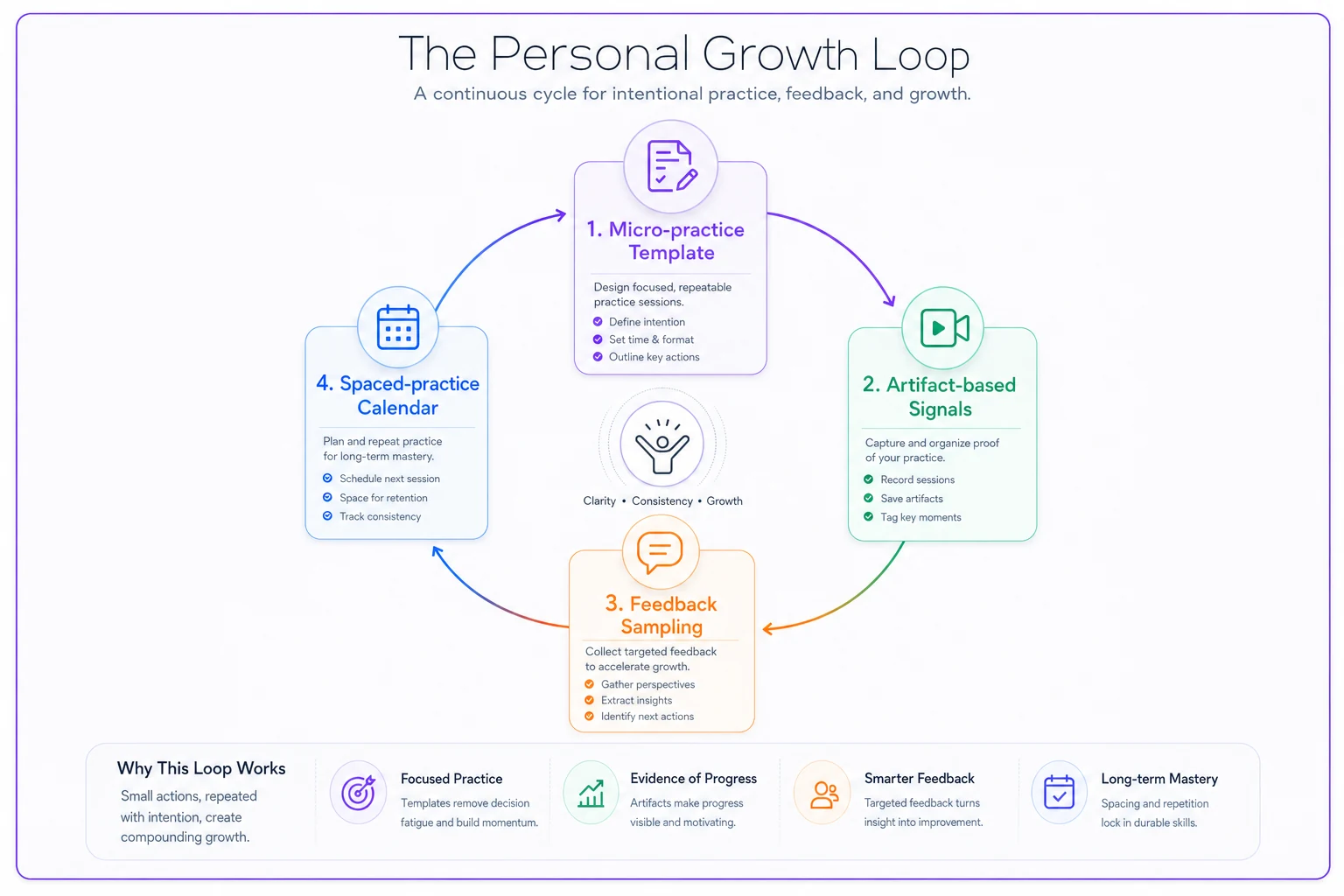
These feed each other. The micro-template produces an artifact. The artifact gets sampled for feedback. The feedback reshapes the next micro-template. The calendar decides when each of those happens. It's a loop, not a checklist — and like any loop, the weakest link caps the whole thing.
Here's a simple visual of how the four parts loop together.
The design details are where most people go wrong, so it's worth going through each part carefully.
1. Micro-practice templates: making each rep target something specific
A micro-practice template is a small, repeatable script for a single session that forces you to name a target before you start. Not "practice piano for 30 minutes." Instead: "play bars 12–16 of this piece at 70 BPM, hands separate, until I can do it three times clean, then bump to 80."
The point of writing it down isn't organization. It's that the act of specifying a target exposes whether you actually have one. When people try to fill in a template and can't name what they're working on, that blank space is the diagnosis — they've been doing undirected reps this whole time and didn't notice.
-
Target — the specific sub-skill, narrow enough to fail at
-
Constraint — the condition that makes it hard (tempo, time limit, no reference material)
-
Stop rule — how you know the session is done ("three clean reps" not "30 minutes")
-
Note — one sentence on what broke, written the moment it broke
That fourth field matters more than it looks. In real practice, insight is extremely time-sensitive — you notice exactly why something felt wrong for about four seconds, and then it's gone. If you capture it in the moment, next session's template basically writes itself. This is the same reason a short structured reflection beats a vague end-of-week review; a 10-minute daily reflection practice that turns insights into habit experiments works because it locks in the observation while it's still specific enough to act on.
Write the 'Note' the moment something breaks—insights vanish within seconds.
A common mistake: making the target too big. "Get better at public speaking" isn't a target, it's a category. "Cut filler words in the opening 60 seconds" is a target. The narrower it is, the faster you get a clear pass/fail signal — and clear signals are the entire fuel supply for this system.
2. Artifact-based progress signals: proof over feeling
Feelings about your own progress are almost useless. You feel great on days you rehearse easy material and terrible on days you attack the hard edge — which means your emotional read is inversely correlated with actual learning. If you steer by feel, you'll drift toward the easy stuff every time.
Artifacts fix this. An artifact is any durable trace of a rep you can compare against a past version of yourself: a recording, a saved draft, a screenshot of a solved problem, a photo of a sketch, a timed score. The rule is simple — if you can't line up today's artifact against last month's, you have no idea whether you improved.
This is different from tracking that you did the practice. Logging "practiced 45 min" tells you about consistency. An artifact tells you about capability. Those are separate axes, and people constantly confuse a full habit log for evidence of skill.
-
Recordings for anything performative (music, speaking, language) — brutal but honest
-
Versioned drafts for writing or design — save every version, compare month-over-month
-
Solved-problem logs for technical skills — keep the ones you couldn't do before
-
Timed benchmarks — same task, same conditions, monthly, watch the clock drop
The best cadence is usually a small artifact every session and a benchmark artifact every few weeks — same task, same conditions, so the comparison is clean.
One thing worth flagging: people who record themselves and never re-watch get almost nothing out of it. The artifact only pays off in the comparison. Set a recurring appointment to review the old ones, or the whole thing becomes an elaborate way of hoarding files.
3. Feedback sampling: you can't correct what you can't see
Here's the uncomfortable part about solo practice: you are wrong about your own weak points, and confidently so. The errors you can't perceive are exactly the errors you'll never fix on your own, because from the inside they don't feel like errors.
That's what feedback sampling is for. And the word sampling is deliberate — you don't need constant coaching, which is expensive and often paralyzing. You need periodic, targeted checks that catch the blind spots your own perception misses.
A practical sampling schedule looks like layers running at different frequencies:
-
Self-feedback (every session) compare your artifact to the target from your template. Cheap, fast, catches the obvious stuff.
-
Peer or tool feedback (weekly-ish) a practice partner, a community, or software that flags patterns you'd miss. Catches the medium stuff.
-
Expert feedback (monthly or less) a coach, a teacher, a paid critique. Expensive, so you sample it rarely — but this is what catches the deep structural errors nothing else will.
The mistake people make is inverting this. They either get no outside feedback (pure solo drift) or they over-rely on expert feedback for things a five-minute self-check would've caught, burning money and time. Match the feedback source to the type of error, and sample the expensive layers sparingly.
One more thing: feedback you don't convert into a template change is wasted feedback. The loop only closes when a critique becomes tomorrow's target. Otherwise you're collecting notes about your weaknesses without ever practicing against them, which is somehow worse than not knowing.
4. The spaced-practice calendar: timing is a skill input
Most practice calendars are just "do it every day," which handles consistency but ignores two forces that heavily affect learning: spacing (revisiting material after a delay strengthens retention more than massing it) and interleaving (mixing skills rather than blocking one).
A pure everyday-same-thing schedule quietly wastes reps. If you drill one narrow sub-skill for ten days straight, you get rapid short-term gains that fade fast. If you rotate through a few related sub-skills and come back to each after a gap, the gains are slower to appear but stick dramatically better.
A workable weekly rhythm might look like:
-
3–4 "edge" sessions on your current hardest sub-skill
-
1–2 "revisit" sessions on something you thought you'd already learned (you didn't — spacing exposes this)
-
1 "integration" session where you combine sub-skills under realistic conditions, closer to how the skill actually gets used
-
1 benchmark or review slot every few weeks for the comparison artifact
The revisit sessions are the ones everyone skips, and skipping them is exactly why skills feel like they leak. You "learned" a chord change or a grammar rule, moved on, and quietly lost it. Spacing isn't a nice-to-have — it's the difference between accumulating skill and re-learning the same things on a loop.
Where the whole system breaks as you scale up
The four-part loop works fine for one skill. The failures start when practice ambition grows.
Failure point one — too many targets at once. You start with guitar, then add Spanish, then a writing project, and each has its own template, artifacts, and feedback cadence. The coordination overhead alone eats the practice time. Most people can realistically run one deep deliberate-practice loop plus maybe one light maintenance skill. Beyond that, everything gets shallow.
Failure point two — artifact debt. Recordings pile up unreviewed, drafts accumulate uncompared, benchmark slots get skipped because "there's no time." The capture side keeps running while the comparison side silently dies, and without comparison, the artifacts are just clutter. This is the single most common slow death of a practice system.
Failure point three — feedback starvation. As the skill gets more advanced, the errors get subtler, which means you need better feedback exactly when good feedback gets harder to find. Beginners can self-correct on obvious mistakes. Intermediates hit a wall precisely because their remaining errors are invisible to them and require a real outside eye.
Failure point four — the calendar ossifies. You set up a solid spaced schedule, and then you keep running it long after your weak points have shifted. The calendar was designed for the you of two months ago. If the schedule never gets re-pointed at your current edge, it slowly becomes a comfortable habit again — right back where we started.
These are system failures, not motivation failures. Someone can be fully committed and still have their practice quietly stall because the loop degraded at one of these joints.
A real scenario with numbers
Consider someone learning illustration on the side — a designer trying to build a portfolio, practicing roughly 40 minutes most evenings.
Before the system: She'd been drawing nearly every day for about seven months. Solid habit, real consistency. But she felt stuck, and she was right — she was redrawing the same kinds of figures she was already comfortable with. No targets, no comparison beyond a general sense that things weren't clicking. She had something like 200+ sketches in a folder she never looked back at.
After restructuring around the loop: She narrowed to one target at a time (started with hands, which she'd been avoiding). Micro-templates with a constraint — "five hand studies from reference, 8 minutes each, no erasing." A benchmark artifact every two weeks: the same three hand poses, timed, saved side by side. Feedback sampling through a weekly post in an art critique community, plus one paid critique a month.
Over about ten weeks, the benchmark comparisons were the tell — the two-week gaps made the improvement obvious in a way daily drawing never had. The monthly paid critiques caught a proportion problem she genuinely could not see on her own; she'd been repeating it for months. Her daily practice time barely changed. What changed was where the reps pointed and whether anyone was checking. The portfolio pieces she produced afterward were, in her words, the first ones she didn't want to hide.
Nothing dramatic happened to her schedule. The system just stopped wasting the reps she was already putting in.
A 12-week skill sprint template
If you want to run this end-to-end, here's a structure that keeps all four parts in sync. Twelve weeks is long enough for spacing to matter and short enough to stay pointed at one thing.
Weeks 1–2: Setup and baseline
-
Pick one primary skill and name three sub-skills inside it
-
Capture a baseline benchmark artifact for each sub-skill — this is your before
-
Build your first micro-templates for the weakest sub-skill
-
Set your feedback sampling schedule (self daily, peer weekly, expert at weeks 4, 8, 12)
Weeks 3–6: First edge block
-
Run 3–4 edge sessions/week on the weakest sub-skill
-
Capture a session artifact each time; note what broke, in the moment
-
Benchmark at week 4 and compare to baseline — first honest read on whether the loop works
-
Convert your week-4 expert feedback directly into new targets
Weeks 7–10: Rotate and interleave
-
Shift edge sessions to the next weakest sub-skill
-
Add revisit sessions on the first sub-skill (spacing check — did it hold?)
-
Introduce integration sessions combining sub-skills under realistic conditions
-
Benchmark at week 8; watch specifically for skills you thought were done
Weeks 11–12: Integration and review
-
Mostly integration sessions now — the whole skill, real conditions
-
Final benchmark; line up week 12 against your week 1 baseline
-
Write the retrospective
what moved, what didn't, what the next sprint targets
A quick pre-launch checklist before you start a sprint:
-
- [ ] One primary skill only (resist the second one)
-
- [ ] Three named sub-skills, narrow enough to fail at
-
- [ ] A baseline artifact captured for each
-
- [ ] A defined stop rule for sessions (not a time limit)
-
- [ ] A feedback source lined up for each layer
-
- [ ] A recurring slot to review old artifacts, not just make new ones
-
- [ ] A benchmark cadence on the calendar
If you can't check every box, you're setting up a habit, not a practice system — and it'll drift toward comfort within a few weeks.
When this actually makes sense — and when it doesn't
This full apparatus is overkill for a lot of goals, and pretending otherwise just adds friction.
It makes sense when the skill is complex, the errors are subtle, and improvement genuinely plateaus without correction — instruments, languages, writing, technical crafts, sports, design. Anything where "just doing it more" visibly stops working after a while.
It's a bad fit for early beginners. When you're just starting out, almost any practice improves you, and heavy structure kills the momentum you need most. Just do the reps for a few weeks. Build the habit before you build the practice loop on top of it — the two-week habit lab approach to fast, low-risk experiments is a better fit for that stage than a full sprint template.
Who should skip this entirely: anyone whose actual bottleneck is still showing up. If you're not yet consistent, adding templates and benchmarks is like installing telemetry on a car that won't start. Get the engine running first. The practice system is a second layer, and it only pays off once the first layer is stable.
Where lightweight tooling helps — and where it doesn't
You can run this whole roadmap in a notebook, and plenty of people should. But a few joints in the system are genuinely tedious by hand, and that's where a habit-and-practice platform earns its place: keeping micro-templates reusable so you're not rewriting them, storing artifacts where the comparison is one tap away instead of buried in folders, and nudging the spaced revisit sessions that everyone forgets. Some tools with AI-assisted review can flag drift — like when your "edge" sessions have quietly turned into comfortable rehearsal, or when your benchmarks have flatlined for weeks.
What tooling can't do is want it for you or supply the hard feedback that a real critique provides. Software handles the coordination and memory work well — the reminders, the comparisons, the pattern-spotting across weeks of artifacts. It's bad at being the outside eye on your blind spots. Use it for the plumbing, not the judgment. The moment a tool becomes a place you log activity instead of a system that sharpens where your reps point, it's just a fancier streak counter.
Pulling it together
The gap between practicing and improving is a systems gap, not an effort gap. Consistency gets you to the desk; the loop of targeted reps, honest artifacts, sampled feedback, and spaced timing is what turns that time into skill you can actually see. Any one of those pieces failing quietly caps the whole thing — usually artifact debt or feedback starvation, and usually without you noticing until months have gone by.
If you've already won the habit fight, this is the next thing to build. Start narrow, capture proof, get corrected on what you can't see, and space it out so it sticks. Run one twelve-week sprint on a single skill with the loop fully closed, and compare that week-12 benchmark to where you started. That comparison — not the streak, not the hours logged — is the only real measure of whether your practice is doing anything at all.
The gap between practicing and improving is a systems gap, not an effort gap. Consistency gets you to the desk; the loop of targeted reps, honest artifacts, sampled feedback, and spaced timing is what turns that time into skill you can actually see. Any one of those pieces failing quietly caps the whole thing — usually artifact debt or feedback starvation, and usually without you noticing until months have gone by.
If you've already won the habit fight, this is the next thing to build. Start narrow, capture proof, get corrected on what you can't see, and space it out so it sticks. Run one twelve-week sprint on a single skill with the loop fully closed, and compare that week-12 benchmark to where you started. That comparison — not the streak, not the hours logged — is the only real measure of whether your practice is doing anything at all.
Ready to unlock your full potential?
Join thousands of users transforming their lives using Growyly to stay motivated, organized, and growth-focused every day.