


Meeting-heavy days don't kill your habits with one big blow. They kill them by leaving you in a permanent state of half-focus. You finish a call still thinking about the last one, you open the next invite three minutes late, and by 4pm your brain feels like a browser with 30 tabs open. The habits you actually care about — the deep work block, the mid-day walk, the fifteen minutes of reading — never even get a fair shot, because there's no clean edge between one thing and the next.
The problem isn't the meetings themselves. It's the transitions. And transitions are exactly the kind of thing a short, repeatable ritual is built for.
Why the gaps between calls quietly wreck everything
When you go straight from one call into another, your attention doesn't reset — it carries residue. Psychologists call it attention residue, but you don't need the term to recognize it. You're on the 2pm call physically, but a chunk of your head is still replaying the awkward thing someone said at 1:45.
Stack six or seven of those in a day and something predictable happens: you stop being able to tell the difference between "I'm busy" and "I'm getting things done." The two feel identical from the inside. That's the trap.
-
You finish a call with three action items and immediately jump to the next one, so the items live in your short-term memory until they evaporate around dinner.
-
Your calendar has back-to-back 30-minute blocks with zero buffer, so every meeting eats into the start of the next.
-
Your "protected" focus block gets sacrificed first, because it's the only thing on the calendar without another human waiting on the other side.
The habits that get protected are the ones with social accountability. The ones that get crushed are private — which are usually the ones that matter most for long-term growth.
The pre-meeting anchor ritual: 90 seconds, four moves
The point of a pre-meeting anchor ritual isn't to psych yourself up. It's to close the previous loop and load the next one so you walk in with a clear head. Ninety seconds is enough if the moves are fixed and you never improvise them.
Achieve more by focusing on what matters.
Growyly helps you build lasting habits and track your personal growth effortlessly.
- Goal setting with progress tracking
- Daily habit reminders
- Motivational insights and analytics
No credit card required
Here's the version that holds up under a heavy day:
-
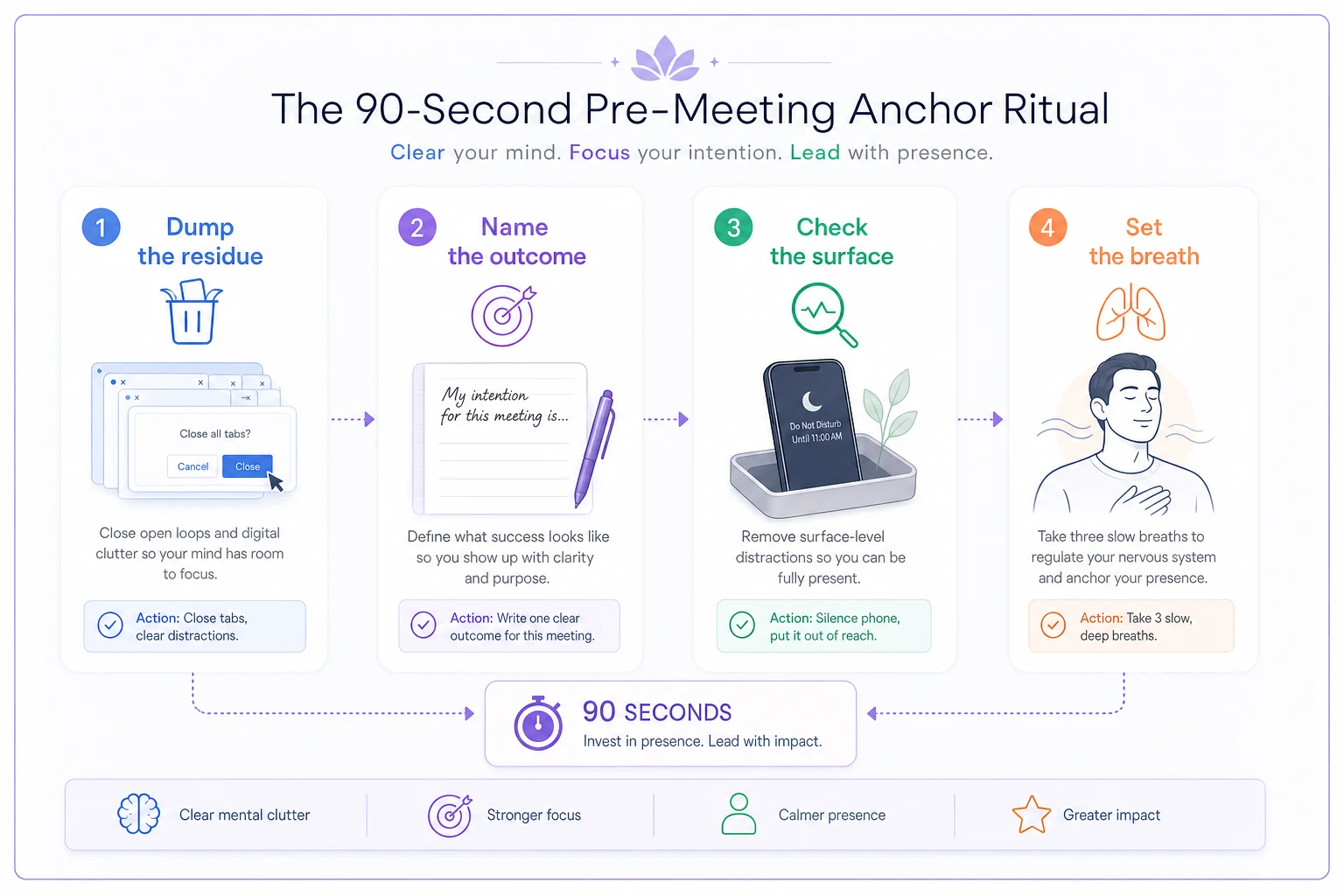
Dump the residue (20 seconds). One line in a scratch note
what was the last thing on your mind? Not to solve it — just to park it somewhere so it stops looping.
-
Name the outcome (25 seconds). One sentence
"By the end of this call, I want ___." If you can't finish that sentence, that's useful information about whether the meeting should exist.
-
Check the surface (20 seconds). Close the tabs you don't need. Put your phone face-down and out of reach. Sounds trivial. It's the highest-leverage move in the whole thing.
-
Set the breath (25 seconds). Three slow breaths, longer on the exhale. Not spiritual — physiological. It drops your heart rate enough that you're not walking in mid-sprint.
A quick visual of the four moves helps you remember the sequence.
The reason this works where "just be more present" doesn't: it gives your nervous system a concrete sequence instead of a vague intention. Intentions collapse under time pressure. Sequences hold.
If your problem is burning through self-control by lunch and having nothing left for the ritual, that's a systems issue more than a discipline issue — worth reading the systems approach to motivation that keeps habits going before you blame yourself for skipping it.
The post-meeting anchor: 60 seconds, three moves
The pre-meeting ritual protects the next thing. The post-meeting ritual protects your memory and your calendar. This one is shorter because you're tired and you'll skip anything longer.
-
Capture, don't trust (25 seconds). Write the one or two actual commitments you made. Not notes — commitments. The stuff you'll be embarrassed about if you drop it.
-
Mark the state (15 seconds). One word
how did that leave you? "Drained," "energized," "irritated." Over a week this becomes a map of which meetings are quietly taxing you.
-
Reclaim the buffer (20 seconds). Stand up. Look out a window. Do literally anything that isn't a screen. Physical signal that the loop is closed.
The state-marking step is the one people skip and the one that pays off most. When you notice that every Thursday standup leaves you rated "drained" three weeks running, you've found something you can actually change — either the meeting or your role in it.
A quick comparison: with anchors vs. without
The difference isn't dramatic on any single call. It's cumulative.
| Situation | Without anchors | With 90s / 60s anchors |
|---|---|---|
| Six back-to-back calls | Residue compounds, focus block dies | Each call starts with a cleared head |
| Action items | Held in memory, roughly half forgotten | Captured in under a minute each |
| End of day | Wired, can't tell busy from productive | Loops closed, calendar reflects reality |
| Which meetings drain you | No idea | Visible pattern after a week |
One skipped anchor costs almost nothing. Skipping them all day is the reason you feel fried at 5pm with nothing to show for it.
Scripts you can actually read off
Improvising the ritual defeats it — the whole point is that it runs on autopilot. Keep these somewhere you'll see them.
Pre-meeting script (paste it into your notes app):
> Last thing on my mind: > What I want by the end: > Tabs closed. Phone away. > Three breaths.
Post-meeting script:
> I committed to: > That left me feeling: > Stand up. Off screen. 20 seconds.
Read them literally for the first two weeks. After that they become muscle memory and you'll only need the paper version on the worst days.
Calendar macros so the ritual actually happens
A ritual that depends on you remembering to do it will fail on exactly the days you need it most. So bake it into the calendar itself.
-
A default 5-minute buffer after every meeting. If your calendar tool supports speedy meetings (25/50-minute defaults instead of 30/60), turn it on. That reclaimed 5 minutes is where both anchors live.
-
A single-line title convention. Rename the buffer block "↺ anchor" so it reads as a ritual, not empty time you'll fill with email.
-
A daily 9am hold that just says "protect the focus block" — a standing reminder that the private habit is not optional today.
Treat these as fixed objects, not suggestions.
Put the anchor holds into your calendar defaults so they appear automatically for every meeting.
When a buffer block gets deleted to squeeze in another meeting, you've made a real decision about your attention — whether you meant to or not.
Fidelity checks: how to know it's still working
Rituals decay. You start skipping the breath, then the residue dump, and within a month the "anchor" is just a name on your calendar. Run a light fidelity check once a week — thirty seconds, no spreadsheet.
-
Am I still doing all four pre-meeting moves, or have I quietly dropped two?
-
Did my protected focus block survive this week, or did it get eaten first?
-
Are my post-meeting state words showing a pattern I'm ignoring?
If the second question is "eaten first" two weeks running, the ritual isn't your problem — your calendar defaults are. That's an environment issue, and it's usually faster to fix the environment than to try harder. The 15-minute environment audit for your top three habits is the right move there. Anchors only work when the surrounding structure lets them.
A real scenario with numbers
A product manager at a mid-size SaaS company had somewhere around 22–26 meetings a week and a standing deep work block that survived maybe once a fortnight. Everything else got sacrificed to fit in one more sync.
She set the calendar to 25/50-minute defaults, added the "↺ anchor" buffer, and ran the 90s/60s scripts off a sticky note for two weeks. Nothing fancy.
The focus block started surviving three or four days out of five instead of once a fortnight. Dropped action items — the ones she'd sheepishly reconstruct from memory the next day — went from a near-daily thing to maybe once a week. And the state-marking turned up something she hadn't noticed: two recurring meetings that left her rated "drained" every single time. She moved one to async and shortened the other. That alone gave back close to two hours a week.
No heroics. Just cleaner edges between things.
When this makes sense — and when it doesn't
This makes sense when your days are genuinely meeting-dense and you feel scattered rather than overloaded. The anchors solve a transition problem, not a volume problem.
This is a bad idea when the real issue is that you have too many meetings, full stop. No ritual fixes a 40-meeting week — that's a boundary problem, and dressing it up with breathing exercises just helps you tolerate something you should be cutting.
Who should skip this: anyone with two or three meetings a day and plenty of natural gaps. You already have buffers. Adding a formal ritual to a schedule that isn't stressed is overhead you'll abandon in a week.
The part that actually matters
The reason meeting-heavy days feel so corrosive isn't the hours — it's that they blur every boundary until your whole day is one long undifferentiated smear of half-attention. The pre-meeting anchor ritual and its 60-second counterpart aren't about optimization. They're about putting edges back on things: a clean start, a clean close, and a small protected space in between where the habits you actually chose still get to exist.
Two minutes total. The math only looks trivial until you notice it's the difference between ending the day fried and ending it knowing what you actually did.
Two minutes total. The math only looks trivial until you notice it's the difference between ending the day fried and ending it knowing what you actually did.
Ready to unlock your full potential?
Join thousands of users transforming their lives using Growyly to stay motivated, organized, and growth-focused every day.