


Most people consume behavioral research backwards. They read a headline ("cold showers boost dopamine 250%"), skip straight to the behavior, and wonder six weeks later why nothing stuck. The problem isn't discipline. It's that they never ran the research through any kind of filter — they treated a single finding as a directive instead of raw material that needs processing.
Translating behavioral science into habits is fundamentally a pipeline problem. Research comes in messy — mixed evidence quality, unclear mechanisms, effects that only showed up in 30 sleep-deprived undergraduates in a lab. On the other end, you need something concrete: a habit template you can install, run for two weeks, and actually measure. The gap between those two ends is where almost everyone gets stuck. They either over-trust weak studies or freeze up because "the science isn't settled."
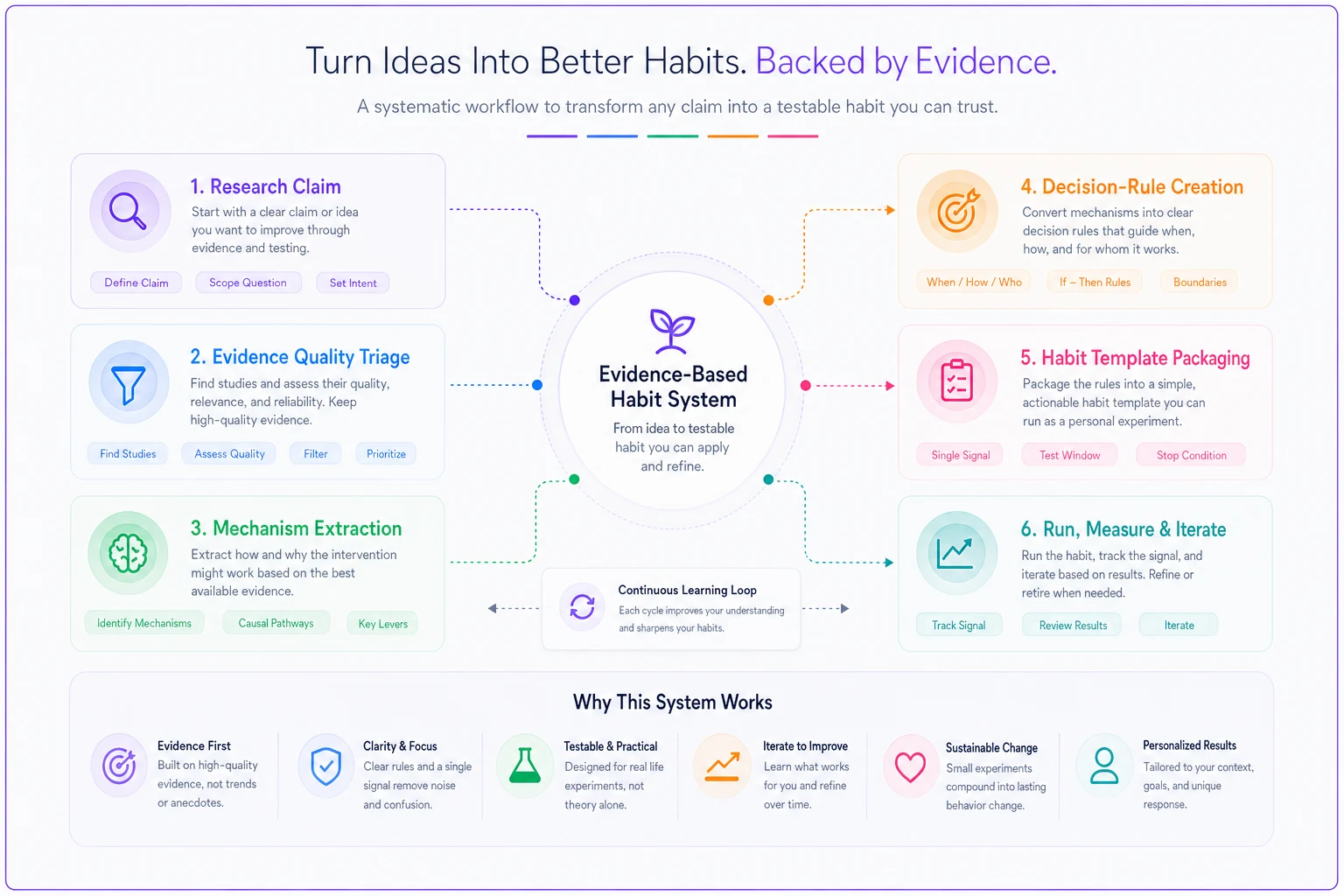
This article lays out the whole pipeline — four stages that take you from a claim to a testable playbook — plus worked examples for sleep, exercise, and focus, a fillable inference worksheet, and guardrails so you don't accidentally run something harmful on yourself. Think of it less as a reading list and more as an operating system for turning findings into behavior.
Why the pipeline breaks (and where)
The reason people struggle here isn't a lack of information. It's a lack of a repeatable process. Every new claim gets approached differently, every decision is one-off, and nothing is consistent.
Here's the pattern. Someone reads about a mechanism — say, that morning light exposure anchors your circadian rhythm. That part is real and well-supported. But then they bolt on an implementation that has nothing to do with the mechanism: buying a $300 light therapy lamp they use for four days. The mechanism was sound. The decision rule they derived from it was garbage. The habit template was untestable. And when it failed, they blamed the science instead of their own translation of it.
-
Evidence stage — you trusted a claim you shouldn't have, or dismissed one worth using
-
Mechanism stage — you copied the surface behavior instead of the underlying cause
-
Decision-rule stage — you turned a mechanism into a vague intention instead of an if-then rule
-
Template stage — you built something you can't actually run or measure
Treat these as separate stages with separate failure modes and the whole thing gets a lot less mysterious.
Stage 1: Assess evidence quality
You don't need a PhD in statistics to sort research into "worth building on" versus "interesting but hold loosely." You need a rough triage system that runs in about two minutes per claim.
Achieve more by focusing on what matters.
Growyly helps you build lasting habits and track your personal growth effortlessly.
- Goal setting with progress tracking
- Daily habit reminders
- Motivational insights and analytics
No credit card required
The mistake most people make is treating all sources as equal — a random health influencer's thread and a meta-analysis carry the same weight in their heads. In practice, you want a crude tiering system that downgrades findings based on how they were produced.
Here's a working triage table:
| Evidence signal | Trust it more when… | Downgrade it when… |
|---|---|---|
| Sample size | Hundreds to thousands of participants | Under ~40 people, single lab |
| Replication | Multiple independent groups found it | One splashy study, never repeated |
| Effect size | Large, consistent effect | Tiny effect dressed up as huge % |
| Population match | Studied people like you | Studied elite athletes / rodents / undergrads only |
| Outcome type | Measured real behavior over weeks | Measured a one-time lab proxy |
| Conflict of interest | Independent funding | Funded by the thing being sold |
You're not grading papers. You're deciding how much weight a claim gets when you build on it. A finding from one 25-person study might still be worth testing — you just build it as a low-confidence experiment, not a cornerstone habit.
When in doubt, treat the claim as low-confidence and run a short, cheap test.
The real insight here: evidence quality shouldn't decide whether you act. It should decide how much you invest before you have your own data. Weak evidence gets a cheap, fast, two-week test. Strong evidence justifies restructuring your week. People invert this constantly — they overhaul their entire routine around a preprint, then run a half-hearted test on something with decades of support behind it.
Stage 2: Extract the causal mechanism
This is the stage everyone skips, and skipping it is why so many habits end up as cargo-cult behaviors — copying the form without the function.
A finding usually comes wrapped in a specific implementation from the study. Someone reads that people who journaled before bed fell asleep faster, so they buy a $40 guided journal. But the journal wasn't the mechanism. The mechanism was probably offloading unfinished mental loops so the brain stops rehearsing them at bedtime. Once you name that, you realize the journal is one of maybe a dozen ways to trigger it — a voice memo, a scratch note, a two-minute brain dump all hit the same cause.
To extract a mechanism, ask: "What is the actual thing that produced the effect, stated without any specific product or ritual?"
-
Surface
"cold plunge every morning" → Mechanism: acute stress exposure that raises alertness and builds tolerance to discomfort
-
Surface
"gratitude journal" → Mechanism: directing attention toward positive appraisals to shift baseline mood
-
Surface
"Pomodoro timer" → Mechanism: pre-committing to a bounded work interval to lower the activation cost of starting
Once you have the mechanism in plain language, you gain flexibility. You can swap implementations when one doesn't fit your life without losing the effect. This is also where a lot of the deliberate practice research becomes useful — the mechanism behind skill growth is targeted, feedback-rich repetition, not any particular drill. Nail the mechanism and the specific exercise becomes negotiable.
Common mistake: naming a mechanism that's really just a restatement of the behavior. "The mechanism is that journaling helps you sleep" isn't a mechanism — it's the claim reworded. Push until you hit something about attention, physiology, motivation, or friction.
Stage 3: Derive decision rules
A mechanism is still not a habit. It's a principle. To make it runnable, you convert it into if-then decision rules — concrete triggers and responses that leave no room for in-the-moment negotiation.
The translation looks like this:
-
Take the mechanism (e.g., offload unfinished mental loops before bed).
-
Pick a trigger — an existing anchor in your day (e.g., "after I set my phone to charge").
-
Define the minimum action that engages the mechanism (e.g., "write down every open loop for 2 minutes").
-
Set a completion definition so you know if you did it (e.g., "pen down, list closed").
The structure forces specificity. "Journal more" is not a decision rule. "After I plug in my phone, I write open loops for two minutes" is. The difference is whether a stranger could follow your instruction without asking a single clarifying question.
The subtle failure here is making rules too big. A decision rule should be small enough that you almost can't say no to it. If your minimum action is "meditate for 20 minutes," you've smuggled a hard behavior in and called it a rule. Shrink the minimum until refusal feels absurd, then let yourself do more on good days.
Stage 4: Generate testable habit templates
Now you package everything into a template you can run and measure. A template is a decision rule plus a measurement plan plus a stop condition. Without the measurement piece you'll never know if it worked — you'll just have vibes.
A complete template has:
-
The rule (trigger → action → completion)
-
The mechanism it's meant to engage (so you know what you're testing)
-
A single primary signal to track — not ten metrics, one
-
A test window (usually two weeks)
-
A success threshold decided in advance
-
A stop/adjust condition if it's not working or causing harm
The single-signal part matters more than people expect. When you track everything, you drown in noise and can't tell what moved. Picking the smallest measurement that actually predicts change is its own skill — worth reading up on which small signals genuinely predict habit change before you decide what to log. For a sleep habit, that might just be "did I fall asleep faster than usual, yes/no" rather than a full sleep-stage breakdown.
Here's a simple visual of the pipeline if you like diagrams.
Pre-deciding your success threshold is the anti-cheating mechanism. If you decide after the fact what counts as success, you'll always find a way to call it a win. Write down "success = I hit the rule at least 10 of 14 nights AND noticed faster sleep onset on most of them" before you start. Future-you will absolutely want to move the goalposts.
The fillable inference worksheet
Here's the worksheet that runs the whole pipeline. Copy it and fill one out per claim you want to test.
1. The claim > Write the finding in one sentence: 2. Evidence check > Sample size / replication / population match: > Confidence: high / medium / low 3. Mechanism > The actual cause, stated without any product or ritual: 4. Decision rule > After I (trigger), I will (minimum action) until (completion). > Dose: Skip when: 5. Measurement > Single signal I'll track: > Test window: (usually 2 weeks) > Success threshold (decided now): 6. Safety check > Could this harm me physically or mentally? > Stop condition:
If you can't fill in section 3 (mechanism), stop — you're about to copy a behavior blindly. If you can't fill in section 5 (measurement), you're building faith, not an experiment.
Worked example: Sleep
Claim: "A consistent wind-down cue helps people fall asleep faster."
Evidence check: Broadly supported across many studies, real-world populations, replicated. Confidence: high.
Mechanism: A repeated, low-stimulation pre-sleep cue signals the nervous system to downshift, reducing the time spent lying awake rehearsing the day.
Decision rule: After I plug in my phone across the room, I dim the lights and read a physical book until my eyes get heavy. Dose: every work night. Skip when: I'm already in bed past my target time.
Measurement: Single signal — "fell asleep noticeably faster than typical (yes/no)." Test window: 14 nights. Success threshold: rule followed on 10+ nights AND "yes" on the majority of those.
Safety check: Low risk. Stop condition: if reading energizes me instead of relaxing me, swap to a duller activity.
The phone-across-the-room piece isn't decorative — it engages the mechanism (removing a high-stimulation loop) rather than just being a rule I heard somewhere.
Worked example: Exercise
Claim: "Very short exercise bouts still produce meaningful fitness gains."
Evidence check: Solid and growing support for short, intense efforts in general populations. Confidence: medium-high.
Mechanism: The gains come mostly from actually showing up and reaching moderate exertion consistently — not from long sessions. The real bottleneck for most people is the activation cost of starting, not the workout length.
Decision rule: After my morning coffee finishes brewing, I do a 6-minute bodyweight circuit in the kitchen. Dose: weekdays. Skip when: I'm sick or injured.
Measurement: Single signal — "completed the 6 minutes (yes/no)." Test window: 2 weeks. Success threshold: 8 of 10 weekdays.
Safety check: Moderate. Stop condition: any sharp joint pain, back off and reassess. This is exactly the kind of habit where a conservative ramp matters more than intensity.
The key move: I derived the rule from the activation-cost mechanism, so I made starting trivially easy (6 minutes, in the kitchen, tied to coffee) rather than optimizing for a "perfect" workout I'd probably skip half the time.
Worked example: Focus
Claim: "Removing your phone from view improves sustained attention."
Evidence check: Reasonable support, some in lab settings, effect sizes vary. Confidence: medium.
Mechanism: Mere phone presence occupies a slice of attention through anticipated interruption; removing it reduces that background tax.
Decision rule: When I sit down for focused work, I put my phone in a drawer in another room before I open my document. Dose: every deep-work block. Skip when: I'm on-call.
Measurement: Single signal — "did one uninterrupted 25-minute block (yes/no)." Test window: 2 weeks. Success threshold: at least one clean block on 8+ working days.
Safety check: Low. Stop condition: if being unreachable causes real problems, keep the phone in the room but face-down and silenced.
Safety and ethics guardrails
Running experiments on yourself is still running experiments on a person. The stakes are lower than clinical research, but the guardrails aren't optional — especially when a habit touches sleep deprivation, restrictive eating, extreme exertion, or anything affecting mood and mental health.
-
No self-experiments that reduce sleep below a safe floor, restrict calories aggressively, or push exertion into pain. These have real downside and belong under professional guidance.
-
Build in a stop condition, always. Every template needs a line that says "if X happens, I stop." No open-ended trials.
-
Watch for mood effects. If a habit consistently makes you more anxious, irritable, or low, that's data — end the trial regardless of the "productivity" gain.
-
Don't run five experiments at once. You won't know what caused what, and the combined load can quietly overwhelm you.
If your experiments involve other people — a partner, a household, a group — consent and privacy stop being abstract. The guardrails around consent, privacy, and mental-health safety for habit experiments are worth reviewing before you enlist anyone else or start logging sensitive data.
The overlooked risk isn't any single habit — it's the accumulation. People run a sleep experiment, a fasting experiment, and a cold-exposure experiment simultaneously, then wonder why they feel wrecked. The pipeline should have a governor: one or two active experiments at a time, full stop.
When this framework makes sense — and when it doesn't
When it's worth the effort: You keep bouncing off habits that "should" work. You read a lot of behavioral content and want a filter so you're not whipsawed by every new claim. You're making a change that matters enough to test properly — sleep, focus, training, anything you'll invest weeks in.
When it's overkill: The habit is trivial and reversible, like trying a new tea. Running a full worksheet on whether to keep a plant on your desk is process for its own sake. Just try it.
Who should skip the DIY approach entirely: Anyone dealing with a diagnosed condition where the behavior intersects with treatment — disordered eating, a mood disorder, a sleep disorder, injury rehab. In those cases the "experiment" should be run with a professional, not from a blog worksheet. The framework is for ordinary optimization, not for replacing care.
A real scenario: from scattered reading to a working system
Consider a grad student — the situation is pretty common — who'd bookmarked dozens of productivity and health findings over a year. She'd tried maybe fifteen of them: cold showers, a fancy journal, a meditation app, blue-light glasses, three different morning routines. Almost none survived past two weeks. Her conclusion was that she was "bad at habits."
The actual problem was that she had no pipeline. Every claim went straight from headline to behavior, skipping evidence-check and mechanism entirely. She was copying rituals from studies whose populations looked nothing like her, with no measurement, so failure and success looked identical from the inside.
She started running claims through the worksheet — roughly one new claim per week instead of five at once. She dropped about half of what she'd bookmarked at the evidence stage (small studies, no replication, wrong population). Of the ones that passed, she extracted mechanisms and built small, measurable rules. Over about three months she ran maybe ten clean two-week tests. Around four of them clearly stuck — a wind-down cue, a short morning movement block, phone-in-another-room for focus, and a shutdown ritual for the workday.
The number that mattered wasn't the success rate. It was that she finally knew which four worked and why, instead of a blur of fifteen half-attempts. The failures became cheap and informative rather than demoralizing. When something didn't work, she could point to the stage that broke — usually a rule that was too big — and retry a smaller version.
Bringing it together as a system
The reason this works where isolated tips don't is that it's a connected process, not a bag of hacks. Evidence quality determines how much you invest. The mechanism determines what you're actually testing and gives you flexibility to swap implementations. The decision rule makes the behavior small enough to run daily. The template makes it measurable enough to learn from. Pull out any one stage and the whole thing wobbles — strong evidence with no mechanism gives you cargo-cult copying; a great mechanism with no decision rule gives you good intentions that never actually fire.
Run enough of these and you start building a personal library: a set of mechanisms you trust, decision-rule shapes that fit your schedule, and a track record of what your particular body responds to. That accumulated knowledge is worth far more than any single study, because it's been tested on the only population that matters for your habits — you.
Start with one claim you've been meaning to try. Run it through the worksheet. Give it two weeks and a single honest signal. Then decide with data instead of vibes — and let the failures be cheap, small, and informative rather than proof that you're bad at this.
Ready to unlock your full potential?
Join thousands of users transforming their lives using Growyly to stay motivated, organized, and growth-focused every day.