

The hardest part of co-parenting isn't usually the big stuff. Custody splits get negotiated. Holidays get scheduled. What quietly erodes a kid's stability is the handoff — that fifteen-minute window on a Sunday evening where one parent's week ends and another's begins, and somewhere in the shuffle, the kid's bedtime drifts by 40 minutes, the reading log goes missing, and nobody mentioned the dentist appointment on Thursday.
Nobody's being negligent. The information just doesn't survive the trip between houses. And when routines break at the seam, kids feel it before anyone can name it — the eight-year-old who's suddenly cranky every Monday, the homework that's always late the first day back, the "I don't have my inhaler here" phone call.
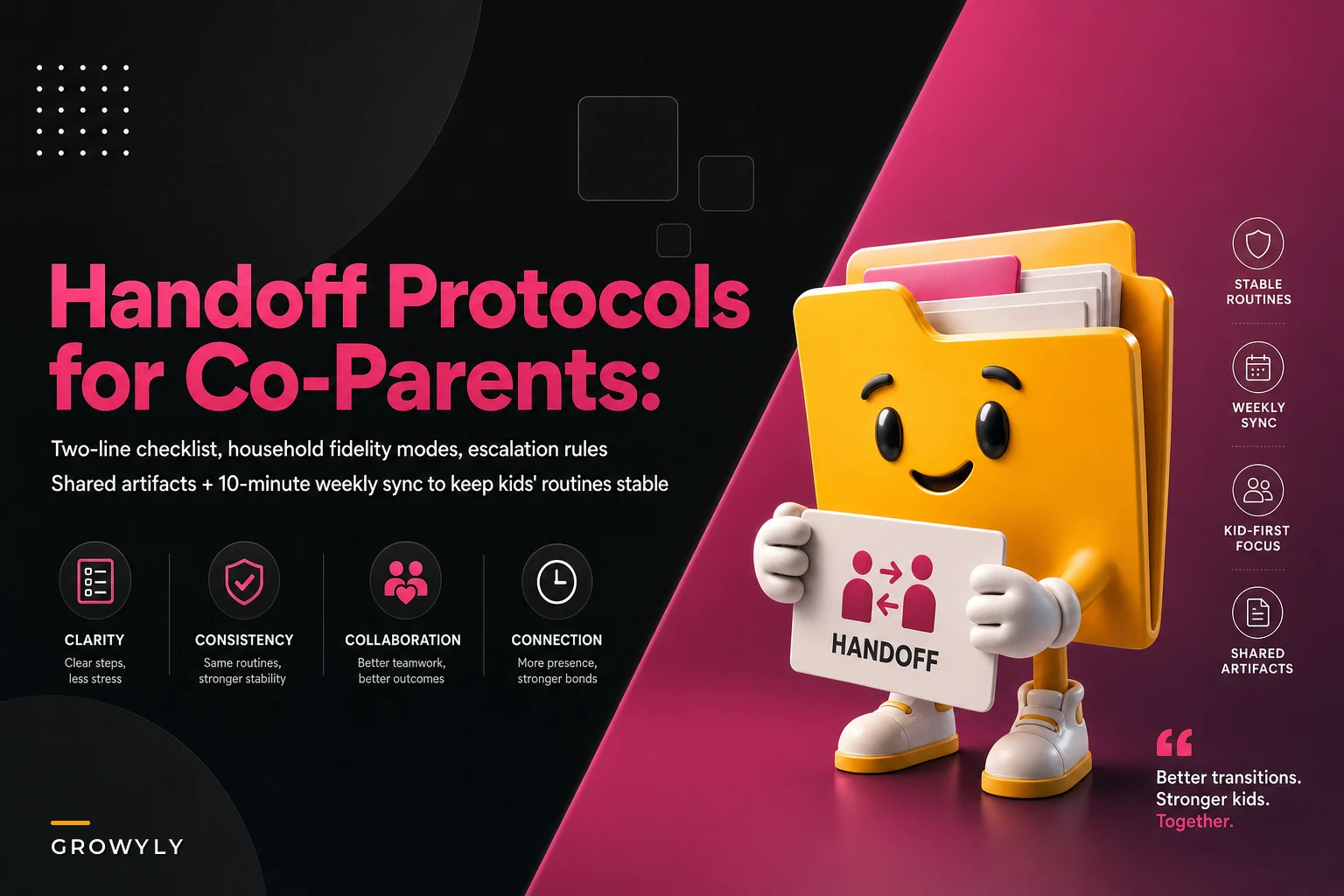
This post is about building handoff routines that hold. Not a parenting philosophy, not a co-parenting-is-hard pep talk. A practical operational system: a two-line handoff contract, fidelity modes so each house isn't trying to copy the other exactly, escalation rules for when something breaks, a shared artifact setup, and a weekly sync that takes less time than brushing your teeth.
Why handoffs break (it's almost always a transfer problem, not an effort problem)
Most handoff failures aren't about one parent not caring. They're about information living in someone's head instead of somewhere both houses can see.
A typical breakdown looks like this. Parent A knows the kid has been off dairy this week because of a stomach thing. Parent A assumes this is obvious and doesn't mention it. The kid gets handed off, eats yogurt at Parent B's, feels sick, and now Parent B thinks Parent A is being difficult when they bring it up later. Nobody did anything wrong. The information just never made the jump.
The second pattern is fidelity mismatch. One parent tries to replicate the other house's routine exactly — same dinner time, same screen rules, same everything — and it fails, because the two homes have different schedules, different work hours, different bedrooms. Then both parents feel like they're failing to "stay consistent," when consistency was never a realistic goal. What the kid actually needs is predictability within each house, plus a few non-negotiable anchors that stay identical everywhere.
Those two failures — information loss at the seam, and chasing impossible fidelity — cause most of the damage. The rest of this is built around fixing both.
The two-line handoff contract
The core tool is deliberately small, because anything bigger doesn't get used. The handoff contract is two lines, sent at every handoff, every time, no exceptions. One line is state, one line is upcoming.
Achieve more by focusing on what matters.
Growyly helps you build lasting habits and track your personal growth effortlessly.
- Goal setting with progress tracking
- Daily habit reminders
- Motivational insights and analytics
No credit card required
-
State line what's true right now that the next house needs to know. Sleep, mood, meds, food, anything active.
-
Upcoming line what's scheduled or due in the next few days that the next house owns.
> State: Slept badly last 2 nights, finishing antibiotic (last dose Wed AM), off dairy till stomach settles. > Upcoming: Spelling test Thursday, soccer cleats need to come back Sunday, dentist 3pm Friday — your appt to take.
That's it. Thirty seconds to write. The discipline is in always sending it, even when "nothing's happening" — because that's exactly when the forgotten detail slips through.
Why two lines and not a form
People try to build elaborate handoff templates — mood scale 1-10, meals eaten, homework status, emotional check-in. They look thorough. They get filled out for about nine days and then abandoned, because the overhead is too high for a Tuesday night when everyone's tired.
Two lines survive. The constraint is the feature. If something genuinely doesn't fit in two lines, that's your signal it needs an actual conversation, not a longer form.
Fidelity modes: stop trying to make both houses identical
This is the piece most co-parents get wrong.
You do not need both homes to run the same routine. You need to decide, explicitly, which parts must match and which parts are allowed to differ. Write it down once. This removes the constant low-grade conflict of "that's not how we do it at my house."
| Tier | What it means | Examples |
|---|---|---|
| Locked | Must be identical in both homes. Non-negotiable. | Medication timing/dosage, allergy rules, bedtime on school nights, no-screens-during-homework |
| Aligned | Same intent, different execution is fine | Dinner "around 6-7pm" (exact time varies), reading "most nights," similar wake-up window |
| Local | Each home does its own thing, no coordination needed | Weekend pancakes vs. eggs, which chores, bath vs. shower, house rules on dessert |
The mistake is treating everything as Locked. That creates endless friction and makes both parents feel policed. The opposite mistake — treating meds or bedtime as Local — breaks the kid's stability where it actually matters.
A good rule of thumb: Locked should be short. If your Locked list has fifteen items, you're going to spend your co-parenting energy enforcing trivia instead of protecting the handful of things that genuinely keep your kid regulated. Most families land on four to six Locked items in practice — school-night bedtime, meds, allergies, and homework-before-screens is a common core.
Keeping the non-negotiables small and letting the rest flex is the same logic behind shared habit systems for households that actually work — the systems that survive are the ones that don't demand perfect uniformity from everyone involved.
The shared artifact system: give the routine a physical home
Information that lives only in parents' heads dies at the handoff. Information attached to a thing that travels with the kid survives.
That's the artifact system. You pick a small set of shared objects and documents that move between houses and carry the routine with them, so the kid's stability doesn't depend on two adults remembering to talk.
-
The travel folder or pouch. One physical container that always moves with the kid. Reading log, homework that's due, permission slips, the two-line contract printed if you're doing it on paper. If it's in the pouch, it made the trip. If it's not, it didn't exist.
-
The shared calendar. One calendar, both parents on it, color-coded by who owns what. Dentist, soccer, school events, who's taking which appointment. This is where the Upcoming line lives permanently so nobody's relying on memory.
-
The meds card. A single card or note that lists current medications, doses, and timing. It travels with the kid or lives in both bathrooms, updated whenever something changes. This is a Locked-tier artifact.
-
The "home base" document. One shared doc with the stable stuff: doctor contacts, allergy details, teacher emails, clothing sizes, the agreed fidelity tiers. You build it once and update rarely.
Keep a small spare meds card photocopied in both bathrooms so a quick update doesn't rely on a single physical item.
The artifact system does something subtle but important: it moves responsibility off of personalities. You're not depending on the other parent being organized or communicative. You're depending on whether the folder made it into the backpack — which is checkable, binary, and nobody's fault to fix.
This is basically an environment-design move. The same thinking in a 15-minute environment audit to remove obstacles to your top three habits applies here: when you want a behavior to survive, you change the surroundings so the right action is the easy one, instead of relying on willpower or memory at the moment it matters.
Escalation rules: decide in advance what counts as "call me now"
Most co-parenting conflict at handoffs comes from mismatched expectations about when to interrupt the other house. One parent texts about every minor thing and the other feels micromanaged. Or one parent never reaches out and the other feels left in the dark. Both situations are just missing agreed escalation rules.
-
Level 1 — Log it. Goes in the two-line contract or the shared calendar. No immediate response needed. ("Kid scraped knee, cleaned it, fine." "Finished the antibiotic.")
-
Level 2 — Same-day heads up. A text that doesn't need an answer but needs to be seen before the next handoff. ("Teacher emailed about missing homework." "He's been really anxious about the test.")
-
Level 3 — Call now. Health, safety, or anything that changes the other parent's immediate plans. ("ER visit." "School called, he's sick, can you pick up?")
The value isn't the categories themselves — it's that you agreed on them when nobody was upset. When something tense happens, you're not also arguing about whether it warranted a call. The protocol already answered that.
One pattern worth flagging: high-conflict situations often produce over-escalation of small things as a way of documenting fault, which turns every scraped knee into a Level 3 event and poisons the channel. If that's happening, the escalation rules aren't the core problem — but having them written down at least makes the over-escalation visible, which is a start.
The weekly sync ritual: 10 minutes, same time, tightly scoped
Daily coordination is too much. No coordination means slow drift. The fix is one short, scheduled sync — Sunday evening, ten minutes, phone or text, same time every week.
-
Next week's calendar — any appointments, events, schedule changes, who's covering what. (3 min)
-
Anything in the Locked tier that changed — new meds, a bedtime shift the doctor recommended, a new allergy. (2 min)
-
One thing that's working, one thing that's not — kept factual, about the kid, not about each other. (3 min)
-
Confirm the handoff logistics — time, place, who's bringing what. (2 min)
Here's a quick visual of the weekly sync workflow to keep the meeting tight and predictable.
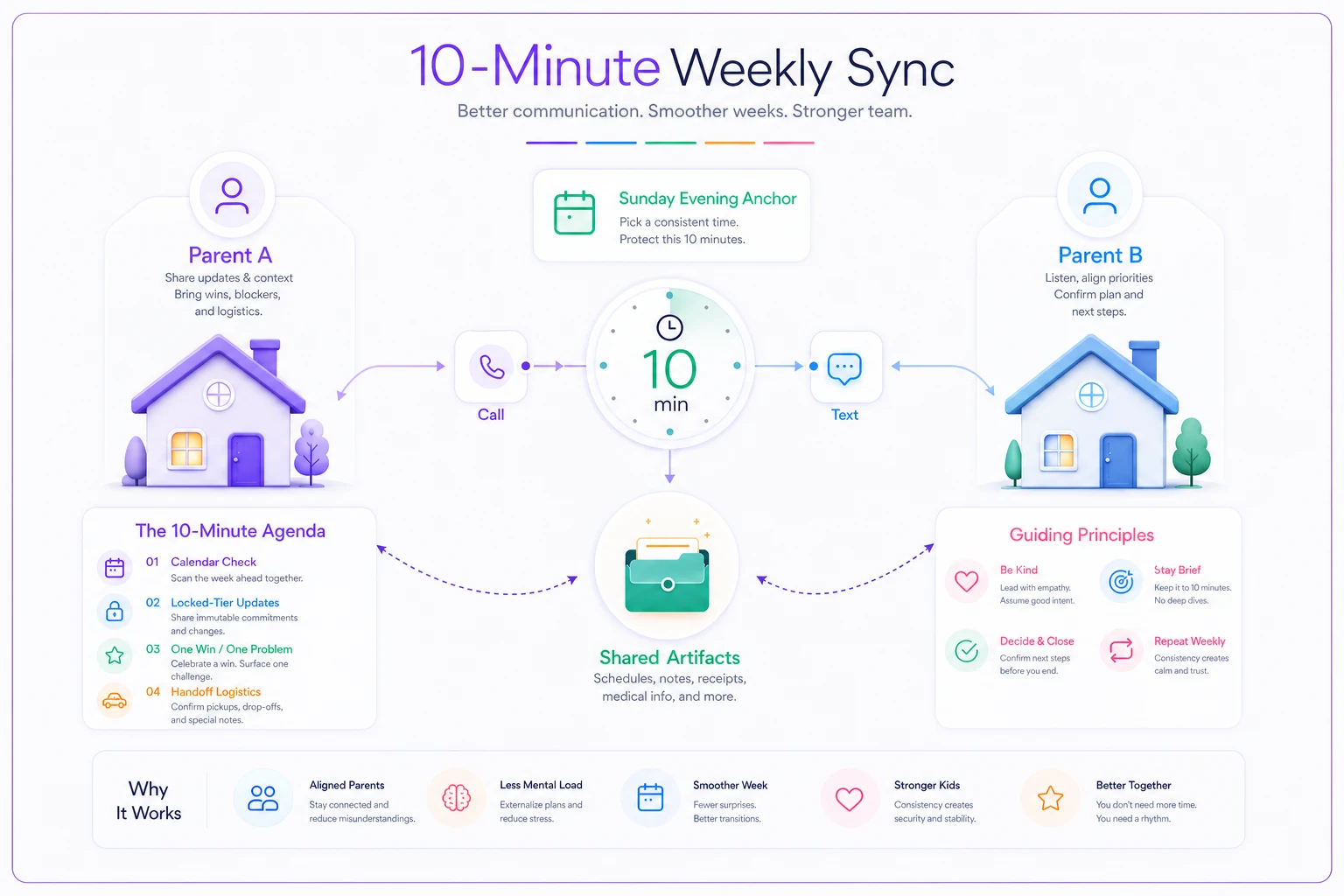
Keeping it to ten minutes and a fixed agenda is what makes it sustainable. The temptation is to let it sprawl into a relationship conversation. Don't. The sync is an operations meeting about a kid's week, not a venue for the relationship. If something bigger needs discussing, name it and schedule it separately — don't let it eat the sync, because the moment the sync becomes painful, it stops happening.
It also works best when it's anchored to something you already do — right after Sunday dinner, before the kid's bath, whatever's already fixed in your week. Attaching a new routine to an existing anchor is far more reliable than depending on a reminder, which is the whole premise behind building a portable anchor library of one-minute triggers you can use anywhere.
A real scenario
A separated couple with a nine-year-old on a roughly 50/50 week-on/week-off split. The recurring problem: Mondays were a wreck. The kid came back to the other house tired, homework half-done, and twice forgot medication entirely because each parent assumed the other had sent it. The handoffs were cordial but information-thin — a quick "he's good, see you next week" and that's it.
They set up four things: the two-line contract at every handoff, a shared calendar, a meds card in the kid's backpack, and a Sunday-night ten-minute sync. Locked tier was four items: meds, school-night bedtime, no screens until homework's done, and the nut allergy.
Over the first couple of months the Monday chaos didn't vanish overnight, but the pattern clearly shifted. Missed-medication incidents went to zero once the meds card lived in the backpack. The "I don't have my soccer stuff" calls dropped from most weeks to maybe one every few weeks. And the thing both parents mentioned without prompting: the handoffs got less tense, because the two-line contract took the guesswork and the blame out of it. There was less to argue about when the information was just written down.
Nothing here was complicated. It was mostly about moving the routine out of two adults' heads and into objects and a short weekly rhythm.
When this setup makes sense — and when it doesn't
This works well when both parents are willing to follow a light protocol, even if the relationship is strained. The system actually helps more when things are tense, because it reduces the number of judgment calls that turn into conflict.
Scale it down when you have a low-conflict, high-communication situation and a young kid with simple needs. You might only need the shared calendar and the two-line contract. Don't build escalation tiers for a scenario that never escalates.
This is a bad fit when there's an active safety concern, a protective order, or a situation where direct communication isn't safe or advisable. In those cases coordination has to run through supervised or court-structured channels, and a casual Sunday sync is the wrong tool entirely. The artifact system can still help — information attached to the kid rather than passed between adults — but the sync and informal escalation rules don't apply.
Who should skip the weekly sync specifically: parents who can't yet keep a ten-minute conversation factual. If every sync becomes a fight, pause it and lean harder on the written artifacts and the two-line contract until the channel cools down. A broken sync is worse than no sync.
The point
A kid's stability across two homes doesn't come from the parents being perfectly aligned people. It comes from a few small systems that carry the routine across the gap — so it doesn't depend on memory, mood, or goodwill on any given Sunday. Keep the handoff contract to two lines. Keep the Locked tier short. Let the rest of each house be its own place. Attach the routine to objects that travel with the kid, agree on what counts as an emergency before one happens, and protect a short weekly rhythm that stays scoped to logistics. None of it is elaborate — and that's exactly why it survives the handoff, week after week, which is the only measure that actually matters to the kid in the middle of it.
Ready to unlock your full potential?
Join thousands of users transforming their lives using Growyly to stay motivated, organized, and growth-focused every day.