

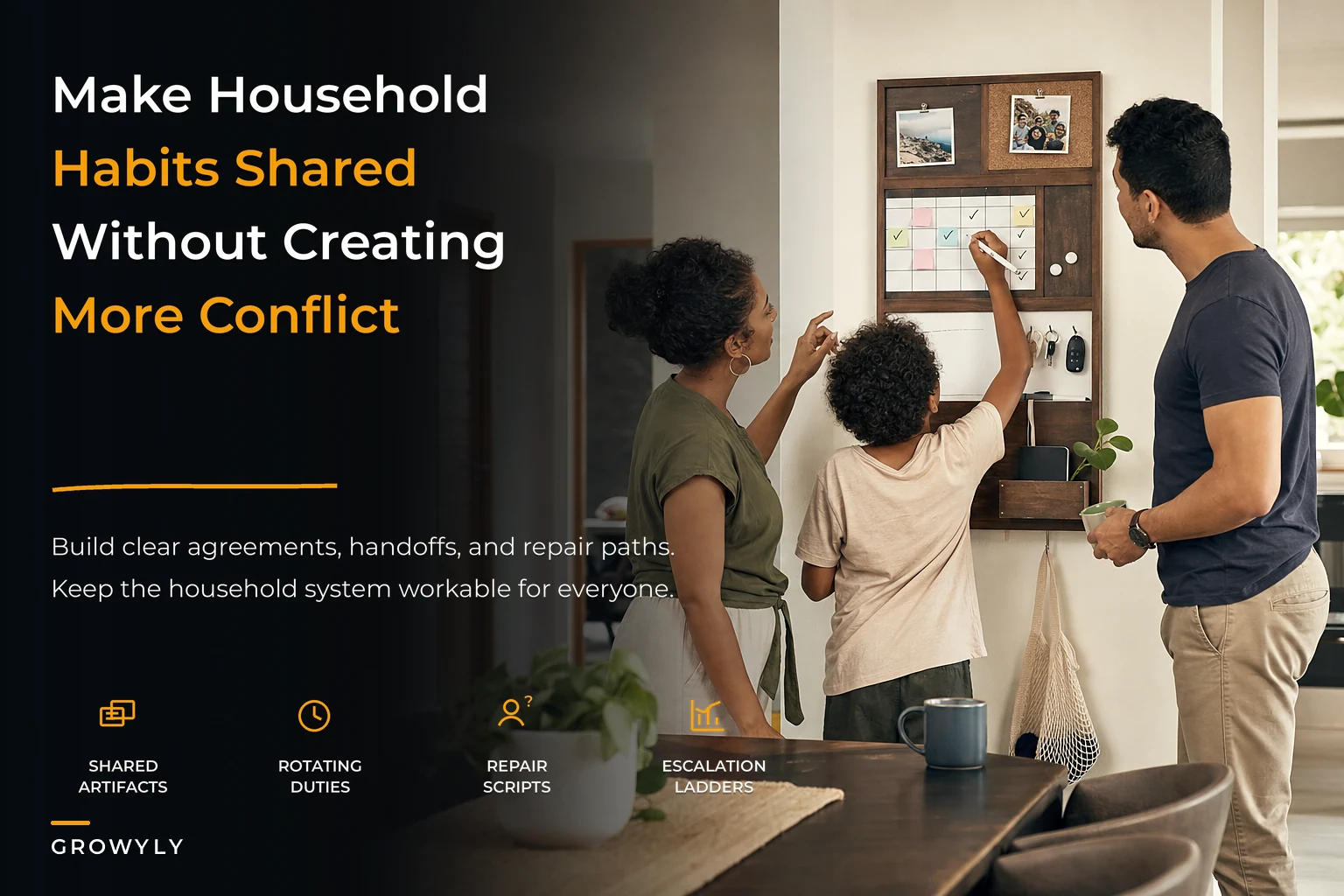

Solo habits are simple in one important way: there's only one person to blame, one calendar to check, one definition of "done." The moment you add a partner, a roommate, kids, or an aging parent into the mix, the whole thing stops being a habit problem and turns into a coordination problem.
Coordination problems fail differently than personal ones. A solo habit dies quietly when you skip it three days in a row. A shared habit dies loudly — through resentment, silent scorekeeping, and the phrase "I thought you were doing that." Nobody actually decided to stop. The system just had no rules for what happens when two humans, two energy levels, and two memories collide.
Most advice about shared habit systems in a household treats this like a motivation issue. It isn't. It's a governance issue. You're running a tiny two-to-five person operation with no org chart, no handoff protocol, and no plan for what happens when someone gets sick. So this post is about the boring, load-bearing infrastructure — shared artifacts, rotating duties, reduced-effort modes, repair steps, and escalation paths — that keeps a household running when willpower runs out.
The real failure mode: invisible work and mismatched mental models
Before fixing anything, it helps to name why household systems break in such predictable ways.
The first failure is invisible work. One person is usually tracking a huge amount of the household in their head — when the trash goes out, that the dog's flea meds are due, that the kid needs new shoes soon. This is the classic "mental load" problem. The person carrying it feels overwhelmed; the other person genuinely doesn't see the work, so they can't step in even when they'd happily do it. Nothing is written down, so nothing can be shared.
The second failure is mismatched standards. Two people can both "do the dishes" and mean completely different things — one means loading the dishwasher, the other means wiping counters and scrubbing the pan too. Neither is wrong. But without a shared definition, every handoff creates a small friction charge, and those charges accumulate into "why do I always have to redo everything."
The third failure is no degraded mode. Households build routines for good weeks — everyone healthy, calm, home by 6. Then a kid gets the flu, someone's slammed at work, and the whole thing evaporates because there was never a plan for the bad week. A system with only one operating mode isn't a system. It's a fair-weather agreement.
The households that stay functional aren't the ones with the most disciplined people. They're the ones that externalized the work — got it out of one person's head and into something both people can see and act on. That's the whole game.
The core building block: shared artifacts
An artifact is anything outside your head that carries the state of the system — a whiteboard, a shared list, a chart on the fridge, a shared calendar. It sounds trivial. It's also the single highest-leverage move you can make.
Achieve more by focusing on what matters.
Growyly helps you build lasting habits and track your personal growth effortlessly.
- Goal setting with progress tracking
- Daily habit reminders
- Motivational insights and analytics
No credit card required
The reason artifacts matter so much: they convert remembering into reading. Instead of one person holding "the trash goes out Tuesday night" in memory forever, the artifact holds it, and anyone who walks past can act. This is the same principle behind collecting only the signals you can actually act on — the artifact should surface the next action, not become a second job to maintain.
A good household artifact has three properties:
-
Visible by default. If you have to open an app and dig three menus deep, it won't get checked. A whiteboard in the kitchen beats a perfectly organized app nobody opens.
-
Low-fidelity to update. Adding "buy dog food" should take five seconds. If updating the artifact is harder than just doing the task, people stop updating it — and stale artifacts are worse than none.
-
Shared write access. Both people can add and check off. The moment one person "owns" the list, it becomes their mental load again, just in a different container.
A simple workflow for keeping an artifact useful:
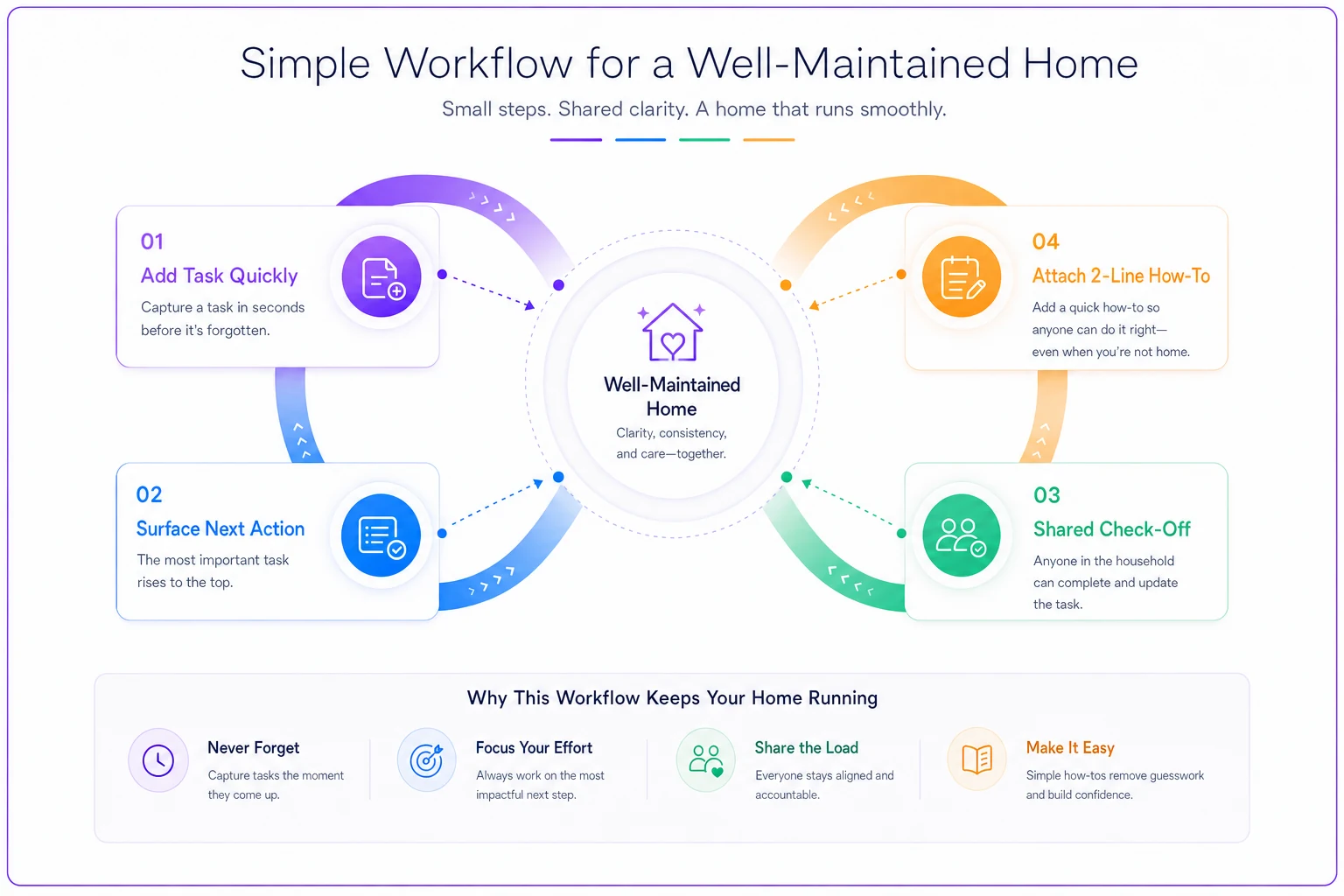
A typical example: a couple keeps a running "house state" note — one section for recurring duties, one for the rolling shopping list, one for "things that will need doing soon" (the kid's shoes, the car registration). It's ugly. It works because it's the same thing both people look at, so there's no longer a version of reality living only in one head.
Rotating responsibilities without turning it into a chore chart from hell
Rigid, permanent assignments feel efficient but quietly build resentment. "You always do X, I always do Y" works great until someone's circumstances change and the split stops feeling fair. Then it calcifies, and renegotiating feels like starting a fight.
Rotation solves two problems at once. It spreads the knowledge (so both people actually know how to do everything) and it spreads the unpleasantness (nobody is permanently stuck with the worst job). The trick is picking the right rotation grain.
| Rotation approach | Best for | Where it breaks |
|---|---|---|
| Fixed permanent split | Tasks tied to genuine skill or preference (one person cooks, one does finances) | When circumstances shift and the split stops being fair |
| Weekly rotation | Medium tasks — trash, dishes lead, tidying | Too much churn for high-skill tasks |
| Alternating / "whoever's turn" | Small recurring tasks | Requires an artifact to track whose turn it is |
| On-demand claim | Variable-load weeks | Needs a fallback so nothing gets orphaned |
The mistake most households make is trying to rotate everything. Don't. Some tasks genuinely belong to whoever's better at them or cares more — let those stay fixed. Rotate the stuff that's roughly equal-effort and mildly unpleasant, because that's where "who does more" fights actually happen.
One thing worth borrowing from operations: rotation only works if the task is documented well enough to hand off. If only one person knows how to run the weird dishwasher or pay a specific bill, rotation just creates failures. Write the two-line "how to do this" once, attach it to the artifact, and now it's genuinely transferable.
Minimal-fidelity modes: how to keep the system alive during bad weeks
This is the piece almost everyone skips, and it's the one that determines whether your system survives the year.
Every household routine should have at least two modes: full and minimal. Full mode is the good week — everything gets done to the normal standard. Minimal mode is what you drop to when someone's sick, traveling, overwhelmed, or just fried. The point of naming minimal mode in advance is that you decide while calm what actually matters, instead of improvising while stressed and fighting about it.
This maps directly onto how you protect habits with a fidelity plan during disruption — the household version just adds a second person who needs to know which mode you're in.
-
Full mode
cook most nights, kitchen reset daily, laundry twice a week, deep clean weekly.
-
Minimal mode
keep the kitchen sanitary and the dishes from becoming a biohazard, everyone gets fed (takeout counts), laundry only when someone's out of clothes. Everything else pauses without guilt.
The critical rule: minimal mode is declared out loud. One person says "I need us to be in minimal mode this week," and that's a signal both people recognize — not a passive-aggressive slow fade where one person stops doing things and the other notices later. Declaring the mode is what keeps a hard week from becoming a fight.
Pick a short, obvious phrase for minimal mode (e.g., "minimal week") so declaring it is fast and unambiguous.
One person says "I need us to be in minimal mode this week," and that's a signal both people recognize — not a passive-aggressive slow fade where one person stops doing things and the other notices later. Declaring the mode is what keeps a hard week from becoming a fight.
Repair protocols: what happens when someone drops the ball
Things will get missed. The trash won't go out, the bill will be late, someone will forget the thing they swore they'd handle. In a household without a repair protocol, this becomes a character referendum — "you're so irresponsible" — when it should just be a system event.
A repair protocol is a pre-agreed, low-drama way to handle a miss. The whole purpose is to separate the mistake from the relationship. A shame-free repair loop looks roughly like this:
-
Name it plainly. "Trash didn't go out, we missed pickup." No adjectives, no tone. Just the state of the world.
-
Fix the immediate thing. Handle it or plan the workaround. Don't relitigate yet.
-
Ask if it's a one-off or a pattern. A one-time slip needs no changes. A repeating miss means the system is wrong, not the person.
-
Adjust the system, not the person. If the same task keeps getting dropped, the reminder is failing, the artifact is invisible, or the task is on the wrong person. Change one of those.
Repeated misses are almost always design problems disguised as discipline problems. If your partner keeps forgetting to take out the recycling, the answer is rarely "try harder." It's usually a missing anchor or a bad artifact placement. A quick environment audit to remove the obstacle — moving the bin, adding a visible cue, changing whose task it is — solves more than a dozen reminder conversations ever will.
That said, the repair loop only works if both people actually trust it. If one person uses "name it plainly" as cover for passive-aggressive scorekeeping, the whole thing collapses. The protocol works when both people are genuinely trying to fix the system, not win the argument.
Escalation ladders: when a small thing needs to become a bigger conversation
Not every issue deserves a full sit-down, and not every issue should be handled with a passing comment. Households get this wrong in both directions — either everything triggers a Big Serious Talk (exhausting) or nothing does and problems fester until they explode.
An escalation ladder is just agreed-upon levels of response matched to how serious or persistent something is:
-
Level 1 — In-the-moment note. "Hey, dishes piled up." Handled in ten seconds, no charge attached. Most things live here.
-
Level 2 — Weekly check-in. Recurring small frictions get parked for a short, scheduled review instead of being raised in the heat of the moment. This is where most household governance actually happens.
-
Level 3 — Dedicated conversation. For patterns that a weekly check-in can't fix — a chronic imbalance, a system that's clearly not working, a resentment that's been building for a while.
The weekly check-in is the load-bearing rung. A 15-to-20-minute recurring conversation — same time each week — is where you review what got missed, whether anyone needs minimal mode coming up, and whether any rotation needs adjusting. Households that install this one habit resolve most conflicts at Level 1 or 2 and rarely need to escalate further.
Ready-to-use contracts and scripts
The reason these are worth writing down: in the moment, people default to their worst instincts — vagueness, blame, avoidance. A pre-written phrase gives you a rail to grab.
A lightweight household operating agreement — just answer these together, once:
-
What are our recurring duties, and who owns each (fixed vs. rotating)?
-
What does "done" mean for the tasks that cause friction?
-
What's our minimal mode, and how do we declare it?
-
When do we do our weekly check-in?
Scripts for the common moments:
-
Declaring minimal mode
"This week's rough for me — can we drop to minimal mode? I'll keep the kitchen going, but I need to pause everything else."
-
Naming a miss without blame
"The registration lapsed. Not blaming — I just want to figure out how it slipped so it doesn't again."
-
Renegotiating a fixed task
"The X arrangement worked for a while, but my schedule changed. Can we look at rebalancing it?"
-
Handing off a rotated task
"It's your turn for trash this week — the notes for it are on the list if you need them."
These feel almost too simple written out. That's the point. The value isn't cleverness; it's having the words ready so you don't have to invent them while irritated.
A real scenario: two roommates and a resentment spiral
A pair of roommates sharing a two-bedroom kept hitting the same wall. One did most of the cleaning and quietly stewed; the other genuinely didn't notice the imbalance because none of it was visible. Chores got done inconsistently, and every few weeks it boiled over into a tense conversation that fixed nothing for long.
They made three changes. First, a shared list on the fridge — every recurring task written down, so the invisible work became visible for the first time. Second, they split it: fixed assignments for the stuff each genuinely preferred, weekly rotation for the roughly-equal chores like trash and bathroom. Third, a 15-minute Sunday check-in to catch misses and flag any upcoming crunch weeks.
The change wasn't dramatic on paper, but the resentment dropped off noticeably within a month or so. The blow-up conversations basically stopped — not because chores got done more perfectly, but because the scorekeeping moved out of one person's head and onto a shared surface both could see. Most of the friction turned out to be an information problem, not an effort problem.
When this level of structure makes sense — and when it doesn't
Not every household needs all of this. Scale the system to the actual complexity.
When it makes sense: more people (kids, roommates, multigenerational homes), genuinely mismatched schedules (shift work, travel), a recurring resentment pattern you can't seem to shake, or a big transition — new baby, new roommate, someone moving in. More coordination surface means more need for explicit rules.
When it's overkill: a low-conflict two-person household where things already flow fine. If you're not fighting and nothing's getting dropped, don't impose bureaucracy on a system that works. A whiteboard and a rough sense of who does what may be all you need.
Who should NOT lead with this: if the real issue is a deeper relational or fairness conflict, no chore chart fixes that. Governance primitives handle coordination problems. They can't substitute for a conversation that's actually about values or respect. Get the harder conversation right first; then the system makes the day-to-day livable.
The bigger point
A household is a small operation, and small operations run on the same fundamentals as big ones: shared visibility, clear ownership, a plan for bad days, and a low-drama way to fix mistakes. The couples and roommates and families that seem to run smoothly aren't more disciplined than everyone else. They just externalized the work and agreed on the rules before they were stressed enough to need them.
Start with one artifact everyone can see. Add a weekly check-in. Name your minimal mode. That's most of the system right there — and it'll outlast any burst of motivation you were counting on to hold it together.
Start with one artifact everyone can see. Add a weekly check-in. Name your minimal mode. That's most of the system right there — and it'll outlast any burst of motivation you were counting on to hold it together.
Ready to unlock your full potential?
Join thousands of users transforming their lives using Growyly to stay motivated, organized, and growth-focused every day.