



Most habit advice fails at the matching step. Not the execution step. People find a tactic that worked for someone else — cold showers, a 5am wake-up, an accountability partner — and bolt it onto a goal that has a completely different shape. The tactic isn't wrong. It's just wrong for that goal, under those constraints, on that timeline.
That mismatch is the actual bottleneck. You can execute a perfectly good intervention flawlessly and still get nothing, because you applied a maintenance tool to a construction problem, or a construction tool to something that only needed a small nudge.
What's missing from most personal-growth systems is a routing layer — something that sits before the tactics and decides which class of intervention a goal even belongs to. That's what a habit intervention taxonomy does. It's not a list of tricks. It's a decision structure that takes three inputs — what kind of goal you have, what's actually constraining it, and how long you have — and routes you to the right class of playbook instead of the trendiest one.
This post builds that taxonomy from the ground up, gives you mapping rules, walks through worked examples, and hands you a fillable diagnosis worksheet you can run on any goal in about ten minutes.
The three axes that actually determine which tool works
Every goal you'll ever set can be described along three axes. Get these three right and the tool almost picks itself. Get them wrong and no amount of discipline saves you.
Axis 1 — Goal type. What are you actually trying to move? There are four practical types:
-
Acquisition — build a behavior that doesn't exist yet (start flossing, start writing daily).
-
Extinction — remove a behavior that's already running (stop doomscrolling at night, stop skipping breakfast).
-
Skill — improve the quality of a behavior you already do (write better, negotiate better, run faster).
-
Stabilization — keep an existing behavior from decaying under stress or change (protect your workout during a busy quarter).
Axis 2 — Constraint. What's the binding limiter? Almost every stalled goal is blocked by exactly one of these, even though people usually blame the wrong one:
-
Motivation — you don't feel the pull.
-
Friction — the behavior is too annoying to start.
-
Capacity — you genuinely don't have the time, energy, or attention.
-
Knowledge — you don't know how to do the thing well.
-
Environment — your surroundings keep triggering the wrong behavior.
Axis 3 — Horizon. How long until you need results?
-
Sprint — days to two weeks.
-
Season — roughly one to three months.
-
Structural — six months and up, or permanent.
The single most common mistake — and it shows up across every domain from fitness to finance to creative work — is treating a capacity constraint like a motivation constraint. Someone can't find time to exercise, so they buy a book about discipline. The book is a knowledge/motivation tool. The problem was capacity. They read the book, feel inspired for four days, and stall again, this time also feeling guilty. The intervention class never matched.
The mapping rules
The goal type tells you the shape of the work. The constraint tells you the lever. The horizon tells you how aggressive the lever can be.
Achieve more by focusing on what matters.
Growyly helps you build lasting habits and track your personal growth effortlessly.
- Goal setting with progress tracking
- Daily habit reminders
- Motivational insights and analytics
No credit card required
| Goal Type | If constrained by… | Route to intervention class |
|---|---|---|
| Acquisition | Friction | Anchoring + tiny-step scaffolds |
| Acquisition | Motivation | Reward-economy + identity framing |
| Acquisition | Environment | Environment redesign / cue placement |
| Extinction | Environment | Cue removal + friction insertion |
| Extinction | Motivation | Replacement behavior + substitution |
| Extinction | Capacity | Load reduction before extinction |
| Skill | Knowledge | Deliberate practice + feedback loops |
| Skill | Capacity | Time-boxing + narrowed rep focus |
| Stabilization | Capacity | Resilience rules + fidelity tiers |
| Stabilization | Environment | Portable systems + context bridging |
Two rules govern how horizon modifies all of this:
-
Short horizons forbid structural interventions. If you have two weeks, you cannot redesign your environment or rebuild your identity. You can only reduce friction or insert a cue. Sprint horizons route almost exclusively to lightweight, reversible tactics.
-
Structural horizons forbid willpower-dependent interventions. Anything you'll be doing in eight months cannot rely on you feeling motivated. If the horizon is long, the intervention must offload effort into environment and systems. This is exactly the logic behind a systems approach to motivation that keeps habits going — willpower is a sprint fuel, not a structural one.
There's a subtle pattern worth naming here. When people set long-horizon goals with short-horizon tools, they experience it as a character failure. "I just can't stick with anything." Nine times out of ten it's a taxonomy failure — they used a sprint intervention on a structural goal and blamed themselves when the fuel ran out on schedule.
Worked example matchings
Abstract taxonomies are useless until you run real goals through them. Here are four, deliberately picked to look similar on the surface but route to completely different classes.
Example A — "I want to read more." Type: Acquisition. Constraint: on inspection, it's friction, not motivation — she wants to read, but her books are in another room and her phone is on the nightstand. Horizon: structural (a permanent identity shift).
Routing: Acquisition + Friction → anchoring and tiny-step scaffolds. Because the horizon is structural, we also apply the environment layer: book on the pillow, phone charging in the kitchen. The wrong move here — and the common one — would be a motivation tool like a reading challenge with points. She doesn't lack motivation. She lacks a frictionless path.
Example B — "I want to stop checking my phone every ten minutes at work." Type: Extinction. Constraint: environment (the phone is visible and buzzing). Horizon: season.
Routing: Extinction + Environment → cue removal and friction insertion. Phone in a drawer, notifications off, a five-second lock-screen delay. A reward economy would do almost nothing here — you can't out-incentivize a cue that's firing forty times an hour. Kill the cue.
Example C — "I want to get genuinely better at public speaking." Type: Skill. Constraint: knowledge — she speaks often but never improves because she gets no structured feedback. Horizon: season to structural.
Routing: Skill + Knowledge → deliberate practice with feedback loops. Record talks, isolate one dimension (pacing) per week, review against a rubric. A friction tool or reward tool is irrelevant; she already does the behavior constantly. Volume was never the problem. Feedback was.
Example D — "I want to keep my gym habit alive through a brutal work quarter." Type: Stabilization. Constraint: capacity. Horizon: season.
Routing: Stabilization + Capacity → resilience rules and fidelity tiers. Define a "minimum viable" version (10 minutes counts) so the habit degrades gracefully instead of snapping. The classic mistake is trying to maintain full intensity under reduced capacity, which guarantees a total collapse rather than a controlled reduction.
Notice how A and D both sound like "I want to keep doing a good thing," but one is acquisition-under-friction and the other is stabilization-under-capacity. Same emotional language, opposite tool classes.
The fillable diagnosis worksheet
Run any goal through this. It takes about ten minutes and it's the whole point of the taxonomy — it forces you to name the axes before you reach for a tactic.
Step 1 — State the goal in one sentence. Write it exactly as it lives in your head. No cleanup.
Step 2 — Classify the goal type. Ask: Am I building something new (Acquisition), removing something (Extinction), improving quality (Skill), or protecting something existing (Stabilization)? Pick one. If two feel true, the goal is actually two goals — split it. Splitting and sequencing tangled goals is its own discipline, and there's a full operational decision tree for splitting and prioritizing growth goals if this step gets messy.
Step 3 — Find the binding constraint. This is the step people rush and get wrong. Don't guess. Ask: If this one thing were magically fixed, would the goal basically solve itself? Test each candidate — Motivation, Friction, Capacity, Knowledge, Environment — against that question. Only one usually survives. That's your binding constraint. The others are noise.
Step 4 — Set the honest horizon. Not the aspirational one. Sprint, Season, or Structural. A permanent behavior is structural even if you're impatient about it.
Step 5 — Route. Take your (Goal type × Constraint) pair to the mapping table, then apply the horizon rules to narrow the aggressiveness. Write down the intervention class, not the specific tactic yet.
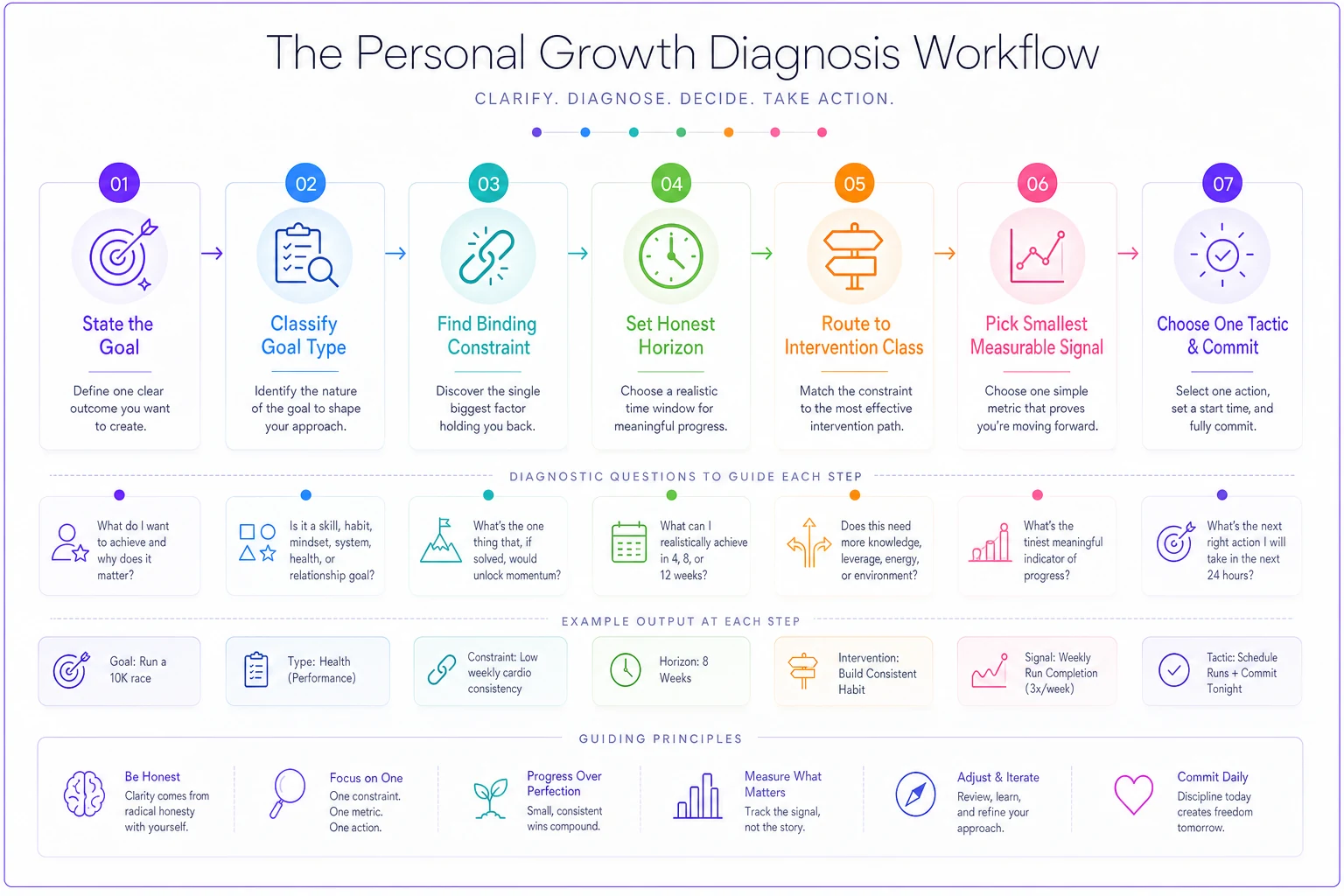
A quick visual of the worksheet workflow.
Step 6 — Pick the smallest measurable signal. Before you choose tactics, decide how you'll know it's working. This is where most systems quietly fail — they never define a signal, so they can't tell a working intervention from a lucky week. Pick the smallest signal that actually predicts progress; there's a whole method for choosing the smallest signals that predict change so you're not drowning in vanity metrics.
Step 7 — Choose one tactic from the routed class. Commit for one horizon cycle. One tactic. Not five. Run it for a full sprint or season, then re-diagnose.
When the taxonomy actually helps — and when it's overkill
When it makes sense: any time a goal has stalled and you can't figure out why, or when you're setting a goal important enough to be worth ten minutes of diagnosis. It's especially valuable for goals you've failed at before — repeated failure almost always means repeated mis-routing, and the worksheet catches it.
When it's overkill: trivial one-off changes. If you want to drink more water today, don't build a taxonomy — just put a bottle on your desk. Diagnosis has a cost, and for low-stakes, short-horizon goals, that cost outweighs the benefit.
Who should skip this entirely: anyone in the middle of an acute crisis — illness, grief, burnout. During those windows the only correct move is aggressive load reduction. Diagnosing "constraints" while you're underwater just adds cognitive overhead. Stabilize first, taxonomize later.
Same goal, two routings, very different outcomes
A freelance designer wanted to "publish work more consistently." First attempt, no taxonomy: she treated it as a motivation problem and set up a public posting streak with a spreadsheet and a reward for hitting 30 days. She lasted about nine days. When work got busy, the streak felt like pressure, and one missed day collapsed the whole thing.
Re-run through the worksheet, the picture changed. Goal type wasn't acquisition driven by motivation — she had plenty of finished work sitting unpublished. The real constraint was friction: publishing meant writing a caption, resizing images, and second-guessing every post. Horizon was structural.
New routing: Acquisition + Friction → anchoring plus friction removal, with an environment layer because the horizon was long. She built a two-line caption template, a pre-set export size, and anchored publishing to Tuesday mornings right after coffee. No streak. No reward. No willpower dependency.
Over the next couple of months she went from posting maybe twice a month to something like eight or nine times — not because she got more disciplined, but because the intervention finally matched the constraint. The first system failed on a good tactic aimed at the wrong axis. The second worked on a boring tactic aimed at the right one.
That gap — good tactic, wrong axis versus boring tactic, right axis — is basically the entire argument for building a diagnosis layer before you touch tactics.
How the pieces connect as your system grows
One goal is easy to route. The real value shows up when you're running six or eight habits across work and home and they start competing for the same limited resources. Two failure points emerge at scale.
The first is constraint collision. Three of your goals all bind on capacity, and there simply isn't enough of it. The taxonomy makes this visible — when you diagnose everything on the same axes, you can see that you've stacked four capacity-limited goals into one quarter and something has to give. Without the shared language, you just feel vaguely overwhelmed and blame willpower.
The second is horizon drift. Structural goals quietly get treated with sprint tools over time because sprint tools feel productive. You keep restarting the streak instead of fixing the environment. A periodic re-diagnosis — running the worksheet on your whole portfolio once a season — catches this drift before it turns into another abandoned habit.
The taxonomy isn't a one-time sort. It's a routing layer you re-run whenever a goal stalls, whenever your constraints shift, or whenever life changes your available capacity. The goals don't need new tactics nearly as often as people think. They need to be re-routed to the class of tactic that matches what's actually blocking them right now. Match the class first. The specific tools are the easy part.
The taxonomy isn't a one-time sort. It's a routing layer you re-run whenever a goal stalls, whenever your constraints shift, or whenever life changes your available capacity. The goals don't need new tactics nearly as often as people think. They need to be re-routed to the class of tactic that matches what's actually blocking them right now. Match the class first. The specific tools are the easy part.
Ready to unlock your full potential?
Join thousands of users transforming their lives using Growyly to stay motivated, organized, and growth-focused every day.