


The frustrating thing about most habit advice is that it assumes your life stays still. Same kitchen, same desk, same morning light through the same window. But real life doesn't work that way. You spend Monday at the office, Tuesday working from home, Thursday in an airport, and by the weekend your "solid" routines have quietly fallen apart.
What's actually breaking isn't your discipline. It's that your habits are welded to a specific place. The moment the place disappears, the habit has nowhere to live. This is the core failure that context-agnostic habit systems are built to solve — habits designed so they can travel across environments without losing their shape.
This piece is about the underlying architecture. Not tips. Not "drink water when you wake up." The actual load-bearing pieces that let a habit survive being dropped into a completely different setting.
The real problem: your habits are location-dependent by default
Most habits get built accidentally. You start flossing after brushing at your bathroom sink, and after a few weeks it feels automatic. But what you actually built wasn't "flossing." You built "flossing at that specific sink after brushing." Change the sink, remove the mirror, shift the timing — and the behavior evaporates.
This is fine when your environment is stable. It becomes a real problem the moment you have three or four environments competing for the same 24 hours. The habit doesn't generalize because it was never designed to. It was designed to fire off one specific cue in one specific room.
Worth noticing: people rarely lose all their habits when they travel or switch contexts. They lose the ones tied to physical objects and locations, and keep the ones tied to internal states or portable actions. The person who "meditates in their meditation corner" loses it on the road. The person who "takes three breaths before opening their laptop" keeps it everywhere, because the laptop travels with them.
That difference isn't personality. It's architecture.
The four primitives every portable habit needs
Think of a habit as a small system with parts. When the system is well-built, you can move it anywhere. When it's built sloppily, one missing piece takes the whole thing down. There are four primitives worth naming.
Achieve more by focusing on what matters.
Growyly helps you build lasting habits and track your personal growth effortlessly.
- Goal setting with progress tracking
- Daily habit reminders
- Motivational insights and analytics
No credit card required
1. The anchor. This is what triggers the habit. The mistake most people make is choosing a location-based anchor ("in my kitchen") when they should choose an event-based one ("after I pour my first coffee"). Events travel. Kitchens don't.
2. The micro-commitment. The smallest version of the habit that still counts. Not the ideal version — the floor. If your reading habit is "one page," that page can happen on a plane, in a hotel, on a couch. The micro-commitment is your survival mode, and it needs to be small enough to be embarrassing to skip.
3. The portable trigger. The physical or digital cue you carry so the anchor works even in an unfamiliar setting. A specific playlist, a physical token in your pocket, a phone reminder tied to a calendar event rather than a location. This is what makes an anchor fire when the surrounding environment offers no help.
4. The fallback. The pre-decided alternative for when the normal version is impossible. Not an improvisation — a decision made in advance. Travel days, sick days, chaos days. The fallback is what stops a single disruption from becoming a two-week gap.
What most people miss: these four aren't optional add-ons. A habit missing even one of them is fragile in a predictable way. No anchor and it never fires. No micro-commitment and it collapses under any time pressure. No portable trigger and it dies the moment you leave home. No fallback and one bad day snowballs into a full lapse.
Why this breaks at scale
The single-habit version of this is manageable. Where it falls apart is when you're running six, eight, ten habits across multiple environments. That's when the coordination problem shows up.
Usually it goes like this: you build each habit in isolation, in the environment where it was convenient to build. Your workout is a "home gym" habit. Your deep-work block is an "office" habit. Your evening wind-down is a "your-own-bed" habit. Individually they're fine. But you've now built a portfolio of habits that each depend on a different environment, which means no single day reliably gives you all your cues.
The result is what I'd call habit fragmentation. On office days you lose your home habits. On travel days you lose almost everything. And because the losses feel random, you blame yourself instead of the design.
The bottleneck isn't willpower — it's that your habits share no common architecture. Each one has its own anchor logic, its own triggers, its own assumptions about where you are. There's no portable layer connecting them. If you've read the piece on a systems approach to motivation that keeps habits going, this is the same principle scaled up: the failure is structural, and no amount of trying harder fixes a structural problem.
Building cross-context templates
The fix is to stop designing habits per environment and start designing them as templates that get filled in differently per context. Same skeleton, different limbs.
A cross-context template works like this. You define the habit's non-negotiable core (the micro-commitment), then specify the anchor and fallback separately for each environment you regularly operate in. The habit stays the same. The scaffolding changes.
Here's a filled-in template for a "10 minutes of focused reading" habit:
| Context | Anchor (event-based) | Portable trigger | Fallback |
|---|---|---|---|
| Home | After morning coffee is poured | Book left on kitchen table night before | Audiobook while making breakfast |
| Office | After first email triage, before deep work | E-reader app pinned on phone home screen | One article on commute home |
| Travel | After boarding / settling into seat | Downloaded book on phone (offline) | One page before sleep, hotel or plane |
Notice what stays constant: the action (reading) and the floor (roughly 10 minutes, dropping to one page on the worst days). Everything else adapts. You're not maintaining three separate habits. You're maintaining one habit with three sets of clothes.
This is the shift that makes habits genuinely context-agnostic. The identity of the habit lives in the micro-commitment, not in the surroundings. When people say a habit "finally stuck," what usually happened is they accidentally stumbled into this structure — a core action they could perform anywhere, with whatever anchor was available.
A matrix for choosing anchors and fallbacks per context
The hard part of building these templates is picking the right anchor and fallback for each environment. Pick a weak anchor and the habit won't fire. Pick an unrealistic fallback and you'll skip it entirely.
-
Reliability — Does this event happen in this context every single time? (Coffee happens daily. "When I feel motivated" does not.)
-
Proximity — Does the anchor happen right before the habit is actually possible? An anchor that fires two hours before you can act on it is useless.
-
Portability — If this is meant to work across contexts, does the anchor exist in all of them, or do you need a context-specific one?
-
Visibility — Will you notice the anchor happening, or does it slip by unconsciously?
For fallbacks, the test is different and simpler:
-
Is it genuinely easier than the main version? If your fallback takes the same effort, it's not a fallback.
-
Does it preserve the identity of the habit? Skipping a workout and "resting" is a gap. Doing five bodyweight squats is a fallback. One keeps the streak of being someone who moves; the other doesn't.
-
Have you decided it in advance? A fallback invented in the moment is just a rationalization wearing a costume.
The pattern worth internalizing: anchors are chosen for reliability, fallbacks are chosen for ease. People get this backwards constantly — picking anchors that are convenient but unreliable, and fallbacks that sound ambitious but never actually get used.
A real scenario: rebuilding a fragmented routine
Consider someone in a consulting-style hybrid role — two office days, two home days, and a week of travel most months. On paper, a strong routine: morning workout, midday journaling, evening reading, no phone in bed.
The problem was that every one of those habits was location-locked. The workout needed their apartment gym. Journaling happened at their home desk. Reading required the nightstand setup. On roughly 8–10 travel days a month, the entire stack collapsed, and it took most of the following week to recover. Realistically they were running their "full" routine maybe 12–15 days out of 30.
The fix wasn't adding habits. It was rebuilding four existing ones as cross-context templates. The workout got a travel fallback — a 7-minute bodyweight circuit anchored to "after I wake up in the hotel." Journaling moved from "desk" to "after I close my laptop for the day," which happens in every environment. Reading became a downloaded-book habit anchored to bedtime rather than the physical nightstand.
Within about two months, the number of days running the full stack climbed from that 12–15 range to somewhere north of 25. Travel weeks stopped being total resets. Nothing about willpower changed. The habits just finally had architecture that traveled with them.
When this makes sense — and when it doesn't
This whole approach earns its keep when you genuinely move between multiple environments. Hybrid workers, frequent travelers, parents splitting time across two households, anyone whose week looks different on Monday than it does on Thursday.
When it's overkill: if your environment is genuinely stable — same workplace, same bed, rarely traveling — building elaborate cross-context templates is solving a problem you don't have. A location-anchored habit works perfectly fine when the location never changes. Don't add architecture for transitions that don't happen.
Who should not start here: if you're currently recovering from a lapse, don't try to build a full portable system on day one. Get one habit firing again first. The shame-free recovery playbook for restarting after a lapse is the better starting point before you worry about portability.
And a warning sign that you're over-engineering: if you're spending more time maintaining your habit system than doing the habits, you've inverted the whole point. The architecture should be invisible once it's set. If it keeps demanding attention, simplify.
The workflow: how to actually build one
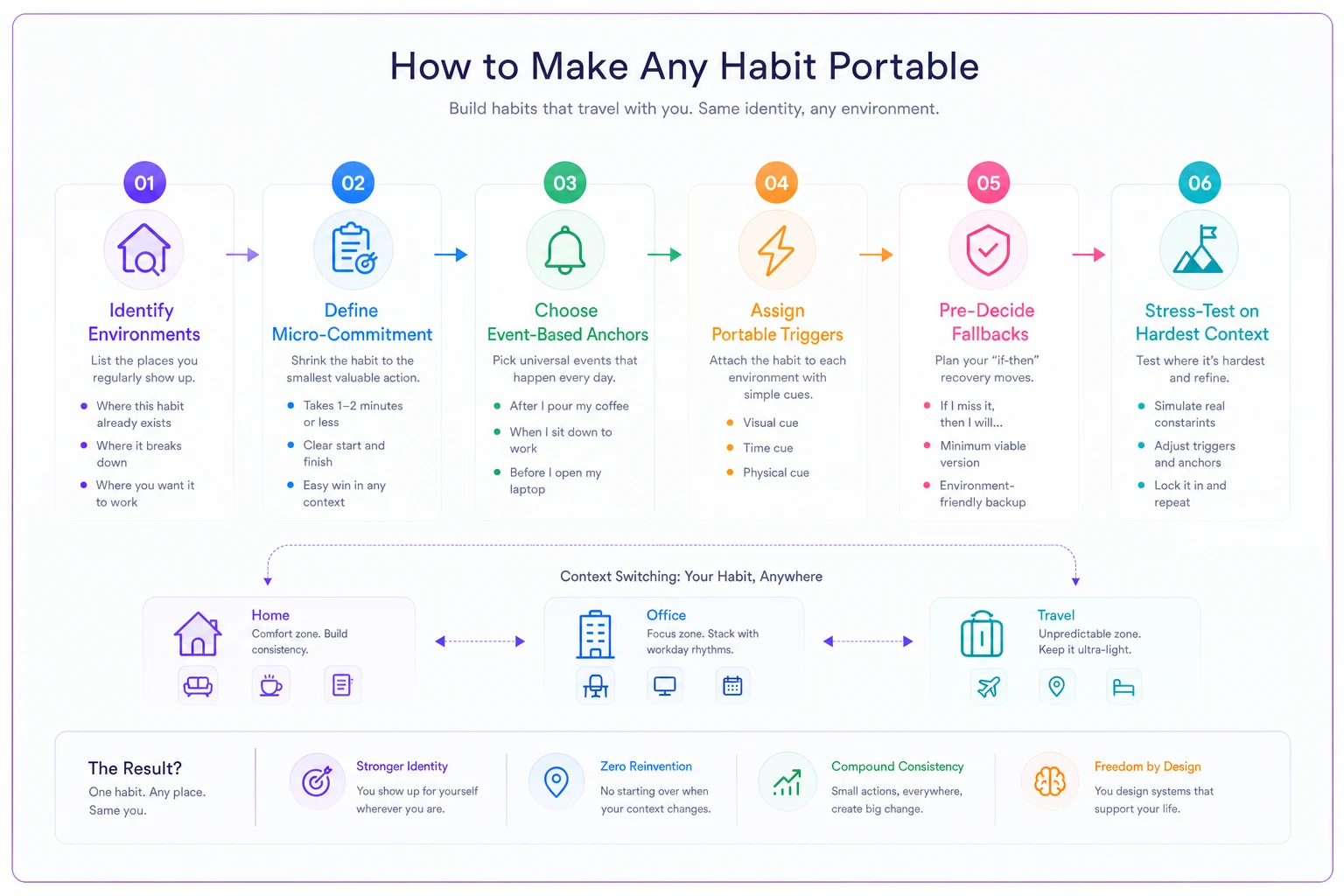
Here's the sequence for converting a fragile habit into a portable one. The order matters.
-
Identify the environments you actually operate in. Not aspirational ones. The real ones — home, office, travel, wherever. Most people have three to four.
-
Define the micro-commitment first. Strip the habit down to the smallest version that still counts everywhere. This is your constant.
-
Choose an event-based anchor for each environment. Run each candidate through the reliability/proximity/portability/visibility test. Reject convenient-but-unreliable anchors.
-
Assign a portable trigger. Something you carry — a downloaded file, a phone reminder tied to an event, a physical token — that makes the anchor fire even in unfamiliar settings.
-
Pre-decide a fallback per environment. Easier than the main version, still preserves the habit's identity, decided now not in the moment.
-
Stress-test on the hardest context first. Don't validate on easy home days. Validate on travel. If it survives the worst environment, the rest are trivial.
Visualize the sequence as a simple workflow to keep the steps consistent across contexts.
That last step is where most people go wrong. They design for the ideal day and get blindsided by the chaotic one. Build for the airport, and the kitchen takes care of itself.
Keeping the transitions themselves clean
One layer people forget: the transition between environments is its own risk zone. The travel day, the first day back, the shift from office mode to home mode. These are the moments habits die, not the destinations.
A small but reliable move is building a single "reset" anchor that marks the transition — something you do when you arrive somewhere new that re-activates the relevant habit set. For evening habits especially, this matters a lot, because wind-down routines are the first casualty of a disrupted day. The hour-by-hour evening routine for reducing screen time and improving sleep works far better when it's anchored to an event ("after I set my alarm") than to a location ("in my bedroom"), precisely because the event survives a hotel and the bedroom doesn't.
Decide one simple arrival ritual (a 'reset' anchor) to re-activate evening or morning routines whenever you reach a new context.
Transitions deserve their own fallbacks too. A "first day back from travel" plan that expects nothing more than the micro-commitments will beat a plan that expects your full routine to snap back instantly. It never snaps back instantly. Design for the ramp, not the switch.
Pulling it together
The reason habits feel so fragile across changing environments is almost never a character flaw. It's that they were built for a single setting and then asked to perform everywhere.
Strip a habit down to its four primitives — anchor, micro-commitment, portable trigger, fallback — and you can rebuild it as something that moves with you instead of staying behind. The real skill here isn't more discipline. It's separating what a habit is (the small action you can do anywhere) from where it happens to live right now. Once that separation is clean, home, office, and travel stop being three different battles. They become three sets of scaffolding around the same durable core — which is the entire point of a system that doesn't care what room you're standing in.
The reason habits feel so fragile across changing environments is almost never a character flaw. It's that they were built for a single setting and then asked to perform everywhere.
Strip a habit down to its four primitives — anchor, micro-commitment, portable trigger, fallback — and you can rebuild it as something that moves with you instead of staying behind. The real skill here isn't more discipline. It's separating what a habit is (the small action you can do anywhere) from where it happens to live right now.
Ready to unlock your full potential?
Join thousands of users transforming their lives using Growyly to stay motivated, organized, and growth-focused every day.