


Most multi-year plans die the same way. Not with a dramatic failure — with a slow drift where the plan you wrote in January stops matching the life you're actually living by August. A new job, a move, a health scare, a relationship change — and suddenly the whole thing feels irrelevant, so you quietly stop looking at it.
The problem isn't ambition. It's architecture. Most people build growth plans as a single flat list of goals stacked on a fixed timeline. That structure works great until the timeline breaks. And the timeline always breaks.
What survives is a layered system — where your long-range direction, your medium-term themes, your annual focus, and your small experiments are separate layers that can move independently. When one layer gets hit, the others absorb the shock. That's the whole idea behind a durable multi-year personal growth plan: not rigidity, but a structure where the pieces flex at different speeds.
Below is how the layers connect, where they usually break, and how to build re-sequencing rules so a disrupted year doesn't nuke a ten-year direction.
Why single-layer plans collapse (and why it's a design flaw, not a discipline problem)
Someone writes a five-year plan that reads like a to-do list scaled up: "Year 1, learn Spanish. Year 2, run a half marathon. Year 3, get promoted." It looks organized. It feels serious.
Then life reorders things. The promotion happens in Year 1 instead of Year 3. An injury kills the running goal. Suddenly the plan is "wrong," and being wrong makes it feel useless. So it gets abandoned — not because the goals were bad, but because the plan had no way to reabsorb change.
Single-layer plans fail because they fuse two things that should never be fused: direction and schedule. Direction should be stable. Schedule should be disposable. When they're welded together, any schedule disruption reads as a direction failure.
The other quiet failure is coordination. A flat plan has no sense of which goals depend on which. You can't tell what's foundational versus what's downstream. So when you have to cut something under pressure, you cut randomly — and half the time you cut the thing everything else was resting on.
A layered architecture fixes both problems by giving each part of the plan its own job, its own time horizon, and its own rules for when it's allowed to change.
The four layers and how they actually connect
Think of your growth system as four horizons stacked on top of each other. Each layer changes at a different pace, and each one feeds the layer below it.
Achieve more by focusing on what matters.
Growyly helps you build lasting habits and track your personal growth effortlessly.
- Goal setting with progress tracking
- Daily habit reminders
- Motivational insights and analytics
No credit card required
| Layer | Time horizon | Changes how often | Its job |
|---|---|---|---|
| Mission | 10+ years | Almost never | Direction and identity — who you're becoming |
| Mid-term themes | 3–5 years | Rarely (major life shifts) | Broad areas of development that serve the mission |
| Annual cycles | 12 months | Once a year, planned | The current focus and measurable targets |
| Experiment scaffolds | 2–8 weeks | Constantly | Small tests that feed learning upward |
The connection runs downward for guidance and upward for evidence. Your mission tells your mid-term themes what matters. Your themes tell your annual cycle what to prioritize. Your annual cycle spawns experiments. And the experiments send data back up — sometimes even reshaping a theme when you learn something big enough.
The thing most people miss: the top two layers should be almost boring in how stable they are, and the bottom two should be almost chaotic in how often they change. If your mission is shifting every year, it's not a mission — it's a mood. If your experiments never change, you're not learning anything.
A quick example of how this flows in practice. Say your mission is something like "build the health and capability to stay active and independent into old age." A mid-term theme under that might be "develop real strength, not just cardio." Your current annual cycle turns that into "train consistently three times a week and progressively overload." And your experiments this month test how — barbell versus kettlebell, morning versus evening, gym versus home setup. The experiment might fail. The theme doesn't care. The mission definitely doesn't care.
Sample templates: 3, 5, and 10-year scaffolds
People always want to see the actual shape of this, so here are working templates you can adapt. These aren't meant to be filled in perfectly. They're meant to be sketched loosely and revised often.
The 10-year mission sketch
Keep this short. Genuinely short — a paragraph, maybe two. It should describe the kind of person you're building toward and two or three domains that matter most. Not milestones. Not numbers. Direction.
-
Core identity statement one or two sentences on who you're becoming
-
Anchor domains 2–4 areas (health, craft, relationships, finances, contribution)
-
Non-negotiables things you refuse to sacrifice along the way
-
What "off track" would look like a warning signal, not a schedule
Writing those "off track" signals matters more than it seems. They let you notice drift without needing a rigid plan to compare against.
The 5-year theme map
This is where you translate the mission into broad development areas. Each theme should be big enough to hold several years of work but specific enough to actually guide an annual focus.
-
The theme (e.g., "become a confident public speaker")
-
Why it serves the mission
-
Rough sequencing — which theme leads, which can wait
-
Dependencies — what has to exist before this theme is realistic
That sequencing and dependency work matters more than it looks. If you've ever tried to figure out which goal should come first when two feel equally important, the logic in an operational decision tree to split, sequence, and prioritize growth goals applies directly here — you're sequencing themes, not just tasks.
The 3-year working horizon
Three years is the sweet spot where planning stops being fantasy. This is where you pick which one or two themes get real attention and which stay dormant.
-
Active themes 1–2 max (this is the discipline)
-
Maintenance themes things you keep alive but don't push
-
Dormant themes consciously parked, with a note on what would reactivate them
-
Annual targets for year one concrete, measurable, revisable
Most people try to run five themes at once and burn out. Two active themes at a time is usually the honest ceiling for someone with a real life, real obligations, and finite energy.
Horizon-aligned experiment rules
Experiments are the engine, but they only work if they match the layer they're serving. An experiment that's fine for testing a daily habit is useless for validating a five-year theme. The mismatch is where a lot of effort gets quietly wasted.
-
Serving an annual target run short, tight experiments (2–4 weeks) that test how you'll hit the target — timing, format, environment.
-
Serving a mid-term theme run longer trials (one to two quarters) that test whether the approach is even right, not just the tactics.
-
Questioning the mission itself these are rare and slow. You don't run a two-week experiment on your life direction. You let a year of evidence accumulate and then reflect.
The rule worth pushing hardest: an experiment should only be allowed to change the layer directly above it, not skip levels. A failed month of workouts can change your annual training approach. It should not make you delete the "get strong" theme. And it definitely shouldn't make you question your mission. Skipping levels is how one bad week convinces someone to throw out a decade of direction.
Keep experiment durations visible next to annual targets so you don't conflate horizons.
If you're new to running structured personal experiments, the foundational rhythm of turning targets into testable cycles is covered well in a repeatable 12-month personal growth system for real results — the annual cycle layer is basically that system sitting inside a bigger frame.
Protective governance: rules that stop panic edits
The most dangerous moment for a multi-year plan isn't neglect. It's a bad day where you feel behind and start "fixing" everything at once. Governance rules exist to protect the plan from you when you're stressed.
Governance sounds corporate, but for personal growth it's just a small set of pre-agreed rules about what's allowed to change, when, and how fast. Setting them in a calm moment protects you during chaotic ones.
-
Mission layer may only be revised deliberately, never during a crisis, and never in a single sitting. Sleep on it for at least a month.
-
Theme layer may be re-sequenced during major life transitions (job, move, health, family), but themes should be parked, not deleted. Deletion requires a real reason written down.
-
Annual layer may be adjusted once mid-year at a scheduled review, plus emergency adjustments only when capacity genuinely drops.
-
Experiment layer change freely. This is the layer meant to fail fast and often.
The mistake people make is inverting the speeds. They treat the mission as flexible ("maybe I don't really want that anymore") the second things get hard, while stubbornly clinging to a specific experiment or annual target that's clearly not working. Governance flips that back: guard the top, flex the bottom.
Re-sequencing worksheets for when life actually breaks
When a real disruption hits — you lose a job, you get sick, you move across the country — you don't need to rebuild the whole system. You need to re-sequence it. Here's a worksheet flow that keeps the architecture intact.
-
Freeze the top two layers. Explicitly tell yourself
the mission and themes are not on the table right now. This alone prevents most panic damage.
-
Assess capacity honestly. What percentage of your normal energy and time do you realistically have — 30%? 60%? Be honest, not aspirational.
-
Re-rank active themes by protection value. Which theme, if it goes fully dormant for six months, causes the least long-term damage? That's your first thing to park.
-
Downgrade, don't delete. Move the parked theme to maintenance or dormant. Write the reactivation trigger next to it.
-
Rewrite only the annual targets. Adjust this year's numbers to your real capacity. Cut targets, extend timelines, shrink scope.
-
Reset the experiment layer entirely. Old experiments assumed old conditions. Kill them and start new, smaller ones that fit your current reality.
Visual workflow below summarizes these re-sequencing steps.
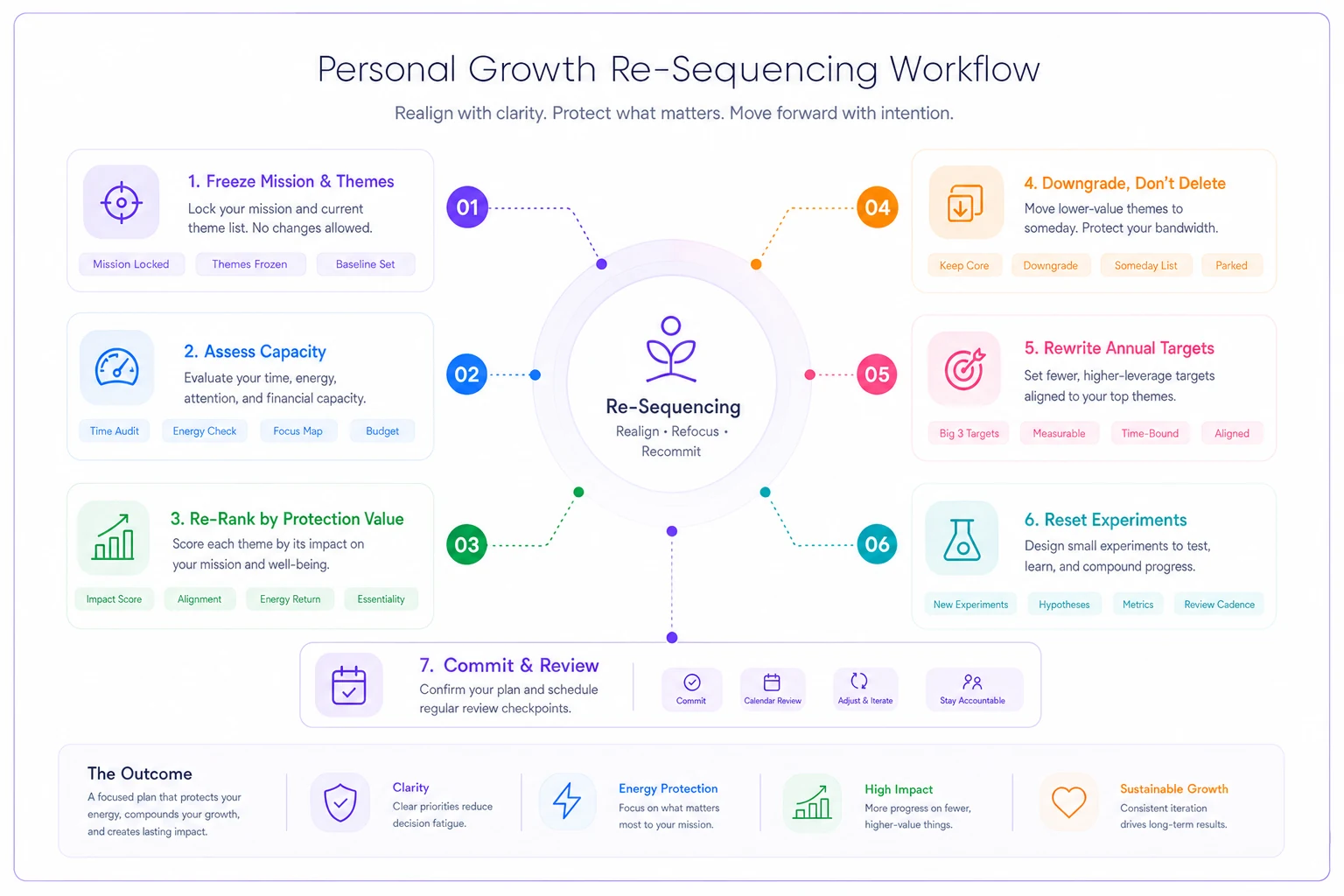
This is the difference between a system that bends and one that shatters. You changed the bottom two layers, parked one theme, and left your direction fully intact. When capacity returns, you reactivate — you don't start over from zero.
Underneath all of this sits the question of why each theme matters at all. When you're deciding what to protect and what to park, it helps enormously to have already done the work of connecting your values to concrete behaviors — values to behaviors mapping that creates measurable habits gives you the reasoning for which themes are actually load-bearing versus which just felt good to write down.
Rituals that preserve trajectory through transitions
Governance rules are the what. Rituals are the when — the recurring moments where you actually look at the system so it doesn't drift into invisibility. Without them, even a solid architecture rots because nobody's checking it.
-
Weekly experiment check (10 minutes) Is the current experiment running? What did it show? Kill or continue. This is the only ritual that touches the fast layer.
-
Quarterly theme review (60–90 minutes) Are the active themes still the right ones? Any drift signals firing? This is where re-sequencing usually happens — calmly, before a crisis forces it.
-
Annual mission read (half a day) Not editing — reading. You sit with the mission, notice whether it still feels true, and only touch it if something has genuinely and durably shifted.
The real value of rituals isn't the editing. It's the continuity of attention. A plan you look at every quarter never becomes a stranger. A plan you write once and file away becomes irrelevant within a year no matter how good it was. The looking is the point.
Where a tool actually helps — and where it doesn't
For the top two layers — mission and themes — you don't need software. You need a quiet document you revisit rarely. Tools can't do the reflection for you, and cluttering your mission with dashboards usually just adds noise.
Where a system genuinely helps is the coordination problem between layers. Keeping track of which experiments feed which annual targets, which themes are parked with what reactivation triggers, and which reviews are overdue — that's the kind of connective bookkeeping that's tedious to maintain by hand and quietly falls apart over time. This is where operational software with light AI automation earns its place: surfacing the review that's overdue, flagging an experiment that's been running with no logged result, reminding you that a parked theme's reactivation trigger just got met. Not making decisions for you — just making sure the layers stay connected and nothing goes silently stale.
The right framing: automate the tracking and reminding, never the deciding. The moment a tool starts telling you what your mission should be, you've handed it the one job that has to stay yours.
A real scenario: a mid-career professional through a rough year
Consider someone in their mid-thirties, demanding job, running a growth system with two active themes: "become genuinely fit" and "build a side consulting practice." Annual targets were reasonable — train four times a week, land three paying clients over the year.
Then in month five, a family health emergency ate most of their available time and energy for roughly four months. Under the old single-list model, this is exactly where the whole plan would've collapsed. Both goals stalled, guilt kicked in, and by the time things settled they'd have quietly written the year off.
Instead, they ran the re-sequencing worksheet. Capacity dropped to maybe 30–40%. Mission and both themes got frozen. The consulting theme got parked entirely — reactivation trigger: "when I have two consecutive stable weeks." The fitness theme dropped to maintenance: two short sessions a week instead of four, just enough to keep the identity alive. All running experiments got killed. One tiny new one started: a ten-minute morning movement anchor.
By around month ten, capacity recovered. The consulting theme reactivated. They finished the year having landed one client instead of three — behind the original target, sure — but both themes were still alive, the mission never wobbled, and they picked right back up. The plan bent through a genuinely hard stretch instead of breaking.
That's the payoff of the layered approach. Not that you hit every target. You won't. It's that a bad year costs you a bad year — not your whole direction.
When this makes sense, and when it doesn't
This makes sense when you're thinking in years, not weeks — when you have real long-range direction you care about and a life volatile enough that flat plans keep dying on you. Anyone navigating a career with predictable disruptions, or building slow compounding skills, benefits from separating direction from schedule.
This is probably overkill when you're just trying to establish a couple of basic habits. If your whole current focus is "floss daily and go for walks," you don't need a four-layer architecture. Build the habits first. The layered system is for people managing multiple long-range trajectories at once.
Who should skip this entirely: anyone in the middle of an acute crisis right now. If you're barely holding on, building a ten-year architecture is avoidance. Stabilize first. The system will still be here when you have the capacity to think in years again.
The core idea is simple even if the structure isn't: stop building growth plans as single lists tied to fixed timelines. Build them as layers that move at different speeds, with clear rules about what's allowed to change and when. Guard your direction fiercely, hold your schedule loosely, and let your small experiments fail as often as they need to. That's what turns a plan you abandon into a multi-year personal growth plan that's still standing after the life changes that would've killed a flatter one.
Ready to unlock your full potential?
Join thousands of users transforming their lives using Growyly to stay motivated, organized, and growth-focused every day.