



Most people who try to "live by their values" hit the same wall. They write down something like health or creativity or being a present parent, feel briefly inspired, and then nothing changes in their calendar. The value sits at the top of a journal page while the actual week runs on autopilot.
The gap isn't motivation. A value and a behavior live at completely different altitudes. A value is a direction. A behavior is a physical action that happens at a specific time. Between them there are two or three missing layers that almost nobody builds, and that missing middle is exactly where the whole thing falls apart.
This is about the plumbing. Not "why values matter" — you already know that — but the actual chain that connects what you care about to what you did on Tuesday at 6:40am, and how to measure whether that chain is holding.
Why the values-to-action chain snaps
Think of values-to-behaviors mapping as a pipeline with five stages: value → intention → micro-behaviors → fidelity metrics → monthly narrative check. Each stage translates the one above it into something more concrete. The failure almost always happens because people try to jump from stage one straight to stage five.
Someone decides they value learning. They set a goal to "read more." They buy books. Three weeks later they've read eleven pages and feel vaguely guilty. When you pull the thread, the breakdown is obvious — "read more" was never converted into a micro-behavior with a trigger, a size, and a location. There was no intention layer specifying why this, this season. And there was nothing to measure except finished-book count, which is a lagging signal that tells you nothing for weeks.
The other common break runs the opposite direction — behavior with no root. People stack habits they read about online (cold showers, 5am wakeups, gratitude lists) that aren't tied to anything they actually value. Those habits have no supply line. The first genuinely stressful week, they get abandoned, because the brain correctly senses there's no why underneath them.
A robust map fails gracefully. When all five layers are connected, a bad week only knocks out the bottom one — the specific behavior — while the value, intention, and metric stay intact and pull you back.
The five layers, and what each one is actually for
I'd rather define each layer by its job than its name, because the job is what people consistently get wrong.
Achieve more by focusing on what matters.
Growyly helps you build lasting habits and track your personal growth effortlessly.
- Goal setting with progress tracking
- Daily habit reminders
- Motivational insights and analytics
No credit card required
| Layer | What it is | Its job | Common mistake |
|---|---|---|---|
| Value | A direction you care about | Supplies the why and the energy | Too vague to guide any choice |
| Intention | A seasonal commitment | Narrows the value to now | Skipped entirely |
| Micro-behaviors | Tiny physical actions | The thing you actually do | Made too big to survive |
| Fidelity metrics | Small trackable signals | Tell you if the behavior is happening as designed | Measuring outcomes instead of fidelity |
| Monthly narrative | A written check-in | Reconnect behavior to identity | Never done, so drift goes unnoticed |
The intention layer is the one almost everyone skips, and it does the most work. A value like health could translate into a hundred behaviors. The intention layer forces you to pick a lane for the next season: "For the next three months, health means my body feels strong enough to hike on weekends." That narrowing rules out ninety of the hundred possible behaviors. That's a feature, not a limitation.
The fidelity metrics layer is the second most misunderstood. Fidelity means did I do the behavior the way I designed it — not did I get the result. If your behavior is "10 minutes of guitar after dinner," the fidelity metric is "did the 10 minutes happen," not "am I better at guitar." Outcomes lag by months. Fidelity you can see today. Outcome-chasing at this layer poisons the whole map.
Building the map, step by step
Do this for one value before you try to map your whole life. Mapping eight values at once is a reliable way to drown in complexity.
-
Write the value in one plain sentence. No jargon. "I want to be someone who makes things, not just consumes them." Not "creative self-actualization."
-
Set the seasonal intention. Add a time boundary and a concrete shape: "For the next 90 days, making things means finishing one small drawing per week." You're allowed to change this next season. That permission is what keeps it honest.
-
Break it into 2–3 micro-behaviors. Each must be small enough to do on your worst day. "Open sketchbook and draw for 8 minutes after morning coffee." If you can't imagine doing it while tired and slightly annoyed, it's too big.
-
Attach a fidelity metric to each behavior. Binary is best
did it happen, yes or no. Occasionally a count works, but never a quality judgment. Quality judgments at this stage kill more habits than skipped days do.
-
Set an identity-linked checkpoint sentence. Write the sentence you'll check monthly: "Am I becoming someone who makes things?" This links the metric back up to the value so tracking never becomes empty box-checking.
-
Schedule the monthly narrative check. Pick a real date. This is where you read your fidelity data and write two paragraphs about what it means.
That sequence takes about 30 minutes per value. The temptation is to rush through steps 2 and 5 because they feel soft. Those are the two doing the heavy lifting.
When choosing micro-behaviors, always test them on your worst day to ensure they're small enough to survive.
Here's a quick visual workflow of the five-stage mapping process.
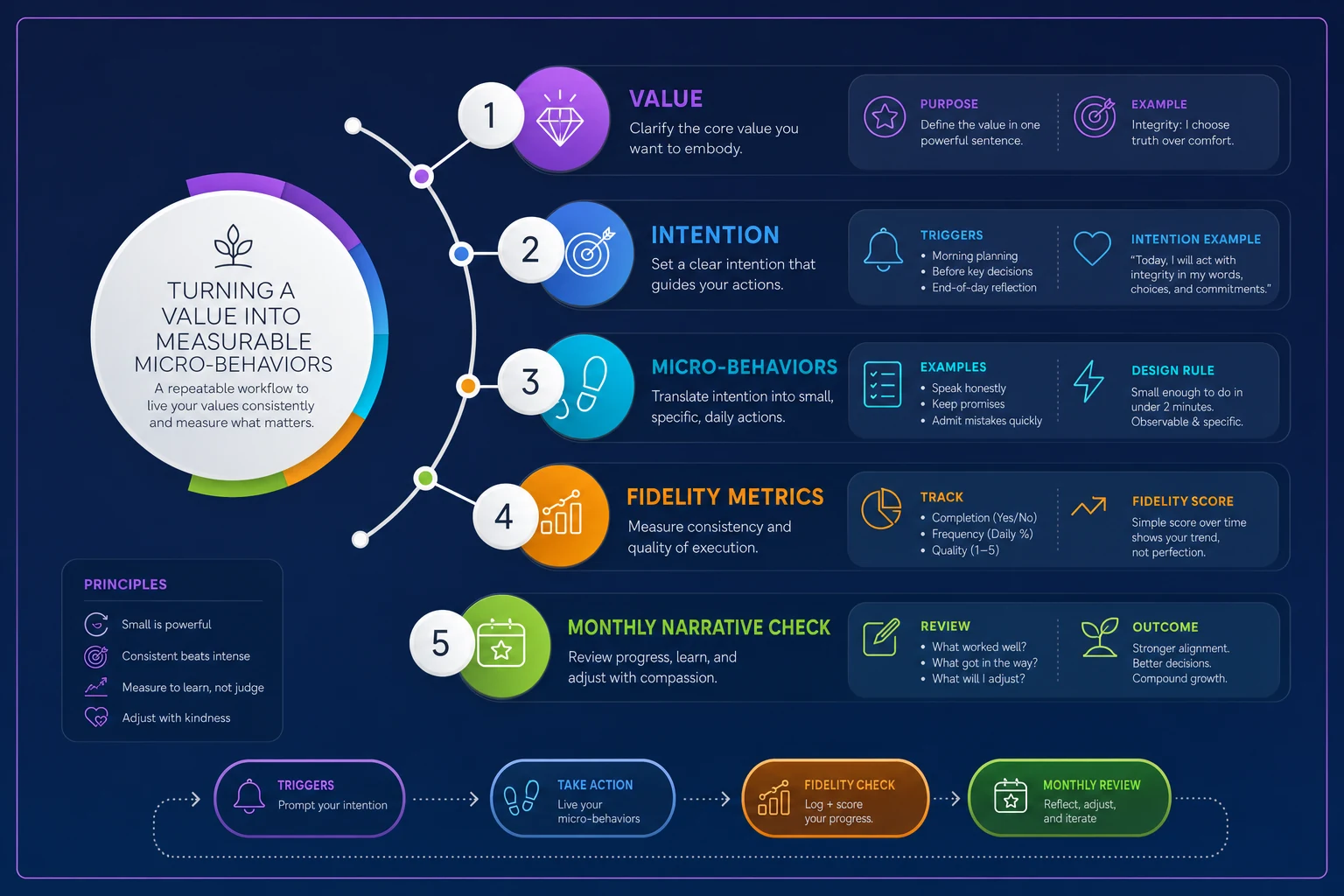
This visual ties the steps together so you can see where triggers, metrics, and the monthly narrative sit in the pipeline.
A worked sample mapping
Here's a full map for one value, filled in the way it should actually look:
-
Value "I want to be a calm, present parent instead of a distracted one."
-
Seasonal intention (Q1) "Present means my kids get 20 undistracted minutes with me between dinner and bedtime."
-
Micro-behaviors - Phone goes in the kitchen drawer when dinner plates are cleared (trigger: clearing plates) - One question at bedtime that isn't about logistics ("What was the best part of today?")
-
Fidelity metrics - Phone in drawer: yes/no, nightly - Non-logistics question asked: yes/no, nightly
-
Identity checkpoint "Am I the kind of parent my kids experience as there?"
-
Monthly narrative prompt "Which nights felt present, which felt phoned-in, and what pattern connects them?"
Notice what's not in there: no goal to be present "all the time," no vague "spend more quality time." The behaviors are physical and triggered. The metrics are binary. And the checkpoint sentence uses identity language, because that's what separates tracking a chore from tracking who you're becoming.
The monthly narrative check — where the map stays alive
Fidelity data on its own goes stale. You end up with a wall of yes/no boxes that stops meaning anything. The monthly narrative check is what keeps the whole system from decaying into empty tracking.
Once a month, sit down with the last four weeks of fidelity data and answer three questions in writing:
-
What does the data actually say — which behaviors held, which slipped?
-
Does the intention still fit, or has life changed enough that it needs a new shape?
-
Am I moving toward the identity in my checkpoint sentence, or just accumulating checkmarks?
That last question is the crucial one. You can hit 90% fidelity and still feel hollow, which signals that the behavior is right but the intention drifted from the value. A parent might nail "phone in drawer" every night and still feel distracted — meaning presence isn't really about the phone, and the intention needs rewriting. The narrative check is the only place you'd catch that. Raw metrics can't tell you they're measuring the wrong thing.
If you already run a regular reflection habit, this folds neatly into it — the 10-minute daily reflection practice works at a shorter cadence, and the monthly narrative check is essentially the longer-horizon version operating on the same data.
What breaks as you scale from one value to several
Mapping one value is manageable. The trouble starts when you have four or five values each spawning two or three behaviors, and suddenly you're tracking a dozen fidelity signals across your week.
A few predictable breakdowns:
Metric overload. Twelve binary signals to log daily is too many. People quietly stop logging around week two. The fix is brutal prioritization — most values can run on a single fidelity signal each, not three. If a value seems to need three behaviors tracked, it's probably really two separate values wearing one label.
Intention collision. Two values compete for the same time slot. "Present parent" and "finish the side project" both want the evening. Without noticing, you satisfy one by starving the other, and the starved one's fidelity quietly drops to zero. The monthly narrative is where you spot the collision, but it's better to sequence intentions so they don't fight — run some values in maintenance mode while one gets the growth focus.
Checkpoint drift. As values multiply, the identity sentences blur together and stop feeling distinct. When your checkpoint sentences all start sounding like generic self-improvement copy, that's a sign you're mapping goals you think you should have rather than values you actually hold.
At this scale the manual version — index cards, a notebook, a spreadsheet — starts to strain. Tracking one map by hand is fine. Keeping five maps coherent, remembering monthly check dates, and noticing when a fidelity signal has quietly flatlined for two weeks is exactly the kind of coordination work that a habit platform with automated reminders and trend views handles better than memory does. Not because the thinking gets outsourced — the mapping is still yours — but because the bookkeeping between layers is where drift hides, and surfacing that drift on a schedule is genuinely hard to do manually across several habits at once.
For anyone running values-to-behaviors mapping as part of a larger 12-month personal growth system, this is the layer that connects the two: your annual review sets the values, and monthly narrative checks are the throttle that keeps behaviors honest quarter to quarter.
A real scenario
A freelance designer in his mid-thirties valued "financial stability" but kept it purely abstract — it lived as background anxiety, never as a behavior. Over a couple of months he built one map: the intention became "stability means I always know my runway," the micro-behavior became "update the income tracker every Friday before logging off" (trigger: closing the laptop for the week), and the fidelity metric was a simple weekly yes/no.
Nothing dramatic happened at first. By the second monthly narrative check, he'd logged the Friday update maybe 7 of 8 weeks. The identity sentence — "Am I someone who knows where my money stands?" — started returning a yes, and the background anxiety noticeably eased. His income didn't change. What changed was that a vague value became a five-minute Friday behavior with a checkpoint attached, and the thing he actually wanted — to feel stable — showed up long before any change in the numbers.
That's the whole mechanism in miniature. The value never did any work until it was translated down through intention and behavior, verified with fidelity, then reconnected to identity in the monthly check.
When this system makes sense — and when it doesn't
When it's worth building: You have values you genuinely hold but can't seem to act on consistently. You're comfortable writing a couple of sentences a month. You're chasing something where the outcome lags — parenting, craft, health, relationships — so you need fidelity signals to know you're on track before results show up.
When it's overkill: If your problem is a single, concrete habit with an obvious behavior — "floss at night" — you don't need five layers. Just build the habit. The mapping system earns its complexity only when the why keeps evaporating.
Who should skip it: Anyone in a genuinely chaotic season — a move, a newborn, a health crisis — where even one reliable behavior counts as a win. Layered mapping assumes enough baseline stability to run a monthly check. In pure survival mode, the narrative layer becomes another thing to feel guilty about, and guilt is a terrible fidelity signal. Better to run one bare-bones habit and rebuild the full map when the ground stops moving.
One more thing worth saying: don't confuse fidelity with worth. High fidelity on a behavior tied to a value you don't actually hold just means you're efficiently doing the wrong thing. And if you're leaning on rewards to keep fidelity up, be careful about what you're actually reinforcing — there's a real difference between rewarding the behavior and accidentally rewarding the tracking, which is a trap worth understanding before you build a reward economy around any of this.
The takeaway
The reason values so rarely turn into behavior isn't a character flaw. It's a missing translation layer. A value is a direction; a behavior is a physical act; and without the intention, fidelity, and narrative layers in between, the two never connect — you're just trying to leap a gap that's structurally too wide.
Build the middle. Narrow each value to a seasonal intention, break it into behaviors small enough to survive a bad day, measure whether they happened rather than whether they worked, and once a month write a few honest sentences reconnecting the whole chain back to who you're trying to become. That's the entire system. Not complicated to build — just usually left half-built, which is why the values stay on the page and the weeks keep running on autopilot.
Ready to unlock your full potential?
Join thousands of users transforming their lives using Growyly to stay motivated, organized, and growth-focused every day.