


Most habit groups die the same boring death. They start with a burst of energy — a shared spreadsheet, a group chat, a couple of enthusiastic check-ins — and then somewhere around week five, the accountability that felt so solid just... loosens. One person goes quiet. Then two. Then the whole thing becomes a graveyard of "sorry, crazy week!" messages nobody responds to.
The problem almost never comes from bad people or weak willpower. It comes from missing governance. When a group has no explicit roles, no agreed cadence, and no plan for what happens when someone falls behind, it defaults to the weakest possible coordination mechanism: hoping people feel guilty enough to keep showing up.
Peer governance is basically the operating system underneath the group. The boring infrastructure — who does what, how often the group meets, what happens when things break — that lets the interesting stuff (actual behavior change) survive contact with real life. And the mechanics scale very differently at 2 people versus 6 versus 20. A structure that works beautifully for a pair will collapse under a dozen people, and something built for twelve will feel suffocating for two.
Here's how these systems actually work, where they break, and how to design one that holds.
Why leaderless groups drift
The default assumption in most peer habit groups is that everyone is equally responsible for keeping the group alive. Sounds fair. In practice, it means nobody is responsible — "everyone's job" is the fastest route to "nobody's job."
You see the same pattern over and over. A group of five friends starts a reading-and-writing accountability pod. The first two weeks are great. Then one person misses a check-in. Nobody wants to be the nag, so nobody says anything. The silence gets read as permission. Within a week, a second person quietly tests whether missing is fine too. It is. The norm has shifted — not through any decision, but through the absence of one. By week six the group is functionally dead even though nobody ever quit.
This is a coordination failure, not a motivation failure. The individuals may still care about their habits. What's missing is any mechanism that converts individual intent into group-level consistency. The same person who lets a friend group dissolve will often show up religiously to a paid class, because the class has structure the friend group never built.
The lesson isn't "add more pressure." It's "add clearer structure." Governance isn't about being harsh — it's about removing the ambiguity that lets drift happen invisibly.
The three primitives every group needs
Everything in peer governance reduces to three building blocks: roles, cadences, and escalation paths. Get these right and most other problems solve themselves. Get them wrong and no amount of enthusiasm compensates.
Achieve more by focusing on what matters.
Growyly helps you build lasting habits and track your personal growth effortlessly.
- Goal setting with progress tracking
- Daily habit reminders
- Motivational insights and analytics
No credit card required
Roles answer the question "who is responsible for the group functioning?" This is separate from who is doing their habit. Someone has to run the meeting, someone has to notice when a person goes quiet, someone has to hold the shared record. In a group of two you can share these informally. Past four or five people, the roles need actual names.
Cadences answer "how often does the group interact, and in what format?" There's a real difference between a daily lightweight check-in and a weekly deeper review. Most groups pick one and neglect the other. Strong groups run at least two: a fast, low-effort pulse and a slower, higher-context sync.
Escalation paths answer "what happens when someone falls behind?" This is the primitive almost every group skips, and it's the one that determines whether the group survives its first real stress test. Without an agreed path, a lapse becomes a personal awkwardness that people avoid — and avoidance kills groups.
Here's roughly how the three primitives shift as the group grows:
| Group size | Roles | Cadence | Escalation |
|---|---|---|---|
| 2 people | Fully shared, no titles | Daily text + weekly call | Direct: "Hey, you good?" |
| 3–6 people | One rotating facilitator | Daily async + weekly sync | Facilitator checks in privately after 2 misses |
| 7–12 people | Facilitator + record-keeper | Async pulse + biweekly sync in subgroups | Defined 3-strike repair sequence |
| 13–20 people | Facilitator + record-keeper + 2–3 pod leads | Pod-level dailies + monthly full sync | Pod lead handles first, escalates to facilitator |
The escalation path gets more explicit as the group grows, not less. Small groups can rely on relationship; large groups have to rely on process, because relationship doesn't scale to twenty people who barely know each other.
What actually breaks at each size
At two people, the failure mode is co-dependence. If one person has a bad week, the whole system wobbles — there's no redundancy. Pairs feel intense and effective right up until one partner's life gets chaotic, then the whole thing pauses and often never restarts. The fix is agreeing in advance that one person's lapse doesn't excuse the other. The habit is yours; the partner is support, not a load-bearing wall.
At three to six, the failure mode is the free rider. There's almost always one person who benefits from the group's energy without contributing much back. It's not malicious — they're busy, or shy, or coasting. But other members notice, and reciprocity quietly erodes. If one person is putting in effort and another is silently taking, the motivated person's investment starts to drop. This is where an incentive-alignment check matters: everyone should be getting roughly proportional value to what they put in.
At seven to twelve, the failure mode is diffusion. The group gets big enough that individual check-ins get lost. Someone posts an update, three people react, everyone else scrolls past. The intimacy that made small groups work is gone, but the structure to replace it isn't there yet. This is the awkward middle where most ambitious groups die. The fix is subgroups — splitting into pods of 3–4 so intimacy comes back at the small scale while the larger group provides variety and energy.
At thirteen to twenty, the failure mode is administrative collapse. Nobody wants to run it. The facilitator burns out because they're doing all the coordination alone. What worked at six — one person keeping everything organized — becomes an unpaid part-time job at twenty. Distributed roles stop being optional. You need pod leads and a record-keeper, or the facilitator quietly resents everyone and disappears.
A useful principle from operations applies here directly: as any system scales, informal coordination has to be replaced by explicit process, or the system caps out at the limit of one person's attention. The same thing that happens to a growing business happens to a growing habit group. The founder-facilitator can hold it together up to a point, then it has to become a real structure or it breaks.
Norm-setting: agree on the boring stuff first
The single highest-leverage thing a group can do is spend its first session setting norms explicitly, before any habits start. Most groups skip this because it feels premature. It isn't. The norms you don't set will be set for you by whoever behaves worst first.
A norm-setting template doesn't need to be long. It needs to cover the questions that will otherwise cause silent conflict later:
-
What counts as a "check-in"? A thumbs-up emoji? A sentence? A photo? Define it so people aren't secretly judging each other's effort levels.
-
What's the response time expectation? Do people need to reply to others, or just post their own update? Ambiguity here creates guilt and resentment in equal measure.
-
What happens when someone misses? Agree on the repair path now, while it's abstract and nobody's feelings are involved.
-
Is this group for streaks or for consistency-over-time? These are different games. Streak-focused groups punish any lapse; consistency-focused groups care about the trend line. Pick one.
-
How do we exit gracefully? Groups need a way for people to leave without ghosting. "If you need to step out, just say so — no explanation required" removes the awkwardness that otherwise turns into silent departure.
Write the norms down in a single shared place (a pinned doc or channel) so everyone can reference them without awkward conversation.
Writing these down converts a vibe into an agreement. And an agreement is something you can point back to without it feeling personal. "We agreed a missed day means a quick note in the chat" lands very differently than "you never tell us when you skip."
This connects closely to how households build durable shared routines. The mechanics of getting several people to coordinate around behavior are surprisingly similar whether it's roommates or a running group — a lot of the thinking in shared habit systems for households that actually work transfers directly to peer groups, especially the parts about making expectations explicit instead of assumed.
Reciprocity and incentive alignment
The quiet engine of any lasting group is reciprocity — the sense that giving support and receiving it are roughly balanced over time. When that balance breaks, the group dies, even if everyone technically still shows up.
You can map this pretty simply. For each member, ask: what do they give the group, and what do they get from it? Someone might give consistency and encouragement while getting structure and social pressure in return. Healthy trade. But when someone gives nothing and takes the group's energy, or gives constantly and gets ignored, the exchange is broken and it will surface eventually as resentment or withdrawal.
-
The over-giver burns out. The person who cheers everyone on, remembers everyone's goals, and never gets the same back will eventually stop — and their absence often triggers the group's collapse, because they were doing invisible glue work. Distribute the encouragement; don't let it fall entirely on one warm person.
-
The lurker drags morale. Someone who reads everything but posts nothing isn't neutral. Their silence reads as low investment and subtly gives everyone else permission to invest less too. A gentle norm — "everyone posts, even a one-liner" — fixes this.
-
Mismatched stakes create tension. If one person is chasing a life-changing habit and another is casually experimenting, their intensity levels clash. Neither is wrong, but the group needs to acknowledge the range so the serious person doesn't feel unsupported and the casual person doesn't feel judged.
Groups run on a kind of emotional economy, and like any economy, it collapses when the exchange stops feeling fair. You don't need to make it transactional — you just need to notice when the balance tips and correct it before it becomes structural.
Plug-and-play cadences
Cadence is where most groups either over-engineer or under-engineer. Too little and the group fades; too much and people feel monitored and quit. The sweet spot is usually two layers: a fast pulse and a slow sync.
-
Daily async pulse (30 seconds). Everyone posts a single line
did the habit or didn't, plus optional context. No pressure to respond to others. This keeps the group present in everyone's day without demanding much.
-
Weekly sync (20–30 minutes). A short call or structured thread where each person shares one win, one struggle, and one intention for the coming week. The facilitator keeps it moving so nobody dominates.
-
Monthly review (45 minutes). Zoom out. What's working in the group's structure? Who's drifting? Should the norms change? This is the maintenance layer most groups never build, which is exactly why most groups don't last.
The monthly review is the underrated one. It's where you catch structural problems before they become terminal — a role that's overloaded, a cadence that's too heavy, a member who's been quietly checked out. Treating the group itself as something that needs periodic tuning, not just the habits within it, is what separates groups that last a year from groups that last a month. This kind of recurring review rhythm mirrors the logic behind a repeatable 12-month personal growth system — the same review-and-adjust discipline that keeps individual growth on track keeps group governance from silently rotting.
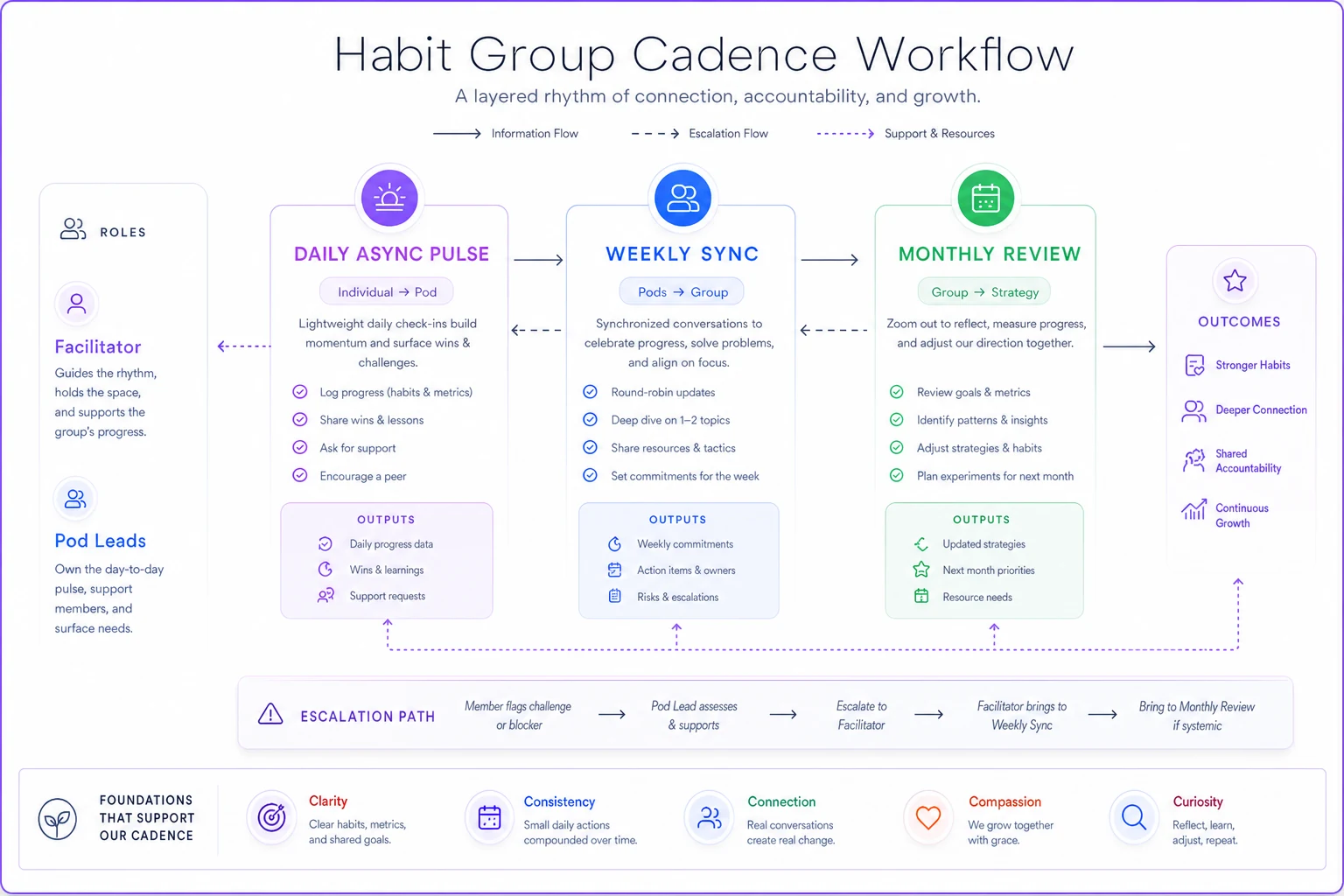
The visual shows how fast pulses surface immediate updates while slower syncs and reviews catch structural issues and route escalations to the right role.
Repair scripts: what to say when someone falls behind
The moment a member lapses is the moment the group's design gets tested. Handle it well and the group gets stronger. Handle it badly — usually through awkward silence — and you've started the drift.
Lapses are normal and should be treated as routine maintenance, not failures requiring drama. That means having actual scripts ready, so awkwardness doesn't stop anyone from reaching out.
-
First miss — no action. Everyone misses occasionally. Reacting to a single miss makes people feel surveilled. Let it go.
-
Second miss — gentle private check. The facilitator or pod lead sends a low-pressure note: "Hey, noticed you've been off the last couple days — everything okay? No pressure to explain, just checking in." The framing matters: concern, not accountability enforcement.
-
Third miss — reset offer. Now the conversation is about restarting, not catching up: "Want to reset your goal for this week? Sometimes the target needs to shrink for a bit. Totally fine to scale down." This gives the person a graceful on-ramp instead of a shame spiral.
Notice what these scripts avoid: guilt, interrogation, and any implication that the person has let the group down. The goal is to make returning easy. Someone who lapses and feels judged disappears. Someone who lapses and feels welcomed back tends to stay.
There's a deeper systems point here. Relying on willpower and guilt to hold a group together is fragile — both are finite and unreliable under stress. Building the group so that returning after a lapse is frictionless is the same principle as designing individual habits that don't depend on constant motivation — something worth reading more on in this systems approach to motivation. The group version is just applying that logic socially: make the default behavior easy, and stop depending on people feeling bad enough to comply.
A real scenario
A group of nine people — mostly former coworkers — started a fitness-and-writing accountability group. Classic setup: one big group chat, daily updates, everyone welcome to cheer everyone on.
The first month averaged around 80% daily check-in participation. By week six it had dropped to roughly 40%, and two people had gone fully silent. The single chat had become noise — nine people posting meant nobody felt individually seen, and the enthusiasm that carried the early weeks had nowhere structured to go.
They restructured instead of quitting. Three pods of three, each with a rotating pod lead. Daily pulse moved to the pods, so updates went to two people who'd actually notice, not eight who'd scroll past. The full group kept a weekly sync for variety and a monthly review to tune the structure. They wrote down norms — what counts as a check-in, the two-miss check-in rule, the graceful exit clause.
Over the next couple of months, daily participation stabilized somewhere in the 70s and stayed there. Two people eventually left, but they left cleanly, using the exit norm, instead of ghosting and dragging down morale. The group was still running roughly six months later — which, for a peer habit group, is genuinely rare.
The difference wasn't better people. It was the shift from one undifferentiated group hoping for the best to a structure with roles, layered cadences, and a repair path.
When peer governance makes sense — and when it doesn't
When it's a good fit: You want external structure but not a paid coach. The habit benefits from social visibility — fitness, writing, learning, creative practice. You have at least a couple of people genuinely committed, not just curious. And you're willing to spend the boring first session setting norms instead of jumping straight to action.
When it's a bad idea: The habit is deeply private or something you'd feel judged sharing. You're using the group to outsource motivation you don't actually have — no group structure fixes a habit you don't want. Or you're in a season of genuine overload, where adding social obligations creates more stress than support. In that case, solo systems with light tracking serve you better than another set of people to feel guilty about.
Who should not run one: If you're the type who takes on all the coordination and burns out, don't start a group unless you're genuinely willing to distribute roles. A group built entirely on one person's energy is a countdown, not a system. Either commit to real delegation or join someone else's group instead of founding your own.
The bigger picture
The reason most peer habit groups fail isn't that habits are hard or that people are flaky. It's that the group has no operating system — no explicit roles, no layered cadence, no plan for the inevitable lapse. It's running on enthusiasm, and enthusiasm is a terrible load-bearing material.
The groups that last treat their own structure as something to design and maintain, not assume. They set norms before problems arise. They match roles and cadences to their actual size. They make returning after a lapse easy instead of shameful. And they periodically step back to check whether the structure still fits — because a group of five and a group of fifteen are genuinely different machines that need different governance.
You don't need all of this on day one. Start with the three primitives — roles, cadence, escalation — sized to your group, plus a short written set of norms. Add the monthly review once you're past a handful of people. Build the pods when the single group starts feeling noisy. The whole point is a structure that grows with you, so the group survives the exact moment — usually around week six — when enthusiasm runs out and only design remains.
Ready to unlock your full potential?
Join thousands of users transforming their lives using Growyly to stay motivated, organized, and growth-focused every day.