
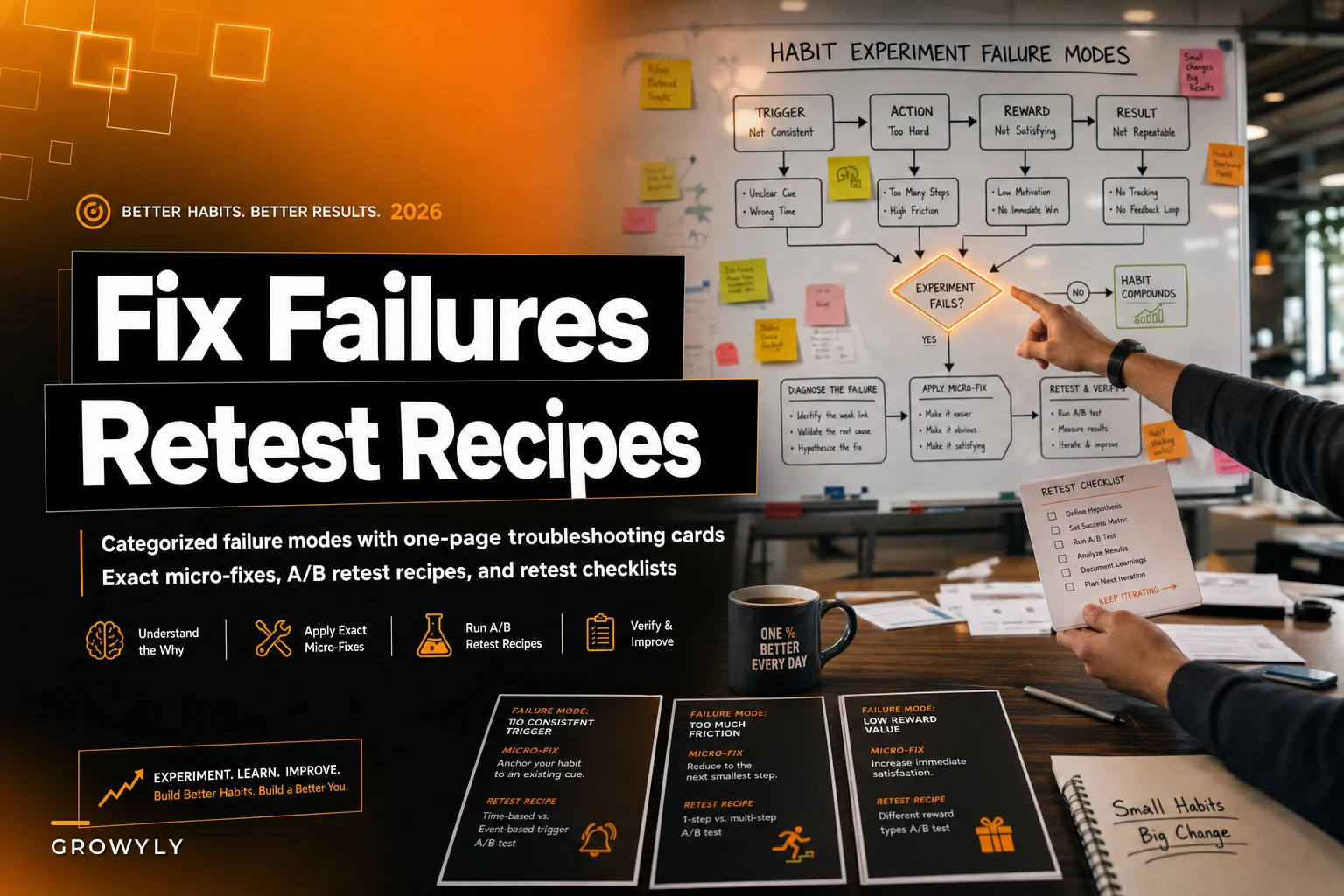

Most habit experiments don't fail dramatically. They fail in specific, repeatable ways—the same handful of breakdowns, slightly different packaging each time. Once you can name the failure mode, the fix is usually small and fast. Diagnosis is the hard part, not the repair.
What follows is a categorized set of failure modes, each written as a one-page troubleshooting card: how to spot it, the exact micro-fix, and a retest recipe so you can actually confirm the fix worked instead of just hoping. Treat this like a repair manual. When an experiment stalls, find the card that matches your symptoms.
If you haven't run a structured experiment before, the format here assumes you're already doing something like a short, low-risk two-week habit lab—a hypothesis, a defined behavior, and some way of tracking whether it happened.
How to use these cards
Every card has the same four fields:
-
Symptom — what you actually observe, not the underlying cause
-
Root cause — the mechanism producing the symptom
-
Micro-fix — the smallest change that addresses the root cause
-
Retest recipe — how to run the next cycle so you can tell if the fix actually worked
The retest matters more than people give it credit for. A common mistake is changing three things after a failed experiment, seeing improvement, and having no idea which change did the work. Every retest recipe below changes exactly one variable and specifies what result counts as "fixed."
Quick index before we get into the detail:
| Failure Mode | Core Symptom | Fix Difficulty |
|---|---|---|
| Ceiling-Too-High | You skip on tired/busy days | Easy |
| Phantom Trigger | You "forget" constantly | Easy |
| Ambiguous Success | You're unsure if you did it | Easy |
| Reward Mistiming | Motivation fades week 2 | Medium |
| Measurement Drag | Tracking feels like the chore | Medium |
| Context Collapse | Works at home, dies elsewhere | Medium |
| False Positive | Data says yes, life says no | Hard |
| Silent Substitution | Habit morphs into something easier | Hard |
When the table is in front of you, use it as a quick pointer to the card that matches your symptom and then read the full card for the micro-fix and retest recipe.
Card 1: The Ceiling-Too-High Failure
Symptom: You hit the habit on good days and skip entirely on tired, stressed, or overbooked days. Your completion rate looks bimodal—great weeks and dead weeks, nothing in between.
Achieve more by focusing on what matters.
Growyly helps you build lasting habits and track your personal growth effortlessly.
- Goal setting with progress tracking
- Daily habit reminders
- Motivational insights and analytics
No credit card required
Root cause: The habit's minimum version is still too big. When capacity drops, the whole thing gets cut because there's no smaller acceptable version. People design habits for their median day and then get surprised when bad days break the streak.
Micro-fix: Define an explicit floor version that takes under two minutes and requires zero setup. Not "20 minutes of reading" but "open the book and read one paragraph." The floor isn't the goal—it's the thing that keeps the habit alive on the worst day of the week.
Retest recipe: Run seven days. Change only one variable: add the floor version, keep everything else identical. Success criterion: on your two lowest-capacity days that week, did you do at least the floor? If yes on both, the mode is fixed. If you still skipped a low day, your floor is still too high—cut it in half and rerun.
One subtle trap worth flagging: some people set a floor and then feel guilty doing only the floor, which quietly kills it. The floor is a full win. Log it as a win. If your tracking system penalizes floor days, your tracking is fighting your design.
Card 2: The Phantom Trigger
Symptom: You genuinely intend to do the habit but keep "forgetting" until the moment has passed. You remember at 9pm that you meant to do it at 8am.
Root cause: The trigger isn't anchored to something that reliably happens. Vague triggers like "in the morning" or "after work" aren't events—they're time windows, and time windows don't fire reminders in your body. The habit is floating without a physical anchor.
Micro-fix: Attach the habit to a specific, already-automatic action with a clear completion point. Not "after work" but "after I set my bag down by the door." The anchor needs an obvious edge—a moment where it's clearly done, which becomes the cue to start.
Retest recipe: Seven days, one variable: replace the vague trigger with a concrete physical anchor. Success criterion: at least five of seven days, the anchor reminded you before the window closed. Track whether the cue fired, separately from whether you completed. This distinction matters—if the cue fires but you still skip, that's a different failure mode (see Card 4).
The pattern worth noticing: people blame willpower for what is actually a missing cue. If you never even remembered, willpower was never in the room.
Card 3: The Ambiguous Success Problem
Symptom: At the end of the day you're not sure whether you "did it." You find yourself negotiating with your own definition. "Does a quick stretch count as the mobility routine?"
Root cause: The success condition is fuzzy. When the finish line is undefined, your brain rounds up on tired days and rounds down on strict days, and your data becomes noise. You can't improve what you can't consistently score.
Micro-fix: Write a binary pass/fail definition in one sentence with a physical proof. "Did it = I completed all three stretches and my mat is back on the hook." The proof should be observable, not a feeling. A finished artifact beats a subjective sense of effort every time.
Retest recipe: Seven days, one variable: add the one-sentence definition. Success criterion: you can answer yes/no in under three seconds every day without internal debate. If you're still negotiating, your definition has a soft edge—find the word doing the fuzzing (usually "some," "a bit," "try to") and replace it with a countable thing.
Card 4: Reward Mistiming
Symptom: The habit runs fine for about a week to ten days, then motivation quietly drains. You're doing it, but it feels heavier each day until it stops.
Root cause: The reward is too far from the behavior, or there's no felt reward at all. Behaviors that only pay off in three months don't sustain themselves in week two. The nervous system needs something now, not a projected outcome later.
Micro-fix: Add an immediate, tiny marker of completion that you actually feel—not a big treat, a small closure signal. This is less about bribing yourself and more about building a functioning reward loop. If you want the full mechanics on this, building a tiny reward economy that actually sustains motivation covers how to size rewards so they reinforce without becoming the entire point.
Retest recipe: Fourteen days this time, because this failure shows up specifically in week two. One variable: add the immediate marker. Success criterion: your completion rate in days 8–14 is within a few points of days 1–7. If week two still collapses, the reward is either too abstract or too delayed—move it closer to the moment of completion.
A common mistake here: people respond to fading motivation by making the habit bigger or "more meaningful," which adds friction and accelerates the collapse. Motivation fade is usually a reward-loop problem, not a meaning problem.
Card 5: Measurement Drag
Symptom: The habit itself is fine, but logging it feels like the actual chore. You start skipping the log, then skipping the habit because you stopped seeing it.
Root cause: Your tracking system costs more than the behavior it measures. When logging a two-minute habit takes forty-five seconds of app-tapping, categorizing, and note-writing, the measurement overhead becomes the reason you quit.
Micro-fix: Cut tracking to a single tap or a single mark. One binary signal per habit, nothing else. No mood scores, no notes, no tags during the experiment. You can add richness later if a specific question demands it, but during a retest you want the lightest possible signal.
Retest recipe: Seven days, one variable: strip tracking down to one binary mark. Success criterion: you logged at least six of seven days and logging never felt like the barrier. If you still skipped logs, your capture step is still too slow—move it physically closer to where the habit happens.
Quick checklist for lean tracking during a retest:
-
- [ ] One signal per habit, binary (did / didn't)
-
- [ ] Capture takes under five seconds
-
- [ ] The log lives where the habit happens
-
- [ ] No optional fields visible during entry
-
- [ ] You can review the whole week in one glance
Put the capture where the habit happens so logging becomes a single physical motion.
The insight most people miss: rich data is worthless if the collection cost kills the habit you were measuring. Collect the smallest signal that answers your actual question, and nothing more.
Card 6: Context Collapse
Symptom: The habit is rock-solid at home but vanishes the moment you're traveling, at the office, or off your normal schedule.
Root cause: The habit is welded to a specific environment—a particular room, object, or time slot. When the environment changes, the entire scaffold disappears because it was never portable. The habit lived in the setting, not in you.
Micro-fix: Rebuild the trigger around something you carry everywhere, not a fixed location. A physical object in your pocket, a recurring event that happens regardless of location (first coffee, first email open), or a body-based cue. The anchor has to travel with you.
Retest recipe: Run the experiment specifically across a context switch—pick a week that includes at least two days outside your normal environment. One variable: the portable anchor. Success criterion: the habit survived the out-of-context days at least at floor level. If it died on travel days, the anchor is still location-dependent—find the version that needs zero specific setting.
Worth flagging: people declare a habit "established" based only on stable-environment data, then panic when a trip breaks it. A habit that hasn't survived a context change hasn't actually been stress-tested yet.
Card 7: The False Positive
Symptom: Your tracking says the experiment is succeeding, but the outcome you actually wanted isn't showing up. High completion, no result.
Root cause: You're measuring the wrong signal, or you're measuring compliance instead of effect. Doing the behavior daily doesn't automatically produce the outcome if the behavior itself is the wrong lever. This is the most dangerous mode because the data actively reassures you while nothing improves.
Micro-fix: Add one lightweight outcome check alongside the behavior signal. If the habit is "10 minutes of focused study," pair it with a weekly outcome proxy—a short self-quiz score, or a count of problems you can now solve. Behavior signals tell you if you showed up; outcome signals tell you if showing up mattered.
Retest recipe: This one needs a longer window—three to four weeks. Keep the behavior identical. Add exactly one outcome measurement, checked weekly. Success criterion: the outcome proxy moves in the direction you expected over the window. If completion stays high but the outcome is flat, the habit itself is the problem, not the execution—and no amount of consistency will fix a wrong lever.
The diagnostic workflow when you suspect a false positive:
-
Confirm the behavior signal is genuinely high (not itself a measurement artifact)
-
Define the single outcome you actually care about
-
Pick the cheapest possible proxy for that outcome
-
Measure the proxy weekly for three weeks
-
Compare behavior consistency against outcome movement
-
If behavior is high and outcome is flat, change the behavior—not the tracking
This is the failure mode people avoid looking at, because the streak feels so good. A satisfying streak that produces nothing is worse than a broken one, because it consumes weeks before you notice.
Card 8: Silent Substitution
Symptom: Over a few weeks, the habit slowly morphs into an easier version without you deciding to change it. "Journaling" becomes "thinking about journaling." "Workout" becomes "putting on gym clothes."
Root cause: Under repeated friction, the brain quietly renegotiates the definition downward while keeping the same label. You still check the box, but the box now means something different than it did on day one. The drift is gradual enough that no single day feels like cheating.
Micro-fix: Lock the definition to a fixed proof artifact that can't drift—a finished page, a completed set count, a saved file. If the proof is concrete, the habit can't quietly shrink underneath the label. When the artifact is missing, it didn't happen, regardless of how it felt.
Retest recipe: Two weeks, one variable: attach the fixed proof artifact. Success criterion: every logged "yes" has a corresponding artifact you can point to. If you find "yes" days with no artifact, the substitution is still happening—tighten the artifact until it's unfakeable.
When a failed experiment isn't a failure mode at all
Not every stall belongs on a troubleshooting card. Sometimes the experiment is telling you the truth: this habit doesn't fit your life right now, and the honest move is to stop, not to fix.
When to keep troubleshooting:
-
- The behavior clearly matters to you and the breakdown is mechanical (cue, floor, reward)
-
- You've only tried one or two configurations
-
- The outcome signal is trending the right way even if consistency is rough
When to stop and let it go:
-
- You've run three clean retests changing one variable each and none held
-
- The outcome proxy stays flat across every version
-
- The habit only survives when your life is unusually calm, and your life is rarely calm
Distinguishing these is a judgment call, but the three-retest rule keeps you honest. If a habit can't survive three focused single-variable fixes, the problem probably isn't the configuration.
A short real scenario
Someone running a personal writing experiment—target was 300 words each morning—kept collapsing around day nine, every single attempt. Three cycles in a row, same shape: strong first week, dead second week.
Running the cards in order, the first two didn't match. The floor was fine (they had a "one sentence counts" version). The trigger fired reliably. But Card 4, Reward Mistiming, fit exactly—there was no felt closure at completion, just the vague hope of a finished draft someday. The outcome was so distant it did nothing for day-nine motivation.
The micro-fix was almost embarrassingly small: a physical checkmark on a paper card taped by the desk, made immediately after writing. One variable, fourteen-day retest. Week-two completion went from roughly 2 of 7 days in prior attempts to 6 of 7. The habit had never been broken—the reward loop had.
That's the whole point of treating failures as categorized modes. The person had spent weeks assuming they lacked discipline, when the actual defect was a five-second missing closure signal.
The retest discipline that makes all of this work
The cards are only half the system. The other half is refusing to change more than one variable per retest. When something fails, the temptation is to overhaul everything. But an overhaul that works teaches you nothing, because you can't isolate what fixed it—which means you can't repair the next failure any faster.
Run it like a controlled test every time:
-
One variable per cycle. Change the floor, or the trigger, or the reward—never two at once.
-
A defined success criterion before you start. Decide what "fixed" looks like in advance, so you're not grading on a curve afterward.
-
A fixed window. Seven days for cue/floor/definition issues, fourteen for reward and drift issues, three-to-four weeks for outcome false positives.
-
A written record of which card you were treating. Over time you'll notice your personal recurring modes, and you'll catch them before they fully form.
Most habit apps track completion, which is fine, but for diagnostic work you want to record two things separately: whether the cue fired and whether the behavior completed. That single distinction—separating "I forgot" from "I remembered but skipped"—routes you to the correct card faster than anything else, because it splits trigger failures from motivation failures instantly.
Visual workflow of the retest discipline:
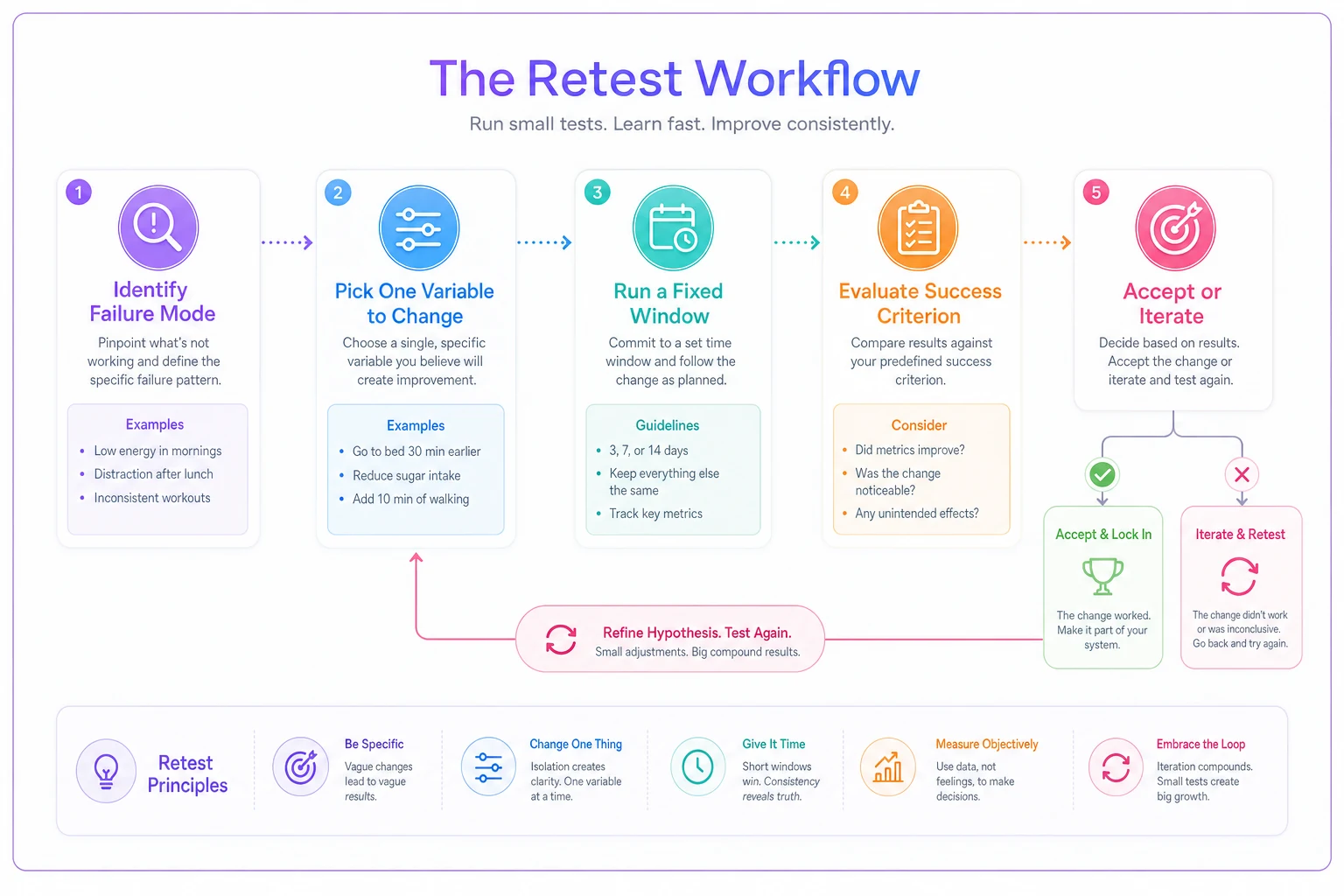
This sketch shows the simple loop you should run whenever a card matches your symptom.
Closing thought
Habit experiments don't collapse for mysterious reasons. They collapse in a small number of predictable ways, and each one has a specific, small repair. The value isn't in any single fix—it's in learning to diagnose the mode quickly and retest cleanly, so a stalled habit becomes a fifteen-minute troubleshooting job instead of an identity crisis about your discipline.
When a fix doesn't hold after a few honest retests, that's not failure either. If you need to walk one back to zero and start again, do it without the guilt spiral—a shame-free recovery approach to restarting after a lapse is part of the same skill. The people who build durable habits aren't the ones who never break them. They're the ones who can name exactly what broke and fix that one thing.
Habit experiments don't collapse for mysterious reasons. They collapse in a small number of predictable ways, and each one has a specific, small repair. The value isn't in any single fix—it's in learning to diagnose the mode quickly and retest cleanly, so a stalled habit becomes a fifteen-minute troubleshooting job instead of an identity crisis about your discipline.
When a fix doesn't hold after a few honest retests, that's not failure either. If you need to walk one back to zero and start again, do it without the guilt spiral—a shame-free recovery approach to restarting after a lapse is part of the same skill. The people who build durable habits aren't the ones who never break them. They're the ones who can name exactly what broke and fix that one thing.
Ready to unlock your full potential?
Join thousands of users transforming their lives using Growyly to stay motivated, organized, and growth-focused every day.