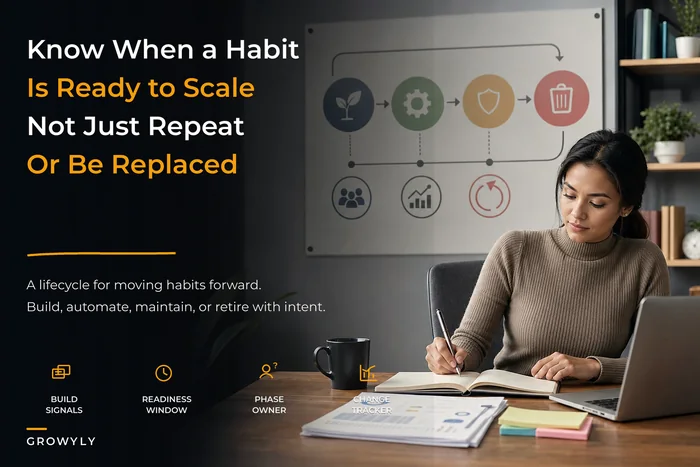


Most people run their habits the way a hoarder runs a garage. New stuff comes in, nothing goes out, and eventually you can't find the thing you actually need. You start a morning walk. Add journaling. Then cold showers, a language app, meal prep, breathwork. Six months later you're "doing" eleven habits, half of them badly, and you feel busier without feeling better.
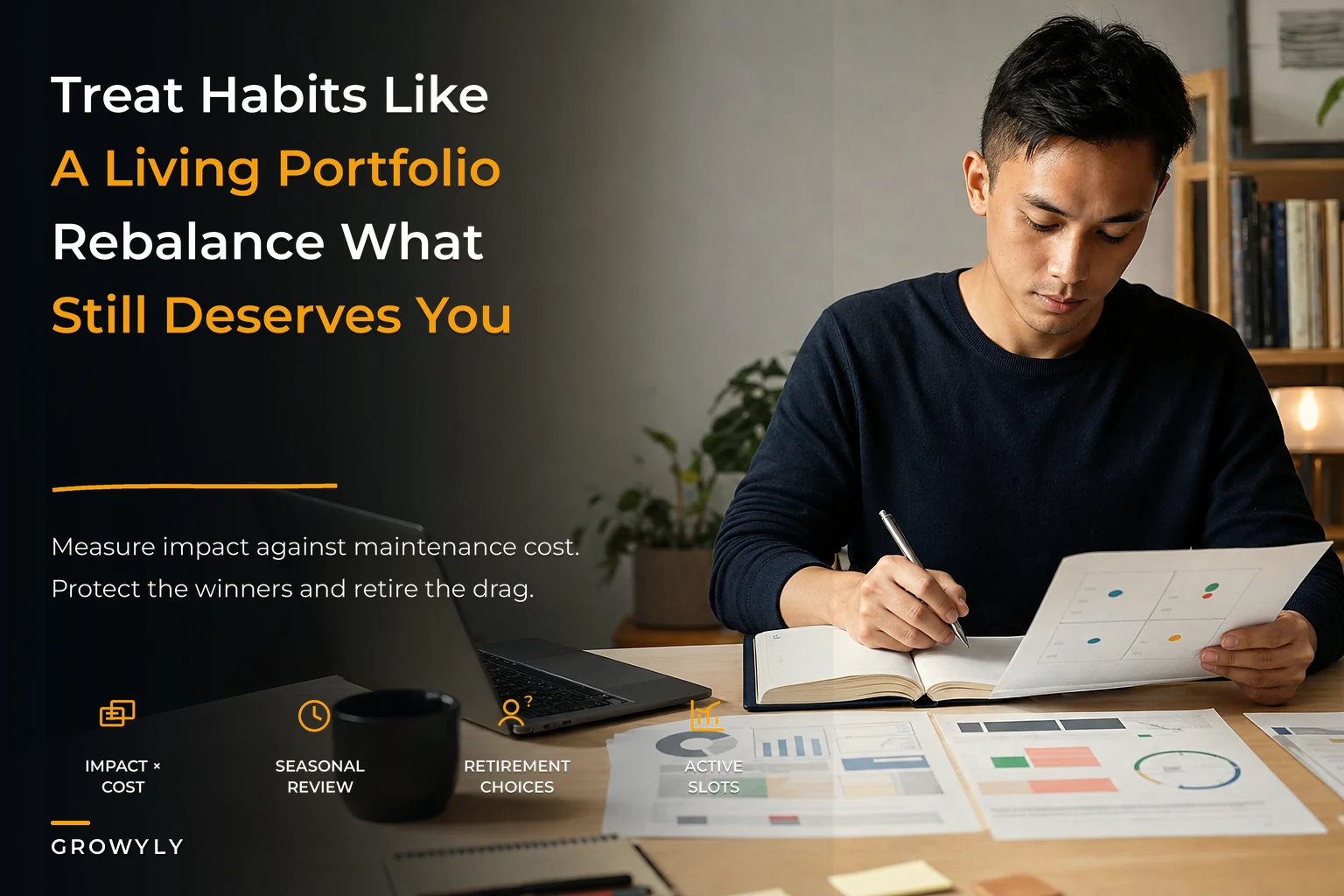
The fix isn't more discipline. It's portfolio thinking. If you've ever looked at an investment account, you already know the core idea: some positions carry the returns, some are dead weight, and occasionally you have to sell things off to keep the whole thing healthy. Habit portfolio management applies that same logic to your routines—so you're putting your limited attention toward habits that actually move your life, and retiring the ones quietly draining it.
This isn't about tracking everything. It's about running your habits like a small operation with a budget, a scorecard, and a regular review cycle.
Why habit collections quietly rot
The reason habit stacks fall apart usually isn't the individual habits. It's that nobody's managing the set.
Every habit you keep has two ongoing costs, and people only ever measure one. They track the effort to do it. They ignore the effort to maintain the system around it—the tracking, the reminders, the mental "did I do this today?" tax, the guilt when you miss. A habit that takes two minutes to perform can cost twenty minutes of low-grade cognitive overhead across a week.
Stack ten of those and your attention budget is gone before you've done anything meaningful. It's the operational equivalent of a business hiring more people to manage the tools they bought to manage the people. The overhead eats the output.
The second failure is that habits don't get retired. They get abandoned—silently, with shame attached. There's a real difference between "I evaluated this habit and decided it's done its job" and "I stopped doing it and now feel like a failure every time I open my app." One is a decision. The other is just decay. A portfolio approach forces the first and prevents the second.
The two metrics that run everything
You don't need fifteen data points per habit. You need two, scored roughly, updated occasionally.
Achieve more by focusing on what matters.
Growyly helps you build lasting habits and track your personal growth effortlessly.
- Goal setting with progress tracking
- Daily habit reminders
- Motivational insights and analytics
No credit card required
Expected impact — how much this habit moves something you actually care about. Not how virtuous it feels. Not your streak count. Real downstream effect on health, work, relationships, money, or sanity. Score it 1–5. Maintenance cost — the total load, including the invisible overhead: setup, tracking, willpower draw, reminders, the coordination it requires with other parts of your life. Also 1–5.
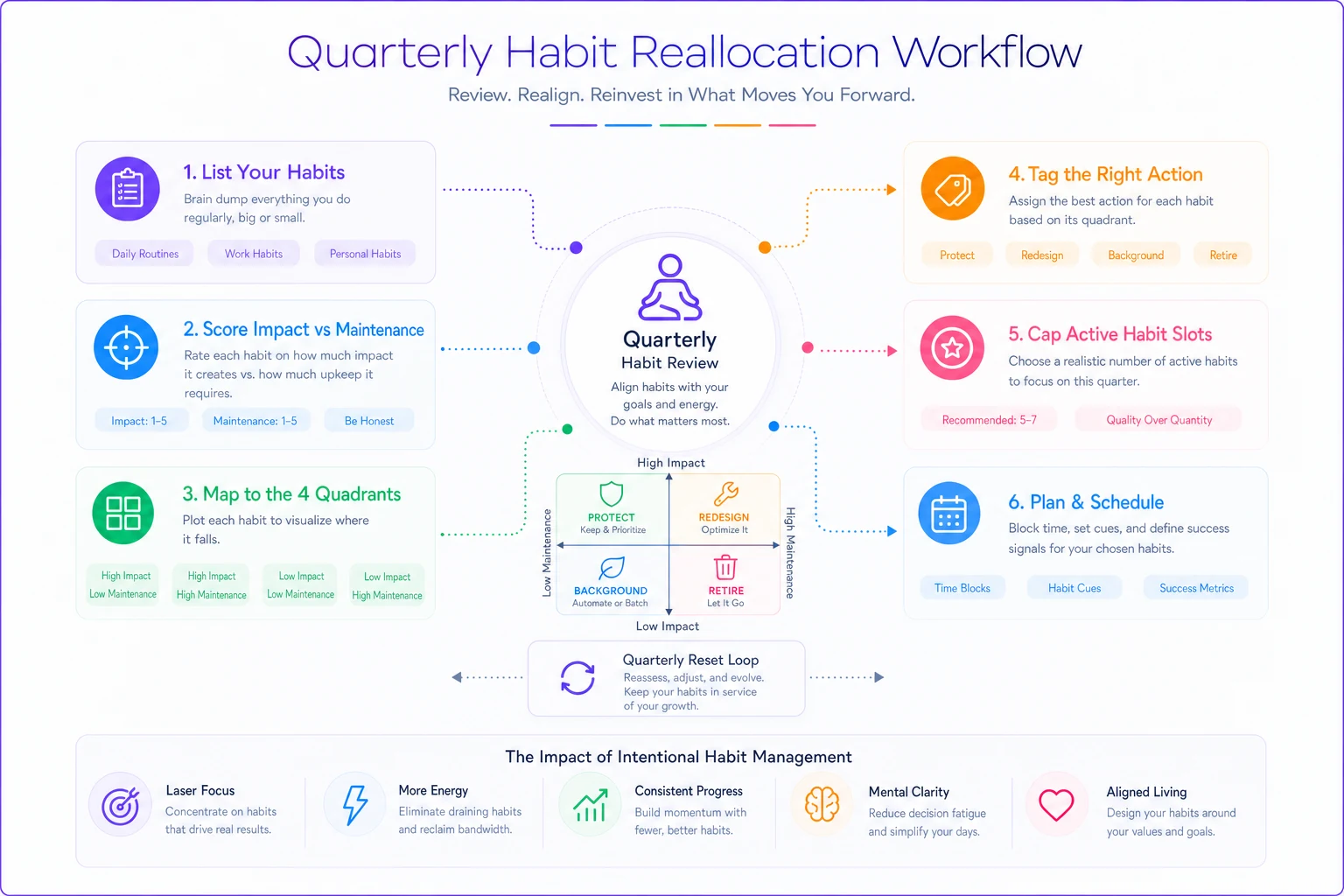
The ratio between these is your habit's health. High impact, low maintenance? That's a core holding—protect it. High impact but brutal maintenance? It needs redesign before it burns you out. Low impact, low maintenance? Fine to keep on autopilot, but don't let it crowd your attention. Low impact, high maintenance? That's the drag on your whole portfolio. Cut it.
| Impact ↓ / Cost → | Low maintenance | High maintenance |
|---|---|---|
| High impact | Core holding – protect, never touch | Redesign or automate – valuable but bleeding you |
| Low impact | Background – keep on autopilot, ignore | Retire immediately – the portfolio killer |
The mistake almost everyone makes is scoring impact based on identity ("I'm the kind of person who meditates") instead of results. A habit can be central to your self-image and still belong in the retire bucket. That's not a contradiction—it's just an honest audit.
A worked example: what a real portfolio looks like
The abstraction only clicks when you see it scored, so let me run actual numbers.
-
Morning walk — impact 4, cost 1. Massive return, almost zero overhead. Core holding.
-
Daily journaling (long-form) — impact 3, cost 4. Real value, but the "must write a full page" rule means it gets skipped when work spikes, then triggers guilt spirals. Redesign candidate.
-
Language app — impact 2, cost 3. Been at it 14 months, still can't hold a conversation. Notifications nag daily. Retire candidate.
-
Meal prep Sundays — impact 4, cost 3. High value, high effort, but the effort is concentrated, not spread across the week. Keep, maybe streamline.
-
Cold shower — impact 2, cost 2. Feels hardcore. Actual downstream effect? Marginal. Background at best.
-
Evening breathwork — impact 3, cost 1. Cheap, helps sleep. Core-ish.
The portfolio view does something a to-do list never could. It shows that roughly a third of this person's daily habit overhead—the language app plus the rigid journaling rules—is producing maybe a fifth of the value. That's the imbalance you're rebalancing around.
The move isn't "try harder on the language app." It's: retire the app, shrink journaling from a full page to three bullet lines (drops cost from 4 to 2 without killing the value), and leave the walk and breathwork completely alone because they're already working. Fewer habits, more return.
Seasonal rebalancing rituals
Portfolios drift. So do you. What was high-impact in January is often irrelevant by September because your life changed—new job, new season, kid started school, deadline crunch hit. Habits that fit the old context become dead weight in the new one.
-
Winter / deep-work season — capacity is often higher, social load lower. Good time to build. You can carry a heavier portfolio.
-
Spring / transition season — things are shifting. Rebalance toward flexibility, cut anything rigid.
-
Summer / low-structure season — travel, kids home, schedules blow up. This is a reduce season. Cut your portfolio by a third and don't feel bad about it.
-
Fall / re-onboarding season — the natural "back to routine" window. Best time to reintroduce retired habits or run new experiments.
The seasonal framing kills the biggest guilt driver in habit-building: the belief that your portfolio should stay constant year-round. It shouldn't. A good manager expects to hold different positions in different conditions. If you want a fuller framework for matching habits to capacity across a full year, the repeatable 12-month personal growth system pairs well with this.
The quarterly reallocation worksheet
Set aside 30–45 minutes once a quarter. This isn't reflection journaling—it's an operational review.
-
List every active habit. All of them, including the ones you barely do. Especially those.
-
Score impact and maintenance for each, 1–5, gut-level. Don't overthink. First instinct is usually right.
-
Sort into the four quadrants from the table above.
-
Tag each habit with one action
protect,redesign,background, orretire. -
Cap your total. Pick a number of "active attention" slots for the season—usually 3 to 5 high-effort habits max. If you're over, something in the redesign or retire column has to move.
-
Rewrite the redesign candidates. For each one, cut the maintenance cost specifically—shrink the target, remove the tracking, attach it to an existing anchor. Don't try to raise impact; just lower the drag.
-
Retire deliberately (more on this below).
-
Log what you changed and why. Next quarter you'll want the paper trail so you're not re-litigating the same decisions.
Step 5 is where people trip up most. The cap is the whole point. Without a hard limit, every review just adds more. The cap forces trade-offs, and trade-offs are what make this a portfolio instead of a pile.
Enforce the cap first—picking slots forces the hard decision and makes the rest straightforward.
If deciding which habits to cut versus sequence versus split is where you get stuck, the operational decision tree for prioritizing growth goals is useful for that specific bottleneck.
Retirement templates (so quitting stops feeling like failing)
Retiring a habit needs a script, or it doesn't happen cleanly. People either cling to dead habits out of guilt or drop them so quietly they never learn anything. A retirement template makes it a real decision with a record.
Graduated. The habit worked so well it's now automatic and doesn't need a slot. Flossing, seatbelts, your morning walk after two years. You're not quitting—you're promoting it out of active management. This is the goal state. The concept of habits maturing until they no longer need attention is covered well in the habit maturity lifecycle, and it's the healthiest reason to retire anything.
Contextual. The habit fit an old context that's gone. The commute-based podcast habit after you went remote. Nothing failed—the conditions just changed. Retire it and note the trigger, in case the context returns.
Honest cut. After a fair trial, the impact just isn't there. The language app. The cold showers you kept doing to prove something. This is the hardest one emotionally and the most valuable operationally.
A minimal retirement note looks like this:
-
Habit language app
-
Type honest cut
-
Ran for ~14 months
-
What I hoped it'd do conversational fluency
-
What it actually did vocabulary drills, no real speaking ability
-
Why retiring low impact, daily notification drag, better to take real lessons if I actually care
-
Revisit? Only if I book a trip
Thirty seconds of writing turns "I quit and feel bad" into "I made a call based on evidence." That distinction is the entire difference between a portfolio and a graveyard.
A real scenario
A freelance designer running her own small studio had accumulated nine tracked habits over about two years—the usual mix of health, business, and self-improvement. She felt productive but was constantly behind and vaguely guilty, opening her tracker mostly just to see red.
Her quarterly review surfaced the real problem quickly. Four of the nine habits were low-impact but high-maintenance—daily gratitude logging, a step-count competition she no longer cared about, a rigid reading target, and a supplement schedule she kept forgetting. Together they generated most of her tracking overhead and most of her guilt, while barely touching her actual goals of steadier income and better sleep.
She retired three outright, downgraded reading to "one book going, no daily target," and left her two genuine core habits—morning client-work blocks and a fixed wind-down routine—completely alone. Active habits dropped from nine to five. Within a couple of months she reported what people almost always report when they do this right: not that she achieved more, but that the habits left standing actually stuck, and the background hum of guilt was mostly gone. Roughly the same effort, redirected, produced noticeably better follow-through.
When this makes sense—and when it doesn't
When portfolio management is worth it: You're running five or more habits, you feel scattered, or you keep adding new routines without ever feeling like you're gaining ground. The overhead has become the problem. This framework works well when the issue is allocation, not motivation.
When it's a bad idea: You're in the first few weeks of a single new habit. Don't manage a portfolio of one. Building an early habit needs focus and consistency, not spreadsheets and quadrants—the analysis will just become another form of procrastination. Get one thing sticking first.
Who should skip this entirely: If you're in a genuine crisis season—illness, grief, major upheaval—don't run reviews. Cut to one or two survival habits and drop the framework until capacity returns. Portfolio management is a tool for steady-state optimization, not triage.
The uncomfortable truth underneath all of this is that most people don't have a habit problem. They have a pruning problem. They're excellent at starting and terrible at stopping, so attention gets diluted across too many positions until nothing performs. Running your habits as a portfolio—scored, capped, rebalanced by season, and deliberately retired—fixes the one thing willpower never will: it decides what not to do, on purpose, on a schedule. Do that four times a year, and the habits that survive will be the ones that were actually worth keeping.
Ready to unlock your full potential?
Join thousands of users transforming their lives using Growyly to stay motivated, organized, and growth-focused every day.