

Most habit systems don't fail loudly. They erode. The 45-minute workout becomes 30, then 20, then "I'll go tomorrow." The daily writing session keeps happening but the word count quietly slides from 800 to 400 to a paragraph. Nobody decides to quit. The habit just... drifts. And by the time you consciously notice, you've usually lost three or four months of ground and a chunk of the confidence that came with the streak.
That slow erosion is the real enemy, and almost nobody has a system for it. People obsess over starting habits and recovering from lapses. But the boring middle — the stretch where a habit is technically alive but slowly rotting — gets almost no attention. This is where habit drift management lives, and it's less about willpower and more about running a monitoring system on yourself the way an ops team monitors production software.
Treat your habits like a portfolio of running processes. Each one emits signals. Some of those signals drift over time. Your job is to build the detectors, thresholds, alerts, and retirement rules before the drift happens — so you're not making emotional decisions in the moment.
Why drift is a different problem than lapse
A lapse is discrete. You missed three workouts because you got sick. Everyone understands that, and there are decent recovery playbooks for it.
Drift is continuous and mostly invisible. The habit stays "on your list." You still check the box. You still think of yourself as someone who does the thing. But the quality, duration, or intensity has quietly collapsed. The checkbox lies to you.
The pattern that keeps showing up: the tracking signal you chose early on stops measuring what actually matters. When you started meditating, "did I sit down" was a fine signal because sitting down at all was the hard part. Eighteen months later, sitting down is trivial and completely disconnected from whether you're getting anything out of it. The signal froze while the habit evolved. That mismatch is drift, and your tracking system is actively hiding it from you.
The baseline: you can't detect drift without a reference point
Monitoring only works against a baseline. If you never captured what "healthy" looked like, you have nothing to compare against, and every judgment becomes vibes.
Achieve more by focusing on what matters.
Growyly helps you build lasting habits and track your personal growth effortlessly.
- Goal setting with progress tracking
- Daily habit reminders
- Motivational insights and analytics
No credit card required
The mistake most people make is setting a baseline at the peak. You have one incredible month where you meditated 25 minutes daily and felt amazing, and now that peak becomes your mental reference forever. Everything after feels like failure. That's not a baseline, that's a trap.
A useful baseline is a sustainable normal band, not a single number. For each core habit, capture three things after it's been running for at least 6–8 weeks:
-
The floor — the minimum version that still counts as "done" and still produces value
-
The typical — what a normal, non-heroic week actually looks like
-
The signal that predicts value — the one measurement that actually correlates with the outcome you care about
That third one is the hard part and the most important. If you're vague about which signal predicts change, your whole monitoring system measures noise. Worth genuinely stopping and working through how to pick the smallest signals that actually predict change before building any of the detectors below, because everything downstream depends on it.
A quick worked example. Say your habit is strength training and your real goal is getting stronger over years, not just showing up. Your baseline band might look something like:
-
Floor
2 sessions/week, at least the main compound lifts
-
Typical
3 sessions/week
-
Predictive signal
total working sets per week on primary lifts (not "did I go to the gym")
Now "did I go to the gym" can stay green while working sets quietly drop from 16 to 9 — and you'll see it, because you're watching the right number.
Drift detectors and thresholds
Once you have baselines, you need rules that fire automatically instead of relying on you to notice. This is the part people skip, and it's the whole game. Noticing drift "when you happen to reflect" means you notice it months late.
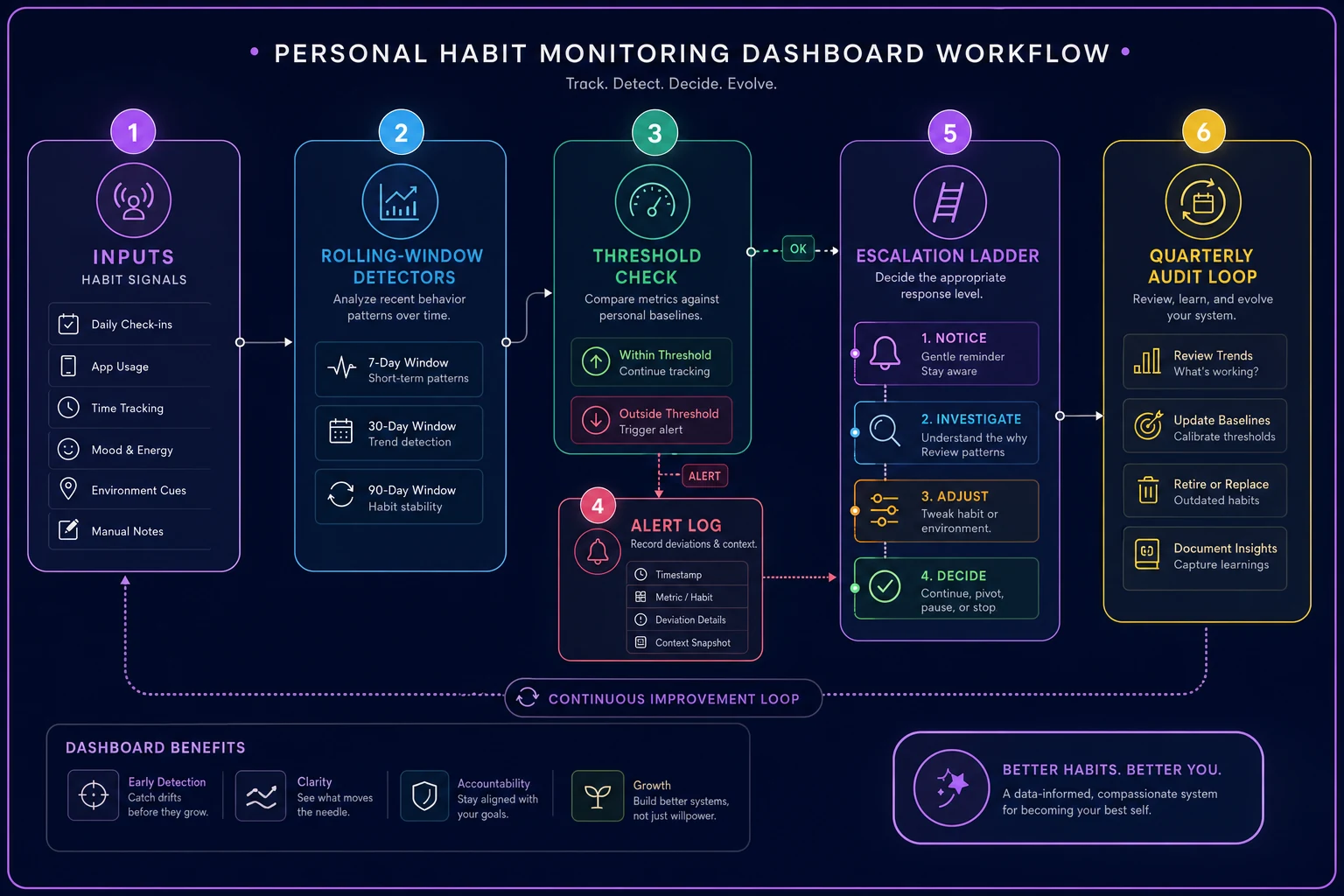
Think in rolling windows, not single days. One bad day is noise. A trend across a window is signal. Here's a detector framework that works for most personal habits:
| Detector | What it watches | Threshold that should trigger review |
|---|---|---|
| Rolling frequency | 4-week completion rate vs baseline typical | Drops below floor for 2 consecutive weeks |
| Intensity trend | Predictive signal, 4-week moving average | Falls 20–30% below baseline band |
| Substitution flag | Ratio of "real" completions to "proxy" completions | Proxy count exceeds real count in any week |
| Context relevance | Self-rated "does this still matter" (monthly) | Two consecutive low ratings |
| Variance spike | Week-to-week swing in the signal | Swings widen sharply even if average holds |
That last one is underrated. Rising variance usually shows up before the average drops. When your workout length starts bouncing wildly between 15 and 50 minutes, that instability is an early warning that the habit is losing its structural support — even though your monthly average still looks fine. Watch variance and you buy yourself weeks of lead time.
Set detector thresholds during a calm review session, not in the moment you notice drift.
The thresholds above aren't sacred. The point is that you set them in advance, in a calm moment, so that when the alert fires you're not negotiating with yourself. Pre-committed thresholds beat in-the-moment judgment every single time, because in the moment you're motivated to explain the drift away.
Alerts and escalation ladders
A detector that fires into the void does nothing. You need the alert to actually reach you and a graduated response so you don't overreact to small drift or underreact to big drift.
The overreaction problem is real. Someone sees a two-week dip, panics, blows up their entire system, adds three new rules, and burns out within a month. The dip was normal fluctuation. An escalation ladder prevents this by matching response size to drift size.
-
Level 1 — Notice. A detector fired once. Response
just log it and keep watching. No action. Most Level 1 alerts resolve on their own.
-
Level 2 — Investigate. Detector fired across two windows. Response: a 10-minute diagnostic. What changed? New job, worse sleep, environment shift? You're looking for the root cause, not adding effort yet.
-
Level 3 — Adjust. Confirmed sustained drift with an identifiable cause. Response: a specific, small intervention — usually lowering the floor temporarily or fixing the environmental trigger, not white-knuckling harder.
-
Level 4 — Decide. Drift persists despite adjustment, or the context-relevance detector is flashing. Response: a real decision. Rebuild, redesign, or retire. This is where you stop maintaining a habit that's no longer earning its place.
The escalation ladder does one crucial thing: it separates detection from decision. You detect constantly and cheaply. You decide rarely and deliberately. Most people fuse the two, which means every small dip feels like an existential referendum on their discipline. Decoupling them is what makes long-term monitoring sustainable instead of exhausting.
For where the "decide" step connects to structured build/automate/maintain/retire choices, the habit maturity lifecycle framework is the natural companion — Level 4 is basically the trigger that drops a habit back into that lifecycle for re-evaluation.
A real scenario: the drifting side project
A freelance designer running a fairly typical pattern had a "learn 3D modeling" habit going for about 14 months. On paper it looked healthy — she logged practice roughly 4–5 days a week the whole time. Green streak, no lapses, looked like a success story.
But her actual skill had basically plateaued around month five. The drift was substitution and intensity, hidden by a frequency-only signal. She was still "practicing" 45 minutes a day, but the sessions had drifted into re-watching tutorials she already knew and tweaking old files — comfortable motion that felt like work and produced almost nothing.
When she set up an actual detector — new completed projects per month as the predictive signal — the truth showed up immediately. Roughly 6 new pieces in her first three months, then close to zero for the following eight months while the frequency stayed high. Eight months of green checkboxes on a dead habit.
The fix wasn't more discipline. Once the intensity detector was in place, her Level 3 adjustment was a rule change: a session only counted if it produced a saved output, not just time spent. Within about six weeks her monthly output was back to 3–4 pieces. The habit hadn't needed rescuing from a lapse. It needed a signal that could see the drift the checkbox was hiding.
That's the whole argument for monitoring in one story. The frequency looked perfect the entire time.
The audit: a scheduled review you don't skip
Detectors catch drift between reviews. The audit is the scheduled, deliberate look at the whole portfolio — quarterly is about right for most people. Weekly is too noisy for this; annually is too slow to catch anything meaningful.
-
- [ ] For each core habit, is the current predictive signal still the right signal, or has the habit outgrown it?
-
- [ ] Which habits triggered detectors this quarter, and at what level?
-
- [ ] Any habits sitting green on frequency but suspicious on intensity? (This is where the worst drift hides.)
-
- [ ] Which habits still map to something you actually care about right now?
-
- [ ] Any thresholds that fired too often (too sensitive) or never fired (too loose)?
-
- [ ] What's one habit that's earned automation and one that's earned retirement?
The recurring thing from running these audits: the signal review is where most of the value comes from. People assume the audit is about the habits themselves, but the bigger payoff is catching measurement drift — cases where you've been diligently tracking a number that stopped meaning anything a year ago. Fix the signal and half your "drift problems" turn out to be measurement problems.
One more audit note. Keep it honest by looking at your actual data, not your self-image. Your self-image will insist the meditation habit is fine. The variance chart on your predictive signal doesn't care about your self-image. Trust the second one.
Retirement policies: killing habits on purpose
Nobody wants to talk about retiring habits, so people don't, and their systems slowly fill with zombie habits — technically tracked, emotionally attached to, producing nothing. A monitoring system without a retirement policy just accumulates dead weight.
A retirement policy is a pre-written rule for when a habit is allowed to end with dignity instead of guilt. Write it before you're attached. Something like: "If the context-relevance detector flashes for two consecutive quarters AND a Level 3 adjustment didn't restore value, this habit retires and its slot opens up."
The key reframe: retirement isn't failure. A habit that served its purpose and is now retired is a win. The strength-training block that got you to a baseline can retire into a maintenance version. The daily language app that got you conversational can be sunset in favor of actual conversation practice. Holding onto the old version out of streak-loyalty is the actual failure.
When retirement is a bad idea: don't retire a habit during a rough patch just because the signal dipped — that's a lapse, not obsolescence, and it needs recovery, not a funeral. And don't retire a foundational keystone habit (sleep, movement) just because it got boring. Boring keystone habits are supposed to be boring. Retirement is for habits whose purpose expired, not habits whose novelty expired. Confusing those two is probably the most common mistake people make here.
Dashboards: making all of this visible at a glance
A monitoring system you have to reconstruct from memory every quarter won't survive. The whole point is that drift is invisible, so your dashboard exists to make it visible.
-
Status row — each core habit, green/yellow/red based on current detector state
-
Trend lines — the predictive signal for each habit as a moving average, so you can literally see the slope
-
Alert log — what fired, when, at what escalation level, and how it resolved
-
Review cadence — next audit date and any thresholds flagged for tuning
The trend lines matter more than the status row. A green status tells you where you are today; a downward-sloping trend line tells you where you're heading, which is the entire value of monitoring. Watch slopes, not snapshots.
Here's a quick workflow visualization.
Honest reality: maintaining this by hand in a spreadsheet works for maybe three or four habits before the upkeep itself becomes the thing that drifts. This is exactly where habit-tracking software with real trend detection earns its place — not for the tracking itself, but for the automatic rolling-window calculations, threshold alerts firing on their own, and trend visualization you'd otherwise never keep current. The tool's job is narrow: run the detectors so you don't have to remember to, and surface the alert so drift can't stay invisible.
The judgment stays with you; the boring computation gets offloaded.
When this whole system is overkill
Full lifecycle monitoring makes sense for habits you're running over years — the ones tied to long-term skill, health, or identity, where slow drift genuinely costs you. Deliberate practice, fitness, creative output, learning a craft. For those, the machinery pays for itself.
For a short-term habit you're running for six weeks to hit a specific goal, all of this is absurd overhead. Just do the thing. And for genuinely automatic habits that have fused into your identity — you're not going to "drift" on brushing your teeth — monitoring adds friction with no upside. Reserve this for the portfolio's serious, long-horizon holdings.
One last guardrail, because monitoring yourself can tip into something unhealthy: the goal is a lighter relationship with your habits, not a surveillance state where you feel watched by your own dashboard. If the monitoring starts generating anxiety instead of reducing it, that's a signal too, and it's worth reviewing the ethics and mental-health guardrails around habit experiments before going further. Detectors should buy you peace of mind — set the thresholds, then stop thinking about it until something fires.
The systems that survive multiple years aren't the ones run by the most disciplined people. They're the ones where drift can't hide long enough to do real damage — because someone built the detectors, wrote the thresholds down in a calm moment, and let the alerts do the noticing they were never going to do reliably on their own.
The systems that survive multiple years aren't the ones run by the most disciplined people. They're the ones where drift can't hide long enough to do real damage — because someone built the detectors, wrote the thresholds down in a calm moment, and let the alerts do the noticing they were never going to do reliably on their own.
Ready to unlock your full potential?
Join thousands of users transforming their lives using Growyly to stay motivated, organized, and growth-focused every day.