

There's a strange problem that hits people whose jobs put them in front of others all day. Executives, salespeople, lawyers, consultants, agency owners — anyone who spends most of their working hours in meetings, on stage, at client dinners, or otherwise "on." They want to build new habits, but every attempt to do so happens in public.
You can't exactly pull out a journal at a board dinner. You can't do a breathing exercise mid-pitch without someone asking if you're okay. You can't check a habit-tracking app while a client is mid-sentence. So the standard advice — "make your habit obvious," "put it where you'll see it," "tell people so they hold you accountable" — actively backfires. For a visible professional, obvious is a liability.
Most habit content assumes privacy you don't have. This piece is about the opposite constraint: building low-visibility habits that survive high-visibility environments. Habits nobody notices, tied to cues nobody else reads.
Why "make it visible" fails when *you're* the visible thing
The visibility advice comes from a real place. Environmental cues work. A book on the pillow, gym clothes by the door, a water bottle on the desk — these lower friction and remind you at the right moment. Fine for a home office. Useless when your "environment" is someone else's conference room and your desk is a rotating cast of restaurant tables, airport lounges, and client lobbies.
There's a second, less obvious reason the standard playbook fails for public-facing people: social cost. When your professional identity depends on projecting competence and control, any habit that reads as "self-improvement in progress" carries a small tax. A colleague seeing you do a mindfulness exercise. A client noticing you scribbling notes to yourself. A direct report catching you counting reps of anything. None of it is catastrophic, but the anticipation of being seen is enough to kill the habit before it starts. You skip it because doing it in front of people feels off-brand.
So the professional ends up in a bad loop. The environments where they most need to reset — before a tense negotiation, between back-to-back meetings, during a draining client dinner — are exactly the environments where they feel least able to run any visible routine. The habit never gets a stable trigger, because every candidate trigger happens under observation.
The core idea: discrete anchors and private signals
The fix isn't to hide who you are. It's to redesign the habit so its mechanics are invisible while its effects are real. Three pieces make this work:
Achieve more by focusing on what matters.
Growyly helps you build lasting habits and track your personal growth effortlessly.
- Goal setting with progress tracking
- Daily habit reminders
- Motivational insights and analytics
No credit card required
Discrete anchors. A cue that's already part of the public moment and requires no visible extra action. You're not adding a gesture someone could clock. You're attaching the habit to something you'd be doing anyway — sitting down, unlocking your phone, pouring water, the half-second before you answer a question.
Private artifact signals. A trace of the habit that only you can read. Not a wall chart. Not a shared streak. A dot in a note only you open, a specific position you leave a pen in, a single character typed into your calendar title. Something that confirms "I did the thing" without broadcasting it. If you want a deeper treatment of choosing signals that are actually worth capturing, the piece on collecting only signals you can act on covers the logic behind keeping these minimal.
Fidelity checks mapped to context. A quick way to confirm the habit is holding up in each specific public setting — meetings, dinners, presentations — rather than one generic "did I do my habit today." The context matters because a habit that survives solo work often collapses at a client dinner, and you want to know which context is breaking it.
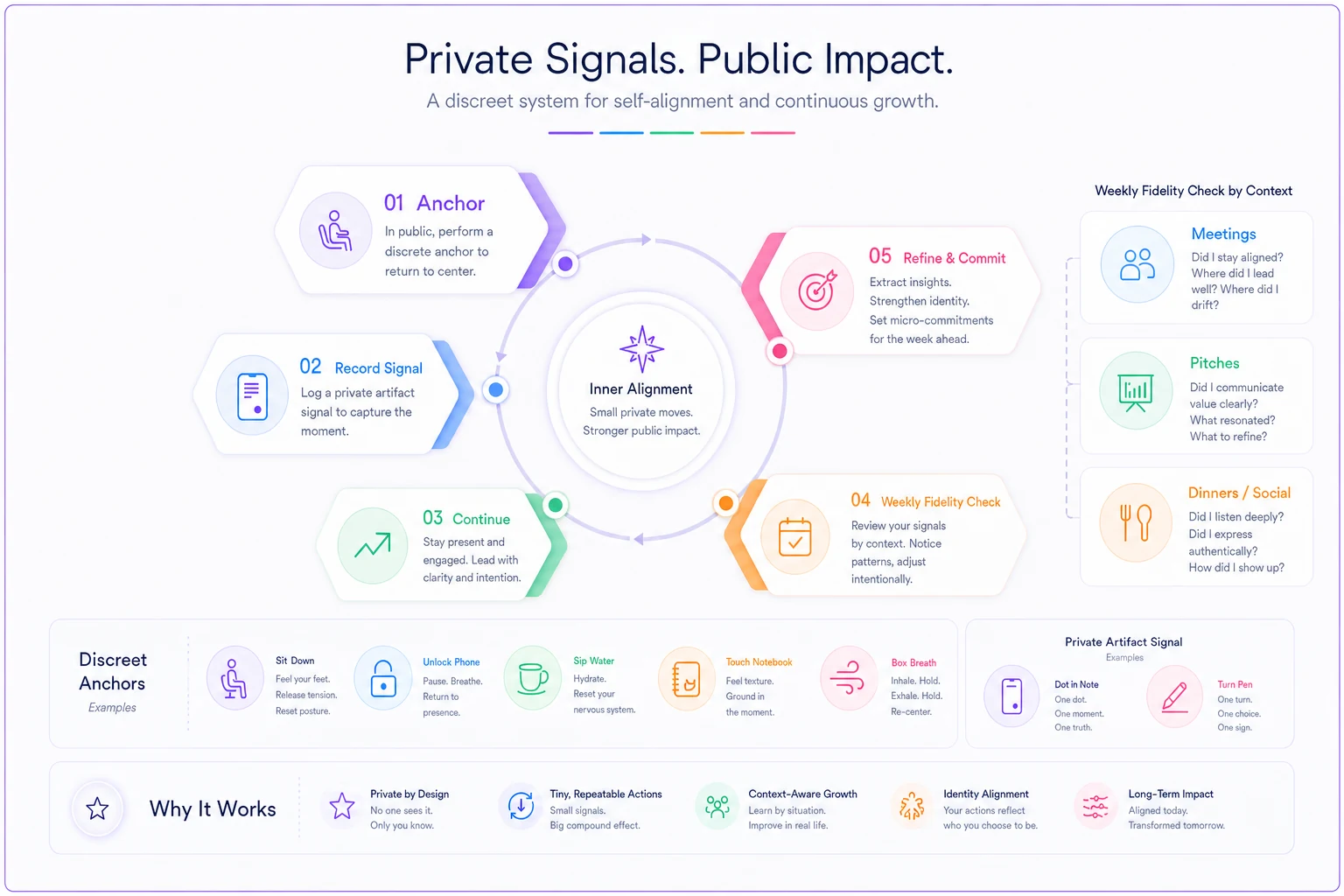
All three serve the same purpose: reduce the public footprint of the habit to near zero while keeping enough of a private trace that you can tell whether it's working.
Mapping habits to specific public contexts
Generic habit design treats the day as one uniform block. For visible professionals it isn't. Each context has different observation levels, different available anchors, and different failure modes. It helps to map them out.
| Public context | Observation level | Usable discrete anchor | Private artifact signal | Common failure mode |
|---|---|---|---|---|
| Internal meeting | Medium | The moment you open your laptop | One keystroke in meeting notes | Habit forgotten in back-to-backs |
| Client pitch | High | The pause before you speak | Mental tally, logged after | Nerves override the cue |
| Client dinner | High, social | Reaching for your water glass | A dot in a phone note in the bathroom | Alcohol + fatigue erase intent |
| Between calls | Low | Standing up / closing a tab | A tick in a running daily note | Immediately jumping to next call |
| On stage / presenting | Very high | The walk to the front | Post-event, from memory | Adrenaline blanks the routine |
The table isn't the answer — it's a prompt. The real work is picking one habit and deciding what its discrete anchor and private signal are in each context where you'll need it. A senior consultant trying to build a "one breath before I respond" habit needs a different anchor in a pitch (the pause is natural, use it) than at a dinner (use the water glass, since no one questions a sip).
What consistently trips people up: they design the habit for their easiest context and assume it transfers. It doesn't. The between-calls version is easy because nobody's watching. The dinner version is the hard one, and if you don't design it separately, the habit quietly becomes a "when I'm alone" habit — which for a public-facing professional means rarely.
Building the discrete anchor
An anchor works when it's already reliably present and requires no added visible motion. Most public moments have several buried in them; you just haven't been looking at them as triggers.
-
The half-second before you answer a direct question
-
Reaching for a glass of water (works in nearly every social setting)
-
Sitting down at a table or desk
-
Unlocking your phone (you can attach a private mental step to this)
-
The transition through a doorway between rooms
-
Setting your bag or laptop down
The anchor should be paired with the smallest possible version of the habit. If your habit is "regulate my state before responding under pressure," the public version is one slow exhale on the pre-answer pause — not a routine, not a technique someone could name if they watched you. If your habit is "capture one insight from each client interaction," the public version is a single mental note held until the bathroom break, not visible scribbling at the table.
If you want a broader menu of one-minute triggers to pull from, the portable anchor library is a good source — the trick here is filtering that list down to only the anchors that leave no public footprint.
There's a related failure worth naming: people pick an anchor that's technically invisible but socially fragile. "I'll do it when there's a lull in conversation" sounds fine until you realize you're now monitoring the conversation for lulls, which pulls you out of the moment and makes you look distracted — the opposite of what you wanted. Good anchors are ones you can respond to while still being fully present.
Private artifact signals that nobody reads but you
The reason to leave a trace at all: memory lies, especially about habits done under stress. After a three-meeting morning you will genuinely not remember whether you did your pre-answer breath in the second meeting. Without a signal, you can't run any honest fidelity check, and the habit drifts.
The signal has to stay private, which rules out most tracking apps. Here's what actually works:
-
A single character in a phone note. One note titled something boring, one dot or letter per rep. Opening a note in a bathroom or elevator reads as normal phone use.
-
A physical position. Pen capped and turned 90 degrees means "done." Only you know the code.
-
A calendar title tweak. A single character appended to a calendar entry after the meeting. Invisible to anyone not staring at your calendar.
-
A post-event log. For high-adrenaline contexts (stage, big pitch) where you can't log in the moment, a 30-second capture right after, before you talk to anyone.
If possible, choose a signal that looks like normal phone use so the action is indistinguishable from typical behavior.
Keep it to one bit of information per rep. Did it happen or not. The moment you try to log quality, notes, mood, and context in the moment, the signal stops being discrete — you're now visibly typing paragraphs, and the whole low-visibility premise collapses. Richer reflection belongs later, in private, not at the table.
This is where a lightweight private habit tracker earns its place, if you use one at all. The useful version isn't a colorful streak-and-badge app you'd be embarrassed to have on screen. It's a plain, single-tap log you can hit in two seconds — something that quietly rolls those individual marks into a weekly picture without asking you to perform anything in public. The tracking should be invisible back-end infrastructure, not another thing that risks exposure.
Fidelity checks by context, not by day
Most people check habit fidelity with one blunt daily question: did I do it today? For a public professional that's too coarse, because "today" contained five wildly different observation environments and the habit might be holding in four and failing in one.
A context-mapped fidelity check, run once a week, takes about ten minutes:
-
Pull your private signals for the week — the dots, the note entries, whatever your trace is.
-
Sort them by context, not by date. Group them
meetings, pitches, dinners, between-calls.
-
Compare hit rate across contexts. You're looking for the one context that's dragging. Maybe you're at 90% between calls and 20% at client dinners.
-
Ask why the weak context is weak. Usually it's the anchor, not your discipline. The dinner anchor was "a lull in conversation" (fragile) instead of "reaching for water" (reliable).
-
Swap the anchor for the failing context only. Don't touch the contexts that work. Change one thing.
-
Set the next week's watch-context. Pick the weak one to pay attention to, and let the strong ones run on autopilot.
A habit almost never fails uniformly. It fails in a specific context because that context has a bad anchor or a specific disruptor — alcohol, adrenaline, social pressure. Fixing the anchor for that one context is far more effective than trying to "want it more" across the board. The pre- and post-meeting reset work in these two-minute meeting anchors is a useful companion here, since the meeting context is often the first one to firm up and the easiest to build fidelity checks around.
A real scenario
A partner at a mid-size advisory firm wanted to stop reacting reflexively in high-stakes conversations — the habit was one slow breath before responding to any pushback. Simple in theory. In practice her days were roughly six or seven hours of meetings and two or three client dinners a week, all observed.
Her first attempt used a visible cue — a bracelet she'd touch as a reminder. She dropped it inside two weeks because touching it mid-meeting felt conspicuous and, worse, she caught herself fidgeting with it, which read as nervous. Wrong direction entirely.
The redesign used discrete anchors mapped by context: in meetings, the anchor became the natural pause before answering; in pitches, the same; at dinners, reaching for her water glass. Her private signal was a single dot in a phone note, logged whenever she stepped away. Weekly fidelity check by context, about ten minutes on Fridays.
The context sort surfaced the real problem fast. Meetings were solid — she was hitting the breath maybe 8 out of 10 times within a couple of weeks. Dinners were near zero. The disruptor wasn't willpower; it was that the water-glass anchor competed with wine, and by the second hour she wasn't reaching for water at all. She swapped the dinner anchor to "the moment a question is directed at me" — same as her meeting anchor — and left everything else alone. Within a few weeks the dinner context climbed to a respectable, if lower, hit rate. Total change to her public behavior that anyone could observe: none.
The outcome that mattered to her wasn't a streak number. It was that colleagues started noting she seemed "unusually steady" in tense client sessions — the effect was visible, the mechanism never was.
When this actually makes sense
This approach is worth the extra design effort when your habit needs to fire specifically in observed, high-pressure moments and any visible routine would carry a real social or professional cost. State-regulation habits, response-control habits, attention-reset habits, discreet capture habits — these are the natural fits.
It also makes sense when your environment is genuinely non-private for most of your working hours. If you spend the day in and out of rooms full of people you're trying to influence, standard visibility advice is working against you, and going low-visibility isn't paranoia — it's matching the design to the constraint.
When it's a bad idea
If you actually benefit from accountability and don't mind being seen improving, don't hide the habit — visible cues and social support are genuinely more powerful when the social cost is low. A founder among a supportive team, someone building a habit in a private home office, anyone whose work isn't performed under observation: the low-visibility overhead is just friction you don't need.
It's also a bad fit for habits that require visible tools or space. You can't run a low-visibility version of a 30-minute workout or a written planning session. Those need protected private time, not clever anchors. Trying to force them into invisible micro-versions usually just waters them down to the point of uselessness.
One caution worth naming: don't use "it has to be invisible" as an excuse to avoid habits that would benefit from a little accountability. Sometimes the discomfort of being seen is exactly what makes the habit stick. Reserve this approach for cases where the privacy is a real constraint, not a way to dodge commitment.
The quick build checklist
Quick steps to get started:
-
Pick one habit — ideally a small state, response, or capture habit
-
List every public context where it needs to fire (meetings, pitches, dinners, between calls, stage)
-
Assign a discrete anchor to each context — invisible or fully explainable, no added visible motion
-
Choose one private artifact signal — a single bit, one tap or mark per rep
-
Keep the in-the-moment log to did it happen or not — save richer reflection for private time
-
Run a context-sorted fidelity check weekly, about ten minutes
-
Fix only the weakest context each week by swapping its anchor, not by trying harder everywhere
Public-facing work doesn't have to mean your personal growth stalls out because there's nowhere private to do it. The environment is the constraint, so design around it: invisible cues, private traces, context-specific checks. You get to keep changing without ever looking like someone who's in the middle of changing — which, for a lot of professionals, is exactly the point.
Public-facing work doesn't have to mean your personal growth stalls out because there's nowhere private to do it. The environment is the constraint, so design around it: invisible cues, private traces, context-specific checks. You get to keep changing without ever looking like someone who's in the middle of changing — which, for a lot of professionals, is exactly the point.
Ready to unlock your full potential?
Join thousands of users transforming their lives using Growyly to stay motivated, organized, and growth-focused every day.