



Most personal handoffs don't fail at the moment of transfer. They fail three steps later, when something small drifts, nobody flags it, and by the time anyone notices, resentment has already set in. The dishes didn't get done. The kid's permission slip sat in a backpack for four days. The errand your roommate "definitely remembered" never happened.
What's missing almost always isn't effort. It's a shared definition of done, a scheduled moment to catch drift early, and an agreed rule for what happens when things slip. That combination — a one-page agreement, a short recurring check-in, and a tiered response to problems — is what makes personal handoff governance actually work instead of becoming another document nobody reads.
This isn't about turning your home into a corporate org chart. It's about removing the three specific failure points that quietly eat relationships and time.
## The three failure points you're actually solving
Before the templates, it helps to name exactly where handoffs break. Nearly every personal handoff falls apart in one of these places:
-
The definition gap. Two people agree on who but never on what good looks like. "Watch the kids" means "keep them alive" to one person and "stick to the nap schedule, no screens before lunch, dinner by 6" to the other.
-
The silent drift. A task slowly degrades. Nobody raises it because it feels too small to mention, so it compounds until it's a fight instead of a note.
-
The escalation freeze. Something goes wrong and nobody knows the agreed response. Do you text? Call? Wait? Handle it yourself and stew? The absence of a rule is the problem.
A one-page handoff agreement attacks the first. A weekly sync attacks the second. An escalation ladder attacks the third. You need all three, and they're each surprisingly small.
## The one-page handoff agreement (and why it stays one page)
The whole point of keeping it to one page is that length kills adoption. A three-page childcare agreement will be read once and never again. A single sheet stuck to the fridge gets glanced at daily.
Achieve more by focusing on what matters.
Growyly helps you build lasting habits and track your personal growth effortlessly.
- Goal setting with progress tracking
- Daily habit reminders
- Motivational insights and analytics
No credit card required
Here's the structure that actually survives real use:
| Section | What goes here | Common mistake |
|---|---|---|
| The handoff | What's being transferred, from whom, to whom | Naming the task too vaguely ("the kids," "the house") |
| Definition of done | 2–4 bullet points describing the actual finished state | Listing effort instead of outcome |
| Non-negotiables | The 1–3 things that must never slip | Making everything a non-negotiable |
| Decision rights | What the receiver can decide alone vs. what needs a check-in | Leaving this blank, which causes either over-asking or overstepping |
| Flag threshold | The specific line that triggers a heads-up | Assuming "use your judgment" is a threshold |
| Review cadence | When you'll both check in | Scheduling nothing, hoping it self-corrects |
The magic is in definition of done and flag threshold. Most informal handoffs skip both. If you write nothing else, write those two.
A filled-in example: shared evening chores between roommates
-
- The handoff Weeknight kitchen reset, rotating — whoever cooked does not clean.
-
- Definition of done Counters wiped, dishwasher loaded and started, sink empty, stovetop clean. Not "mostly clean" — those four things, visible by morning.
-
- Non-negotiables Dishwasher gets started, not just loaded. A full-but-off dishwasher is the single biggest recurring fight, so it's the non-negotiable.
-
- Decision rights Receiver can decide order, timing, and whether to hand-wash vs. machine. Can't decide to "skip tonight, do double tomorrow" without flagging.
-
- Flag threshold If it won't be done before you go to bed, send one text. Not an apology — just a heads-up.
-
- Review cadence Sunday, five minutes, during the usual grocery list check.
Notice how specific "definition of done" is. "Clean the kitchen" invites interpretation. "These four visible states by morning" doesn't.
If you're building these for a whole household, it's worth reading how shared habit systems for households that actually work handle the coordination layer underneath, because handoffs sit on top of shared routines — they don't replace them.
## The weekly sync script (keep it under seven minutes)
A sync that runs long gets canceled. The goal isn't a meeting — it's a fast drift-check. The script below works because it's repair-focused, not performance-review-focused. You're looking for small corrections, not assigning blame.
Here's the actual script you can read off the page:
-
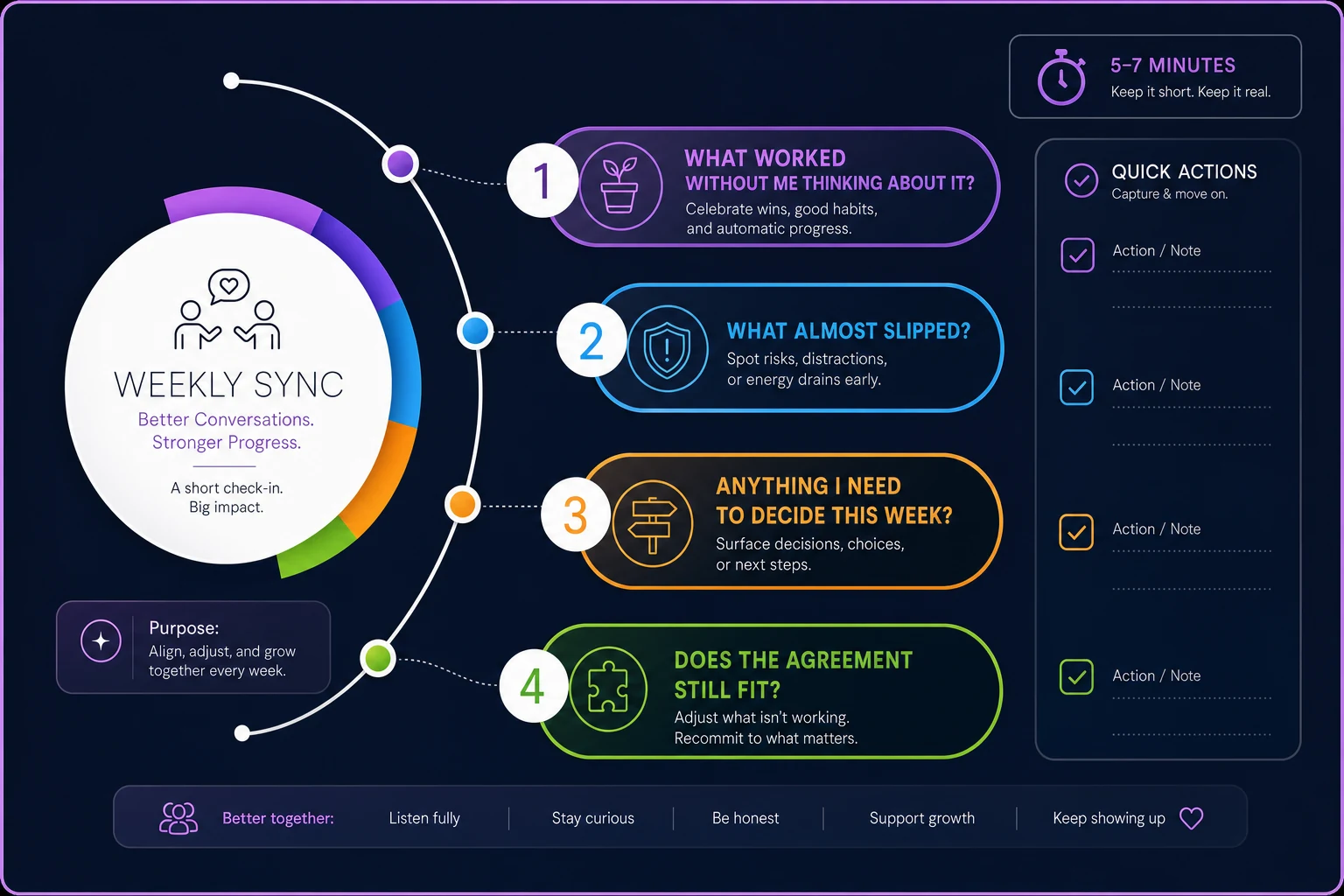
1. "What worked without me thinking about it?" — Confirms what to leave alone. People skip this and spend the whole sync on problems, which makes the other person defensive.
-
2. "What almost slipped?" — This is the real value. "Almost slipped" surfaces drift before it becomes a failure. You're inviting small admissions that aren't yet a crisis.
-
3. "Anything I need to decide this week?" — Catches decision-rights questions before they stall.
-
4. "Does the agreement still fit?" — Life changes. Schedules shift. This question keeps the one-pager alive instead of stale.
Why "almost slipped" matters more than "what went wrong"
Asking "what went wrong" makes people hide the near-misses, because admitting a near-miss feels like admitting a failure. Asking "what almost slipped" normalizes the gray zone. A parent who almost forgot the Tuesday pickup but caught it will tell you that if the question is framed as a near-miss. Frame it as a failure and they'll stay quiet — and next Tuesday they'll forget for real.
A quick visual of the four-question sync can help when you're learning the rhythm.
This framing is the single biggest behavioral difference between syncs that work and syncs that become arguments. The framing of that one question does more work than any amount of structure elsewhere in the system. Worth getting right.
## The escalation ladder: what happens when something actually breaks
The escalation freeze — nobody knowing the agreed response — causes more damage than the original mistake. A ladder fixes it by deciding, in advance and calmly, what each level of problem gets.
| Rung | Trigger | Agreed response | Who acts |
|---|---|---|---|
| 1 – Note it | Minor slip, no real impact | Mention at the next sync. No text needed. | Either person logs it |
| 2 – Flag it now | Something time-sensitive is at risk | One message within the hour, factual, no blame | Whoever noticed |
| 3 – Handle and debrief | Real consequence already happening | Act immediately, discuss after it's resolved | Whoever's present |
The reason this works is that it pre-decides the emotional temperature of each response. Rung 1 says "this doesn't deserve a stressed text at 9pm." Rung 3 says "don't wait for permission, fix it, we'll talk later." Without the ladder, people apply rung 3 energy to rung 1 problems — and that's what turns a forgotten errand into a fight.
A filled-in example: delegated task to a teenager
-
- Rung 1 Fed a bit late, walk was short. Note it, mention Sunday.
-
- Rung 2 Realizes at 9pm they forgot entirely. Text now: "Didn't walk him yet — want me to still do it or is it too late?" Factual, no drama.
-
- Rung 3 Dog got sick or got out. Act, then debrief — don't start with "why didn't you..."
The teenager learns the ladder in about a week, and the forgotten-feeding text becomes routine instead of a confession.
## When this makes sense — and when it's overkill
Handoff governance isn't free. It costs setup time and a small weekly commitment. So it's worth being honest about fit.
When it's clearly worth it:
-
- The handoff repeats (weekly, daily) rather than one-off
-
- More than one person depends on the outcome
-
- Past failures have already caused friction
-
- The receiver is new to the responsibility (a kid taking on chores, a partner covering after a schedule change)
When it's overkill:
-
- One-time favors ("grab milk on your way home") — a text is enough
-
- Handoffs between people who already have a working rhythm and no history of drift
-
- Low-stakes tasks where a failure costs nothing
One important caveat: if there's an active, unresolved conflict underneath the handoff, the agreement won't fix it — it'll become a weapon. "You broke the agreement" is not a productive conversation. Sort the relationship issue first, then build the system. A one-pager is a coordination tool, not a substitute for a hard conversation.
## A quick real scenario
A two-income household with two school-age kids kept hitting the same wall: morning handoffs. One parent did drop-off three days a week, the other did two, and the "handoff" was basically a hurried hallway conversation that forgot something roughly twice a week — a missing lunch, an unsigned form, the wrong shoes for gym day.
They built a single fridge sheet: definition of done for the morning (bag packed, forms signed, gym-day shoes out the night before), a flag threshold ("if you won't finish prep by 8:15, text"), and a Sunday five-minute sync. Nothing fancy.
Within about three weeks the twice-a-week misses dropped to roughly one every couple of weeks. The part they didn't expect — the arguments about the misses basically stopped, because the ladder had already decided a forgotten form was a rung-1 note, not a rung-3 crisis. The time saved was minor. The reduction in friction was the real win.
Co-parenting across two households adds another layer of complexity, and the mechanics there deserve their own treatment — co-parenting handoff routines that keep kids' schedules stable goes deeper on the cross-household version of this problem.
## Mapping templates to common life handoffs
The same three-part structure adapts across most personal role transfers. The template stays identical — only the contents change:
-
- Childcare (partner to partner) Definition of done = schedule adherence; non-negotiable = nap/bedtime; flag threshold = any deviation from the sleep schedule.
-
- Delegated chore (parent to kid) Definition of done = the visible finished state; non-negotiable = the one step they always skip; flag threshold = "if it won't happen tonight."
-
- Shared pet care (roommates) Definition of done = fed, walked, water filled; non-negotiable = medication timing if any; flag threshold = missed feeding.
-
- Covering someone's responsibility temporarily (travel, illness) Definition of done = whatever "normal" looked like; non-negotiable = the thing with external deadlines; flag threshold = anything the covering person can't decide alone.
If the handoff involves paying someone outside the household — a sitter, a cleaner, a dog walker — the agreement needs slightly firmer edges around expectations and response times. The logic of turning informal expectations into clear service terms is covered in safe outsourcing for personal habits: SLA rules and handoff scripts, which pairs naturally with the one-pager approach here.
## Your starter checklist
Before your first handoff agreement goes live, make sure you've got:
-
- [ ] A definition of done written as visible outcomes, not effort
-
- [ ] No more than three non-negotiables (if everything's critical, nothing is)
-
- [ ] A clear line between what the receiver decides alone and what needs a check-in
-
- [ ] One specific flag threshold — the exact line that triggers a heads-up
-
- [ ] A recurring sync on the calendar, under seven minutes, attached to something you already do
-
- [ ] A three-rung ladder that pre-decides the emotional temperature of each response
-
- [ ] Agreement that the one-pager can be revised at any sync — it's a living sheet, not a contract
Work through that list once and the system basically builds itself. Most people can get the whole thing done in under an hour.
## The part people get wrong
The most common failure isn't a bad agreement — it's a perfect agreement that nobody revisits. People spend an hour crafting the ideal one-pager, feel accomplished, tape it up, and never run the sync. Three weeks later the schedule has changed, the sheet is stale, and it quietly becomes wallpaper.
The sync is what keeps the whole thing alive. The agreement defines the baseline; the sync adjusts it; the ladder handles the exceptions. Skip the sync and you've built a rulebook that drifts out of date — which is arguably worse than no rulebook at all.
Keep the sheet short, run the check-in even when nothing seems wrong — especially when nothing seems wrong — and let the ladder absorb the small stuff so it never grows into the big stuff. Three small pieces, honestly maintained, doing more for your household's sanity than any amount of good intentions ever will.
Keep the sheet short, run the check-in even when nothing seems wrong — especially when nothing seems wrong — and let the ladder absorb the small stuff so it never grows into the big stuff. Three small pieces, honestly maintained, doing more for your household's sanity than any amount of good intentions ever will.
Ready to unlock your full potential?
Join thousands of users transforming their lives using Growyly to stay motivated, organized, and growth-focused every day.