



Not every habit deserves your personal attention. Some of the things you do every day — the meal prep, the bill sorting, the weekly review, the grocery restock — are just logistics wearing a self-improvement costume. They don't need you. They need to happen reliably. Those are the ones you can outsource or automate.
The problem is most people outsource the wrong habits, at the wrong time, with no rules for what happens when the handoff quietly degrades. Then three weeks later they're surprised the grocery delivery keeps showing up with the wrong brand of oat milk, or the assistant hired to "manage the calendar" has been double-booking mornings that used to be protected for deep work.
Outsourcing a habit is a decision, not a convenience. And like any decision, it can be made well or badly. This piece is about the operational side of it — the scoring you should run before you delegate, the handoff checklist that prevents drift, the exact scripts to use, and the fallback rules that catch quality problems before they cost you.
The scoring problem: most people outsource by annoyance, not by math
The default way people decide what to hand off is emotional. Whatever feels most irritating this week gets delegated first. That's backwards. The most annoying task is often the cheapest to keep, and the boring-but-load-bearing one is often what you should protect. There's a cleaner way to score it. Three factors: impact, sensitivity, and cost to outsource.
-
Impact — how much this habit actually moves something you care about. High-impact habits (your training program, your writing practice) are usually the ones you should not hand off, because the value comes from you doing them.
-
Sensitivity — how much the outcome depends on personal judgment, taste, or context that's hard to transfer. Booking a flight is low-sensitivity. Choosing which flight, given your energy patterns and a toddler's nap schedule, is high-sensitivity.
-
Cost to outsource — the total real cost
money, plus the overhead of managing, correcting, and re-explaining.
These factors interact. A habit that's low impact, low sensitivity, and low cost is a slam-dunk to outsource. A habit that's high impact, high sensitivity, any cost should stay with you. Everything in between is where the judgment lives.
| Habit example | Impact | Sensitivity | Cost to outsource | Verdict |
|---|---|---|---|---|
| Weekly grocery restock (staples) | Low | Low | Low | Outsource / automate |
| Bill payment + categorization | Low | Medium | Low | Automate with review |
| Meal prep (fixed menu) | Medium | Low | Medium | Outsource |
| Calendar triage | Medium | High | Medium | Delegate with tight rules |
| Morning training block | High | High | — | Keep |
| Journaling / reflection | High | High | — | Keep |
Notice the pattern: sensitivity is the factor that trips people up. Cost and impact are easy to eyeball. But people consistently underestimate how much personal context a "simple" task actually carries. Calendar triage looks low-effort until someone books a dentist appointment over the only two-hour focus window you had all week. If you've already thought through where a habit sits in its lifecycle, this maps neatly onto it. A habit that's mature and stable is a much safer outsourcing candidate than one you're still forming. There's a fuller framework for that in the habit maturity lifecycle breakdown — the short version is: don't outsource a habit you haven't stabilized yourself first, because you won't know what "good" looks like well enough to catch when it goes wrong.
The handoff checklist: what actually causes drift
Nobody really tells you this about delegating a personal habit: the failure almost never happens at the moment of handoff. It happens weeks later, slowly, in ways you don't notice until the damage has accumulated. This is quality drift, and it's the single biggest reason personal outsourcing fails.
Achieve more by focusing on what matters.
Growyly helps you build lasting habits and track your personal growth effortlessly.
- Goal setting with progress tracking
- Daily habit reminders
- Motivational insights and analytics
No credit card required
A typical example: you hire someone to handle your inbox for an hour each morning. Week one, they're careful, ask questions, everything's clean. Week four, they've started making judgment calls you didn't authorize — archiving newsletters you actually read, replying to things in a tone that isn't yours. Nobody did anything wrong exactly. The standard just quietly slid.
The fix is treating the handoff like a service-level agreement, even if the "service provider" is your spouse, a virtual assistant, or a piece of automation. Before you hand anything off, write down:
-
The trigger — exactly when this task starts. Not "in the mornings" but "every weekday when the calendar hits 8:00 AM."
-
The definition of done — what a completed version looks like, specifically enough that two different people would agree it's finished.
-
The non-negotiables — the two or three things that must never happen. ("Never book over a block marked FOCUS." "Never order any brand not on the approved list.")
-
The escalation rule — when the person should stop and ask instead of deciding. This is the one everyone skips, and it's the most important.
-
The check cadence — how often you review the output, and for how long.
That last point matters more than it sounds. Most people either check obsessively (which defeats the purpose) or never check at all (which guarantees drift). What works is a decaying review schedule: heavy at first, tapering as trust builds.
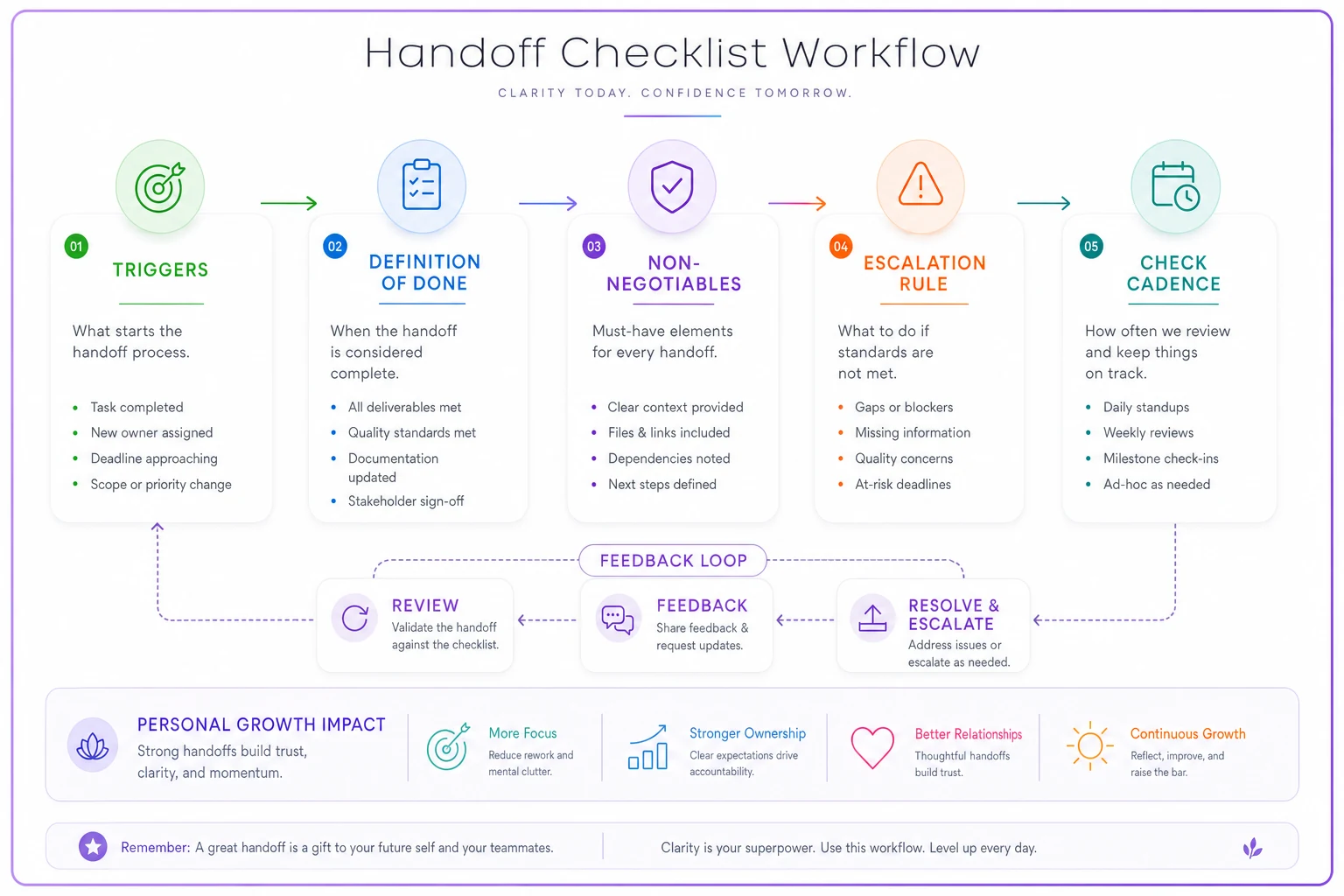
A compact visual like this makes it easy to run the checklist while doing the handoff.
Delegation scripts you can actually use
Vague instructions produce vague results. "Can you just handle the grocery stuff?" is not a handoff — it's a hope. The delegation itself needs a script, and the script needs to include what to do when something doesn't fit the pattern.
A workable structure for the initial handoff conversation, whether it's to a person or a template you're setting up in an app:
-
State the outcome, not the steps. "The pantry should never run out of the twelve staples on this list." Outcomes survive edge cases; step-by-step instructions don't.
-
Give the approved boundaries. The specific brands, the budget ceiling, the vendors. "Stay under $90. If it'd go over, cut the non-essentials first, in this order."
-
Name the escalation trigger explicitly. "If a staple is out of stock, don't substitute — text me and wait." One sentence like this prevents the majority of drift.
-
Set the review checkpoint. "Send me the order summary before you submit for the first three weeks. After that, only if something's off."
-
Confirm they can repeat it back. If they can't restate the non-negotiables, the handoff isn't done.
The escalation trigger is where the whole thing lives or dies. People delegating personal tasks are often terrified of seeming controlling, so they leave the boundaries fuzzy to be "easy to work with." Then they get frustrated when results don't match what was in their head. Clear boundaries aren't controlling — they're actually what lets you stop hovering.
Quality-drift fallback rules
Even a clean handoff degrades over time. You need rules that fire automatically when quality slips, so you're not relying on catching it by chance. Think of these as circuit breakers.
Set two or three simple thresholds per outsourced habit. When a threshold trips, a predefined action happens — no debating it in the moment.
-
The two-strike rule. Two errors of the same type in a month means the handoff goes back to a review checkpoint. Not a firing, not a fight — just a temporary return to closer supervision until it stabilizes.
-
The drift signal. Pick one measurable proxy for quality. For meal prep it might be "how many meals I actually ate versus tossed." For calendar triage, "number of protected blocks that got booked over." When the number crosses a line, you audit.
-
The silent-week check. If you've gone a full month without reviewing an outsourced task at all, that itself is the trigger to do one spot-check. Silence isn't success — it's just the absence of information.
The reason to write these down in advance is that in the moment, you'll rationalize. "It's only one mistake." "They were probably busy." Fallback rules take the rationalizing out of it. The rule fires, you audit, you move on. This is also where being disciplined about what you measure pays off. You don't need a dashboard of twenty metrics on an outsourced habit — you need one or two signals that actually predict whether it's working. The same restraint that makes personal tracking useful applies here; there's a good breakdown of that discipline in why collecting only actionable signals beats tracking everything.
Monitoring templates without turning into a micromanager
Monitoring an outsourced habit should take minutes, not hours. If it takes hours, you haven't outsourced anything — you've just added a coordination job on top of the original task.
A lightweight monitoring template has three fields and nothing more:
-
What was supposed to happen (the definition of done)
-
What actually happened (a one-line status, ideally self-reported by whoever's doing it)
-
Anything that needed a decision I wasn't looped into (the drift catcher)
That third field is the whole game. Most quality problems in outsourced personal tasks come from someone making a decision on your behalf that you would have made differently. If your monitoring surfaces those decisions, you catch drift early. If it doesn't, you find out three weeks later when it's already baked in.
Have the person doing the task fill the one-line status — it keeps checks minutes-long and honest.
For habits shared inside a household, the monitoring layer gets trickier because there's no clean "manager and worker" relationship — it's two people trying not to duplicate or drop things. That coordination has its own failure modes worth understanding separately, covered in how shared habit systems actually work between people.
A real scenario: outsourcing meal prep without losing the plot
A freelance designer — works irregular hours, wanted to stop spending Sunday afternoons cooking for the week. Meal prep scored as medium impact (energy and money both mattered), low sensitivity (fixed menu, no complex dietary needs), medium cost (a meal-prep service ran about $110–$130 a week).
The first attempt failed the way most do. They signed up, said "just pick healthy stuff," and within two weeks were throwing out roughly a third of the meals because the service leaned heavily on ingredients they didn't like. No boundaries, no escalation rule, no definition of done.
The second attempt used the structure above. Approved ingredient list, a hard "no seafood, no mushrooms" non-negotiable, and one escalation rule: if a planned meal has to change, send the swap before cooking it. Review checkpoint for the first three weeks, then only on drift. The result wasn't dramatic, but it held. Waste dropped to maybe one meal every couple of weeks. The time savings — around three to four hours each Sunday — actually stuck, because the handoff stopped boomeranging back to them for corrections. The difference between the two attempts wasn't the service. It was whether there were rules.
When outsourcing a habit actually makes sense
The habit is stable and well-understood — you know what "good" looks like well enough to spot "bad."
-
The habit is stable and well-understood — you know what "good" looks like well enough to spot "bad."
-
The value comes from the outcome, not from you personally doing it.
-
The task is low-to-medium sensitivity — you can write down the boundaries in a few sentences.
-
You have the bandwidth to monitor it for the first few weeks. Handoffs need a break-in period.
The value comes from the outcome, not from you personally doing it.
When it's a bad idea
The habit is still forming. You can't outsource a standard you haven't set.
-
The habit is still forming. You can't outsource a standard you haven't set.
-
The whole point is the practice itself — training, writing, reflection, anything where the doing is the benefit.
-
The task carries a lot of invisible context that would take longer to explain than to just do.
-
You won't actually check the output. An unmonitored handoff will drift, guaranteed, and you'll find out at the worst possible time.
The whole point is the practice itself — training, writing, reflection, anything where the doing is the benefit.
Who should not do this yet
If you're outsourcing to escape a habit you feel guilty about rather than one that's genuinely just logistics, pause. Outsourcing doesn't fix an unresolved habit — it hides it. And if you're delegating because you haven't decided what the habit is even for, the person or tool you hand it to won't have decided either. They'll just make it up, and it'll drift.
The whole approach here is unglamorous on purpose. Scoring, checklists, scripts, fallback rules, thin monitoring templates. None of it is exciting. But that's exactly why outsourced personal habits fail — people treat the handoff as a one-time act of relief instead of an ongoing agreement with clear rules. Get the rules right up front, keep the monitoring light but real, and you can genuinely take things off your plate without watching them quietly fall apart behind your back.
Get the rules right up front, keep the monitoring light but real, and you can genuinely take things off your plate without watching them quietly fall apart behind your back.
Ready to unlock your full potential?
Join thousands of users transforming their lives using Growyly to stay motivated, organized, and growth-focused every day.