
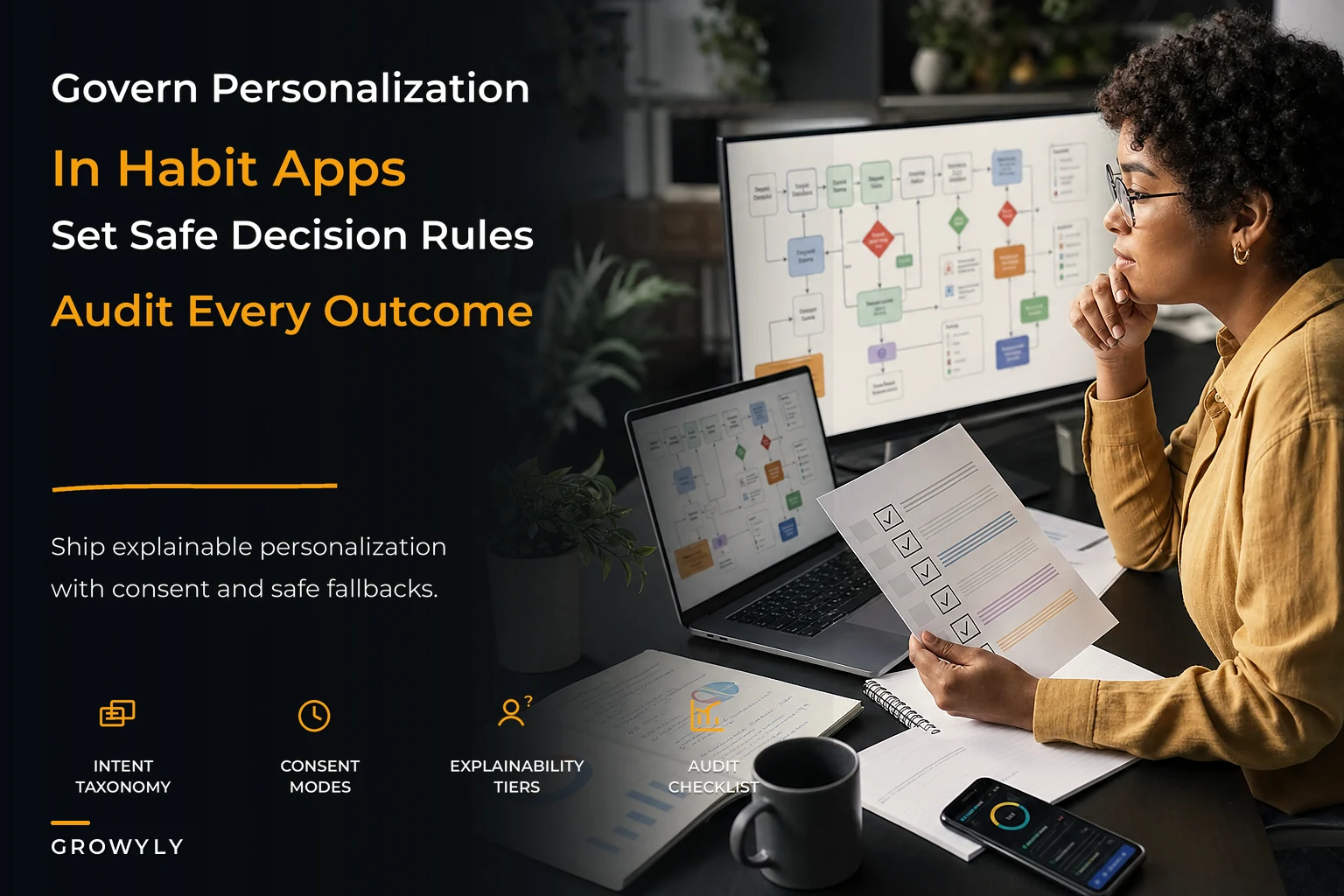

Most habit apps don't fail because their personalization is dumb. They fail because nobody decided, up front, who gets to change your behavior, based on what signal, and with what right of refusal. The recommendation engine ships, it starts nudging, and six months later you've got a product pushing a user to do 40 pushups the morning after they logged a panic attack — because no one wrote down the rule that says "don't escalate intensity when stress markers spike."
Personalization governance is the boring layer underneath the smart features. It's the set of written rules that decide which inferences are allowed, how confident the system has to be before it acts, what it tells the user, and what happens when it's wrong. If you're a power user building your own stack, or a small team shipping a tracker, this is the part that keeps the whole thing from quietly going sideways as you scale.
This isn't a privacy lecture. It's an operations blueprint.
Why personalization quietly breaks as the product grows
In the early version of almost any habit product, personalization is a few hardcoded rules. Miss three days, soften the reminders. Hit a streak, celebrate. Everyone on the team understands the logic because there are maybe eight rules total and one person wrote all of them.
Then the product grows. Someone adds a sleep signal. Someone else adds mood check-ins. A model gets dropped in to predict "best time to nudge." Now you have rules firing off inferred states nobody can fully trace. The classic failure pattern: three separate systems each decide, independently, that the user is "struggling." One dims the goals, one sends an encouraging message, one offers a discount on premium. The user gets hit with all three at once and reads it as the app panicking about them.
That's the real scaling problem. Personalization logic doesn't break at one big moment — it fragments into dozens of small, uncoordinated decisions that were each reasonable in isolation. Governance is what reconnects them into something you can actually reason about.
Teams that get this right treat personalization like a pipeline with stages, not a bag of clever features. Signal comes in, intent gets classified, a decision rule fires, an action goes out, and every step is logged with a reason. When something feels off to a user, you can walk backward through that chain and find the exact decision that misfired. Without that structure, you're debugging behavior change by vibes.
Start with an intent taxonomy, not features
Before you decide how to personalize, you have to decide what the system is even trying to infer. Most products skip this and jump straight to "the model will figure out what the user needs." That's how you end up with inferences nobody can name or audit.
Achieve more by focusing on what matters.
Growyly helps you build lasting habits and track your personal growth effortlessly.
- Goal setting with progress tracking
- Daily habit reminders
- Motivational insights and analytics
No credit card required
-
Scheduling intent — the user wants help with when, not whether. Low stakes. Safe to personalize aggressively.
-
Difficulty-fit intent — the current habit is too hard or too easy. Medium stakes. Getting it wrong is annoying but recoverable.
-
Motivation-state intent — inferred drops or spikes in engagement. Medium-high stakes, because acting on it means commenting on the user's internal state.
-
Capacity/stress intent — signals that the user is overwhelmed, ill, or stretched thin. High stakes. Mistakes here feel invasive or tone-deaf.
-
Risk intent — anything brushing against mental health, disordered patterns, or self-worth. Highest stakes. Should rarely trigger automated action at all.
The insight most teams miss: the stakes of an intent should determine how conservative the whole pipeline is downstream. Scheduling intent can run on a thin signal and a cheap model. Capacity intent needs multiple corroborating signals and a quiet, reversible action. Writing this down forces an honest conversation about which inferences you're actually qualified to make — a conversation closely tied to the consent and mental-health guardrails that should sit over the whole system.
How a decision moves through the pipeline
Most governance breakdowns don't happen because the rules are wrong. They happen because nobody mapped out how a decision actually travels from raw signal to user-facing action. Here's the basic flow for a well-structured personalization pipeline:
-
Signal ingestion — raw data comes in (check-in logs, completion timestamps, sensor data). At this stage, sensitivity is flagged and on-device vs. cloud routing is decided.
-
Intent classification — the signal is matched to a named intent in the taxonomy. If it doesn't map cleanly, it doesn't proceed.
-
Stakes check — the classified intent is checked against its documented stakes level. High-stakes intents trigger a higher confidence threshold before moving forward.
-
Confidence gate — if the model or rule isn't confident enough given the stakes, the decision falls to the defined fallback. No action is taken on a weak signal for a high-stakes intent.
-
Coordination check — the proposed action is checked against what else has fired for this user recently. A cap on stakes-escalating actions per rolling window lives here.
-
Explainability tier applied — the action is wrapped in the appropriate explanation level (silent, notice, explain + confirm, or blocked).
-
Action dispatched and logged — the action fires, and the triggering signal, intent classification, and reason are written to the decision log.
-
Outcome recorded — dismissal, engagement, or user override is captured and fed back into the system without surfacing the sensitive signal layer to the cloud.
A diagram of this sequence helps make coordination gaps obvious.
Running a new proposed nudge through this sequence is the fastest way to spot where it'll break.
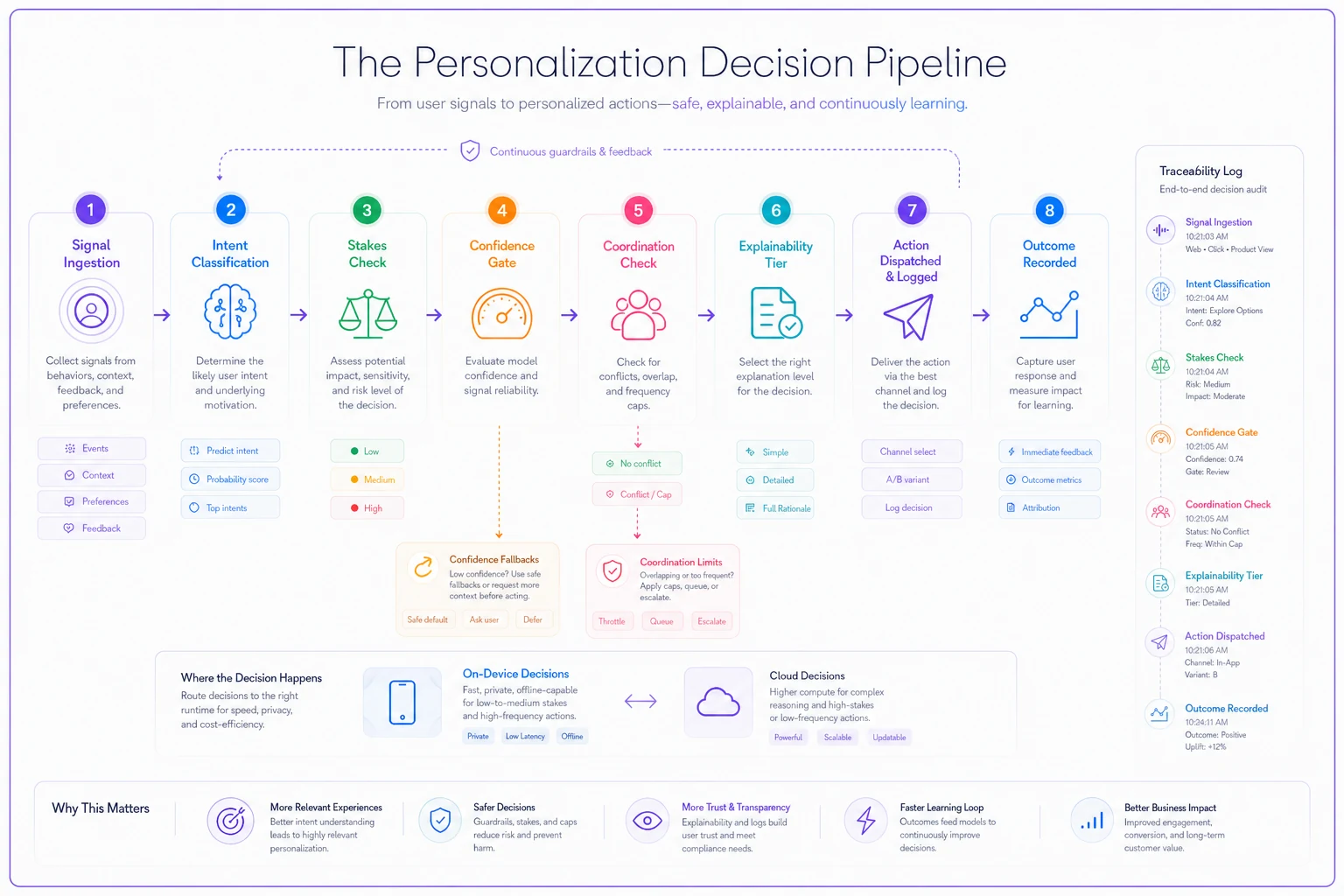
If you can't answer what happens at the confidence gate for a high-stakes intent, the feature isn't ready.
Explainability tiers: match the explanation to the stakes
Not every personalization needs a paragraph of justification. Explaining why the app moved a reminder from 8am to 8:30 would be absurd. But silently cutting a user's goal in half, without a word, is the kind of change that makes people uninstall.
| Tier | Applies to | What the user sees | Example |
|---|---|---|---|
| Silent | Low-stakes scheduling, formatting, ordering | Nothing | Reminder nudged 20 min earlier |
| Notice | Difficulty-fit, minor goal tweaks | One-line "why" with an undo | "Lowered to 10 min since the last 4 sessions got skipped" |
| Explain + Confirm | Motivation and capacity intents | Reason shown before acting, user approves | "Looks like a heavy week — want to pause the streak pressure?" |
| Blocked from automation | Risk intent | No automated action; surfaced as a resource, not a nudge | Offers support content, never changes goals on its own |
The pattern worth borrowing: the higher the stakes, the more the system asks instead of acts. A lot of products get this backwards — they silently make big changes and loudly explain trivial ones, because the trivial ones were easier to build. Flip it. Users tolerate silence on small stuff and resent it on anything that touches how they feel about themselves.
One thing worth noting from watching these systems in practice: the "undo" matters as much as the explanation. A notice tier with no easy reversal just tells the user you changed something they can't change back. The reason text and the undo are a pair.
On-device vs cloud decision rules
Where a decision gets made is a governance choice, not just an engineering one. It determines what data leaves the device, how fast the system can react, and what happens when the network drops.
The practical rule: keep high-sensitivity inferences on-device, and push only low-sensitivity or aggregate decisions to the cloud.
-
On-device is right when the signal is sensitive (mood logs, stress markers), the decision is time-sensitive (a nudge that has to fire at a specific moment), or the user is offline. Capacity and risk intents especially belong here, because the raw signals behind them are exactly the data you don't want leaving the phone.
-
Cloud is right when the decision benefits from patterns across a lot of usage (what nudge timing works best for people with similar schedules), or when the model is too heavy to run locally and the input is non-sensitive.
A clean split looks like this: the device decides whether to act on a sensitive state, and the cloud only ever sees anonymized outcomes — "a nudge was sent, it was dismissed" — never the stress reading that triggered it. Your learning loop still improves without hoovering up the sensitive layer. This connects directly to collecting only the signals you can actually act on rather than everything the sensors can grab.
The mistake is defaulting everything to the cloud "to be safe for the model" and then discovering you're storing a detailed emotional timeline of every user. That's not a feature. That's a liability with a retention schedule.
Consent and fallback modes
Consent in habit products is usually treated as a one-time checkbox at signup. That's not consent — that's a shrug. Real consent for personalization is scoped and revocable per intent category. A user should be able to say "yes, help me with timing, but don't try to read my mood" and have the system actually respect that.
That means consent has to map onto the intent taxonomy. Each intent category gets its own switch. When a user turns off motivation-state personalization, the system doesn't just hide the feature — it stops computing the inference entirely, and the decision rules downstream fall back to non-personalized defaults.
-
Consent withdrawn — user opted out of this intent category.
-
Low confidence — the model isn't sure enough to act given the stakes.
-
Signal missing — the data the rule depends on isn't available (offline, sensor off, new user with no history).
In every case, the fallback should be a sane, non-personalized default — not a frozen screen, not a wrong guess, not nothing. For a reminder, the fallback is the fixed schedule. For difficulty, it's the goal the user last set manually. The quiet failure mode to avoid: a system that, when it loses the signal, keeps acting on a stale inference from last week. That's how someone who recovered from a rough patch keeps getting treated like they're still in it.
Archetype-to-rule worked mappings
Taxonomies and tiers stay abstract until you map them onto real user patterns. The point isn't to box users into permanent types — it's to give the team concrete, reviewable examples of how the rules behave for different people.
Archetype: the overcommitter. Signs up with six habits, strong first week, then drops off a cliff.
-
Difficulty-fit intent fires
after four or more missed sessions across multiple habits, surface a "want to pause some of these?" prompt at Explain + Confirm tier.
-
Rule
suggest, never auto-remove. Reducing someone's declared goals without asking reads as the app giving up on them.
-
Fallback (no consent)
show a plain progress summary and let them decide.
Archetype: the steady-but-stalled. Consistent for months, no growth, mild boredom signals.
-
Difficulty-fit intent fires
detect a long plateau, offer a small step-up at Notice tier with undo.
-
Rule
increase by one small increment, once, then wait and watch before suggesting again.
-
Fallback
keep the current goal.
Archetype: the fragile returner. Coming back after a lapse, high sensitivity to pressure.
-
Capacity intent dominates
suppress streak-pressure language entirely for the first stretch back.
-
Rule
Blocked from automation on anything that frames the lapse as failure. No "you broke your streak" messaging.
-
Fallback
neutral, encouraging default copy regardless of signal.
Writing these out makes them review artifacts. When someone proposes a new nudge, you check it against the fragile-returner mapping and immediately see whether it would hurt the person who most needs gentleness. If you want a market view of how different products handle these tradeoffs, the buyer's guide to personalized habit apps is a useful comparison point.
A real scenario
A small team shipping a habit tracker — around 11,000 active users, five staff — had a churn problem they couldn't explain. Retention looked fine through week three, then dropped hard around week five. Support tickets had a recurring flavor: "the app keeps telling me I'm failing," "it lowered my goals and I didn't ask it to."
When they traced it, the culprit was exactly the fragmentation problem described above. Three features — the adaptive goal system, the re-engagement messaging, and a premium-upsell trigger — were all keying off the same "user is disengaged" signal, firing independently. A user who missed a few days got their goals cut and a guilt-flavored nudge and a discount offer in the same 48 hours.
They didn't add features to fix it. They added governance. A five-intent taxonomy, explainability tiers mapped to each intent, and one coordination rule: no more than one stakes-escalating action per user per rolling week, with capacity intent given veto power over the others. Difficulty changes dropped to Notice tier with undo. The guilt copy got rewritten and gated behind confirm.
The week-five cliff didn't vanish, but it flattened — churn in that window came down by roughly a quarter over the following two months, and the "app is panicking about me" ticket category mostly dried up. Nothing about the models changed. They just stopped letting three systems shout over each other.
When heavy governance actually makes sense — and when it doesn't
This level of governance makes sense when your product infers anything about emotional or capacity states, when multiple features act on overlapping signals, or when you're past the point where one person can hold all the personalization logic in their head. Those are the conditions where silent fragmentation does real damage.
It's overkill when you've got a handful of hardcoded rules and no inferred states. If your "personalization" is "remind at the time the user picked," you don't need an intent taxonomy — you need to not overbuild. Governance scaffolding on a tiny deterministic product is just friction.
And one more thing: anyone treating governance as a compliance checkbox to wave at a privacy policy shouldn't bother. If you write the taxonomy and never use it to review new features, you've built a document, not a system. The point is that it changes decisions — if it never blocks or reshapes a proposed nudge, it isn't doing anything.
An audit checklist you can actually run
Run this quarterly, or whenever you add a signal or a personalized feature:
-
[ ] Every personalized action maps to exactly one named intent in the taxonomy
-
[ ] Each intent has a documented stakes level and a matching explainability tier
-
[ ] High-stakes intents (capacity, risk) are blocked from or gated before automated action
-
[ ] Every decision rule has a defined fallback for
consent off, low confidence, missing signal
-
[ ] No rule acts on a stale inference older than its defined freshness window
-
[ ] Sensitive inferences run on-device; cloud sees only non-sensitive or aggregated outcomes
-
[ ] Consent is scoped per intent category and actually stops the inference when off
-
[ ] A coordination rule caps how many stakes-escalating actions hit one user in a window
-
[ ] Every fired decision is logged with its triggering signal and reason, traceable end to end
-
[ ] The archetype mappings have been re-checked against any new features
The simplest way to use this: pick one personalized feature at random and try to answer every line for it. If you can't, that's your next piece of work.
Personalization in habit products isn't really an AI problem — it's a coordination problem wearing AI's clothes. The models are usually fine. What breaks is the absence of agreed rules about which inferences are allowed, how confident the system must be, what it owes the user in explanation, and what it does when it's unsure. Those decisions don't make themselves, and if you don't write them down, the system makes them for you — inconsistently, invisibly, and usually at the worst moment for the person on the other end.
Build the taxonomy, tier the explanations, decide where decisions live, scope the consent, and keep the audit honest. Do that and personalization stops being something that happens to your users and becomes something they can actually steer.
Ready to unlock your full potential?
Join thousands of users transforming their lives using Growyly to stay motivated, organized, and growth-focused every day.