


The dangerous part of getting sick isn't the sickness. It's day four — when you feel fine enough to jump straight back into your 6am runs, your two-hour deep work blocks, and your evening cooking routine all at once — and then you're flattened again by the weekend.
Most people treat recovery as binary. Sick, then not sick. Back to normal. But the body doesn't come back online all at once, and neither should your routines. You actually need a graded re-entry with hard checkpoints, explicit conditions for slowing down, and a very conservative definition of "ready."
This is a non-medical framework. It won't tell you whether you're recovered — that's between you and a clinician. What it does is give you a structured way to reintroduce habits after you're clinically cleared to resume normal activity, using signals you can actually observe, so you don't torch your progress by rushing.
The core mistake: treating "I feel better" as a green light
Feeling better is a terrible signal to rebuild on. It's noisy, it's mood-dependent, and it spikes right before you overreach.
This pattern comes up constantly with anyone who tracks their own routines. Energy returns in bursts during recovery. You get one good morning, feel like yourself again, and stack four habits back on in a single day. By evening you're wrecked — and now you're not just recovering from the illness, you're recovering from the crash you caused. That secondary dip often lasts longer than the original setback.
Stop trusting the feeling. Start trusting a small set of observable, boring signals that don't lie to you. Sleep is the big one. Then symptom presence during specific windows. Then a self-rated capacity check you commit to before you know how the day is going.
The three signals worth watching
You don't need a fancy setup. You need two or three signals that actually predict whether tomorrow will hold. Tracking more than that during recovery just creates noise you'll ignore. If you've read the case for collecting only signals you can act on, this is that principle applied under pressure — recovery is exactly when you have the least attention to spend on dashboards.
Achieve more by focusing on what matters.
Growyly helps you build lasting habits and track your personal growth effortlessly.
- Goal setting with progress tracking
- Daily habit reminders
- Motivational insights and analytics
No credit card required
Three checkpoints worth using:
| Signal | What you're checking | Green | Yellow | Red |
|---|---|---|---|---|
| Sleep | Consistency + duration over last 2 nights | Normal duration, no major disruption | Slightly short or one rough night | Broken sleep or notably short both nights |
| Symptom window | Presence of symptoms during your target habit time | None during window | Mild, fades quickly | Present or worsening in the window |
| Capacity check | Self-rated energy scored before the day starts | Feels sustainable | Doable but requires effort | Depleted before you begin |
The symptom window matters more than symptoms in general. You might feel fine at 2pm but be wiped at 6am when your run would happen. So you check for symptoms specifically during the time slot the habit lives in — not your best hour of the day.
One rule for the capacity check: score it in the morning, before coffee, before you've seen how things are going. Scoring it after the fact just rationalizes whatever you already did.
The 7/14/30 structure
The ramp runs in three phases. Each phase has a fidelity ceiling — a maximum you're allowed to do, not a target you're pushing toward. That inversion matters. During recovery, restraint is the discipline.
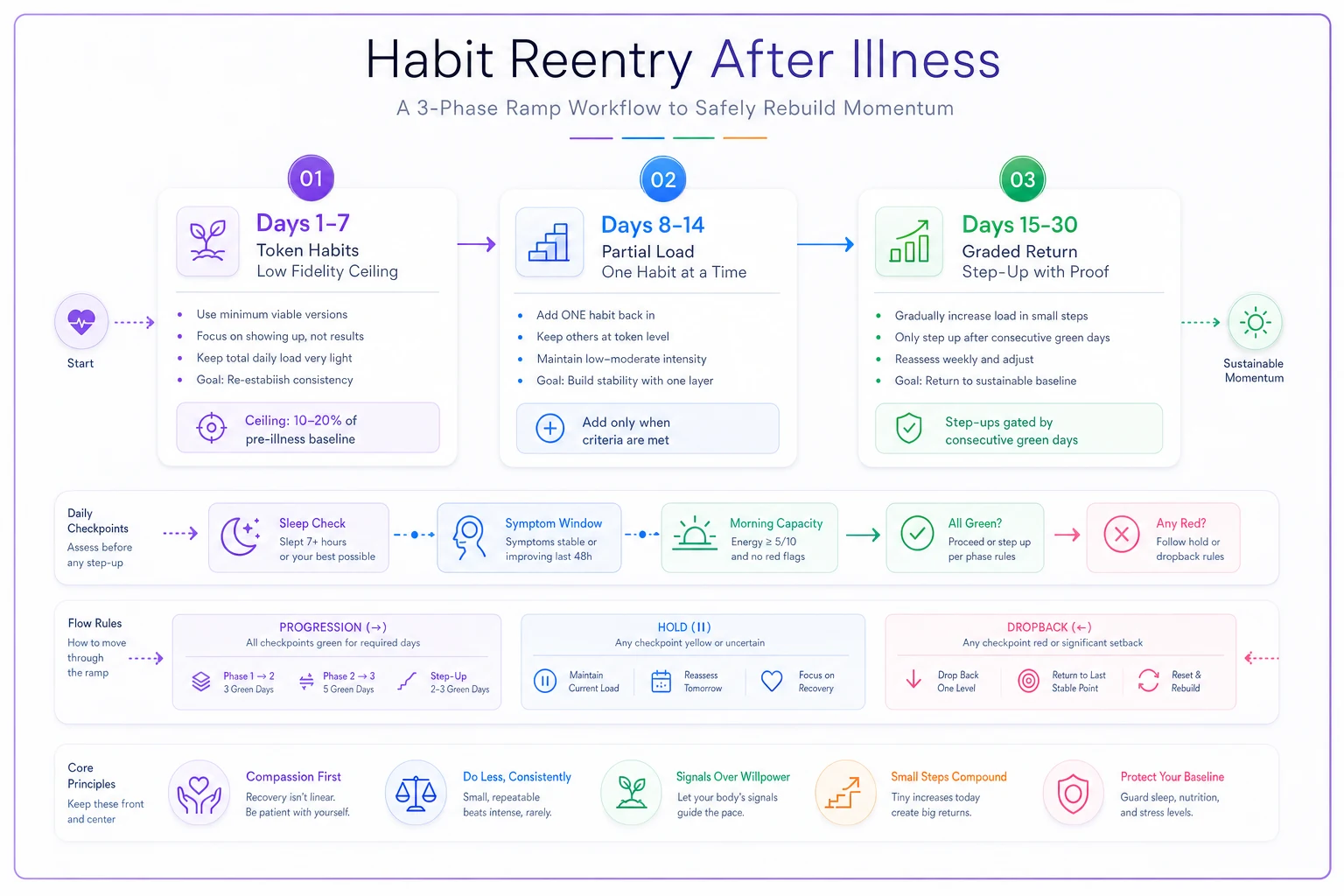
A simple visual to keep the ceilings and checkpoints clear.
```
[GRAPH: 7/14/30 Ramp Phases — Fidelity Ceiling by Day] Days 1–7: Token habits only, 20% ceiling Days 8–14: Partial load, 50% ceiling, one habit at a time Days 15–30: Graded return, 10–15% step-ups gated by green days
```
Days 1–7: Anchors only
You're not rebuilding habits yet. You're re-establishing the cues so the neural furniture is still there when you're ready to load it.
Each habit gets reduced to a one-minute token version. Not shortened — token. A 40-minute workout becomes putting on your shoes and walking to the end of the street. A writing session becomes opening the document and typing one sentence.
Fidelity ceiling: 20% of normal. You're not allowed to exceed it even if you feel great.
This feels absurdly easy, and that's the design. Week one's goal is zero crashes, not progress. If you can't hit even the token version because symptoms are present in the window, you don't advance — you hold.
This mirrors the logic in a shame-free lapse recovery approach: the re-entry itself is the win, and the size of the action is deliberately trivial so nothing can knock you off it.
Days 8–14: Partial load
Now you start adding real volume, but only for habits that cleared week one without a red flag.
Fidelity ceiling rises to 50% of normal. Habits come back one at a time, spaced at least 48 hours apart — no stacking two new ones on the same day. A run comes back at half distance and a slower pace. A deep work block comes back at 45 minutes instead of 90. Physically demanding or high-cognitive-load habits go last, regardless of how much you miss them.
The 48-hour spacing exists because the crash from overreaching often lags a day. If you add two habits Monday and feel awful Wednesday, you can't tell which one caused it. One at a time keeps the signal clean.
Days 15–30: Graded return to full
This phase moves from 50% toward 100%, but the last stretch is where people faceplant.
The ceiling climbs by roughly 10–15% every few days, gated by checkpoints. Two consecutive green days required before each step up. Full fidelity is the last thing you restore, not the assumed default you race back to.
Don't compress this phase. Around day 20 — when you're basically fine — the temptation is to declare victory and go back to full. That's the exact moment the conservative approach earns its keep.
Explicit stop rules
A ramp without stop rules is just a wish. You need pre-committed conditions that force you to hold or drop back, decided in advance so you're not negotiating with yourself mid-crash.
-
Two yellow days in a row → hold. Don't advance the ceiling. Repeat the current phase.
-
Any red day → drop back one phase. No exceptions, no "but I feel okay now."
-
Symptom return during the target window → full stop on that specific habit. Others can continue.
-
Sleep disruption two nights running → hold everything, regardless of how the rest feels.
-
Three holds in the same phase → stop the ramp and check in with a clinician.
That last one matters. If you keep bouncing off the same checkpoint, the problem isn't your ramp pacing — it's that you may not be recovered enough to be doing this at all. That's a medical question, not a habit question.
If you keep bouncing off the same checkpoint, the problem isn't your ramp pacing — it's that you may not be recovered enough to be doing this at all. That's a medical question, not a habit question.
Where the clinician line sits
This framework starts after medical clearance and stops the moment your signals suggest you're not actually cleared. Those are the two hard edges.
If any of the following show up, you're outside the scope of a self-directed ramp: symptoms getting worse across days rather than better, new symptoms appearing, chest or breathing issues during even light activity, or that repeated-holds pattern against the same checkpoint. None of those are things a habit protocol should manage. Step out, don't push through.
The conservative fidelity thresholds — the low ceilings, the required green days, the 48-hour spacing — exist partly to surface these situations early. A ramp that keeps stalling is giving you diagnostic information. Listen to it.
A real scenario
Someone recovering from a bad flu had a normal stack: morning strength training four days a week, a daily 90-minute writing block, and an evening meal-prep routine. Cleared by their doctor on day six, they'd always crashed around day nine in previous recoveries — because they'd go from zero straight back to the full stack in about two days.
This time they ran the ramp.
Week one was token-only: shoes on and a short walk, one paragraph, reheating instead of cooking. Ceiling capped at 20%. Two mildly rough sleep nights triggered a hold, so week one stretched closer to nine days.
Week two, the writing block came back first at 45 minutes, with a two-day wait before reintroducing light training at half volume. Strength work threw a yellow-yellow pair around day 12, so they held instead of climbing. By the back half of the month they were near full on writing and meal prep, with training the last thing restored — hitting normal load around day 28.
No heroic comeback. But no secondary crash either — the first clean recovery in years. And the total time to full function was actually shorter than the old crash-and-recover cycle, even though it felt slower day to day.
When this makes sense (and when it doesn't)
This is worth doing when: you have a meaningful habit stack, you've historically crashed during re-entry, and you're recovering from something with a real energy cost — flu, a bad viral run, anything that flattened you for several days.
This is overkill when: you had a mild 24-hour thing and bounced back fully. You don't need a 30-day protocol for a one-day cold. Just resume normally.
Do NOT use this as a substitute for medical guidance if you're recovering from anything serious, anything cardiac or respiratory, or anything where a professional gave you specific return-to-activity instructions. Their instructions override everything here. This framework organizes habit re-entry within clearance you've already been given — it never replaces it.
Making the ramp actually stick
People abandon this kind of plan not because it's wrong — it's because the ceilings feel too low when energy returns and impatience takes over. The fidelity thresholds only work if you treat them as non-negotiable ceilings, not suggestions.
One thing that helps: this whole approach fits cleanly into a resilience-first habit design where auto-adjust rules are baked in from the start. If your habits already have built-in downshift levels — full, reduced, token — you're not inventing a recovery plan from scratch while sick. You're just moving down levels you already defined, then climbing back up on green days.
Map your habit downshift levels to the ramp before you get sick so you can switch levels without decision fatigue.
Set the stop rules in writing before you start. Pick your two or three signals and ignore everything else. Honor the ceilings. And when the ramp keeps stalling on the same checkpoint, take that as the signal it is — not to push harder, but to ask someone qualified whether you should be ramping at all.
Coming back slower than you want is annoying. Coming back and crashing again costs you two weeks and your confidence. The conservative version is faster in the only measure that counts: time to a full return that actually holds.
Coming back slower than you want is annoying. Coming back and crashing again costs you two weeks and your confidence. The conservative version is faster in the only measure that counts: time to a full return that actually holds.
Ready to unlock your full potential?
Join thousands of users transforming their lives using Growyly to stay motivated, organized, and growth-focused every day.