


Most team habit initiatives die in week three. Not because the habits were bad, but because nobody built the machinery to keep them running once the initial enthusiasm faded. A manager reads a book, gets excited, rolls out a "daily standup reflection" or a "Friday wins thread," and for about two weeks it's magic. Then one person skips. Then two. Then the manager stops nagging because nagging feels gross, and within a month the whole thing is a ghost town in a Slack channel nobody opens.
The problem isn't the habit. It's that individual habit design and team habit design are two completely different disciplines, and almost everyone treats them like they're the same thing. When you're building a habit for yourself, you only have to coordinate with one person. When you're scaling habit systems across teams, you're managing variance, drift, onboarding, retirement, and the fact that what works for your most organized person actively annoys your most creative one.
This is the piece I wish someone had handed me when I first tried to get a team to adopt shared rituals. It's about the system — the playbooks, the cadence, the escalation rules — not the motivational pep talk.
Why team habits break where individual habits don't
An individual habit has a single point of failure: you. A team habit has a point of failure for every single member, plus the connective tissue between them. That's not additive difficulty, it's multiplicative.
Here's the pattern that shows up over and over. A manager designs a team habit around their own working style. They're a morning person who loves written reflection, so the ritual becomes a 9 a.m. written check-in. Half the team is fine. The other half includes two night owls, one person who processes verbally instead of in writing, and someone in a different time zone for whom 9 a.m. is 6 a.m. The habit was never designed for them, so their non-adoption gets read as a discipline problem when it's actually a design problem.
What breaks at scale is coordination cost. With three people, you can eyeball whether the ritual is working. At eight people, you can't hold it all in your head. At fifteen-plus across functions, the manager becomes a bottleneck — every reminder, every exception, every "hey, are we still doing this?" routes through one person who has an actual job besides being the habit police.
The other quiet killer is that teams accumulate habits the same way they accumulate meetings: by addition, never subtraction. Nobody ever retires the Tuesday ritual when they add the Thursday one. Within a year you've got a calendar full of rituals that each made sense individually and collectively suffocate everyone. The same logic behind prioritizing, rebalancing, and retiring habits at the individual level applies brutally hard at the team level — except now retirement requires social permission, which most teams never grant.
Role-based playbooks: stop asking everyone to do the same thing
The single biggest unlock in team habit design is accepting that roles have different habit needs, and building the playbook around the role rather than the person.
Achieve more by focusing on what matters.
Growyly helps you build lasting habits and track your personal growth effortlessly.
- Goal setting with progress tracking
- Daily habit reminders
- Motivational insights and analytics
No credit card required
A sales rep's useful daily habit might be a two-minute pipeline hygiene pass. A support lead's might be a ticket-sentiment scan. An engineer's might be a 15-minute "leave a trail" note so the next person isn't lost. Forcing all three into the same "daily reflection" template produces three people half-heartedly doing a ritual that fits none of them.
-
What's the core habit this role actually benefits from? (Not what sounds nice — what moves their work.)
-
What's the trigger? (A calendar event, a status change, the end of a meeting — something that already exists in their day.)
-
What's the minimum viable version? (The thing they do on their worst, busiest day so the streak never fully breaks.)
-
What's the artifact? (The visible trace that proves it happened without anyone having to ask.)
That last one matters more than people expect. If a habit produces no artifact, the manager has only two options for knowing whether it's happening: trust or surveillance. Both corrode over time. A lightweight artifact — a one-line entry, a checked box, a short thread reply — lets adoption be observed passively instead of policed actively.
| Role | Core habit | Trigger | Minimum version | Artifact |
|---|---|---|---|---|
| IC / Engineer | End-of-day handoff note | Last calendar block | One sentence on where they left off | Note in shared doc |
| Team lead | Weekly blocker scan | Monday first hour | Three-bullet blocker list | Posted in team channel |
| Sales | Pipeline hygiene pass | After last call | Update two stale deals | CRM timestamp |
| Support | Sentiment check | Shift end | Flag one recurring theme | Tagged ticket |
| Manager | Cadence health review | Friday close | Glance at participation | Short status in review doc |
Notice that the manager has a habit too, and it's about watching the system rather than doing the frontline ritual. That's the part most managers skip, which is exactly why the system drifts.
Make the artifact the default way to signal completion so passive observation works without extra nudges.
Here's how the same underlying habit — "reflect and adjust" — translates across roles:
Onboarding templates: the first two weeks decide everything
When a new person joins, they inherit the team's habits by osmosis — which means they inherit a garbled, half-explained version of them. The habit gets described in a sentence during week one, buried under forty other onboarding tasks, and the new hire reasonably concludes it's optional.
-
Day 1–2
Explain the why, not the what.
New people adopt rituals they understand the purpose of and abandon the ones that feel like busywork. Thirty seconds on "we do the end-of-day note because handoffs used to lose us hours" beats a paragraph of instructions. -
Day 3–5
Pair them with a model.
The new hire watches someone experienced do the habit and copies the format exactly. Format consistency early prevents the slow mutation where everyone's version drifts apart. -
Week 2
Shadow period with low stakes.
They do the habit but nothing bad happens if they forget. The point is building the trigger association, not enforcing perfection. -
Week 3–4
Full participation with one check-in.
A single "how's the rhythm feeling?" conversation catches friction before it hardens into avoidance.
The mistake I see constantly: teams onboard people to the tools and the org chart but never to the rituals. Then six months later there's a visible split between the "old guard" who do the habits and the newer folks who never learned them, and the manager wonders why culture feels inconsistent. It's not a culture problem. It's a missing onboarding step.
Cadence design: daily async → weekly sync → monthly review
The most common cadence mistake is putting everything on the same frequency. Teams either try to do everything daily (exhausting, collapses fast) or everything in a big weekly meeting (bloated, nobody remembers Monday by Friday). The fix is matching the frequency to what the habit actually needs.
Daily should be async and tiny. Anything that happens every day has to survive on days when people are slammed, sick, or traveling. The only things that belong at daily frequency are habits with a sub-two-minute minimum version and a trigger that already exists. Daily sync meetings for habit reinforcement are almost always a mistake — they create scheduling tax that eventually outweighs the benefit.
Weekly should be the sync point. Not a status readout — those can be async — but the genuinely synchronous stuff: surfacing blockers, catching drift, celebrating something real. A weekly sync of 20–30 minutes focused on the habit system (not crammed into a packed standup) gives the rituals a heartbeat.
Monthly should be the review and rebalance. Once a month, the manager and ideally a couple of team members step back and ask: Which habits are actually running? Which ones have quietly died? Which ones should we retire on purpose instead of letting them rot? This is also where you decide if a new habit earns a slot — and critically, what gets removed to make room. A team that can only run four rituals well should never be carrying nine.
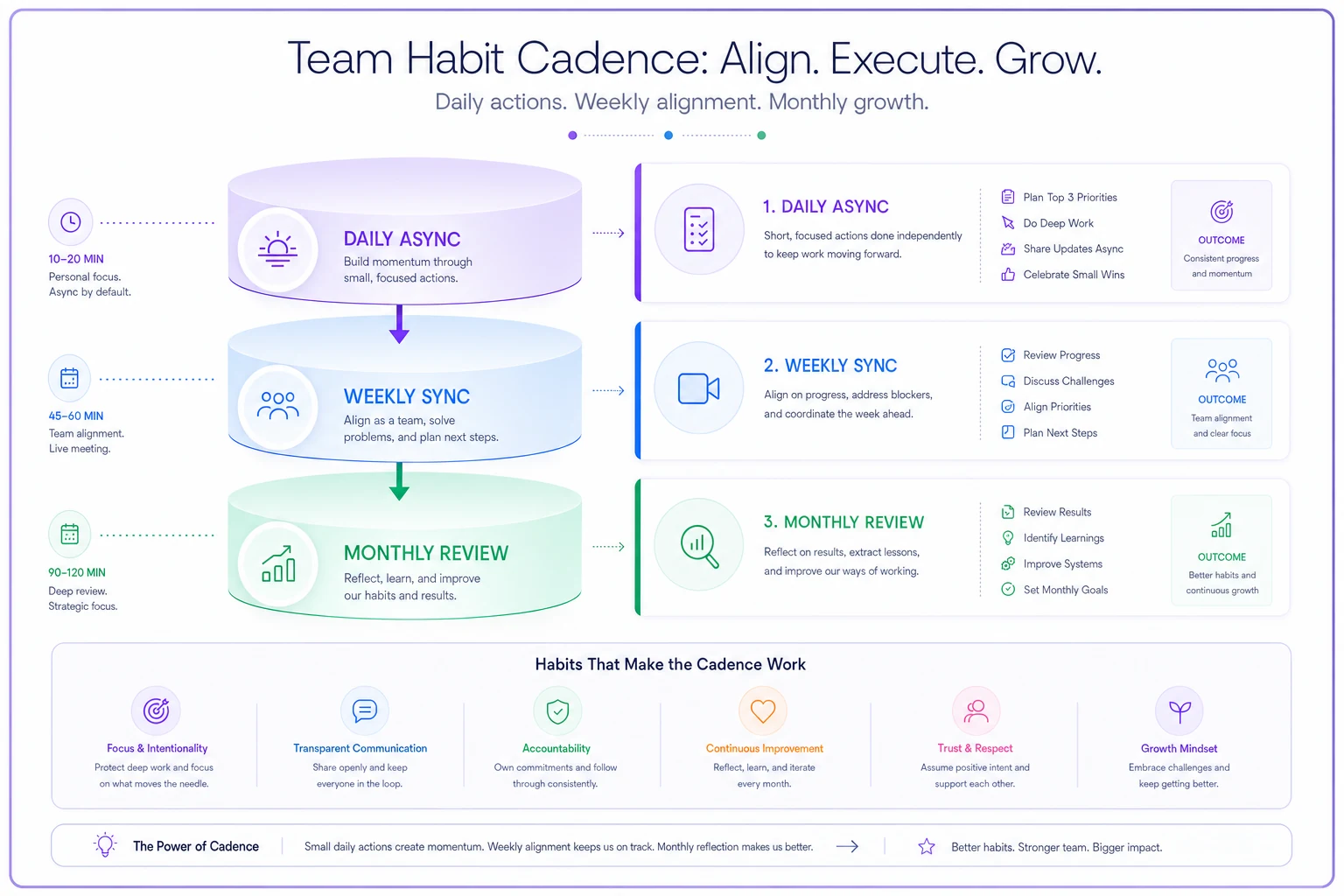
The rhythm matters because each layer catches what the others miss. Daily builds the muscle. Weekly catches individual drift. Monthly catches systemic drift. Skip the monthly and you get the meeting-accumulation problem — rituals pile up and nobody has authority to cut them. Skip the weekly and small problems compound silently for a month before anyone notices.
Escalation and retirement rules: what to do when a habit stops working
Most teams have nothing here — no rules at all. A habit starts slipping and the manager's only tools are awkward private nudges or pretending not to notice. Both are bad. You need pre-agreed rules so that when adoption drops, the response is a system, not a personality conflict.
Escalation is for when a habit is still worth saving but adoption is sliding. A reasonable ladder:
-
Tier 1 — Passive signal. Participation drops below a threshold (say, under 60% of the team in a given week). The manager mentions it lightly in the weekly sync. No names, no shame, just "hey, the end-of-day notes got thin this week — anything getting in the way?"
-
Tier 2 — Friction investigation. If it's still low two weeks later, the assumption flips: the problem is the design, not the people. The manager actually asks what's broken. Usually the trigger moved, the minimum version is too big, or the habit stopped being useful.
-
Tier 3 — Decision point. If it's still failing after investigation, you either redesign it or retire it. You do not keep limping along. A half-dead ritual costs more than no ritual because it generates guilt and clutters the system.
Retirement is the part nobody builds and everyone needs. A habit should be retired — deliberately, out loud — when it's done its job, when the thing it was fixing no longer exists, or when the cost finally outweighs the value. The ritual of retiring matters: announce it, thank the habit, remove it from every doc and channel. Silent death leaves zombie rituals cluttering the onboarding template for the next hire who dutifully learns a habit the team abandoned months ago.
This is genuinely easier when the team has shared decision-making rather than one person unilaterally deciding. The dynamics of peer governance for small-group habit systems apply directly here — habits that the group collectively owns get retired cleanly, while habits owned by one manager either live forever out of inertia or die the moment that manager gets busy.
Measuring cultural adoption without turning into a surveillance machine
The temptation when scaling is to measure everything. Resist it. The goal isn't a dashboard with forty metrics; it's two or three signals that actually predict whether the culture is sticking.
-
Participation breadth, not depth. How many people touched the habit this week, not how perfectly. A ritual done loosely by everyone beats one done perfectly by three people and ignored by the rest.
-
Self-restart rate. When someone lapses, do they come back on their own, or only when nudged? A team where people self-restart has internalized the habit. A team that needs constant nudging hasn't — and that gap tells you the habit isn't yet cultural, it's just compliant.
-
New-hire adoption time. How long until a new person is doing the habit naturally? If it's taking months, your onboarding template is broken.
What you deliberately should not measure: streaks for individuals, perfection scores, or anything that creates a leaderboard. The moment a team habit becomes a competition, people optimize for the metric instead of the outcome, and the quiet folks who do the work without fanfare get punished.
One thing worth naming: adoption metrics are lagging indicators of friction. By the time participation visibly drops, the friction has usually been building for weeks. The weekly sync exists partly to catch the qualitative grumbling before it shows up in the numbers.
When this whole approach makes sense — and when it doesn't
This makes sense when: your team is above roughly five people, spans more than one role or time zone, and you've already tried the "just tell everyone to do it" approach and watched it fade. The playbook machinery is overhead, and overhead only pays off when coordination cost is real.
This is a bad idea when: you're a team of two or three who already talk constantly. At that size, formal playbooks and cadence design are bureaucracy you don't need — a shared habit between three people who sit in the same room runs on conversation, not documentation. You'd be building a cathedral to hold a campfire.
Who should NOT do this: managers hoping the system will substitute for them actually caring whether the habit helps their people. If the underlying ritual doesn't make someone's work better, no amount of cadence design or escalation rules will save it. The machinery amplifies a good habit; it can't rescue a pointless one. And managers who try to run this on pure willpower and nagging will burn out — the whole point is to build something that runs on structure instead of pressure, the same way individuals learn to stop burning willpower with a systems approach to motivation.
A real scenario: a 12-person support and ops team
A mid-sized e-commerce company had a 12-person team split between customer support and operations, across two time zones. They'd rolled out a daily "wins and blockers" thread about four months earlier. Early on, nine or ten people posted daily. By the time it came up as a problem, it was down to maybe three regulars, and those three were quietly resentful that it felt like only they were bothering.
The manager's instinct was to send a firm reminder email. Instead they ran the thing through an actual diagnosis. Two findings: the ops folks had no natural trigger — their day didn't have a clean "end," so the ritual never attached to anything. And the whole team had been forced into one format, when support genuinely benefited from logging recurring customer themes while ops needed something closer to a blocker list.
They split it into role-based versions, moved it from daily-mandatory to daily-async-with-a-weekly-sync-recap, and set a participation threshold of around 60% before the manager would raise it in the weekly meeting. They also retired an old Friday "shout-out" ritual that had been dead for months but was still cluttering the onboarding doc.
Within about six weeks, participation across the whole team recovered to a steady rhythm — not perfect, but broadly consistent, with roughly 8–10 of 12 engaging in any given week. More telling: when a couple of people lapsed during a busy stretch, they came back on their own without being chased. That self-restart was the real signal the habit had actually taken root instead of just being obeyed.
The system is the point
The difference between a team that has habits and a team that has a habit system is whether the thing survives the manager getting busy, a couple of people leaving, and the slow entropy that erodes every ritual over time. A single enthusiastic person can start a team habit. Only a system keeps it alive.
Build the role-based playbooks so people get habits that fit their actual work. Build the onboarding so new people inherit the real version instead of a rumor. Build the cadence so each ritual runs at the frequency it can sustain. Build the escalation and retirement rules so drift gets handled by structure instead of guilt. Measure the two or three signals that tell you whether it's becoming culture — then leave the rest alone.
Do that, and the habits stop depending on any one person's energy. Which is the whole game, because energy runs out. Systems don't.
Ready to unlock your full potential?
Join thousands of users transforming their lives using Growyly to stay motivated, organized, and growth-focused every day.