


The hardest part about touring isn't the work on stage, or the pitch meetings, or the gallery openings. It's everything that collapses the second you leave home — the morning sketch, the vocal warmup you never skip, the 20 minutes of writing you do before email eats your brain. The routine that made you good is also, weirdly, the most fragile thing you own. Hotel rooms, airport gates, and green rooms don't come with your desk, your light, or your quiet.
Most advice on this is useless because it assumes you can just "do a smaller version." That's half right. What actually survives travel is a plan that decides in advance what you're protecting, what you're shrinking, and what you're letting go completely — before you're exhausted and making that call at 11pm in a strange city. That's the whole point of a touring fidelity plan.
If you've already read about the three-tier fidelity approach for general travel and vacations, this is the version built specifically for creative work on the road, where what you're trying to preserve isn't just a streak — it's your skill and your output quality.
The real failure: you keep deciding at the worst possible moment
The breakdown almost never looks like "I quit my practice." It looks like a series of small decisions made while depleted.
You land at 3pm, the hotel gym is closed, soundcheck is at 6, and you tell yourself you'll do your writing "after the show." After the show it's midnight, you're wired, and you scroll instead. Next day the pattern repeats, except now there's a little guilt tax attached, which makes avoiding the work even easier. By day four you're not touring with a practice — you're touring instead of one.
The problem isn't willpower. It's that you're forcing a full decision — what, when, how long, how good — every single day, under conditions designed to make you choose "nothing." A fidelity plan removes that decision. You pre-sort your work into three tiers so that on any given day you just look at your energy and your calendar and pick the tier. No negotiating with yourself at the gate.
The three tiers, defined for creative work
Here's the core structure. The names matter because they tell you what you're actually optimizing for.
Achieve more by focusing on what matters.
Growyly helps you build lasting habits and track your personal growth effortlessly.
- Goal setting with progress tracking
- Daily habit reminders
- Motivational insights and analytics
No credit card required
| Tier | Goal | Time budget | Quality bar | What you're protecting |
|---|---|---|---|---|
| Maintain | Keep skill sharp | 30–60 min | Normal working quality | The actual craft and output |
| Minimal | Keep the circuit warm | 10–15 min | Deliberately low | The habit loop and identity |
| Capture-only | Lose nothing | 2–5 min | No execution at all | Raw material and ideas |
The mistake people make is treating these as "good day / okay day / bad day." They're not a quality ranking of you. They're a quality ranking of conditions. A capture-only day on a 5am flight with two connections is not a failure — it's the correct response. Trying to run Maintain on that day is how you burn out by day three.
Maintain is your home routine, slightly compressed. If you normally write 1,000 words, you write 500. If you normally do a 45-minute technical practice, you do 30 minutes focused on the parts that matter most.
Minimal is not a smaller version of the work — it's a different job entirely. Its only purpose is to keep the neural pathway and the identity intact. A guitarist doesn't practice material at Minimal; they run 10 minutes of scales and one passage. A writer doesn't draft; they edit one paragraph of yesterday's work. You're keeping the circuit warm, not advancing the project.
Capture-only means you don't execute at all. You record the voice memo, snap the reference photo, jot the three lines of dialogue that came to you in the cab. You're preserving the artifact so that when you get home — or hit a Maintain day — you have something to build from instead of a blank page.
Portable warmups: the part everyone skips
The reason your practice collapses on day one is usually that your warmup is location-dependent. You "can't get into it" without your setup, so you don't start, so nothing happens.
A touring warmup has to work in a bathroom, a backstage hallway, or seat 34C. The trick is that a warmup's job isn't to produce good work — it's to get you past the starting friction. On tour that friction is triple what it is at home, so the warmup gets shorter and dumber on purpose.
-
Writers Read one paragraph of yesterday's work out loud, then type the next sentence badly. The "badly" part is a rule, not a suggestion — it kills the perfectionism that stalls you in unfamiliar spaces.
-
Musicians / vocalists One scale and one phrase at low volume. For vocalists, lip trills and a five-note slide work in a car or a stairwell without disturbing anyone.
-
Visual artists / designers A two-minute blind contour of whatever's in front of you — the hotel lamp, a coffee cup. Zero stakes, pure hand warmup.
-
Photographers / filmmakers Frame five shots without pressing the shutter. You're exercising the eye, not filling a card.
-
Performers / speakers Run the first 30 seconds of a piece, physically, standing up, even whispering.
These double as your Minimal tier on rough days. That overlap is intentional — the warmup is the floor. If all you did was the warmup, you still didn't break the chain. For more on building tiny triggers that fire reliably anywhere, the portable anchor library approach pairs well with this.
Artifact preservation: how to not lose the good ideas
The quietly expensive part of touring isn't the practice you skip — it's the ideas you lose. Tour is weirdly generative. New cities, new people, exhaustion-brain, overheard conversations. You get more raw material on the road than at home, and you capture almost none of it because you have nowhere to put it and no energy to process it.
Artifact preservation is just the discipline of catching that material in a form you can actually use later. The key insight: separate capture from processing. On tour you only capture. Processing happens on a Maintain day or at home. Trying to process on the road is what makes capture feel like too much work, so you stop doing it entirely.
A workable capture workflow:
-
One inbox, not five. Pick a single place everything goes — one voice memo app, or one notes file. The friction of deciding where to put something is what kills capture.
-
Timestamp and tag crudely. "song idea," "essay," "shot" — one word. You're not organizing, you're making it findable.
-
Capture in the native form. Melody? Hum it, don't notate it. Visual? Photograph it, don't describe it. Translation into "proper" form is processing — defer it.
-
Weekly sweep. On one Maintain day per week, spend 15 minutes moving captures into your real project files. That's the only processing step.
Most touring creatives capture somewhere between 15 and 40 small artifacts over a two-week run, and without a system they act on maybe two or three. With a crude inbox and a weekly sweep, that number jumps significantly — not because they had more ideas, but because they stopped losing them.
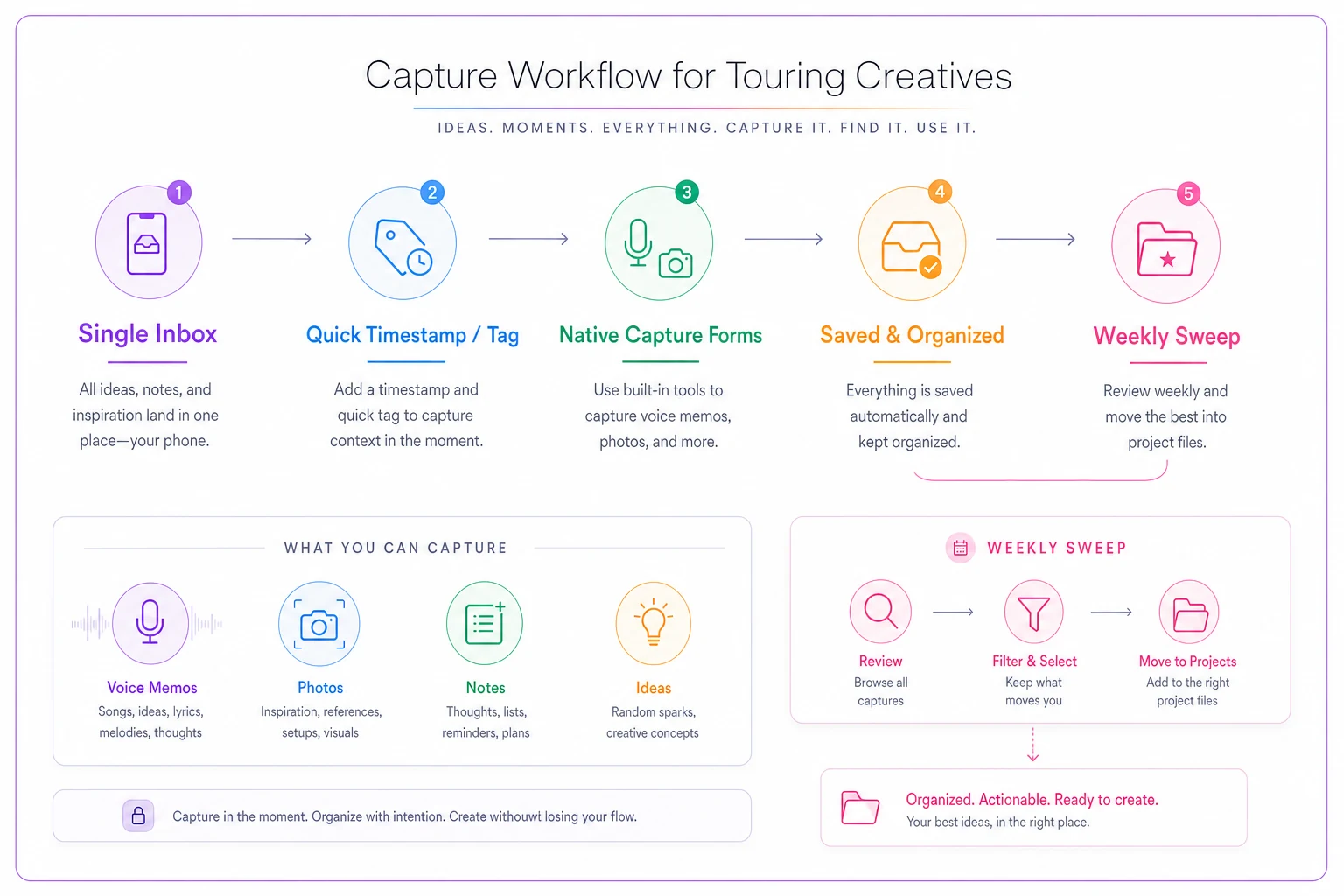
A quick visual of how the capture inbox and weekly sweep link together.
A real scenario
A session musician and part-time songwriter on a mid-size regional touring schedule — roughly 18 shows over three weeks — had the usual pattern: full practice for the first two days, then nothing until he got home, followed by about a week of feeling rusty and "behind."
The change was unglamorous. He pre-sorted everything into the three tiers before leaving. Maintain days (built around lighter show days) got 30 minutes of actual practice. Travel days defaulted to Minimal — 10 minutes of scales and one passage in whatever space existed. Everything else was capture-only, one voice memo inbox for song fragments.
Over three weeks he logged around 50 minutes of warmup-level practice he'd normally have skipped, and captured something like 20-plus fragments instead of his usual handful. The real payoff came after the tour: instead of a week of feeling rusty, he was back to writing in about two days, with a backlog of captured material to actually work from. Not a transformation — just the difference between losing momentum and keeping it.
Packing list: the physical side of not failing
Routines die on tour for dumb physical reasons. The notebook's at home. The headphones are dead. The charger's in the checked bag. A short, boring packing list removes most of these.
-
Dedicated capture device or app — set up before you leave, not configured in a hotel
-
Backup power — a charged battery bank, because a dead phone is a dead capture inbox
-
One analog fallback — a small notebook and pen that work when tech doesn't
-
Role-specific minimum kit — the one thing that lets you run Minimal (a practice mute, a travel sketchbook, a collapsible mic stand, whatever your "circuit warm" tier needs)
-
Noise control — earplugs or decent headphones, because the real enemy of a hotel warmup is noise you can't control
-
Your tier card — literally a note, in your wallet or phone, listing what counts as Maintain / Minimal / Capture-only for you
Put your tier card and your dedicated capture device in the same pocket so both are visible when you reach for your phone.
That last one sounds silly until you're deciding at midnight. Having it written down removes the negotiation.
Re-entry: the week everyone gets wrong
Coming home is where tours quietly cost you. People either slam straight back into full routine and bounce off the exhaustion, or they stay in tour-mode for a week and wonder why they can't get going.
-
Day 1 home
rest and sweep only.
No Maintain. Do one 15-minute capture sweep, moving fragments into project files. That's it. -
Day 2–3
run Minimal, not Maintain.
You just traveled; your nervous system is still catching up. Minimal re-establishes the loop without demanding quality. -
Day 4
first real Maintain session, built around your captured material.
You're not starting cold — you're building from the things you caught. -
End of first week
resume normal fidelity.
By now the circuit's warm and the backlog is cleared.
Re-entry is a ramp, not a switch. The creatives who recover fastest aren't the most disciplined — they're the ones who respect that touring depleted something and rebuild gradually instead of punishing themselves for not snapping back immediately.
When this makes sense — and when it doesn't
This whole system is built for people who tour or travel for work repeatedly and whose creative practice is central to who they are. If you travel twice a year, you don't need a tier card; just preserve a little and move on.
When it's worth the setup:
-
You're on the road more than a few weeks a year
-
Your practice directly feeds your income or your craft's trajectory
-
You've already lost momentum on past trips and paid for it in re-entry time
When it's a bad idea: if you're using the fidelity plan to always run Capture-only and never Maintain, it's become permission to coast. The tiers only work if, on genuinely good days, you actually run Maintain. A plan that's 100% minimum effort isn't a fidelity plan — it's a slow fade.
Who should skip this entirely: anyone whose tour is the practice. If you're a performer doing the same set nightly, the shows themselves are maintaining the core skill. Your version of this is lighter — mostly capture-only for new material, with the stage doing the heavy lifting.
If your challenge is less about touring and more about finding any window for creative work in a chaotic schedule, the approach in 10-minute anchors and artifact signals for irregular schedules is a better starting point, and it layers cleanly on top of the tier system once you're on the road.
Touring doesn't break your practice because the work is too hard. It breaks it because you're asked to make the same exhausting decision every day under conditions built to make you quit. The fidelity plan takes that decision away: you sort the work into Maintain, Minimal, and Capture-only before you leave, you carry warmups short enough to run anywhere, you hoard the raw material instead of losing it, and you ramp back in gently when you get home.
None of it is heroic. It's just pre-deciding — so that the version of you who's tired in a hotel room at midnight doesn't have to be the one who decides whether your craft survives the trip.
Ready to unlock your full potential?
Join thousands of users transforming their lives using Growyly to stay motivated, organized, and growth-focused every day.