



If your week looks like three teaching slots, a last‑minute wedding gig, two unpredictable depping calls, and a day job that eats most of your mornings, you already know the problem. Practice doesn't fail because you don't care. It fails because your schedule refuses to hold still long enough for a "real" session.
Most practice advice assumes you have a predictable 90‑minute block. Gig musicians almost never do. So the whole framing is wrong. The goal isn't to protect a big block — it's to build a system that works regardless of how much time shows up on any given day. That's what good micro-practice routines for musicians actually solve: they match the practice to the gap, not the gap to the practice.
Why normal practice plans collapse for gigging musicians
The usual failure isn't laziness. It's an all‑or‑nothing reflex.
You open your calendar, see you only have 15 minutes, decide it's "not worth it," and skip entirely. Do that four days a week and you've lost an hour of practice to a scheduling story you told yourself. Over a month that's roughly 4–5 hours gone — not because the time didn't exist, but because none of it looked big enough to count.
There's a second, sneakier problem. When your sessions are irregular, every practice becomes a cold start. You spend the first ten minutes figuring out what to even work on, which means a 20‑minute window turns into 10 minutes of actual playing. Irregular schedules don't just steal time — they add overhead to whatever time you do have.
A typical pattern: a freelance violinist with a packed teaching week ends up practicing hard only on the rare empty Sunday, burns out their hands in a 3‑hour panic session, and feels sore and discouraged for two days after. Technique doesn't improve on that schedule. It just oscillates between neglect and overload.
The fix is to stop treating practice as one thing with one size.
The three-tier micro-practice plan
The core idea: pre‑decide three versions of your practice based purely on how much time you have. No deciding in the moment. When a gap appears, you already know which tier fits.
Achieve more by focusing on what matters.
Growyly helps you build lasting habits and track your personal growth effortlessly.
- Goal setting with progress tracking
- Daily habit reminders
- Motivational insights and analytics
No credit card required
| Tier | Time | Goal | What you actually do |
|---|---|---|---|
| Tier 1 — Maintenance | 10 min | Keep the hands/ears alive | One warmup + one technical fragment, slow |
| Tier 2 — Focus | 20 min | Move one specific thing forward | Warmup + targeted problem spot + short capture |
| Tier 3 — Development | 30 min | Build or compose | Warmup + technical work + creative/compositional block |
Tier 1 is not a lesser session. It's the one that keeps you continuous. Continuity is what protects technique during busy seasons — not intensity. A gigging player who touches the instrument for 10 real minutes five days a week holds their level far better than one who does a single heroic Sunday session.
Notice what each tier shares: a warmup always comes first. That's deliberate. It removes the cold‑start decision and protects your body, especially on days you're already fatigued from gigs.
How to assign your tiers without thinking
-
Gap under 15 min → Tier 1, no exceptions
-
Gap 15–25 min → Tier 2
-
Gap over 25 min → Tier 3
If a Tier 3 session gets interrupted at minute 12, it was still a Tier 1 session. You don't "fail" a tier by running short — you just downgrade and keep the streak. This reframing matters more than it sounds, because it's the thing that stops the all‑or‑nothing spiral.
It also mirrors the logic behind a three-tier fidelity plan for keeping habits alive during travel and vacations — you're not pausing, you're scaling fidelity to fit capacity.
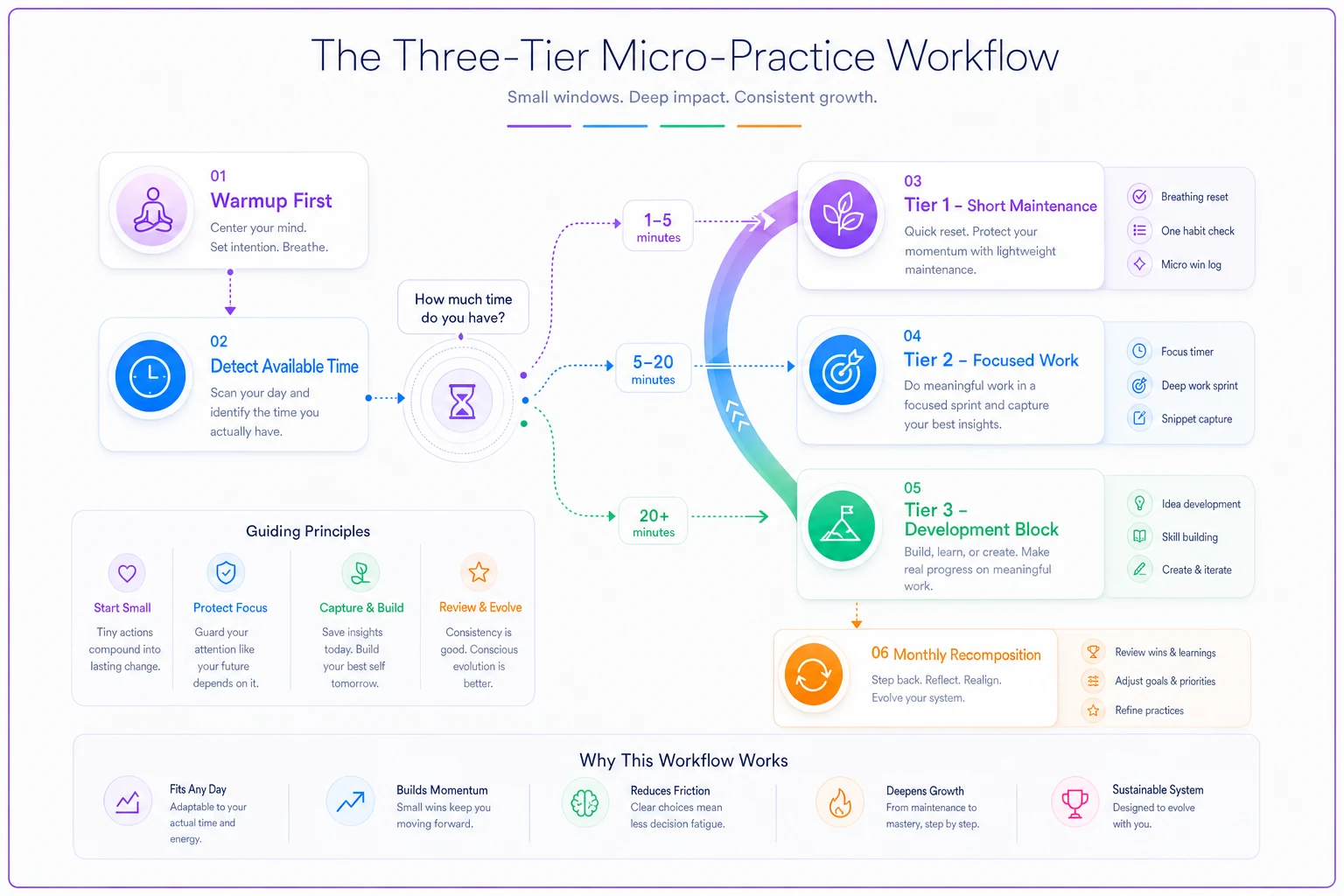
A simple visual like this makes the decision process obvious when you're rushed.
Artifact capture: record snippets so progress doesn't evaporate
There's a specific problem gig musicians run into. You work out a nice voicing, a tricky passage, or a compositional fragment in a 20‑minute window… and three busy days later it's completely gone. You can't rebuild it because you don't remember what you actually did.
The fix is dead simple: record a snippet at the end of every Tier 2 and Tier 3 session. Not a performance. A 20–40 second phone voice memo of whatever you were working on, with one spoken sentence of context: "Bar 14, working the string crossing slow, still sticky on the third beat."
-
It turns practice into a trail you can pick up mid‑stream instead of a cold start
-
It gives you an honest record of technique over weeks, not just a vague feeling
-
Your next session starts 5 minutes faster because you already know where you stopped
A composer juggling freelance work and irregular studio time might capture 15–20 of these snippets a month. Scrubbing back through them is where you actually notice drift — a passage that was clean in week one getting mushy by week three because you only touched it twice. You can't fix what you can't see, and memory is a terrible recorder.
Treat these snippets as signals, not a music library. You're not archiving your genius. You're leaving breadcrumbs. The same thinking applies in using 10‑minute anchors and artifact signals for creative work on irregular schedules — small captured outputs tell you whether the system is actually moving.
Portability-friendly warmups
Warmups are the first thing to die on tour, between gigs, or on a cramped weekday. The reason is straightforward: most warmups assume your instrument, a stand, and space. When you're backstage, in a car, or at a venue two hours early, that setup doesn't exist.
-
Instrument-free finger independence drills on a tabletop, breathing/embouchure patterns, mental scale spelling, silent fingering through a passage
-
Instrument, no sound ghosted bowing, unplugged electric, keyboard with volume off, air‑mandolin left‑hand shapes
-
Full warmup your normal routine, scales, long tones, slow technical patterns
The mistake most players make is having exactly one warmup — the full one — and treating everything else as "not warming up." So on days they can't do the full version, they do nothing and show up to the gig cold.
Write your two chosen drills per category on a single card or phone note so the warmup literally travels with you.
Pick two drills from each category and write them on a card or a phone note you can run in under 5 minutes. The whole point is that the warmup travels with you, not with your gear.
The monthly recomposition ritual
Micro‑practice keeps your hands moving, but it has a blind spot: it's fragmented. Ten‑minute sessions are great for maintenance and terrible for seeing the whole picture. Over a busy month you can stay technically alive and still slowly drift off‑center without noticing.
That's what the monthly recomposition ritual fixes. Once a month, block 60–90 minutes — the one bigger session you do protect — and do three things:
-
Review your snippets. Scrub through the month's captures. Note where technique held and where it slipped.
-
Recompose the plan. Pick the 2–3 things that actually matter for the next month (an upcoming program, a weak technical area, a composition you want to finish) and rebuild your Tier 2/Tier 3 menus around them.
-
Prune. Drop whatever you've been half‑practicing out of habit. If a passage hasn't shown up in snippets in three weeks, either commit to it or let it go.
Without this ritual, micro‑practice can quietly turn into noodling — motion without direction. The monthly reset is what keeps the small sessions pointed at something real.
If you'd rather run small, structured changes to your tier menus instead of overhauling everything at once, the approach in running fast, low‑risk two‑week experiments pairs well here — change one variable, see if snippets improve, keep or drop.
A real scenario: part-time arranger, full schedule
Consider an arranger who freelances, teaches part‑time, and plays weekend gigs — roughly 30–35 hours of music work a week, spread unpredictably.
Before: Practiced only when a big block appeared, usually once or twice a week. Averaged around 2–3 hours of real technical practice weekly, mostly in exhausting marathon sessions. Lost track of in‑progress arrangements constantly, re‑figuring the same voicings. Felt like technique was always slightly slipping.
After adopting the three-tier system: Catching 10–20 minute gaps with pre‑assigned tiers pushed weekly practice closer to 3.5–4 hours — but spread across 5–6 shorter sessions instead of one or two brutal ones. Hand fatigue dropped noticeably. Snippet captures meant arrangements stopped evaporating between sessions, and the monthly recomposition caught a recurring timing weakness that marathon practice had been quietly masking.
Nothing dramatic happened overnight. Over about two months, the swing between neglect and overload flattened out, and the technique stopped feeling fragile. That's the real win — not more hours, but steadier ones.
When this makes sense — and when it doesn't
This works well if:
-
Your schedule is genuinely unpredictable and block practice keeps failing
-
You're maintaining and slowly developing technique, not cramming for an audition in three weeks
-
You tend to skip entirely when you "only" have 15 minutes
This is a bad fit if:
-
You have a hard deadline requiring deep, sustained woodshedding — then you need protected long blocks, not tiers
-
You're learning a brand‑new technique from scratch where short fragmented reps can build bad habits without supervision
-
You thrive on long immersive sessions and your calendar actually allows them
Who should skip it: Students in an intensive program with a fixed daily schedule. You already have structure. Tiering a stable calendar just adds overhead you don't need.
Getting started this week
Keep the first version small:
-
[ ] Write your three tiers on one card
10 / 20 / 30 minutes, with 1–2 lines each
-
[ ] Build your portability warmup list — two drills per availability level
-
[ ] Set the gap rule (under 15 → Tier 1, etc.) and commit to not negotiating it
-
[ ] Record one snippet at the end of your next focused session
-
[ ] Put a 75‑minute monthly recomposition block on the calendar now, before the month fills up
The whole system runs on one idea: match the practice to the gap you actually have, not the gap you wish you had. Irregular schedules aren't going away. Busy seasons will keep showing up. But technique doesn't need perfect conditions to survive — it needs continuity, a trail you can follow back, warmups that fit in your pocket, and one monthly moment to steer.
The whole system runs on one idea: match the practice to the gap you actually have, not the gap you wish you had. Irregular schedules aren't going away. Busy seasons will keep showing up. But technique doesn't need perfect conditions to survive — it needs continuity, a trail you can follow back, warmups that fit in your pocket, and one monthly moment to steer.
Ready to unlock your full potential?
Join thousands of users transforming their lives using Growyly to stay motivated, organized, and growth-focused every day.